- The paper presents a novel selection method that directly maximizes gradient-space diversity using the G-Vendi score, achieving up to +489 improvement over random sampling.
- It introduces a probabilistic, continuous relaxation framework that balances quality and diversity via exponentiated gradient descent, enabling efficient control over data curation budgets.
- Empirical results on DCLM and FineWeb benchmarks show that jointly optimizing for diversity and quality leads to enhanced language model performance across various tasks.
Spokes: Probabilistic Optimization for Diverse Pretraining Subset Selection
Introduction and Motivation
The increasing scale of LLM pretraining has intensified the need for principled, efficient data selection paradigms. While diversity is empirically linked to improved generalization and data efficiency, most pipelines resort to either clustering heuristics or embedding-based similarity deduplication, which offer only proxies for true set-level diversity. "Spokes: Optimizing for Diverse Pretraining Data Selection" (2606.15216) presents a direct, scalable subset selection approach that jointly optimizes both gradient-space diversity and per-example data quality—a critical capability in large-scale corpus curation.
Theoretical Framework: Gradient-space Diversity via G-Vendi
Traditional diversity measures based on input or embedding similarity are limited by representation collapse and diminishing marginal utility in large pools. Spokes instead operationalizes diversity with the G-Vendi score, which quantifies the effective dimension of gradients induced by each data point on a proxy model. Formally, for gradients gi on data points xi and associated kernel K, the G-Vendi score is defined as
G-Vendi(K)=exp(−i∑λilogλi)
where λi are normalized eigenvalues of K. This metric rewards gradient directions with higher mutual orthogonality, mitigating redundancy of learning signals. Empirically, Spokes demonstrates that random sampling quickly saturates G-Vendi scores, whereas its data-driven selection can significantly increase this set-level diversity—by up to +489 points relative to random subsets of size 500k.
Algorithmic Approach: Probabilistic Subset Optimization
Spokes addresses the intractability of discrete subset maximization by relaxing selection into a continuous weight vector w∈Δn over the dataset, combining quality (Q(w)) and diversity (Vendi(K(w))) objectives:
w∈Δnmax αlnQ(w)+(1−α)lnVendi(K(w))
Exponentiated gradient descent optimizes this criterion over the simplex, enabling efficient convergence. The balance between diversity and quality is tunable via xi0. Discrete subsets are recovered via top-xi1 selection on optimized weights, providing deterministic control over data budgets.
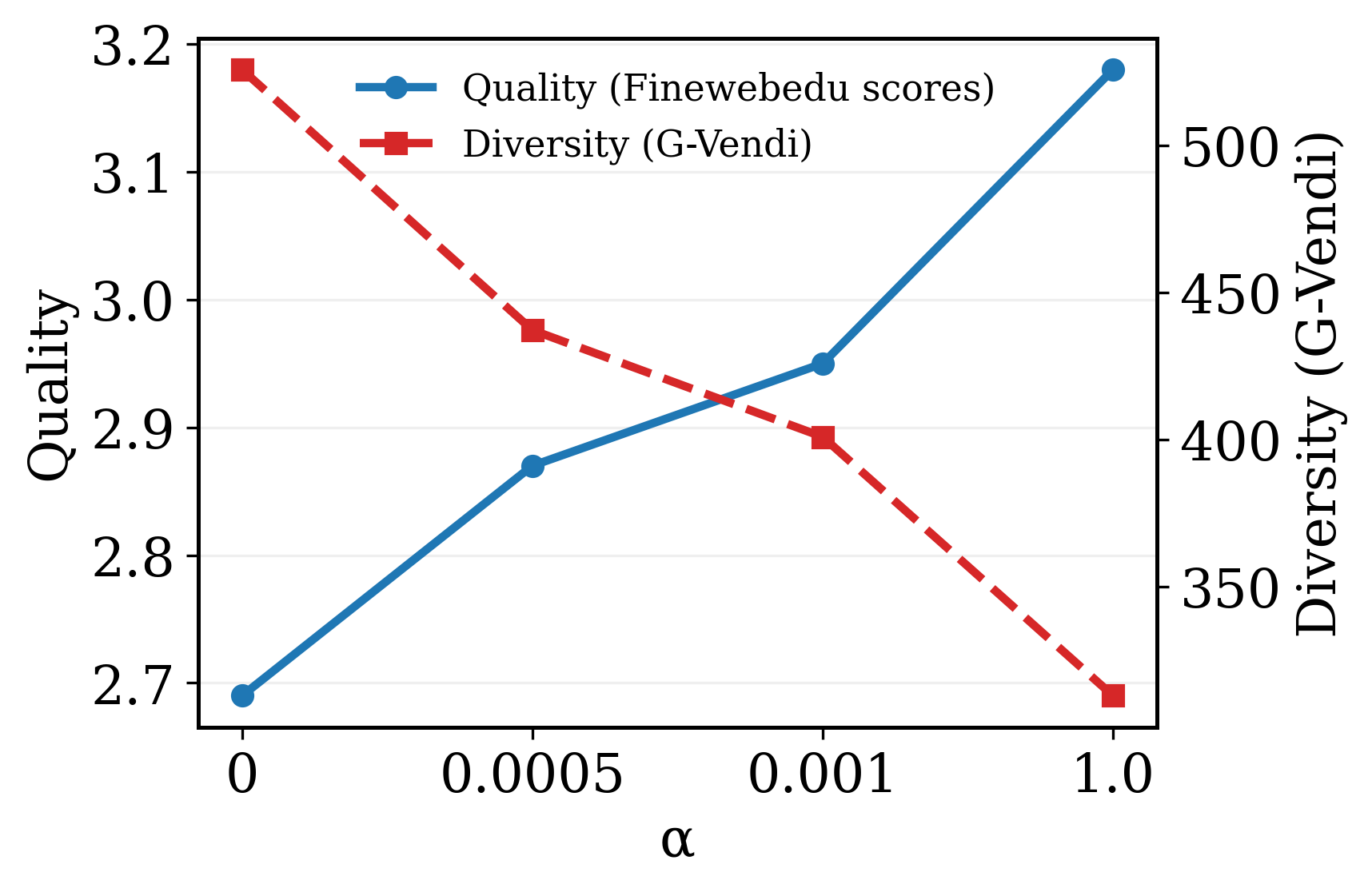
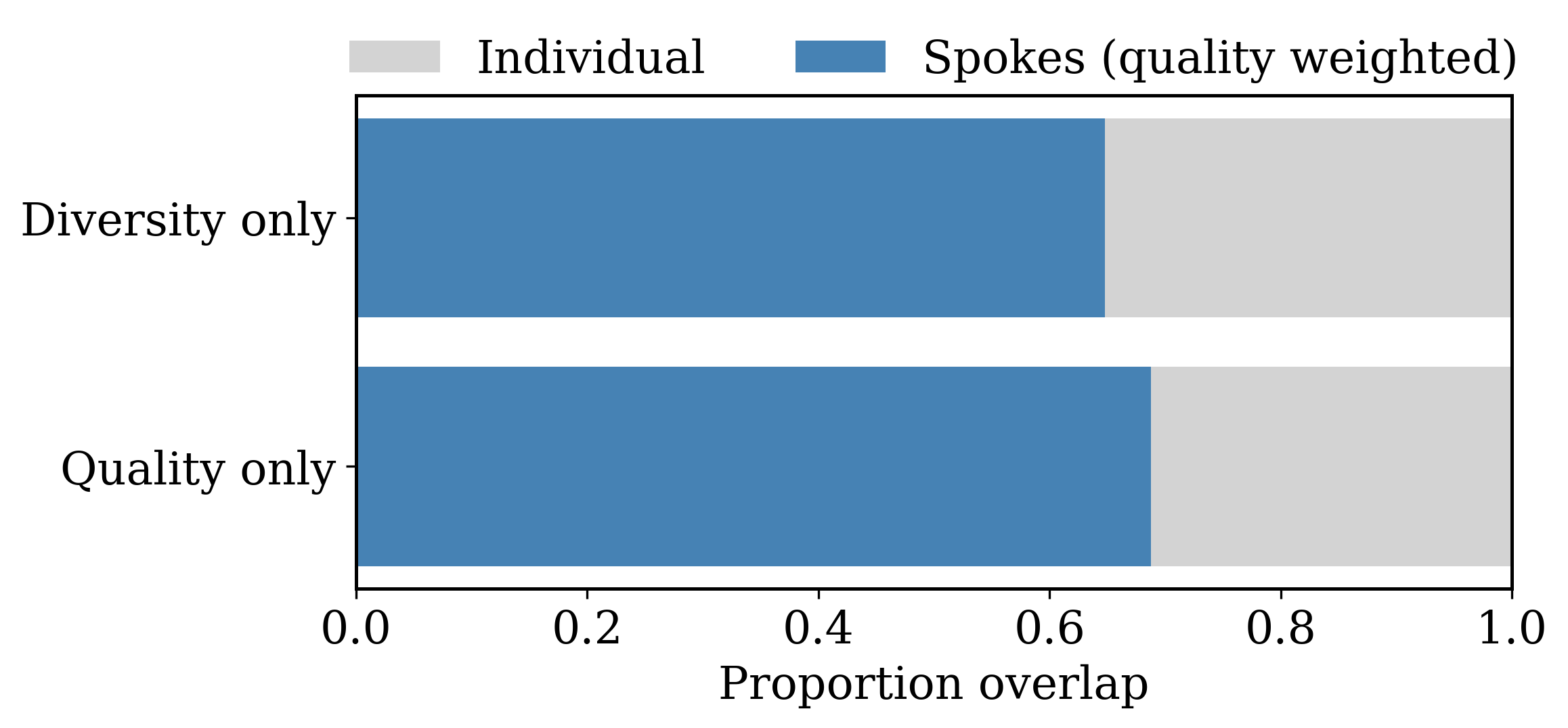
Figure 1: Quality–diversity trade-off across xi2: increasing emphasis on quality decreases G-Vendi diversity in a controlled manner.
This smooth trade-off allows practitioners to select operating points with tailored balance, as demonstrated by varying subset overlap with quality- and diversity-optimized extremes.
Scaling and Implementation: Gradient Projection and Computational Savings
Spokes targets the scalability required for web-scale curation. First, gradient extraction is restricted to the last xi3 transformer layers, reducing costs while preserving high Spearman correlation with the full-model kernels (0.93 for the last 2 layers of Qwen3-0.6B-Base). Second, random projections via the Johnson–Lindenstrauss lemma compress gradient vectors from xi4M dimensions to as little as 1024, retaining ≥95% subset overlap with reference selections even in this low-dimensional regime.
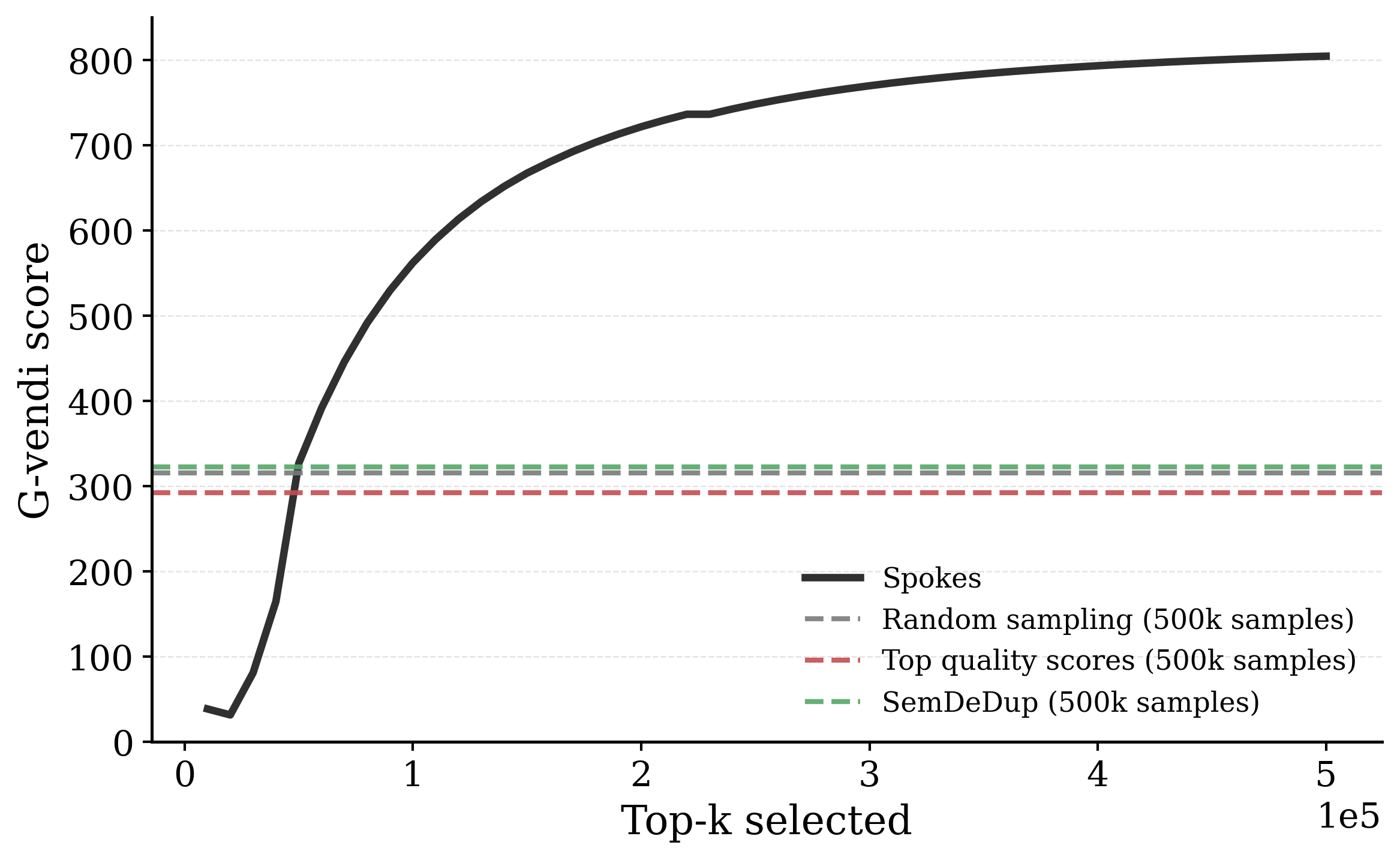
Figure 2: G-vendi scores scale as the number of top-k increases—a monotonic effect driven by Spokes’s optimization.
Time complexity is xi5 for xi6 iterations over subset size xi7 and projected dimension xi8, as opposed to the quadratic xi9 scaling of clustering-deduplication techniques such as SemDeDup. Spokes can be further accelerated by data partitioning.
Empirical Results
Across two curated benchmarks—DCLM and FineWeb, representing filtered and noisy web-scale corpora respectively—Spokes consistently selects subsets with higher batch-level G-Vendi diversity compared to random sampling or semantic deduplication. Notably, gradient-based diversity metrics remain sensitive and discriminative under selection, whereas embedding-based metrics saturate.
Jointly optimizing for quality and diversity (with K0 adjusted per corpus) delivers further improvements. For instance, Spokes delivers average downstream benchmark gains of +1.5 (DCLM) and +1.4 (FineWeb) over baselines, and achieves higher OLMES suite scores than both quality-only and diversity-only selection. These effects persist across downstream task groups; diversity bias improves commonsense tasks (HellaSwag), while quality filtering dominates knowledge-intensive tasks (MMLU), yet joint optimization with Spokes offers Pareto improvements.
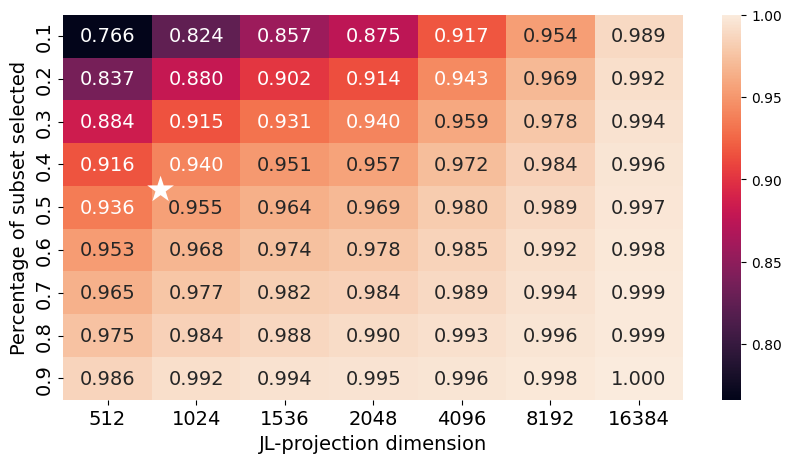
Figure 3: Subset overlap (%) with K1 projection dimension shows high stability of the selection when K2.
Practical and Theoretical Implications
Spokes demonstrates that gradient-based diversity is a robust, transferable signal for pretraining subset selection, complementing conventional quality scores. The method’s scalability and deterministic subset sizing address operational requirements for industrial data pipelines, and its framework generalizes to arbitrary per-example quality annotations.
On the theoretical side, the efficacy of gradient diversity supports the interpretation that set-level orthogonality among update directions enhances training signal orthogonality, resulting in more efficient parameter updates and better generalization per token.
Limitations and Future Work
While Spokes’s projection and layer truncation yield substantial efficiency gains, gradient extraction remains more costly relative to embedding methods. Further acceleration is possible via proxy gradient approximation or techniques such as Cut Cross Entropy. Extensions may also consider incorporating dynamic, context-aware proxy models for gradient extraction.
Future work may investigate integration with mixture-of-experts training or federated selection scenarios, and could explore more adaptive diversity-quality trade-off schedules.
Conclusion
Spokes provides a scalable, principled framework for pretraining data curation via direct optimization of gradient-space diversity, outperforming heuristic and embedding-based deduplication approaches. By enabling explicit joint optimization of quality and diversity, it reliably produces subsets that enhance downstream LLM performance. Spokes thus stands as a recommendation for practitioners seeking efficient, diversity-enriched pretraining pools in large-scale LLM training regimes.

