- The paper introduces a modular evidence chain orchestration framework that decomposes audio reasoning into four distinct, audit-friendly stages.
- It leverages specialized audio tools like YAMNet, Whisper, and SpeechBrain to distill raw outputs into structured evidence, preventing shortcut-based reasoning.
- Empirical results on the MMAR benchmark demonstrate improved accuracy and rubric scores, underscoring the critical role of rigorous evidence integration and verification.
Evidence Chain Orchestration in Audio Reasoning: The EChO-Agent Framework
Limitations of Current LALMs for Audio Reasoning
Despite advances in Large Audio LLMs (LALMs), such as Qwen-Audio, SALMONN, and LTU, their performance on complex audio reasoning tasks is notably limited. As articulated, LALMs encounter four primary constraints: (1) insufficient question-conditioned audio perception, (2) lack of verifiable reasoning chains, (3) shallow domain knowledge integration, and (4) inability to re-examine audio and recover missed signals. These deficiencies impede reliable inference, especially on tasks where rubric-based evaluation penalizes reasoning that is not rigorously grounded in audio evidence, even when answer accuracy appears high. Chain-of-thought methods typically suffer from weak grounding and shortcut-based reasoning, resulting in logical inconsistency and poor evidence alignment.
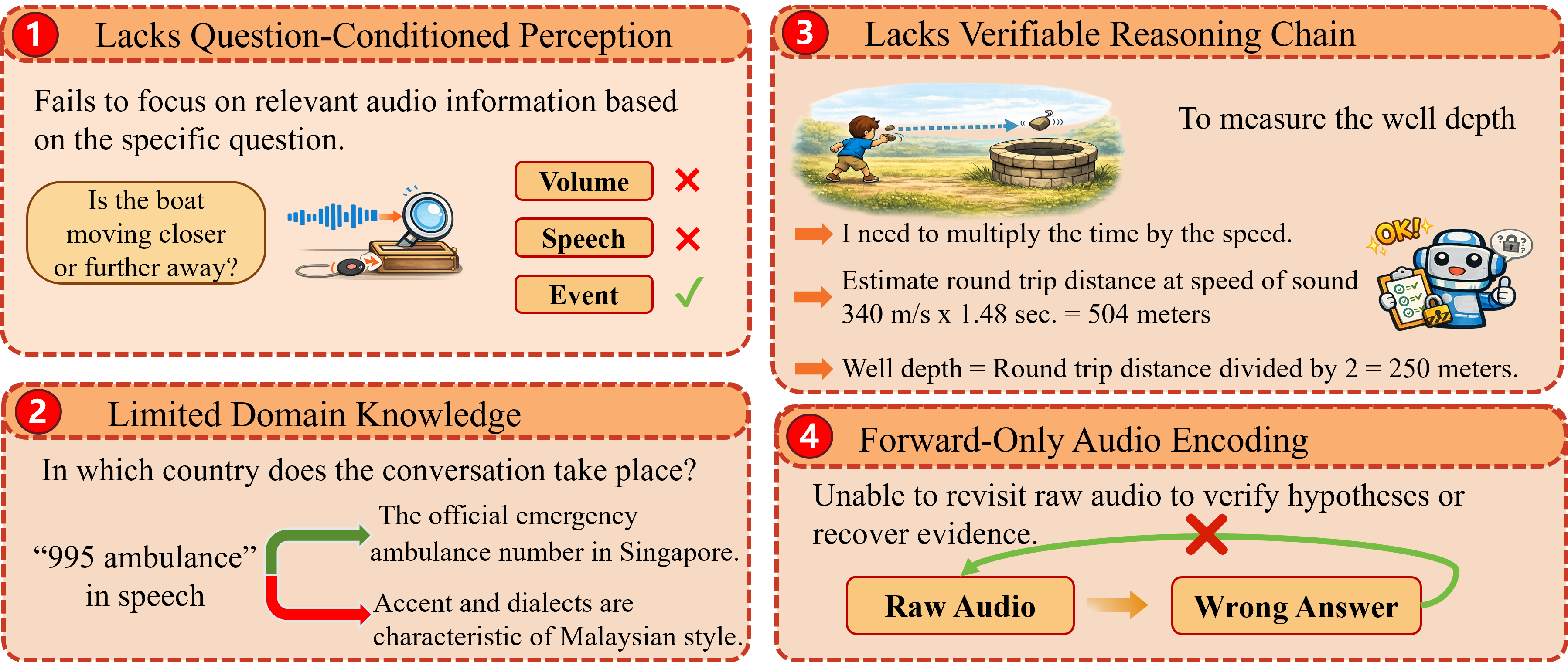
Figure 1: Key architectural and conceptual limitations of current Large Audio LLMs when confronting complex audio reasoning tasks.
EChO-Agent Architecture and Workflow
The EChO-Agent introduces a modular, auditable workflow for evidence-driven audio reasoning, decomposing inference into four distinct stages: Tool, Evidence, Reason, and Verify. The architecture leverages a suite of specialized tools (including YAMNet, Whisper, SpeechBrain, Essentia) for audio event detection, speech recognition, emotion classification, and music feature extraction. Via question-conditioned static dispatch, the orchestrator precisely selects tools relevant to the query, minimizing variance and ensuring reproducibility. Raw tool outputs are distilled into structured, compact evidence using DeepSeek-V3, focusing on relevance filtering, cross-tool synthesis, and evidence structuring. This evidence chain forms the input to Qwen-3-Omni-Instruct, which generates stepwise reasoning, explicitly citing evidence at each intermediate decision. Verification, managed by a dual-pass comparative protocol, enforces format compliance, evidence-answer consistency, and selects the output exhibiting maximal evidence alignment.
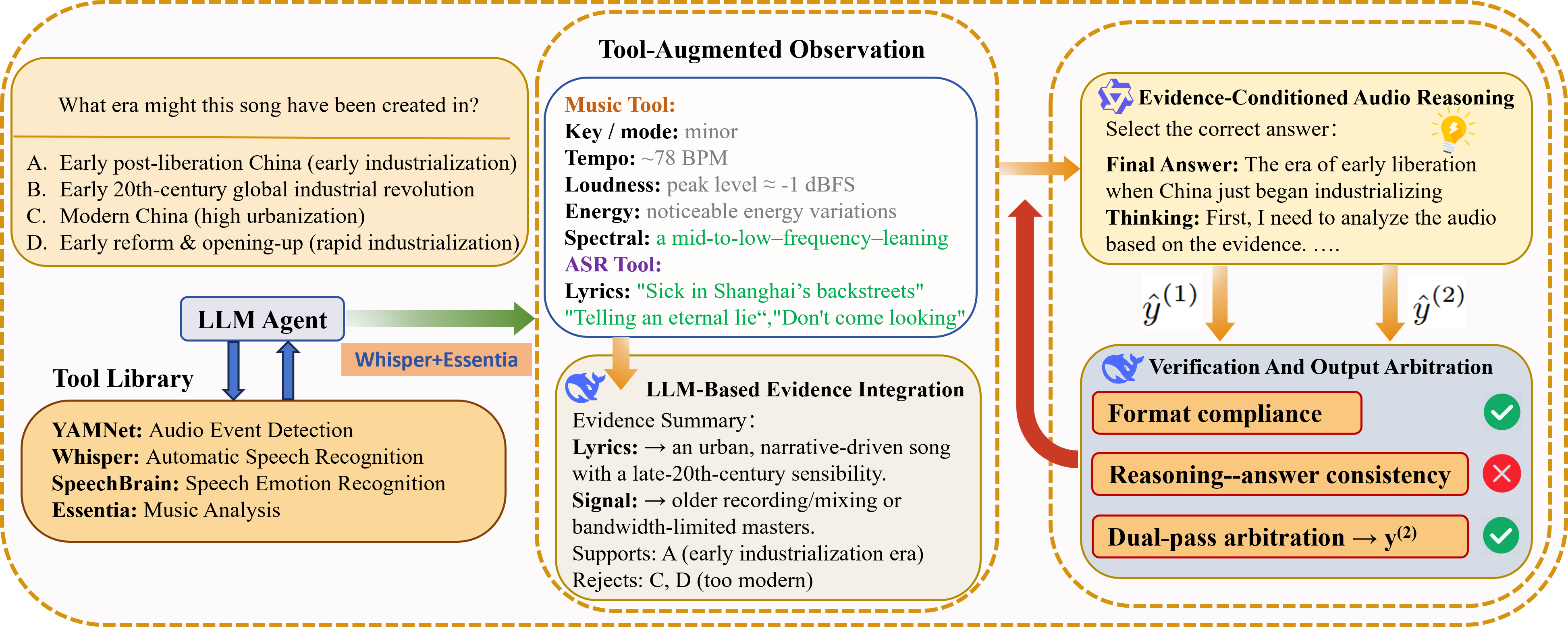
Figure 2: The auditable four-stage workflow of EChO-Agent, integrating tool outputs, evidence structuring, reasoning, and verification.
Empirical Results and Ablations
EChO-Agent demonstrates superior performance on the MMAR benchmark, attaining 71.0% accuracy and a 63.0 rubric score, improving over the Qwen3-Omni baseline by +2.3 and +4.3 points respectively, and ranking fifth on the MMAR Agent Track. Notably, evidence integration emerges as the most critical component; ablation without this stage results in a substantial decline in both accuracy and rubric scores, even below the tool-free baseline. Raw, high-entropy tool outputs introduce distracting context, supporting the necessity of filtered evidence distillation. Verification reduces format violation and evidence-answer inconsistency errors, while tool augmentation only improves reasoning when outputs are systematically aligned with decision-critical evidence. The methodology shows pronounced gains for composite audio scenarios, emphasizing robust cue localization and superior evidence routing.
Practical and Theoretical Implications
Practically, the EChO-Agent architecture highlights the necessity of modular tool orchestration and evidence-grounded inference for complex audio reasoning. By prioritizing auditable evidence chains and rigorous verification, the agentic framework addresses rubric-oriented evaluation protocols where process fidelity is paramount. The approach mitigates shortcut learning, reduces hallucination risk, and improves interpretability. Theoretically, this work underlines the limitations of current LALMs in stepwise inference, advocating for structured tool integration and explicit evidence abstraction. The modular workflow sets a precedent for future agentic reasoning systems across modalities, promoting principled evidence-seeking and validation rather than pattern-matching or unimodal encoding. The bottleneck remains the granularity of perception tools, indicating a direction for future research towards more fine-grained detectors and enhanced temporal segmentation.
Future Directions
Further development should address the granularity of sound-event tools, tool uncertainty calibration, and systematic resolution of cross-tool conflicts. Fine-grained temporal models and adaptive tool selection policies may enhance evidence localization and reasoning robustness. Integration of external domain knowledge via retrieval-augmented models, as explored in AudioRAG, could supplement evidence gaps and support multi-hop reasoning. Improved self-verification protocols and learned arbitration mechanisms could further reduce erroneous outputs without incurring majority-vote cost, advancing agentic frameworks in audio and other modalities.
Conclusion
EChO-Agent represents a structured, evidence-driven solution for audio reasoning tasks, systematically addressing the deficiencies of LALMs via a modular orchestration pipeline. Experimental results confirm the significance of evidence integration and verification, establishing a foundation for auditable, robust, and rubric-faithful audio reasoning agents. Future research should focus on refining perception tool precision, adaptive evidence synthesis, and scalability of verification mechanisms to extend agentic reasoning beyond current benchmarks.