- The paper establishes a universal framework for using temporal modulation to achieve enhanced quantum Fisher information scaling in continuous-variable frequency estimation.
- It shows that polynomial and exponential modulation profiles yield QFI scaling orders of magnitude beyond static protocols under fixed energy and time constraints.
- Standard homodyne detection nearly saturates the theoretical limits, making the proposed approach practical for advanced quantum sensing applications.
Temporal Modulation as a Resource for Enhanced Frequency Estimation in Continuous-Variable Quantum Systems
Overview
The paper "Temporal modulation as a resource: enhanced frequency estimation in continuous variable systems" (2606.15108) establishes a universal framework for exploiting general continuous temporal modulation of quantum oscillator frequencies to achieve superior quantum Fisher information (QFI) scaling in parameter estimation. Temporal modulation is shown to provide genuine, asymptotically unbounded precision gain over traditional static and time-independent protocols, even under stringent constraints on total energy and sensing time. Analytical results are presented for polynomial and exponential modulation profiles, and explicit protocols for optimal measurement are discussed.
Model and Analytical Framework
The work considers a quantum harmonic oscillator (QHO) subject to frequency modulation, characterized by a Hamiltonian with time-dependent frequency Ω(t)=ω0f(t), where ω0 is the parameter to be estimated and f(t) is a deterministic modulation profile independent of ω0. The evolution preserves the Gaussianity of states and is fully solvable in terms of canonical transformations. In the adiabatic regime, the dynamics reduce to analytical forms using a WKB approximation for the mode function z(t).
The QFI associated with the estimation of the base frequency is analytically decomposed into contributions from shearing, squeezing, and rotation operations, in addition to cross-correlation terms, with the latter two becoming suppressed by the adiabaticity and temporal averaging. The rotational component, proportional to the accumulated modulation phase and scaling as F(t)2 where F(t)=∫0tf(s)ds, dominates in all relevant limits.
QFI Scaling under Temporal Modulation
An essential finding is that for f(t)∼tn, the QFI for frequency estimation scales as O(t2(n+1)), while for exponential modulation, f(t)∼eat, the scaling becomes superexponential, ω00. This scaling, directly reprogrammable by ω01, is orders of magnitude beyond the standard ω02 of unmodulated evolution. The effect is purely due to modified phase accumulation dynamics rather than energy injection or ancillary Hamiltonian control.
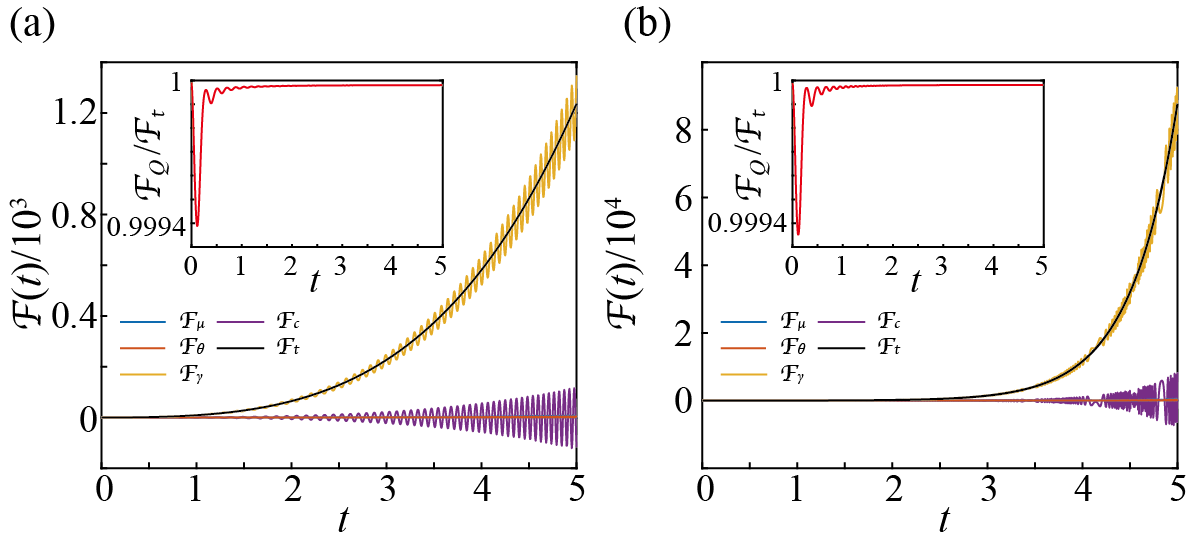
Figure 1: Time evolution of the total QFI ω03 for linear and exponential modulation profiles, demonstrating dominance of the rotational term and saturation of precision via homodyne detection.
Comparison of Modulation Protocols and Genuine Gain
To quantify metrological advantage, the QFI enhancement ratio ω04 is defined, comparing modulated (ω05) vs. static (ω06) scenarios while keeping total mean energy and sensing time fixed. For polynomial modulation, ω07, proving that arbitrary polynomial speedup can be designed; for exponential modulation, ω08. This scaling is asymptotically robust and not contingent on increased energy overhead.
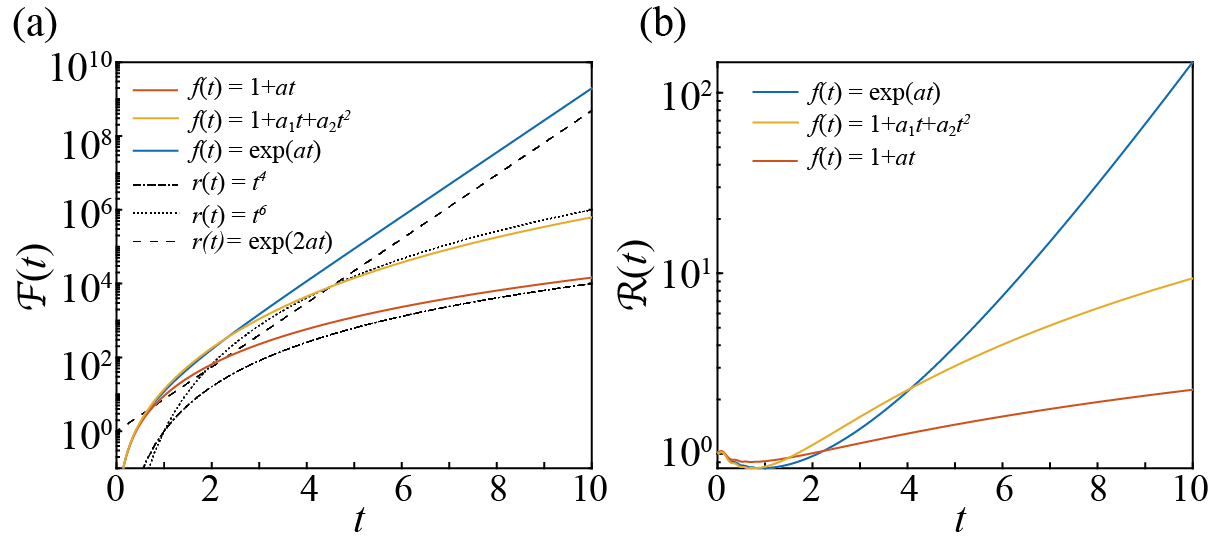
Figure 2: Time evolution of (a) the QFI ω09 and (b) the enhancement ratio f(t)0 for various modulation protocols, demonstrating elevated scaling for higher-order and exponential envelopes.
Measurement Strategies: Practical Saturation
A key practical result is that these ultimate quantum Cramér-Rao bounds can be nearly saturated with standard quadrature homodyne detection. The ratio between classical Fisher information from homodyne detection and the full QFI consistently exceeds 0.999 for all protocols and time scales considered, eliminating the need for non-Gaussian or adaptive measurements.
Theoretical and Practical Implications
This formalism establishes temporal modulation of the parameter-encoding Hamiltonian itself—not just the application of control Hamiltonians, feedback, or dissipation—as an independent and universal resource for quantum metrology. Unlike control-enhanced or feedback methods, the modulation profile is deterministic and does not require knowledge of f(t)1; the energy resource ledger remains transparent, and the approach is compatible with practical adiabatic frequency sweep implementations in atomic, superconducting, and optomechanical platforms.
The implication is that continuous-variable quantum sensors can be systematically optimized for precision via tailored, open-loop temporal modulation protocols alone. As a result, metrological performance can be predictably engineered to match experimental constraints and task requirements, without the typical cost or technical constraints of feedback or control-limited strategies.
Future Outlook
Given its model-independence for continuous-variable systems and the robustness of practical measurement, this paradigm is expected to impact the development of flexible, efficient quantum sensors, particularly in frequency standards, force detectors, and hybrid quantum systems. It motivates further exploration into resource-constrained quantum parameter estimation, the role of non-adiabatic regimes, and generalizations to multi-parameter or dissipative dynamics.
Conclusion
The results demonstrate that arbitrary precision scaling in quantum frequency estimation can be deterministically realized via continuous temporal modulation, with enhancement ratios and QFI scaling directly programmable based on the modulation profile. The gain is robust under realistic resource constraints and practically saturable using homodyne detection. This establishes temporal modulation as a powerful and general tool for continuous-variable quantum metrology, expanding the landscape of strategies beyond conventional control-based or static approaches.