- The paper demonstrates that critical squeezing in a driven Jaynes–Cummings model leads to divergent quantum Fisher information near the critical point, enabling Heisenberg-limited amplitude estimation.
- The research introduces an adiabatic ramping protocol that preserves >99.96% state fidelity while optimizing photon number and quadrature measurements for precise signal estimation.
- The method offers a resource-efficient quantum metrology framework applicable to circuit QED and quantum optics, outlining potential strategies to counteract decoherence and loss.
Quantum-Enhanced Amplitude Estimation with Critical Squeezed States in Photonic Modes
Introduction
This work addresses quantum parameter estimation by leveraging critical phenomena in a driven Jaynes–Cummings model (JCM), with the goal of achieving high-precision estimation of the amplitude of an external signal field coupled to a photonic mode. The manuscript situates itself at the intersection of quantum metrology and quantum phase transitions, highlighting that prior proposals for criticality-enhanced sensing have primarily targeted intrinsic system frequencies. In contrast, the present scheme focuses on the estimation of an external field amplitude, exploiting a unique dark state whose photonic component is a squeezed vacuum exhibiting criticality-induced divergence in sensitivity.
System and Critical Sensing Paradigm
The central physical platform is a driven JCM consisting of a resonantly-coupled qubit and bosonic mode, subjected to a linear drive representing the external signal. In the interaction picture, the Hamiltonian admits a control parameter η proportional to the drive amplitude. Absent driving, the dark state is a trivial vacuum product; introducing the drive, the ground state transforms into a squeezed vacuum state entangled with a qubit superposition, with the degree of squeezing critically dependent on η. This drive breaks the U(1) symmetry of the JCM, and for η→1, the system approaches a quantum critical point at which the quantum Fisher information (QFI) for η diverges.
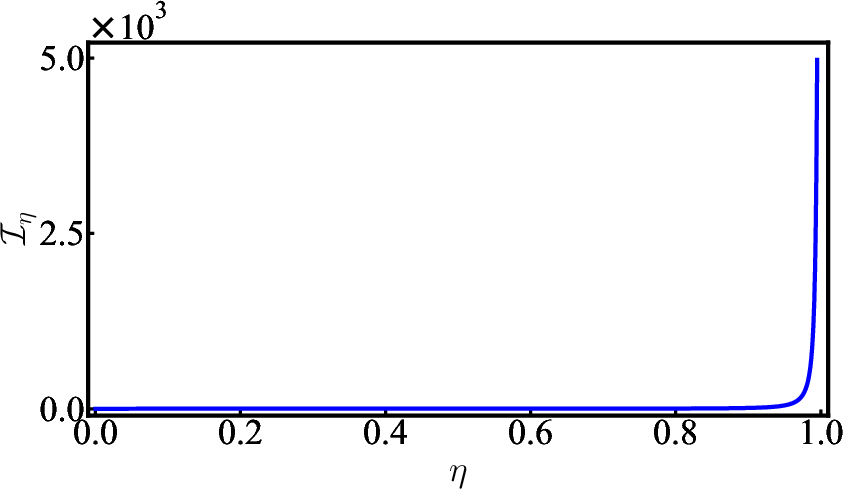
Figure 1: The QFI Iη versus the control parameter η; a divergence near η=1 reflects critical sensitivity enhancement.
The analytic QFI for the photonic mode’s ground state is
Iη=2(1−η2)2η2,
demonstrating divergence as η→1, i.e., near the phase transition. This divergence underpins the critical enhancement of sensitivity. The quantum Cramér–Rao bound for the estimator variance scales inversely with the QFI, and thus close operation to the critical point is advantageous for precision.
Measurement Protocols and Optimality
The measurement protocol prescribes adiabatic following: the system is initialized in the instantaneous dark state and η is ramped quasi-statically according to a tailored schedule. Observables include the average photon number and field quadrature variances. For photon number detection, the relevant inverted variance matches the QFI, thus saturating the fundamental quantum limit:
η0
Quadrature-based measurement schemes, which can be performed via homodyne detection, exhibit identical critical scaling and Heisenberg-limited sensitivity. Notably, squeezing-induced asymmetry in the η1 and η2 quadratures emerges as η3, with η4 fluctuations amplified and η5 fluctuations suppressed, but both routes support optimal estimation.
Adiabatic Evolution and Fidelity
The protocol's fidelity depends on maintaining adiabaticity during the parameter ramp. The rate of change of η6 is set such that transitions out of the dark state are suppressed, and the energy gap to excitations vanishes critically as η7. Numerical simulations confirm that for sufficiently slow ramping (e.g., η8), the fidelity relative to the instantaneous dark state remains above η9 up to η→10.
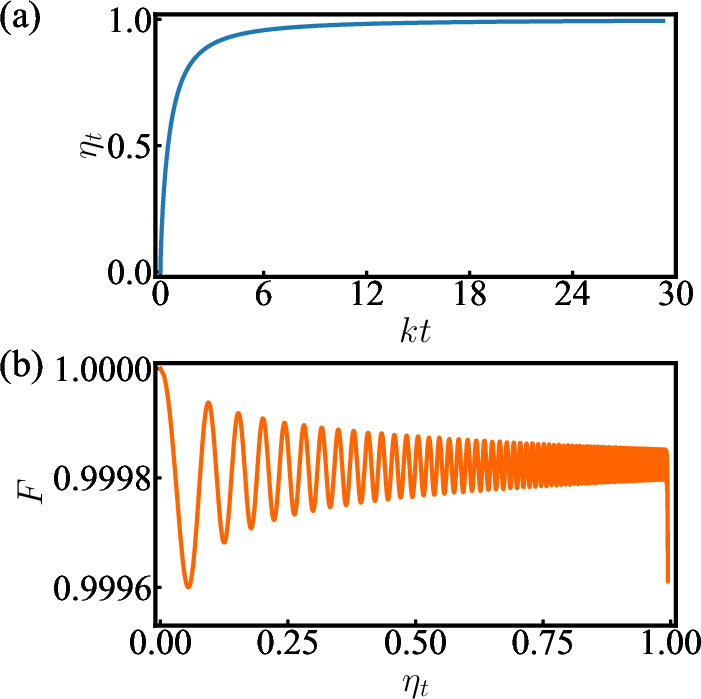
Figure 2: (a) Trajectory of η→11 as a function of rescaled time η→12. (b) Fidelity η→13 of the time-evolved state relative to the dark state, remaining η→14 for η→15 approaching criticality.
The explicit ramp schedule η→16 permits efficient and robust approach to the vicinity of the critical point, balancing speed and adiabaticity.
Metrological Scaling and Heisenberg Limit
Resource scaling analysis demonstrates that both time and photon number contribute multiplicatively to the achievable precision. Near criticality,
η→17
where η→18 is the mean photon number. Consequently, the uncertainty η→19 in amplitude estimation obeys
η0
achieving simultaneous Heisenberg scaling with respect to both encoding time and photon number. This is in sharp contrast to previous schemes, e.g., [Lü et al., Sci. Adv. 12, eady2358 (2026)], where Fisher information scaled only with time.
Practical and Theoretical Implications
The protocol provides a criticality-enhanced framework for quantum sensing of external signals, with potential applications across microwave and optical platforms. The scheme's flexibility with respect to observable (photon number or quadrature moments) broadens its feasibility for implementation in circuit QED or quantum optics, where quantum-limited amplifiers and fast readout permit high-fidelity measurement. While this analysis assumes negligible decoherence, the impact of loss will be central to future investigations, particularly concerning the preservation of critical scaling in dissipative environments. This approach complements previous critical metrology protocols by extending the target to externally-applied field amplitudes rather than intrinsic Hamiltonian parameters.
Conclusion
This manuscript presents and analyzes a critical quantum sensing protocol in a driven JCM, in which the amplitude of an external signal field is estimated via measurements on a critically squeezed photonic dark state. The protocol achieves Heisenberg-limited scaling with both photon number and evolution time, with the QFI diverging near the critical point. The scheme’s optimality over several measurement strategies and robustness to nonadiabatic excitations (under slow driving) position it as a viable route to resource-efficient, quantum-enhanced signal field metrology. Further exploration of robustness to open-system effects and extension to multiparameter estimation remains open for future research.