- The paper demonstrates a robust signal of X(3700) in B meson decays with pronounced near-threshold D⁺D⁻ enhancement due to channel-dependent weak amplitudes.
- It employs a coupled-channel Bethe-Salpeter approach to model D⁺D⁻, Dₛ⁺Dₛ⁻, and ηη interactions, achieving quantitative fits to LHCb mass distributions.
- The analysis predicts a ~13-fold enhancement in B⁺ decays compared to Λb decays, offering a clear experimental handle to confirm the X(3700) state.
Signals of the DDˉ Bound State X(3700) in Heavy Hadron Decays
Introduction
The existence of a DDˉ bound state, labeled X(3700), in the isospin I=0 channel, has been anticipated by a range of theoretical frameworks, including chiral dynamics, potential models, and QCD sum rules. The analogy to the f0(980)—regarded as a KKˉ molecular state—suggests that the heavier charmed-quark analog (DDˉ) could also form a bound state with stronger attraction due to its mass. Lattice QCD calculations offer varying degrees of support for this hypothesis, showing bound or nearly bound DDˉ configurations at relatively large pion masses, though with some dependence on coupled channel effects and extrapolation methods.
Experimental identification of X(3700) remains challenging due to the proximity of the X(3700)0 resonance to the X(3700)1 threshold and the substantial background it creates. Several reactions and decay processes have been proposed to probe this state, notably radiative decays of charmonium, X(3700)2 meson decays, and femtoscopic correlation analyses. The paper systematically advances this experimental search, focusing on three-body decays: X(3700)3, X(3700)4, and X(3700)5. These reactions are uniquely sensitive to X(3700)6 final state interactions (FSIs), offering an avenue to disentangle the contribution of the hypothesized bound state.
Reaction Mechanisms and Theoretical Framework
A detailed model for the weak decay amplitudes leading to X(3700)7 final states was constructed, based on both external and internal emission topologies at the quark level. Final state interactions among X(3700)8, X(3700)9, and DDˉ0 channels were handled via a coupled-channel Bethe-Salpeter approach grounded in the local hidden gauge extension to the charm sector.
For the DDˉ1 channel, external emission with DDˉ2 (or DDˉ3) configurations and internal DDˉ4 emission were weighted according to standard color-suppression factors. In DDˉ5 and DDˉ6 decays, comparable topologies were evaluated, with appropriate alteration for the flavor content and hadronization patterns. The theoretical amplitudes incorporated DDˉ7-wave two-body scattering, with the resonance structure arising dynamically via unitarized interactions.
Resonant contributions from DDˉ8 were explicitly included, reflecting their observed impact on the DDˉ9 mass distributions near threshold. The model was fit to LHCb data, with normalization factors for each decay channel, and a single parameter X(3700)0 governing the relative strength of X(3700)1 excitation across all channels.
Numerical Results and Mass Distribution Analysis
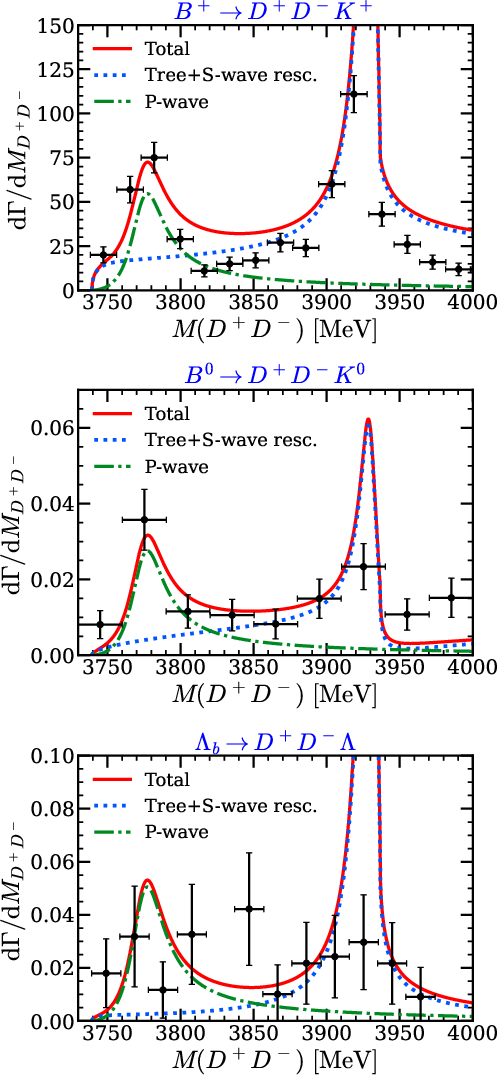
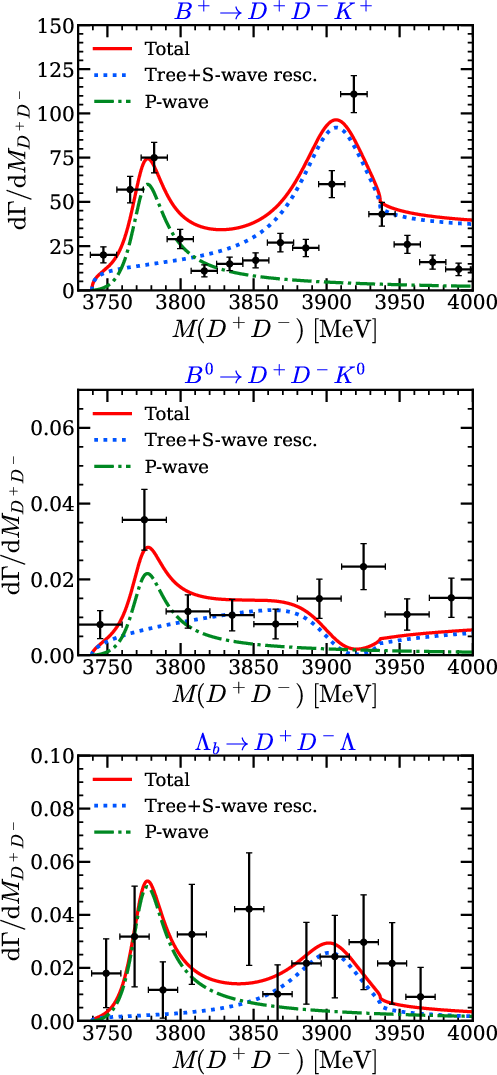
Figure 2: Combined fit results of the X(3700)2 invariant mass distribution for the X(3700)3, X(3700)4 and X(3700)5 reactions.
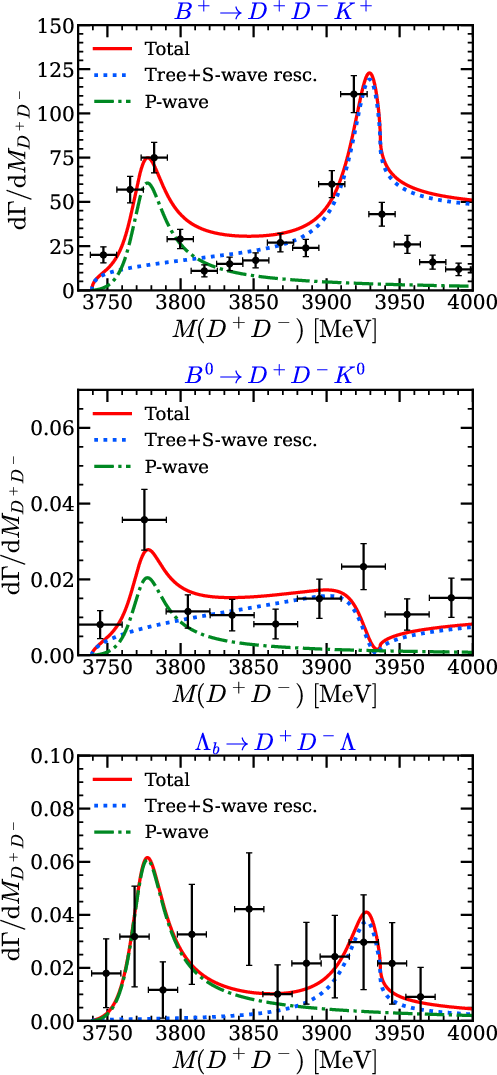
Figure 4: Theoretical description of the X(3700)6 invariant mass distributions for the three key reactions, compared against LHCb data.
A combined fit to the X(3700)7 invariant mass spectra for all three reactions yields a consistent description in the region from threshold to approximately X(3700)8 MeV. Theoretical mass distributions agree quantitatively with the experimental peaks corresponding to X(3700)9 and I=00, the latter coupling predominantly to I=01 but also manifesting in the I=02 channel. The fits are robust against moderate variations in the coupled channel content (two-channel versus three-channel analyses), with slight shifts in peak positions and widths.
A salient feature is the pronounced difference in near-threshold I=03 yields between I=04 and I=05. When the spectra are normalized at the I=06 peak, the I=07 decay exhibits an order-of-magnitude enhancement (factor I=08) in the first 10 MeV above threshold relative to the I=09 decay. This model-dependent prediction is traced to the structure of the weak amplitudes: the f0(980)0 channel greatly amplifies the sensitivity to the f0(980)1-wave f0(980)2 final state interaction, where the f0(980)3 signal resides.
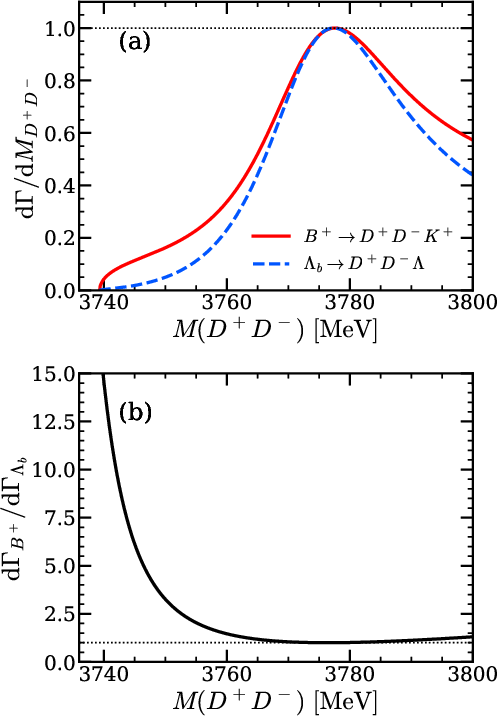
Figure 6: Differential width f0(980)4 for f0(980)5 and f0(980)6, normalized at the f0(980)7 peak, plus their ratio near threshold.
Coupled Channel Dynamics and Pole Structure
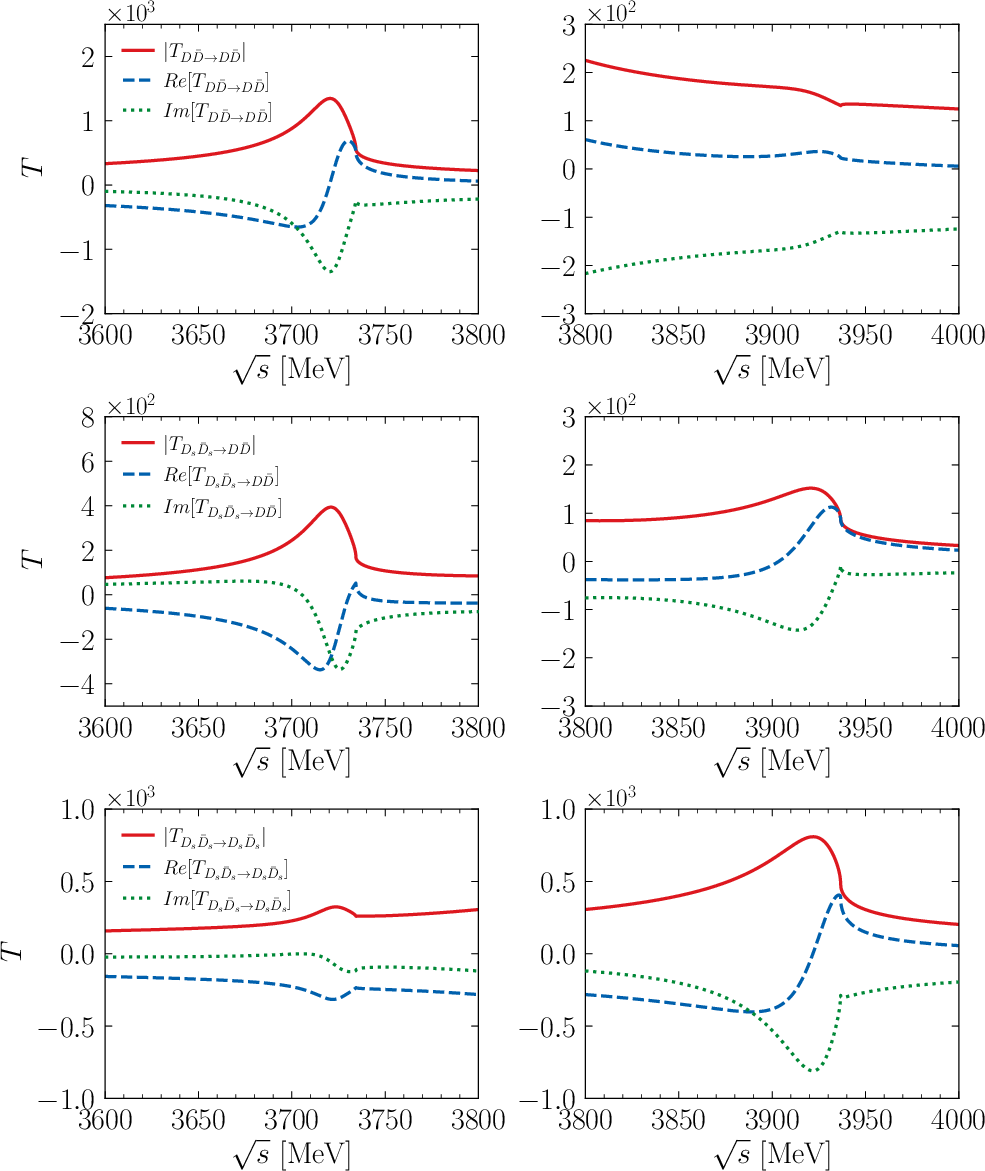
Figure 8: Two-body scattering amplitudes as a function of f0(980)8 for f0(980)9, KKˉ0, and KKˉ1 coupled channels, displaying the dynamical generation of two poles.
The coupled-channel formalism dynamically produces two relevant poles: a near-threshold KKˉ2 state with moderate width (26–22 MeV), associated dominantly with KKˉ3, and a higher KKˉ4 state (width KKˉ545–82 MeV), tied mainly to KKˉ6. The theoretical position and widths depend weakly on the inclusion of the KKˉ7 channel, introduced empirically to account for KKˉ8's finite width through OZI-violating processes.
Empirical Implications and Experimental Prospects
The stark contrast in the near-threshold KKˉ9 yield between DDˉ0 and DDˉ1 decays serves as a sharply-defined observable for the detection of DDˉ2. The current LHCb dataset is insufficiently precise in the critical DDˉ3 MeV region, with large statistical uncertainties precluding a definitive identification. However, the enhancement pattern predicted is robust and directly falsifiable with improved statistics and finer binning in forthcoming LHCb upgrades.
Confirming the predicted DDˉ413-fold enhancement in DDˉ5 relative to DDˉ6-induced spectra, near the DDˉ7 threshold, would bolster the identification of DDˉ8 as a genuine hadronic resonance—potentially a molecular state. Beyond experimental discovery, this has implications for heavy-quark dynamics, the universality of molecular hadron formation mechanisms, and the treatment of coupled-channel effects in charm physics.
Theoretical and Future Developments
The methodology used integrates advances in effective field theory, unitarization techniques, and systematic treatment of weak hadronic decays. The main theoretical sensitivity arises from the modeling of short-range versus FSI-dominated amplitudes, and from uncertainties in channel coupling strengths (especially OZI-suppressed transitions).
Future developments could extend this framework to refine the extraction of pole parameters from data, explore alternative experimental observables as suggested by femtoscopic studies and prompt production in high-energy collisions, and further engage with lattice QCD predictions as calculations at physical pion masses progress. Conclusive identification of DDˉ9 would further illuminate the spectrum of exotic and molecular states in the charm sector, inform models of quark dynamics with heavy flavors, and potentially impact the treatment of multi-hadron systems in effective field theories.
Conclusion
This work presents a comprehensive theoretical study of the production and detection of a DDˉ0 bound state, DDˉ1, in DDˉ2 and DDˉ3 hadronic decays. The analysis demonstrates that the signal for DDˉ4 is strongly channel-dependent, with DDˉ5 decays offering the most pronounced sensitivity. This finding, if experimentally confirmed, would provide compelling evidence for the existence of DDˉ6, contribute significantly to the taxonomy of exotic charmonium-like states, and sharpen our understanding of non-perturbative QCD in the heavy quark sector. The immediate practical implication is a clear prescription for LHCb and similar experiments: focus on near-threshold DDˉ7 invariant mass production in DDˉ8 decays with high resolution and statistics.