- The paper introduces a trap-quenched collimation method that minimizes expansion energies in dual-species atom interferometry by leveraging controlled collective mode excitation.
- It employs a rapid trap frequency relaxation combined with staged decompression and release, achieving sub-100 pK expansion energies and precise center-of-mass control.
- Results validate the technique’s potential for high-precision UFF tests and highlight its successful integration with advanced chip-based modeling in microgravity.
Scientific Motivation
The quest for improved tests of the Universality of Free Fall (UFF) necessitates dual-species atom interferometry with minimized expansion energies and controlled center-of-mass (CoM) dynamics. The sensitivity of quantum sensors for UFF grows quadratically with interrogation time, which is maximized in microgravity environments. However, dual-species collimation is nontrivial due to independent dynamics and constraints imposed by magnetic trapping geometry, residual fields, and atomic interactions.
Trap-Quenched Collimation Methodology
Trap-quenched collimation leverages collective mode excitation induced by sudden trap frequency relaxation, yielding controlled size oscillations and reduced expansion velocities. The protocol comprises excitation, decompression, and release, targeting maximal in-trap sizes to minimize residual interaction energy after release.
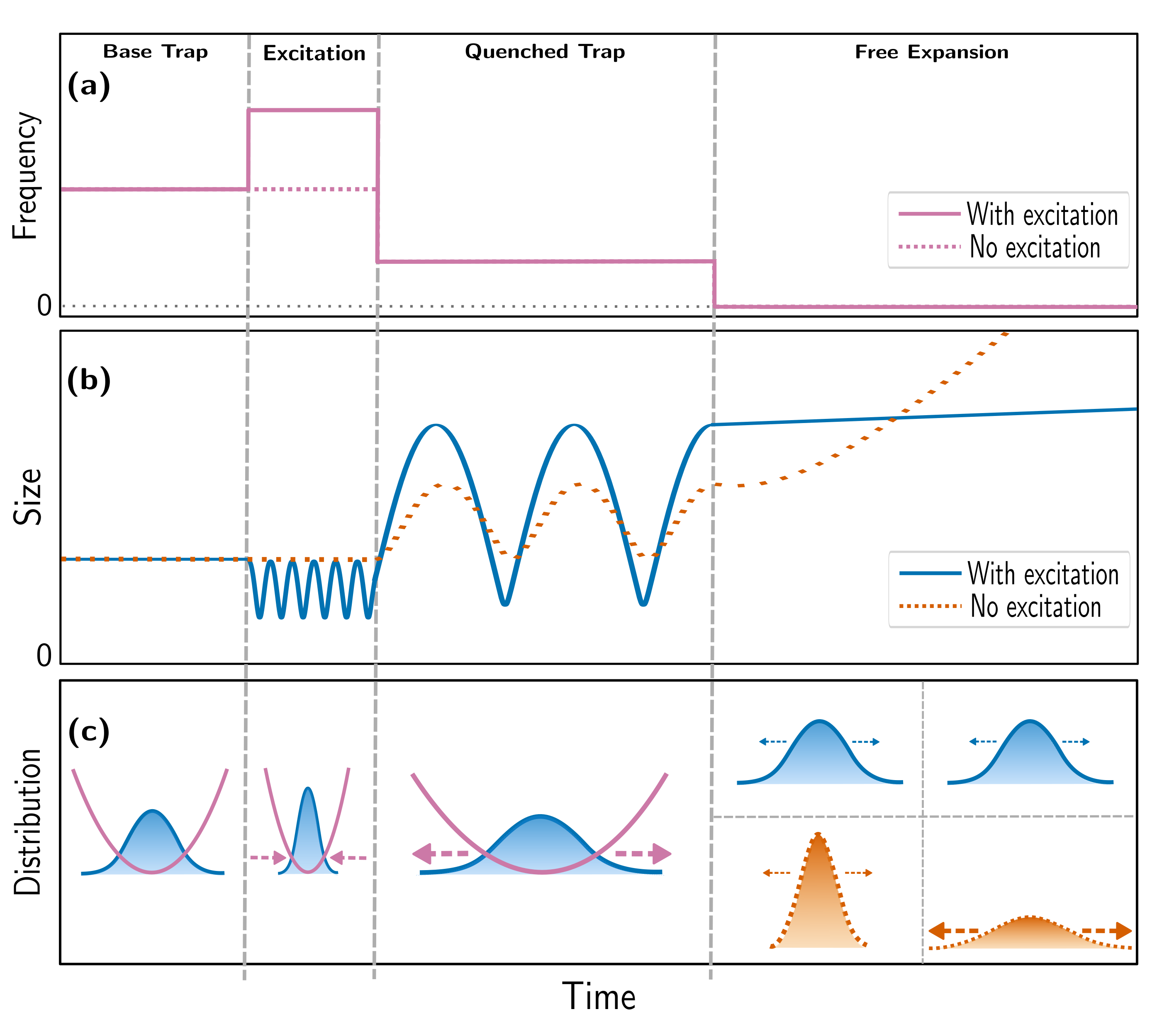
Figure 1: Schematic illustration of trap-quenched collimation with excitation/decompression/release, contrasting protocols with/without collective mode excitation.
The technique retains atoms under continuous magnetic control, permitting complex parameterization and superior CoM management compared to conventional Delta-Kick Collimation (DKC), particularly in dual-species configurations.
Experimental Realization and Modeling
Experiments were conducted using NASA's Cold Atom Laboratory (CAL) aboard the International Space Station, utilizing 87Rb BEC sources. The sequence involved:
- Preparation in high-frequency evaporation traps, transport to base traps, excitation via rapid frequency increase, staged decompression, and finally release in a quenched trap optimized for minimal expansion energy and CoM velocity.
- CoM dynamics were characterized and stabilized via chip modeling and iterative parameter gauging, allowing simulation to closely track measured trajectories.
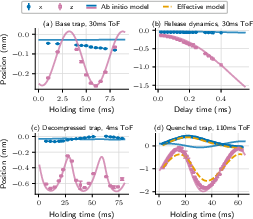
Figure 2: Experimental and simulated CoM trajectories during transport, decompression, and release, validating the chip model and current ramp adjustments.
Size dynamics and expansion energy are quantitatively modeled using effective scaling approaches, directly leveraging local potential curvatures. This accounts for spatial inhomogeneities and trap eigenaxis rotation, critical for accurate expansion predictions.
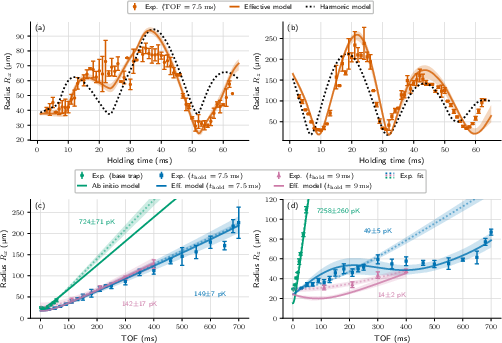
Figure 3: Evolution and expansion of BEC size in x and z directions for varying holding times, displaying model fit quality and importance of spatially resolved trap curvatures.
The protocol achieved a measured 2D expansion energy in the imaging plane of kB⋅78±9 pK and, based on projector modeling, kB⋅15−5+12 pK along two condensate eigenaxes. Extended free-expansion times of up to 700 ms were recorded, outperforming prior microgravity results for picokelvin matter-wave collimation.
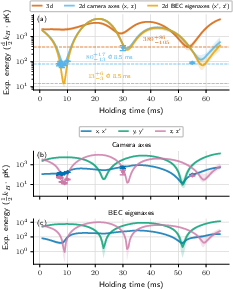
Figure 4: Time evolution of simulated and measured expansion energies in various frames, underscoring projection effects and identification of near-optimal holding times.
The optimal holding times for collimation were precisely determined by combining experimental scans and simulation, elucidating interplay between collective excitations, trap anharmonicities, and eigenaxis misalignment.
Dual-Species Extension: 41K and 87Rb
A detailed theoretical extension to dual-species (41K, 87Rb) was performed, assuming non-interacting conditions and realistic CAL trap frequencies. The optimization sought simultaneous collimation across all axes, exploiting species-dependent trap frequency scaling.
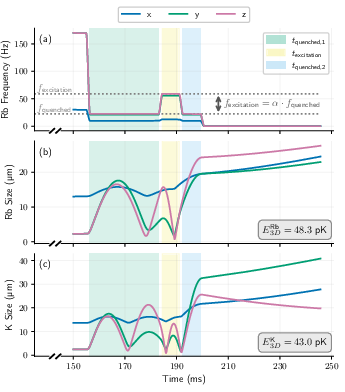
Figure 5: Dual-species trap-quenched collimation sequence, with comparative size dynamics for 87Rb and 41K along all axes and detailed trap frequency modulation.
The model predicts simultaneous 3D collimation energies of 23kB⋅48.3 pK (Rb) and kB⋅78±90 pK (K) after 1 s ToF for kB⋅78±91 atoms per species. These results are below the kB⋅78±92 pK threshold needed for UFF tests at kB⋅78±93 accuracy, contingent on holding durations and frequency ratios tunable within CAL parameters.
Technical Challenges and Advanced Modeling
Instrumental constraints, including atom number fluctuations, magnetically insensitive state transfer inefficiencies, and imaging limitations, dictated a cutoff in usable data and necessitated robust modeling for interpretation. The chip model was iteratively gauged for dynamic current response and spatial inhomogeneities, integrating semi-free expansion effects during ToF.
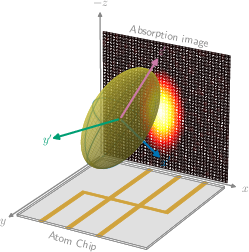
Figure 6: Atom chip schematic showing relevant wire and coil geometry and eigenaxis rotation mapping.
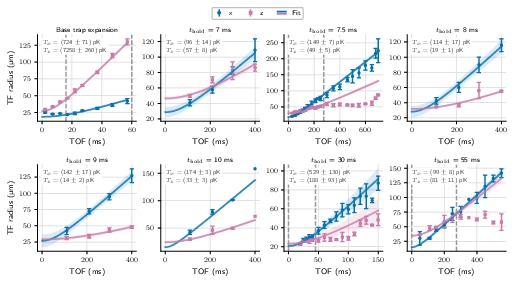
Figure 7: Absorption fit windows for expansion energy extraction, emphasizing ballistic regime selection.
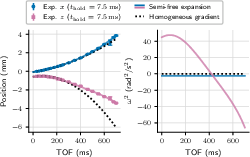
Figure 8: Semi-free expansion modeling results for classical trajectories and spatially dependent curvatures.
Explicit Bayesian optimization, informed by both CoM and size dynamics, enabled parameter selection for effective modeling. The rotation and projection between BEC eigenaxes and imaging frames are non-trivial and require careful incorporation for rigorous expansion energy evaluation.
Implications and Future Directions
Practically, the protocol enables dual-species collimation in microgravity at picokelvin energies, meeting requirements for quantum UFF tests at kB⋅78±94 accuracy. Theoretically, it validates advanced sequence design and modeling approaches for integrated control of collective modes and CoM in atom-chip environments.
Future developments should address scalability to larger atom numbers (kB⋅78±95), modeling of inter-species interactions, and more homogeneous field environments. The framework can be adapted for transport optimization via Bayesian or optimal control protocols in complex geometries, incorporating quantum mixtures or molecules.
Conclusion
Trap-quenched collimation provides a robust methodology for dual-species matter-wave source preparation in microgravity. The demonstrated performance at sub-100 pK expansion energies validates its utility for high-precision UFF tests and lays the groundwork for quantum sensors surpassing current classical limits. The approach is extendable to complex atomic mixtures, contingent on comprehensive modeling and transport control, marking a milestone in space-borne quantum matter-wave optics (2606.14577).