- The paper presents a novel apparatus for creating a quasi-2D Bose mixture of 23Na and 87Rb atoms using modular vacuum chambers and high-resolution imaging.
- It employs advanced methodologies including independent 2D-MOT sources, Dark-SPOT loading, sub-Doppler cooling, and RF evaporative cooling to reach quantum degeneracy.
- The study confirms phase separation, critical density thresholds, and BKT superfluidity, paving the way for exploring low-dimensional quantum many-body phenomena.
Efficient Preparation of a Quasi-2D Bose Mixture of Ultracold 23Na and 87Rb Atoms
Experimental Design and Apparatus Architecture
The paper describes the realization of an ultracold quasi-two-dimensional (2D) Bose mixture of 23Na and 87Rb, emphasizing both technical innovations and quantum state preparation protocols (2604.18072). The apparatus is partitioned into distinct modules: independent 2D-MOT source chambers for Na and Rb, a 3D-MOT chamber optimized for magnetic and optical trapping, and a science chamber with extended optical access allowing for versatile lattice geometries and high-resolution imaging.
Vacuum system design and material selection are optimized for magnetic compatibility and optical accessibility, with non-magnetic TC4 titanium alloy employed to minimize magnetization and eddy currents in high-field operations. The science chamber incorporates precision electrode assemblies, facilitating future control of dipolar interactions in molecular states. High-resolution imaging objectives (NA=0.75) permit single-site resolved detection.
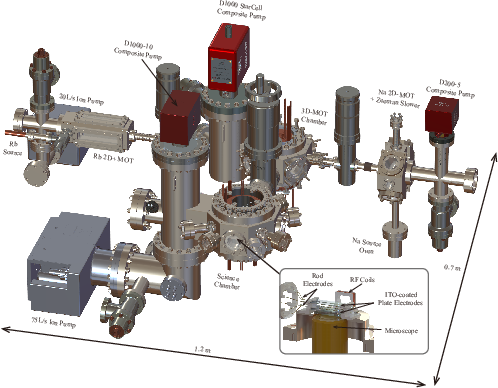
Figure 1: Schematic showing the modular vacuum system and the integration of imaging, magnetic, and electrode hardware.
Laser Cooling, 2D-MOT Sources, and Atomic Flux Control
Atomic flux optimization is realized via bespoke laser cooling strategies for both sodium and rubidium. The Na 2D-MOT employs a compact octagonal chamber and a Zeeman slower configuration using permanent magnets, achieving a pre-cooled flux of up to 2.2×10⁸ atoms s−1. Magnetic field profiles for Zeeman slowing and 2D-MOT are shaped by strategic magnet positioning.
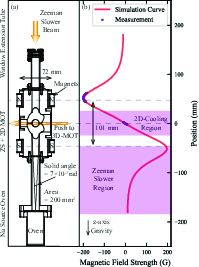
Figure 2: Design of the Na 2D-MOT chamber and magnetic field distribution for efficient Zeeman slowing.
For Rb, a modular 2D+-MOT delivers a high-flux (2×10⁹ atoms/s) beam, with a mirror and magnet array geometry enhancing transverse cooling and axial pushing. The architecture leverages indium-sealed windows for low-temperature bake-out and stable optical alignment.
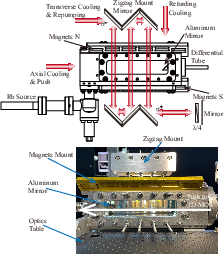
Figure 3: Schematic and photograph depicting the modular 87Rb 2D870-MOT configuration.
Dark-SPOT Loading, Sub-Doppler Cooling, and Hybrid Trap Evaporation
Dual-species capture utilizes Dark-SPOT loading techniques in the 3D-MOT, facilitating high-density accumulation, followed by sub-Doppler cooling stages specific to each atomic species. Gray molasses cooling for Na and molasses cooling for Rb result in temperatures reduced below 871 and dramatically enhance magnetic trap loading efficiency.
Simultaneous RF evaporative cooling in the magnetic trap exploits nearly identical Zeeman splitting for Na and Rb in the 872 state, enabling dual-species evaporation with a single RF frequency sweep. After sequential evaporation stages, the apparatus achieves 873 Na atoms at 874 and 875 Rb atoms at 876, with PSDs of 877 and 878, respectively.
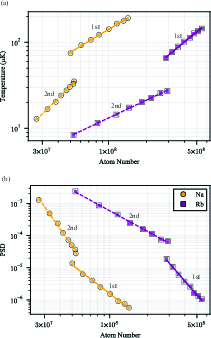
Figure 4: Temperature and phase-space density evolution versus atom number during dual-species RF evaporation.
A hybrid trap formed by combining ODT and magnetic fields is employed to suppress Majorana losses and enable efficient simultaneous evaporation toward quantum degeneracy. The trap configuration allows independent control of depth for each species by leveraging differential levitation gradients.
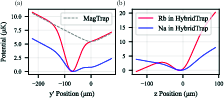
Figure 5: Potential energy profiles demonstrating species-selective trap depth control in the hybrid optical-magnetic trap.
Optical Transport, Crossed ODT Evaporation, and Quantum Degeneracy
Following hybrid trap evaporation, atoms are transferred to the science chamber using a crossed ODT, moved via an air-bearing translation stage. The transport protocol maintains high transfer efficiencies (879 for Na, 230 for Rb) and temperature stability, exploiting a constant-jerk S-curve profile.
In the science chamber, evaporation in crossed ODTs and a pancake trap yields pure dual-species BECs with up to 231 Na and 232 Rb atoms with condensed fractions exceeding 233.
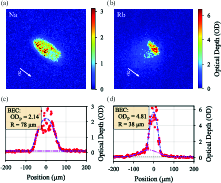
Figure 6: Absorption images and density profiles of the dual-species BEC after time-of-flight expansion.
Quasi-2D Mixture Preparation and In-Situ Density Characterization
Atoms are loaded into a vertical long-lattice (VLL) with 234 and a 235 period, with Galvo mirrors actively controlling the lattice phase for single-layer loading and precise focal alignment for imaging.
Matter-wave interference patterns following lattice release are used to confirm single-plane loading.
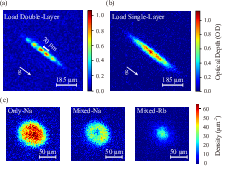
Figure 7: Matter-wave interference and in-situ density distributions signifying successful loading into a single quasi-2D layer.
High-resolution imaging reveals the equilibrium density profiles of the single-species and dual-species gases. Radial density profiles are analyzed via local chemical potential mapping, with Hartree-Fock mean-field (HFMF) theory applied in thermal wings and superfluid mean-field theory describing the central superfluid regions. In the Na single-species case, a peak PSD of 83 is reported, far above the BKT critical PSD of 236, confirming a BKT superfluid regime.
In the mixture, immiscibility is observed as Na is expelled into a partial ring surrounding a central Rb core, consistent with theoretical predictions for the measured interspecies scattering length (237). Thermal and superfluid regions are mapped, and finite-temperature effects are identified as contributing to the smearing of phase separation.
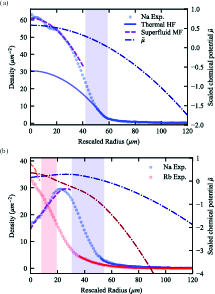
Figure 8: Azimuthal averaged in-situ density profiles for single-species and dual-species cases, with theoretical fits illustrating superfluid and immiscible regimes.
Implications, Applications, and Perspectives
The constructed platform enables the study of quantum impurity dynamics, polaron physics, quantum droplets, and exotic low-dimensional phases, with direct relevance to dipolar molecule formation and manipulation in restricted geometries. The apparatus is particularly suited for investigations into miscible-immiscible boundaries, droplet formation in 2D, finite-temperature BKT physics, and impurity-mediated interactions in Bose mixtures.
The inclusion of precision in-vacuum electrodes and species-selective lattice controls positions the setup for future studies of ultracold polar molecules, engineered shielding, and quantum crystals or supersolids in 2D. High-resolution imaging down to the single-site level allows for exploration of microscopic aspects of quantum correlations, phase transitions, and collective excitation dynamics.
Conclusion
This work rigorously details the preparation and characterization of a quasi-2D quantum degenerate mixture of 238Na and 239Rb, outlining robust technical and methodological advances in dual-species ultracold atom manipulation. The platform's versatility in lattice geometry, molecular control, and high-resolution imaging provides a foundation for systematic exploration of low-dimensional quantum many-body phenomena, advancing both experimental capabilities and the theoretical understanding of Bose mixtures in confined regimes.