- The paper introduces FTSR, a force-guided, constraint-based learning framework that prevents dead points and enables robust fall recovery.
- It employs a teacher-student architecture with latent knowledge distillation and height-progressive stage-wise rewards to stabilize and refine recovery trajectories.
- Experimental results show near 100% recovery success in simulation and real-world deployments, underlining the method’s efficiency and sim-to-real transferability.
Robust Fall Recovery for Armless Bipedal-Wheeled Robots via Force-Guided Learning
Introduction
The paper "Robust Fall Recovery for Armless Bipedal-Wheeled Robots via Force-Guided Learning" (2606.14270) introduces the Force-guided Teacher-student framework with Stage-wise Rewards (FTSR), a novel methodology addressing the challenging problem of autonomous fall recovery in armless bipedal-wheeled robots. Unlike prior art leveraging arm-based actuators or pure reward-driven RL frameworks, FTSR formulates external auxiliary forces as optimizable constraints within a CMDP, overcoming premature convergence to local optima (dead points) and ensuring physically feasible recovery trajectories. The system integrates height-progressive stage-wise rewards and a teacher-student architecture that distills privileged force-related knowledge, supporting robust real-world deployment and generalization to high-DOF humanoids.
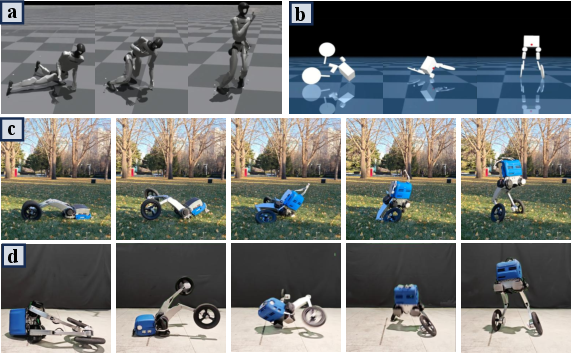
Figure 1: Simulation and physical deployment results illustrate effective recovery of both simulated and real bipedal-wheeled robots under diverse environments and poses.
Methodology
Constrained Force-Guided Learning
Extending conventional RL frameworks, FTSR leverages CMDP where external forces and torques are explicitly formulated as training constraints rather than heuristic curricula. The method constrains policy optimization with auxiliary force F and torque T as hard constraints, driving the policy to rely progressively less on external intervention and discover robust, autonomous recovery strategies. Constrained Policy Optimization (CPO) is adopted with penalty methods, enabling stable update steps and better compliance with physical feasibility.
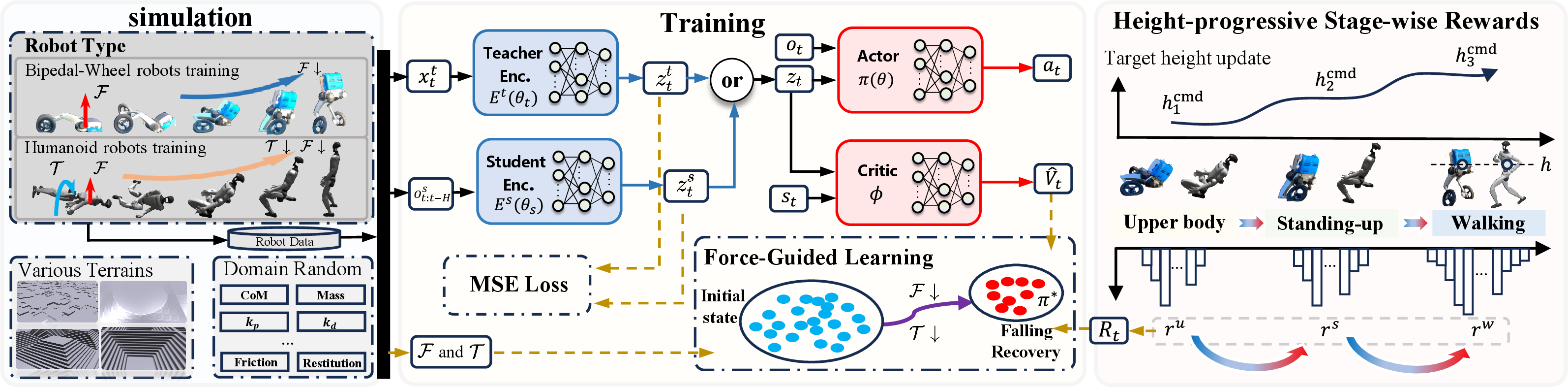
Figure 2: Force-guided fall-recovery training framework, incorporating teacher-student latent encoding and constrained policy optimization.
Teacher-Student Architecture
Privileged information unavailable at deployment—such as contact forces and full-body state—is encoded by a teacher network, supervised via MSE loss against a student encoder that processes only proprioceptive history. Latent features are routed by an "or" module to shared Actor-Critic networks, ensuring privileged knowledge is leveraged during training while supporting proprioceptive-only execution post-deployment.
Height-Progressive Stage-Wise Rewards
To stabilize posture transitions and facilitate locomotion post-recovery, stage-wise rewards are structured around batch height statistics, automatically transitioning from upper body erection (ru) to standing-up (rs) to walking (rw). This adaptive reward mechanism avoids instability associated with fixed height targets and guides the robot through complex pose refinement toward robust standing and locomotion.
Experimental Evaluation
Training Dynamics and Convergence
The methodology is validated in IsaacGym with extensive parallel simulation. Domain randomization and terrain diversity foster sim-to-real transferability. Comparative ablation studies against baseline methods confirm that removal of stage-wise rewards or force-guided constraints severely degrades recovery rates. Excessive penalty multipliers illustrate that over-constraining force guidance can degrade policy robustness.
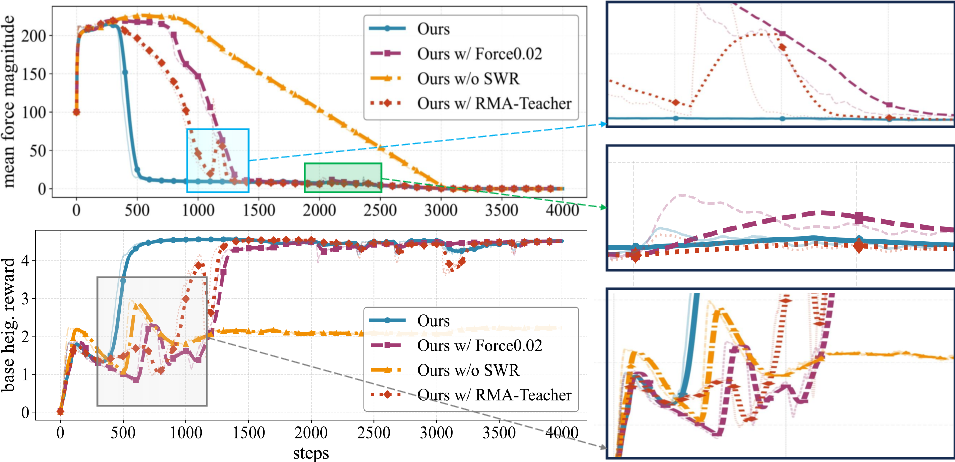
Figure 3: External force and height reward curves demonstrate rapid convergence and stable training for policies employing force-guided constraints.

Figure 4: Success rate and foot travel distance across iterations indicate fast convergence and robust stability with force-guided learning.
Ablation and Generalization
Ablation experiments systematically show that stage-wise rewards and teacher-student architecture are essential for performance; purely proprioceptive policies yield limited robustness, while the inclusion of privileged information dramatically increases recovery success rates and motion stability.
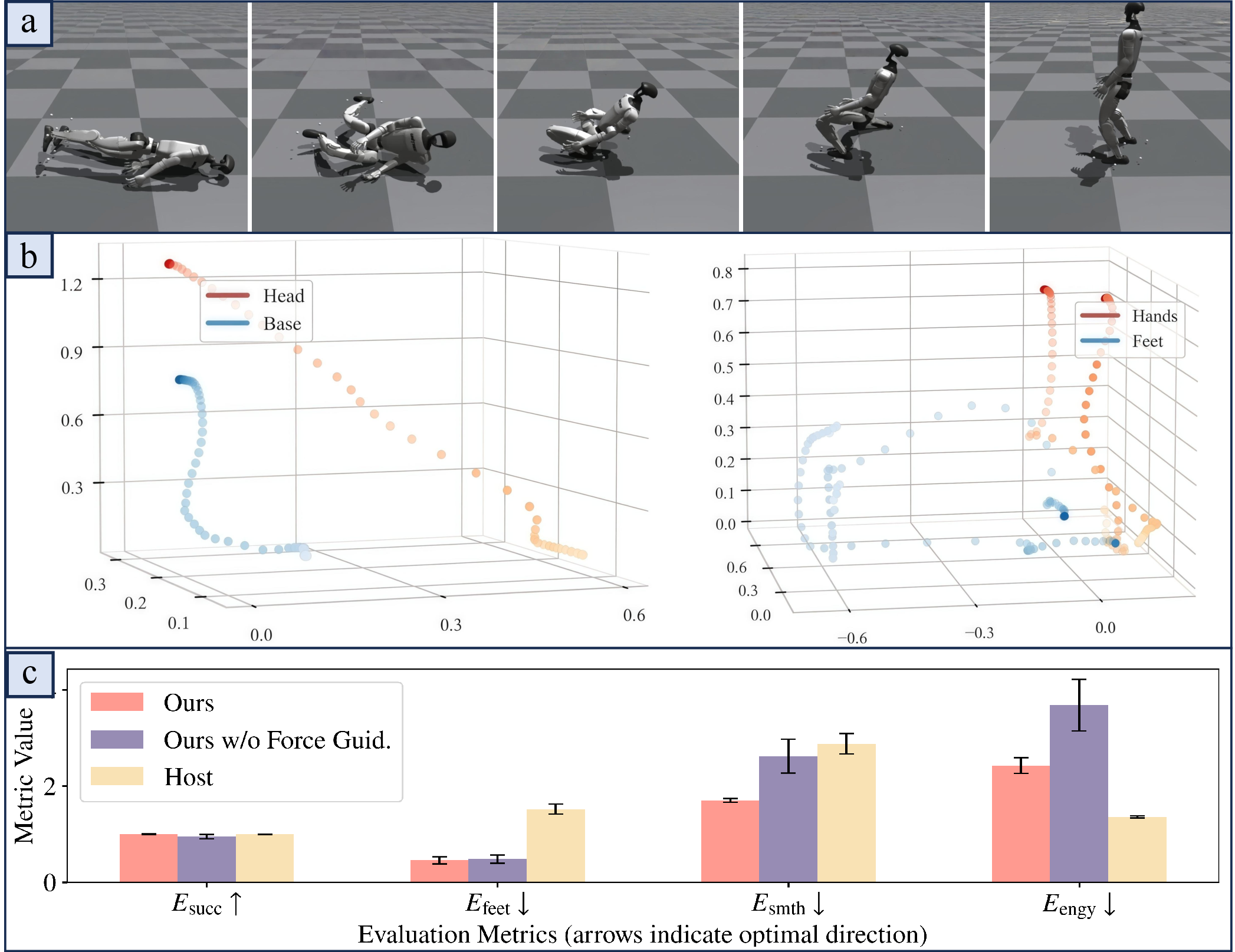
Figure 5: FTSR generalizes to a 23-DOF Unitree humanoid, demonstrating arbitrary pose recovery and superior smoothness to prior methods.
Real-World Deployment
FTSR-trained policies are deployed on the JiaRan armless bipedal-wheeled robot, tested under randomized initial poses and diverse terrains (flat, slope, step, grass, gravel). The method maintains high success rates and strong environmental adaptability, overcoming dead-point pose constraints endemic to force-curriculum approaches.
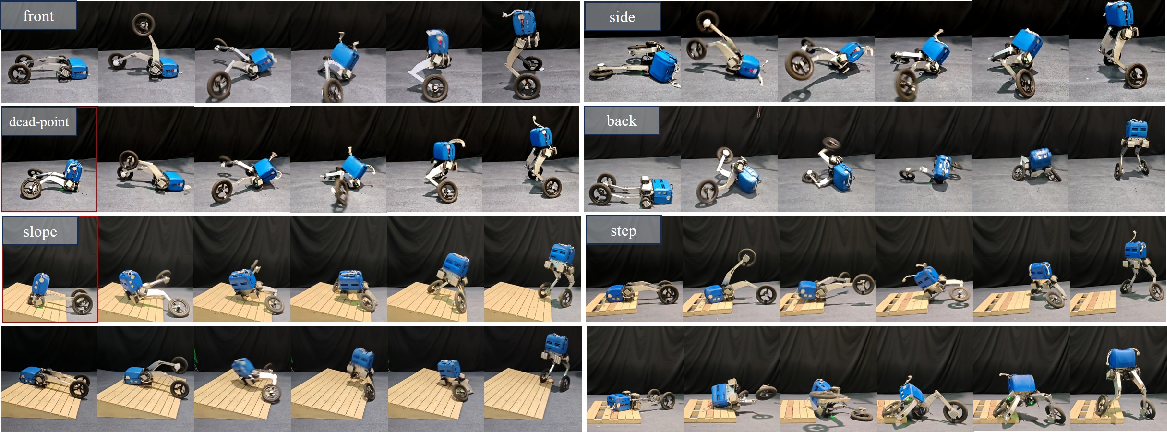
Figure 6: Standing-up tests under varied poses and terrains confirm robust recovery even from dead-point poses.

Figure 7: Outdoor standing-up tests across various poses further demonstrate environmental adaptation.
Additional experiments include fall recovery followed by highly controlled locomotion, proving the preservation of mobility post-recovery.
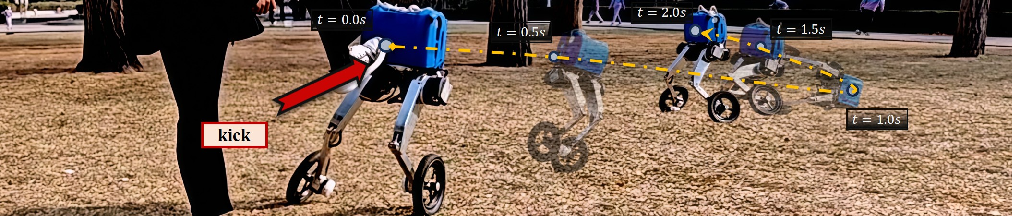
Figure 8: Fall recovery and subsequent locomotion, with kick-induced disturbances, confirm rapid autonomous recovery and sustained motion control.
Numerical Results and Strong Claims
Key reported metrics:
- Simulation success rate: ∼99.8% across varied terrains, exceeding prior RL frameworks and force-curriculum baselines.
- Real-world success: 100% recovery rate across grass, slope, and stairs (15/15 trials), indicating strong sim-to-real transfer and environmental robustness.
- Convergence: Stable recovery observed within 3k–4k iterations; force-free standing achieved rapidly with minimal foot adjustment.
The methodology asserts—contrary to prior work—that constraint-based force guidance critically prevents convergence to non-functional dead points and uniquely enables armless bipedal-wheeled recovery, which prior reward-based or force-curriculum approaches fail to achieve.
Implications and Future Directions
Practically, the FTSR framework delivers a reliable, deployable solution for fall recovery in both bipedal-wheeled and high-DOF humanoid robots lacking supportive upper-body actuation. Theoretical implications include advancing constraint-based RL as a mechanism to enforce physically plausible trajectories, particularly in underactuated systems. The teacher-student paradigm further demonstrates efficient distillation of privileged knowledge, supporting robust policies in sensor-limited deployments.
FTSR's methodology suggests broader applicability to other embodiment-constrained or underactuated robotic platforms. Future research can extend the FTSR paradigm to multi-robot scenarios, variable morphologies, and adaptive constraints responsive to environmental complexity. There is significant scope for integrating additional privileged modalities and extending the teacher-student architecture for multi-phase or hierarchical recovery tasks.
Conclusion
The paper establishes FTSR as the first method to enable reliable fall recovery for armless bipedal-wheeled robots under diverse, randomized poses and terrains. Constraint-based force guidance, height-progressive stage-wise rewards, and teacher-student knowledge distillation collectively yield stable, adaptable, and highly successful policies. Real-world deployment and generalization to high-DOF humanoids substantiate FTSR's efficacy and practical relevance, indicating promising directions for future constrained RL frameworks in complex robotic embodiment and recovery tasks.