- The paper introduces a novel HoloPathTracer framework that fuses ray tracing with wave optics to generate physically accurate holographic reconstructions.
- It employs a two-stage propagation with Gaussian random field phase sampling and multi-frame rendering, achieving rapid convergence and 80% PSNR with lower SPP.
- The method reduces speckle noise, enhances multi-view consistency, and is validated through both simulations and prototype phase-only SLM experiments.
HoloPathTracer: Physically Accurate Wave Path Tracing for Computational Holography
Motivation and Context
Holographic displays target perceptual realism in VR/AR via reconstruction of complex 3D wavefronts. Achieving physically accurate depth and view-continuous cues mandates encoding rich optical phenomena, including specular reflections, high-frequency highlights, and variable-focus defocus, directly into phase holograms. Legacy CGH pipelines employ radiance pre-rendering on discretized primitives, followed by wave propagation, resulting in layer-dependent artifacts, restricted occlusion handling, and compromised amplitude-phase coupling. Recent advances in hardware (e.g., high-speed SLMs) demand CGH frameworks that are compatible, scalable, and capable of supporting robust multi-frame random holography with minimal computational overhead.
Methodology: Wave Path Tracing Pipeline
The proposed HoloPathTracer framework integrates path tracing–empowered rendering with explicit wave optics, leveraging the Rayleigh–Sommerfeld integral to encode both amplitude and phase in the coherent wave field. The pipeline decomposes illumination into coherent (phase-tracked, specular/mirror/transparent) and incoherent (diffuse/glossy/random-phase) components, pre-optimizing the latter to accelerate computation while maintaining physical fidelity.
The processing pipeline, depicted below, comprises nine staged modules: ray sampling, coordinate transforms, BSDF evaluation, amplitude tracing, phase sampling via Gaussian random fields, and accumulation of complex amplitudes on the hologram plane.
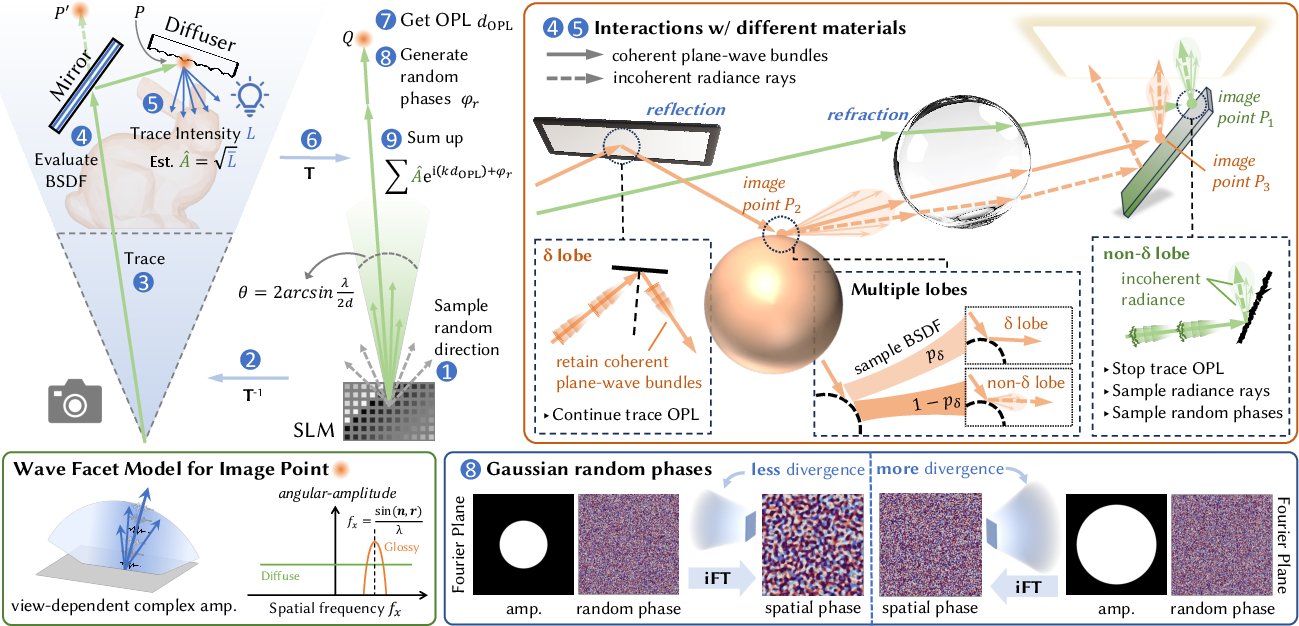
Figure 1: HoloPathTracer processing pipeline, detailing physical ray propagation, BSDF evaluation, phase sampling, and accumulation of complex wave fields for hologram synthesis.
Coherent rays undergo phase accumulation via OPL in both world and hologram spaces, while incoherent interactions are perturbed with precomputed Gaussian random phase maps band-limited to the SLM’s angular spectrum support. This enables variable-frame wavefield multiplexing, required for time-domain incoherence and speckle mitigation.
Angular-Amplitude, Gaussian Random Field Sampling, and Multi-Frame Rendering
The framework constructs the simulated angular amplitude on each wave facet, directly synthesizing random phase structure to broaden angular bandwidth and facilitate perceptual realism.
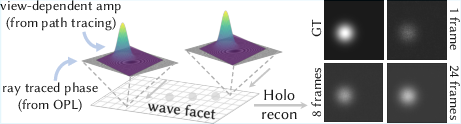
Figure 2: Simulated angular amplitude on each wave facet, built from path tracing amplitude and optical path length phase, enabling variable-frame multiplexing.
Random phase perturbations are physically mapped via GRFs in hologram-space coordinates (not UV), guaranteeing spatially invariant bandwidth and consistent energy distribution across projected facets, robust against changes to facet geometry.
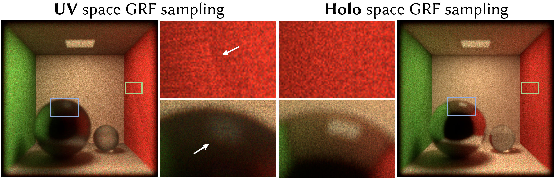
Figure 3: Gaussian random field sampling on facet in UV and Holo spaces, with hologram-space sampling preserving effective angular-phase bandwidth.
Ray reuse is adopted across time-multiplexed hologram generation, with negligible additional computational cost—sub-linear scaling with scene primitives is achieved, and rapid convergence is supported via ambient radiance cache and two-stage WRP–ASM propagation. Experimental results validate efficient multi-frame generation with minimal runtime overhead.
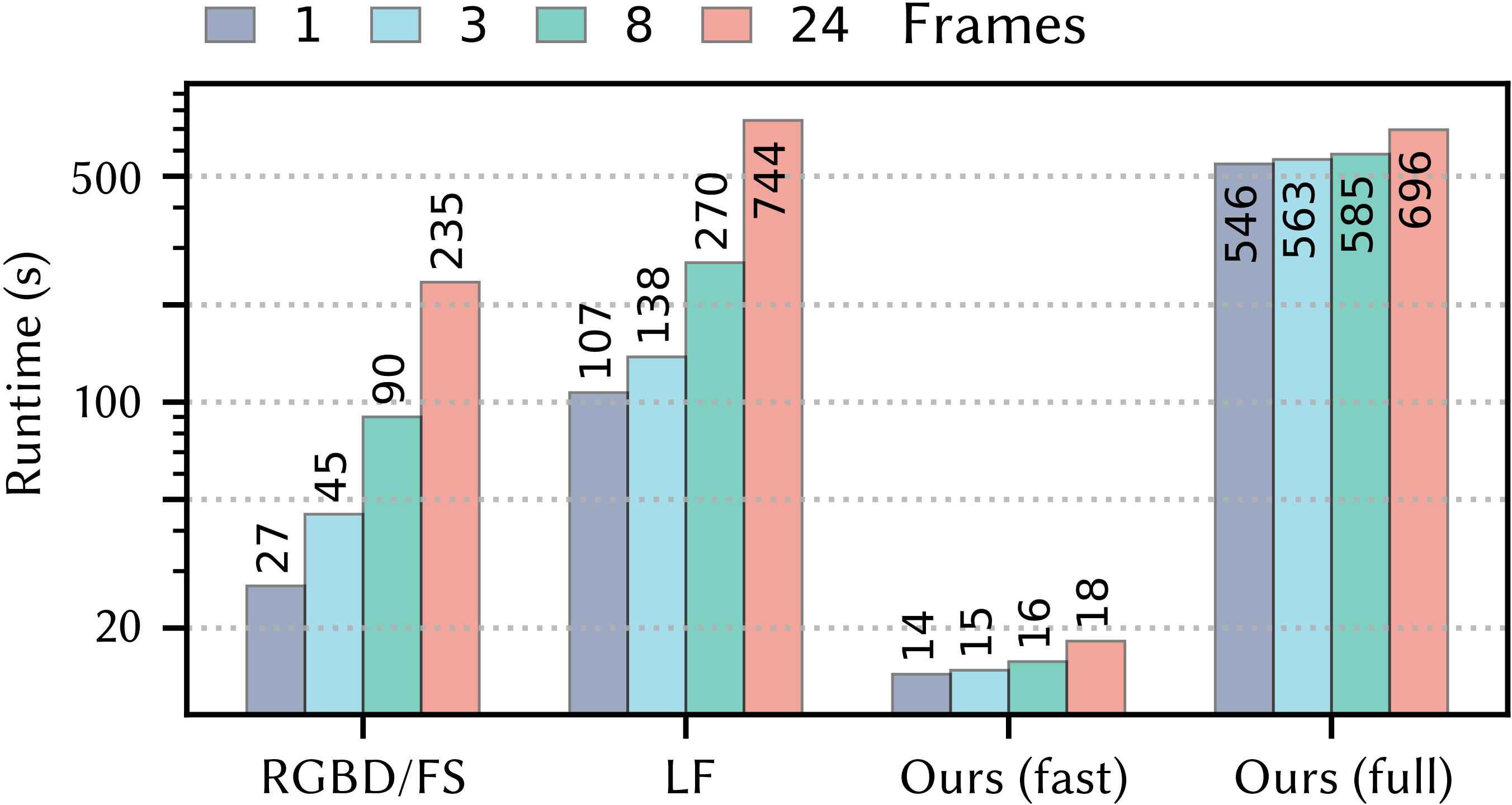
Figure 4: Runtime ablation demonstrating marginal computational overhead for multi-frame time-multiplexed holograms.
Numerical Convergence and Sampling Efficiency
Convergence behavior is critically analyzed, contrasting direct-hologram-plane rendering with WRP–ASM two-stage propagation and texture-baked fast variants. The proposed strategy yields an order-of-magnitude faster convergence, attaining 80% reconstruction PSNR at significantly lower SPP compared to baseline approaches.
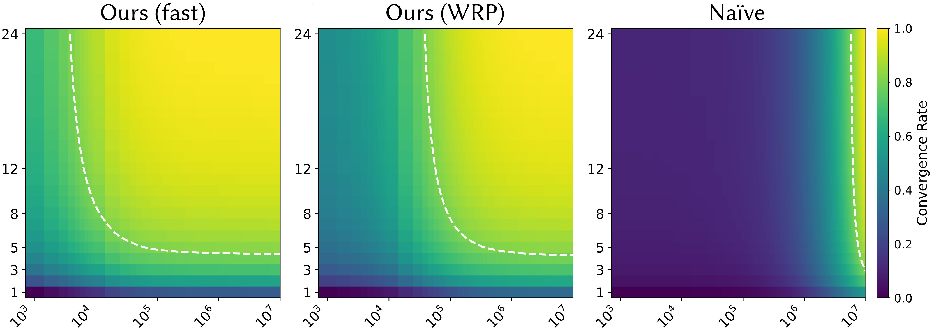
Figure 5: Convergence behavior of wave field rendering schemes, with two-stage WRP+ASM and texture-baking yielding efficient PSNR convergence.
Simulated reconstructions across complex Mitsuba scenes reveal superior depth cues, correct mirror and lens imagery, and sharp in-focus details with natural defocus transitions. Comparisons against RGBD, focal stack, light field, Gaussian splatting, and mesh-based frameworks show HoloPathTracer's higher visual fidelity, notably for multi-view consistency and physical accuracy in depth-dependent focus.
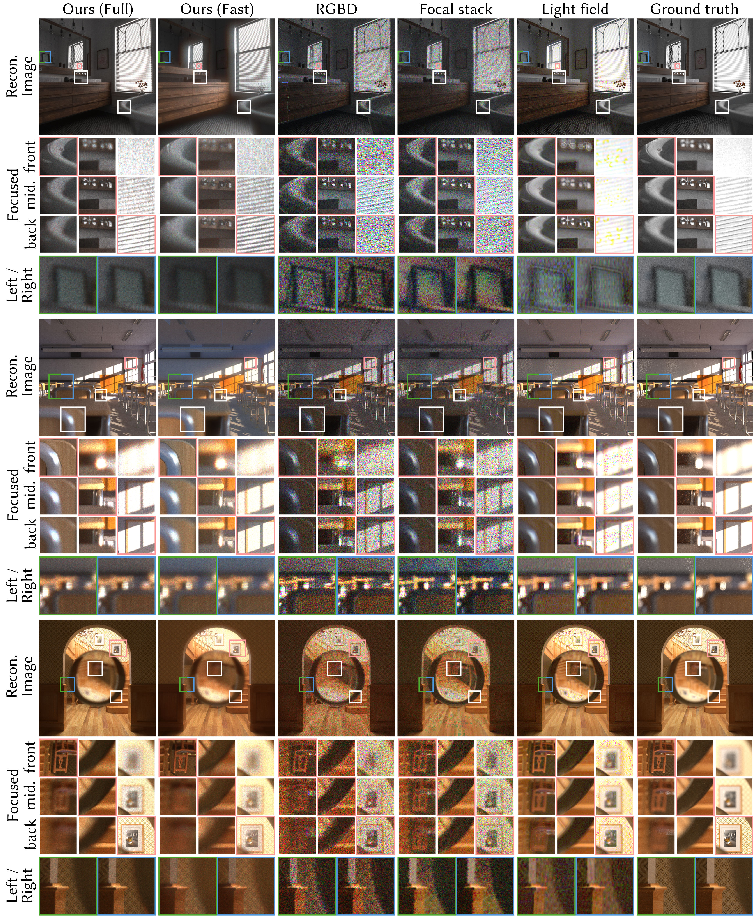
Figure 6: Rendering results from multiple CGH frameworks; the HoloPathTracer fast variant accelerates computation while preserving photorealism.
In scenes with complex reflective geometries, Gaussian splatting and mesh-based approaches fail to reproduce mirror-formed imagery, whereas HoloPathTracer variants reliably match ground-truth renderings.
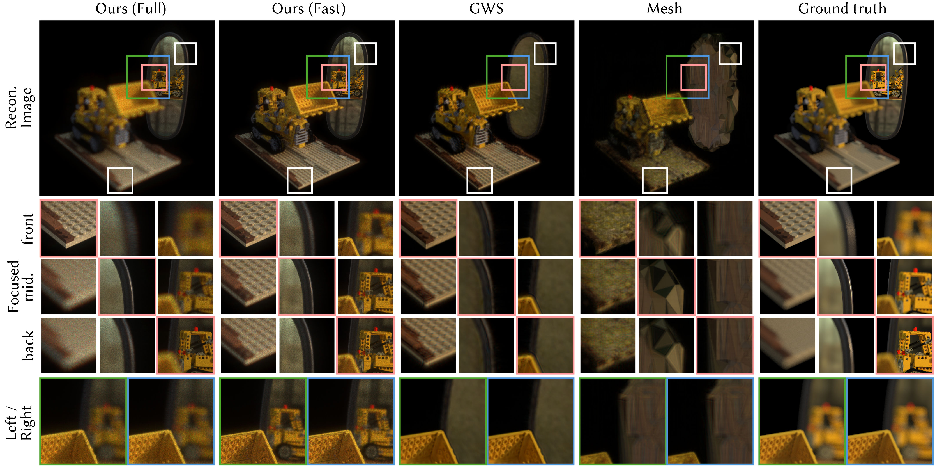
Figure 7: Rendering results comparing HoloPathTracer variants, Gaussian wave splatting, and mesh-based CGH.
Experimental Validation: Prototype and Phase-Only Encoding
A phase-only SLM holographic prototype is constructed, following simulation configuration. Hologram encoding is supervised in the complex domain via stochastic gradient descent, reducing optimization time and supporting single-plane supervision with view and depth continuity. Physical reconstructions demonstrate sharper in-focus details and more natural defocus compared to focal stack baselines, with contrast loss attributable to SLM crosstalk sensitivity intrinsic to random-phase holograms.
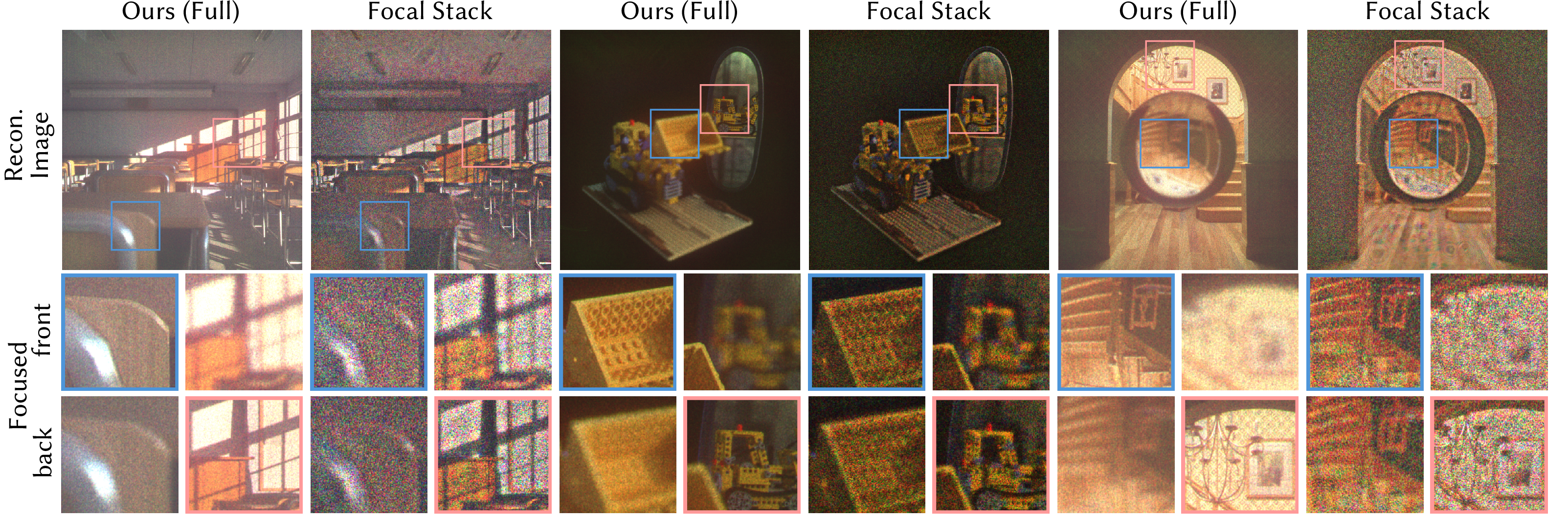
Figure 8: Acquired display results comparing HoloPathTracer and focal stack baseline; sharper details and natural defocus observed with the proposed approach.
Practical and Theoretical Implications
HoloPathTracer establishes a general paradigm for synthesizing physically accurate, spatially continuous, and angularly random wave fields across large-scale 3D scenes. The method’s compatibility with ambient caching, multi-frame rendering, and advanced optimization positions it favorably for deployment in high-throughput SLM-driven CGH systems. The path tracing—RS integral fusion provides granular control over amplitude-phase coupling, essential for modeling advanced material properties (e.g., metallicity, roughness, BRDF/BxDF) and arbitrating coherent/incoherent behaviors.
Practically, time-multiplexed random holography dramatically reduces speckle and enhances multi-view robustness in holographic displays, directly leveraging hardware advances in SLM bandwidth and refresh rates. The pipeline’s modularity facilitates integration with learned propagation models and camera-in-the-loop calibration for further acceleration and resilience against hardware imperfections.
Theoretically, the approach bridges geometric and wave-optical rendering, enabling fine-grained spectrum shaping and adaptive sampling, key for scaling full wave field rendering to complex scenes and broad etendue optical engines.
Limitations and Future Directions
Current runtime is bounded by wave propagation sampling costs. Visual discrepancies for low-roughness glossy materials and color drift near the recording plane can be addressed via continuity-aware phase modeling and multiple recording planes. Integration with advanced network inference for propagation and calibration is a promising avenue for practical acceleration. SLM etendue and pixel pitch remain hardware bottlenecks; photonics-based SLMs promise further relaxation of these constraints.
Conclusion
HoloPathTracer delivers a computationally efficient, physically accurate wave field rendering pipeline for CGH, supporting robust multi-frame random holography with rich 3D cues and view-dependent effects. Simulation and experimental validation confirm its photorealistic reconstruction quality, scalability, and compatibility with modern rendering and holographic display requirements. The methodology sets a foundation for future high-fidelity CGH systems, with opportunities for rapid inference, hardware-aware calibration, and advanced material/scene modeling (2606.14173).

