- The paper presents a general symmetry-based framework that enables simultaneous reversal of electric polarization and spin splitting in collinear antiferromagnets.
- It employs first-principles DFT calculations in 1D, 2D, and 3D systems to verify switching pathways and quantify energy barriers.
- The results highlight potential for low-power, nonvolatile spintronic applications by unifying multiferroic control mechanisms across diverse material classes.
General Theory for Ferroelectric Control of Spin Splitting in Collinear Antiferromagnets
Introduction and Motivation
The interplay between ferroelectricity and magnetism in collinear antiferromagnets (AFMs) is central to the development of energy-efficient spintronic devices. Conventional AFMs and their derivative classes, such as altermagnets (AMs) and collinear compensated ferrimagnets (CFiMs), are recognized for their ultrafast magnetic dynamics and vanishing net magnetization, properties advantageous for device miniaturization and robustness against external perturbations. However, the lack of net magnetization presents challenges in manipulation and detection of their magnetic states. Recent focus has shifted to nonrelativistic spin splitting (NRSS) in materials exhibiting symmetry-protected spin textures, circumventing these challenges and introducing new functionalities such as spin-polarized current generation and emergent Hall effects.
While electric control of NRSS—particularly via spin-orbit torque—has shown potential, it is inherently limited by energy dissipation due to charge currents. Multiferroic materials, which combine ferroelectric and magnetic orders, present a paradigm where the reversal of electric polarization can synchronously manipulate NRSS, thus promising highly efficient control. To date, this coupling between ferroelectricity and unconventional magnetism has largely been demonstrated in low-dimensional (primarily 2D) material systems with polarization confined to out-of-plane orientations, leaving an unmet need for generalized design principles.
Symmetry-Based Framework for Ferroelectric Control
The authors introduce a comprehensive group theoretical approach to classify and enumerate all valid symmetry operations—termed switching operators—enabling simultaneous reversal of electric polarization and NRSS in collinear AFMs. Their framework systematically decomposes the stabilizer subgroup of the multiferroic state into components determined by system dimensionality, polarization orientation, and lattice-intrinsic symmetries.
This symmetry analysis is formalized by associating the switching pathway between two multiferroic states, ∣M1⟩ and ∣M2⟩, with the composite action of spatial inversion (P^) and time-reversal (T^), supplemented by elements of the material's stabilizer group. For materials with minimal intrinsic symmetry, the set of switching operators is defined solely by the spatial dimension and polarization direction, providing a robust scheme valid for low-symmetry CFiMs. In higher-symmetry AMs, intrinsic crystal symmetries expand the available switching pathways, enriching the landscape for NRSS control but making the system sensitive to perturbations.
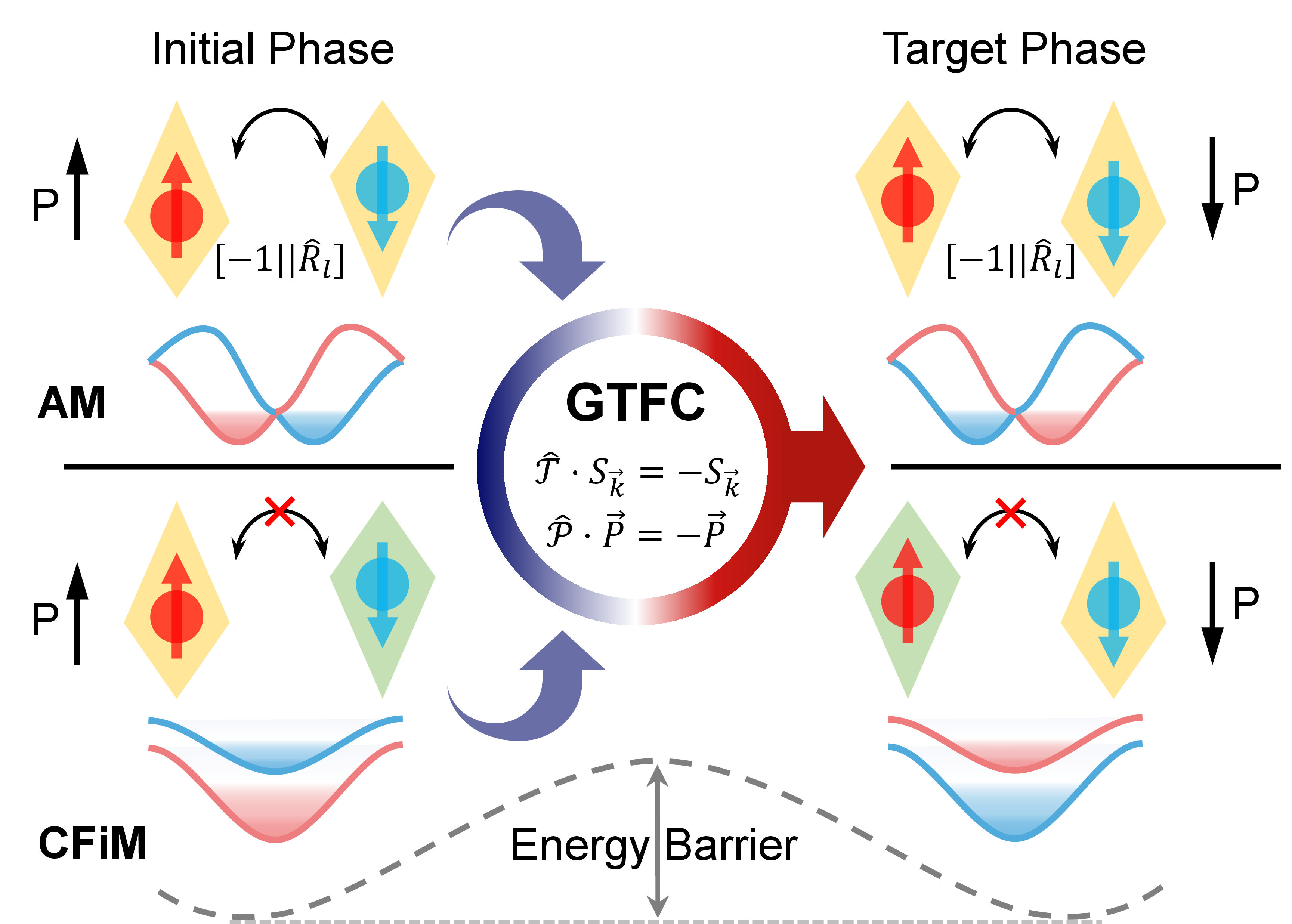
Figure 1: Schematic diagrams illustrating the general symmetry concept for ferroelectric control of spin splitting in altermagnets and CFiMs. In AMs, magnetic sublattices are related by an intrinsic symmetry, while in CFiMs, such connection is absent.
Case Studies: First-Principles Validation across Dimensions
To validate and exemplify the theoretical framework, the authors conduct DFT-based calculations on three prototypical systems spanning one, two, and three dimensions.
1D Case: Sliding Ferroelectric Control in (6,14)-ZGNRs
In bilayer zigzag graphene nanoribbons (ZGNRs) with mismatched widths, introducing interlayer sliding enables electronic reconstruction that breaks inversion symmetry, yielding both electric polarization and NRSS in a CFiM state. Application of the symmetry-classified switching operator ([−1∣∣M^100]) interchanges the AB and BA stacking configurations, which exhibit energetically degenerate, oppositely polarized multiferroic states with maximum spin splitting of ∓42.0 meV at the valence band maximum. The electric polarization can be tuned by the sliding coordinate, with an energy barrier of $30.16$ meV per formula unit, confirming that NRSS manipulation is feasible via lateral electric fields.
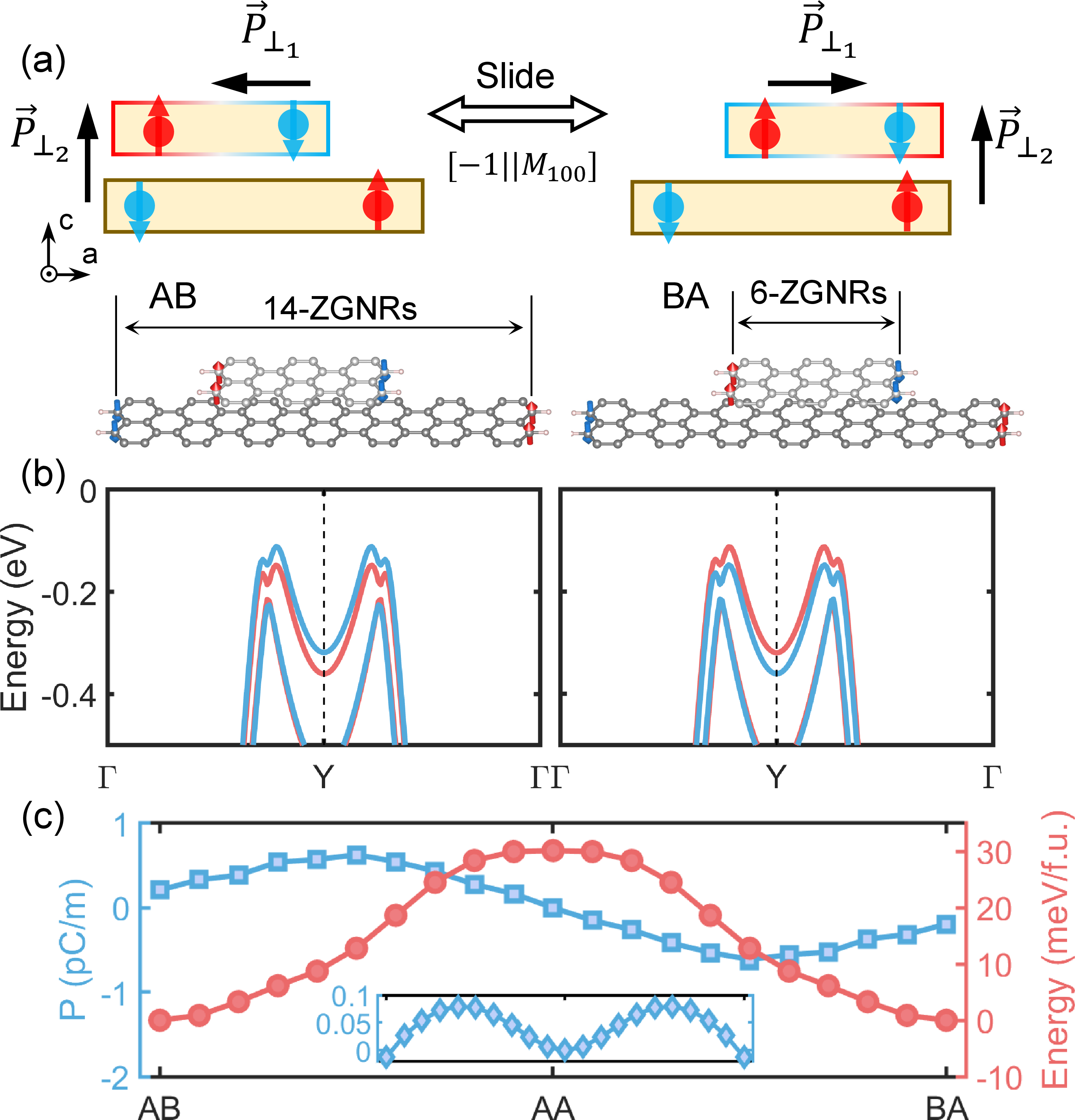
Figure 2: Ferroelectric switching in quasi-1D (6,14)-ZGNRs via interlayer sliding—the band and polarization response confirm theoretical predictions.
2D Case: Bilayer chNb3I8: Out-of-Plane Ferroelectric Control
Bilayer chNb3I8 forms a van der Waals stacking with pronounced breathing kagome lattice, supporting strong magnetoelectric coupling. Here, switching operates via interlayer sliding parallel to specific crystallographic directions, breaking [−1∣∣M^001] symmetry present in the AA stacking and generating a pair of degenerate multiferroic states. The magnitude of NRSS reaches ∣M2⟩0 meV at the valence band maximum, and the out-of-plane polarization is ∣M2⟩1 pC/m. The calculated switching barrier is ∣M2⟩2 meV per formula unit, suitable for device applications that require stability and nonvolatility.
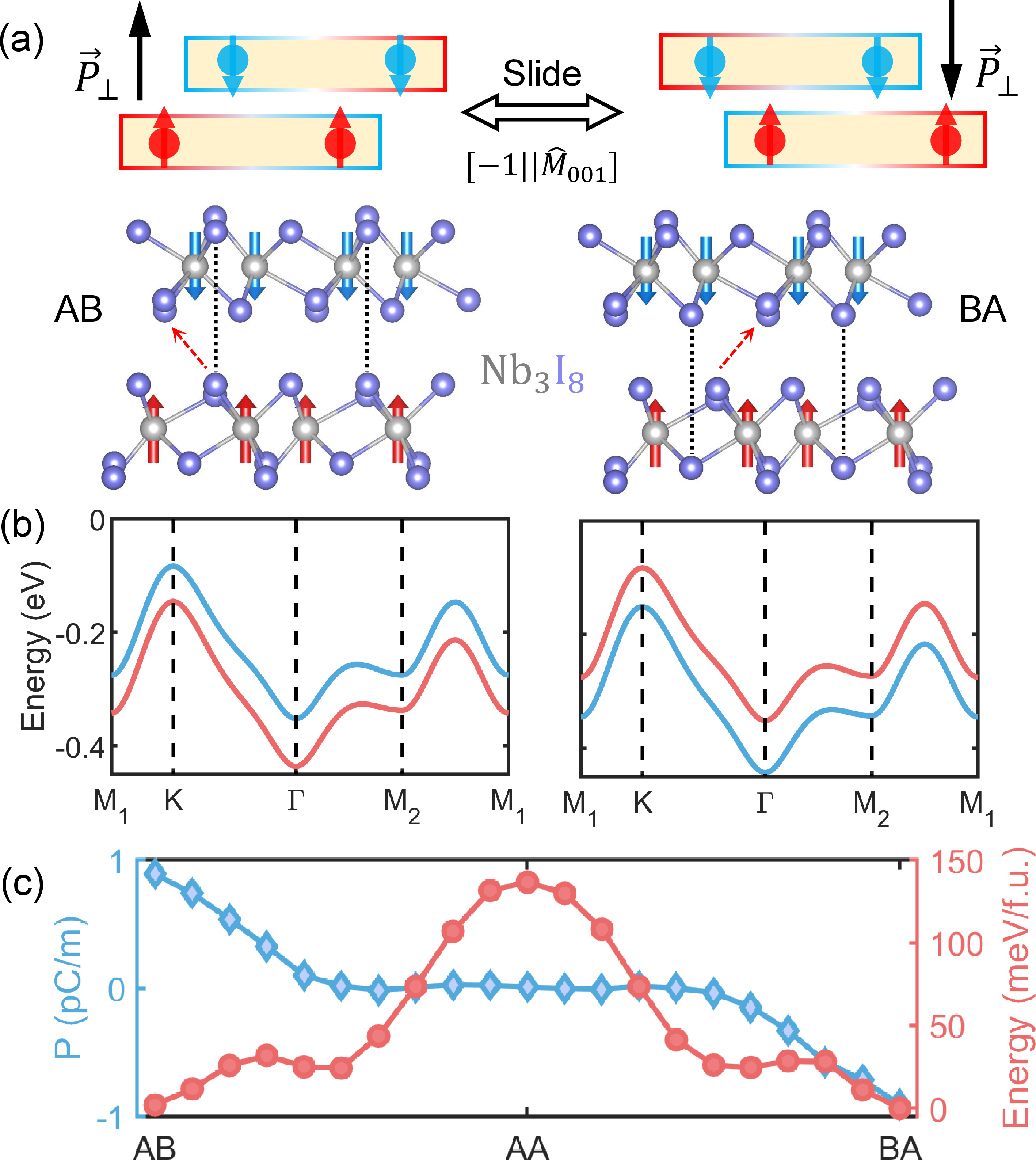
Figure 3: Multiferroic switching in bilayer ∣M2⟩3, demonstrating the coupling of out-of-plane polarization and spin splitting under sliding mediated by symmetry operations.
3D Case: Magnetoelectric Switching in ∣M2⟩4 Supercell Altermagnet
∣M2⟩5 exhibits a supercell altermagnetic order with considerable intrinsic symmetry and type-II multiferroicity. The symmetry analysis reveals a purely magnetic switching pathway, achieved by reversing spins in select Mn-Se layers, leading to a remarkably low energy barrier of ∣M2⟩6 meV per formula unit. This is accompanied by a maximum band splitting of ∣M2⟩7 meV and polarization reversal of ∣M2⟩8, illustrating the efficacy of magnetoelectric coupling for NRSS switching in three-dimensional bulk systems without requiring large ionic displacements.
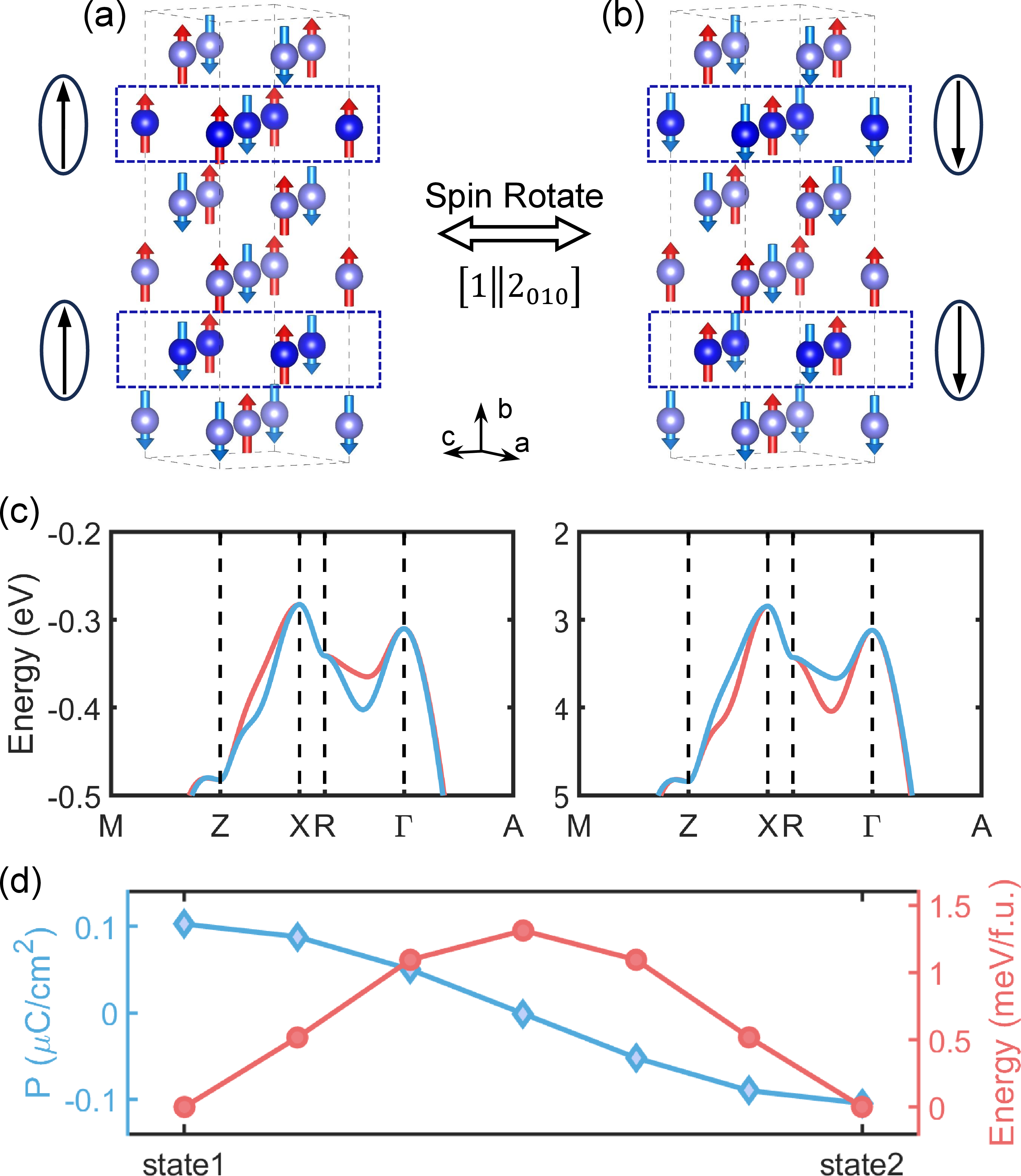
Figure 4: Evolution of energy and polarization during low-barrier, purely magnetic switching in 3D ∣M2⟩9, demonstrating the theory's applicability to supercell altermagnets.
Implications and Prospects
The presented group-theoretical framework consolidates and generalizes all previously identified mechanisms for electrically assisted NRSS switching, covering arbitrary dimensions and polarization directions. This unification not only predicts NRSS switchable pathways in known materials but extends the material and mechanism search beyond low-dimensional, high-symmetry compounds to bulk and low-symmetry systems including type-II and magnetically driven ferroelectrics.
Practically, this theory guides the discovery of multifunctional materials for low-power, nonvolatile memory and logic devices leveraging both ferroelectric and spintronic functionalities. Theoretically, it provides criteria for identifying new symmetry-protected spin textures and designing switchable multiferroics tailored for application-driven requirements such as switching thresholds, anisotropy, and robustness against disorder.
The results suggest that NRSS manipulation in collinear AFMs—whether by sliding ferroelectricity, electric-field-driven ionic displacement, or symmetry-lowering perturbations—can be engineered systematically. Future research can expand this approach to noncollinear magnets, explore dynamic switching protocols, and further investigate the effects of finite temperature, quantum fluctuations, and strong correlations on magnetoelectric switching phenomena.
Conclusion
This work establishes a rigorous, symmetry-based design strategy for ferroelectric control of spin splitting in collinear antiferromagnets, integrating group-theoretical analysis with first-principles materials modeling. The framework enables identification and validation of novel multiferroic switching pathways across a wide range of dimensionalities and material classes, expanding the landscape of candidate materials and mechanisms for low-power spintronic device engineering. By predicting and elucidating both polarization and NRSS reversal mechanisms, this theory forms a robust platform for the realization of next-generation multifunctional spintronics.