- The paper derives exact finite-size formulas for SRE at index 1/2 in periodic and subsystem geometries.
- It demonstrates a universal volume law with a distinctive crossover function and a cusp in the SRE density at the critical point.
- The work connects microscopic lattice solvability with field-theoretic predictions, offering benchmarks for quantum many-body diagnostics.
Universal Crossovers in Stabilizer Rényi Entropy of Quantum Spin Chains
Introduction
Stabilizer Rényi entropy (SRE) has become a key analytic for quantifying nonstabilizerness—a resource for quantum computational advantage—in many-body quantum spin systems. Unlike entanglement entropy, which is conformally controlled at criticality and whose scaling is well understood both in massive and critical phases, SRE’s microscopic scaling properties away from criticality, particularly its universal features in both full-system and open-subsystem geometries, have not been extensively characterized, especially with exact analytical results. The paper "Universal Crossovers of Stabilizer Entropy Beyond Criticality" (2606.13810) provides a comprehensive and exact finite-size scaling analysis of SRE at index α=1/2 for a wide class of one-dimensional spin models mapped to free-fermion systems, bridging critical, massive, crossover, and boundary regimes. Importantly, it connects microscopic lattice solvability with emergent quantum field theoretic descriptions of nonstabilizerness.
Analytical Results for SRE in Free-Fermion Spin Chains
The key technical advance is the derivation of exact finite-size formulas for SRE at α=1/2 in both periodic and open-subsystem (interval) geometries for quadratic spin chains, including the anisotropic XY chain and its extensions. For periodic chains, the full SRE for system size L is reduced to a product over Bogoliubov modes, whereas for finite intervals, the problem reduces to a Pfaffian over a block-Toeplitz matrix—substantially simplifying what is generically a #P-hard sum over absolute values of all minors of the correlation matrix.
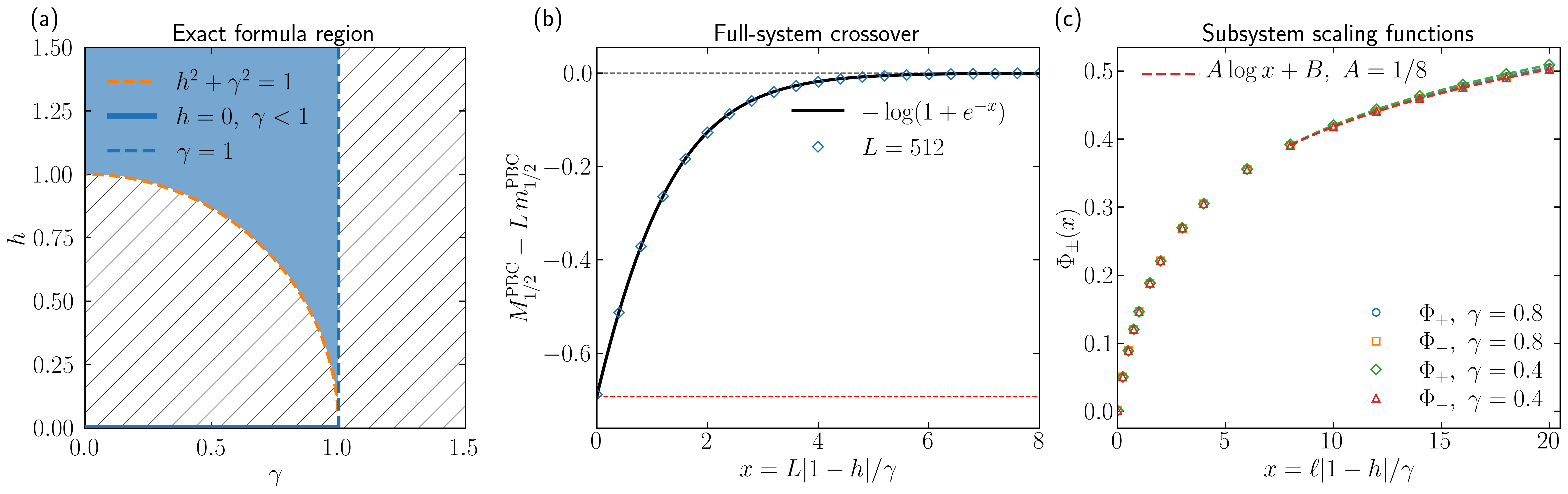
Figure 1: Universal scaling structures of the stabilizer Rényi entropy—exact-formula parameter regimes, finite-system crossover collapse, and subsystem scaling functions in the (γ,h) plane.
These results admit direct calculation of not just the critical SRE scaling, but also massive, crossover, and endpoint scaling with explicit forms for both bulk and boundary contributions. The analysis covers both nearest-neighbor and finite-range string Hamiltonians, together with cluster-Ising models under Kramers–Wannier duality, all realized as special reductions or dualities of the core XY model.
Periodic System: Bulk Volume Law and Universal Crossover
Away from criticality, the SRE in a periodic system exhibits a strict volume law M1/2∼Lm1/2PBC(h,γ) with exponentially small corrections in the ratio x=L∣1−h∣/γ, which serves as the universal finite-size crossover variable. Near the critical point h=1, the SRE exhibits a universal subleading crossover function,
−log(1+e−x)
interpolating between the critical and massive limits. At criticality, the subleading constant is −log2 for α=1/20, with no system-size logarithmic corrections—a distinctive contrast with the subsystem geometry.
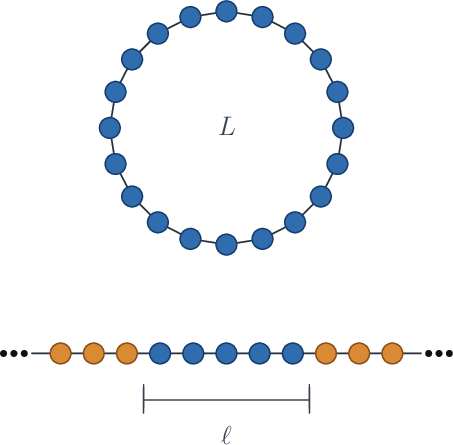
Figure 2: Lattice configurations considered: (a) periodic ring and (b) infinite chain interval subsystem.
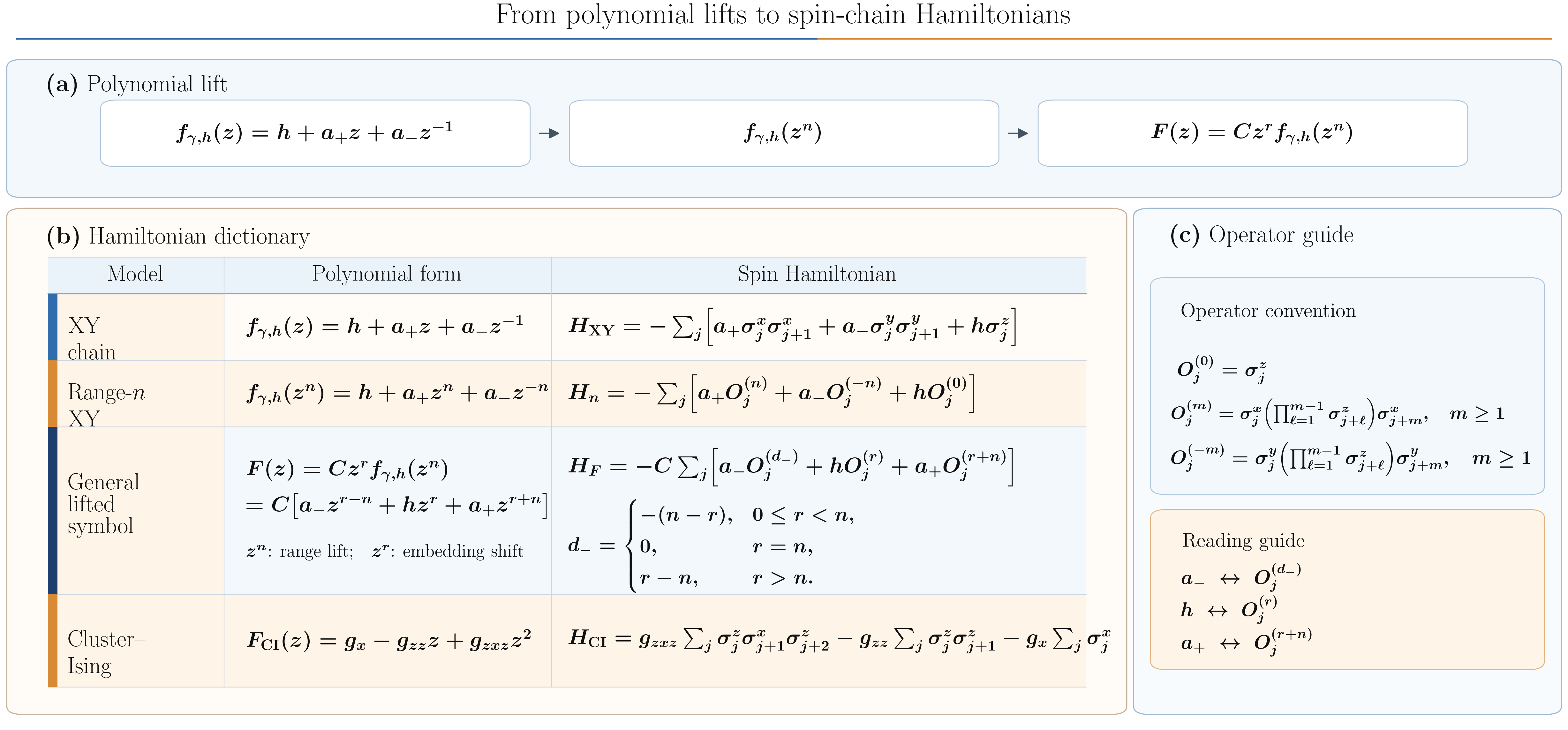
Figure 3: Mapping between Laurent-polynomial symbols and spin-chain Hamiltonians—linking microscopic solvable models used in SRE analysis.
A further robust nonanalytic signature is that the derivative of the SRE density α=1/21 with respect to the field α=1/22 develops a discontinuous jump (a "cusp") at the critical point, quantifying the underlying phase transition directly in the SRE itself. This analytic signature persists in the thermodynamic limit and matches numerical evidence for SRE singularities at critical points (Ding et al., 21 Jan 2025).
For the XX endpoint α=1/23, the crossover scaling is not smooth. Instead, a double-scaling limit with α=1/24, α=1/25 must be taken, controlled by α=1/26—consistent with the quadratic dispersion at the XX saturation point.
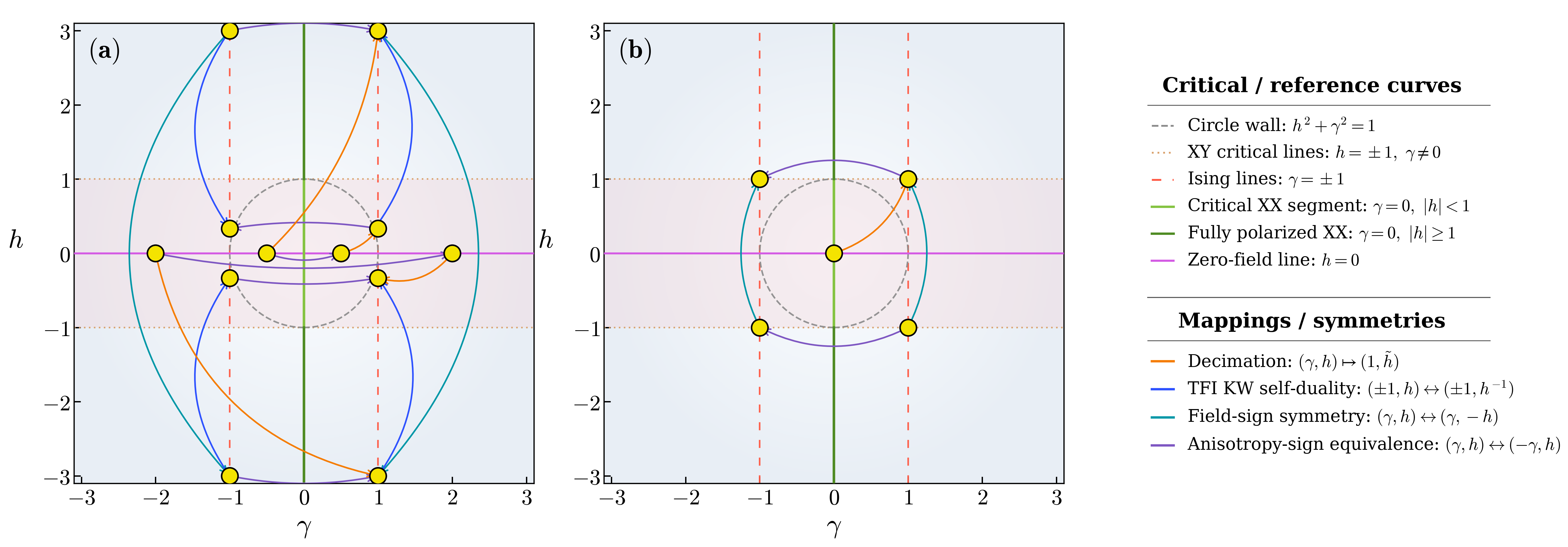
Figure 4: Parameter space of the anisotropic XY chain, showing correspondence and mapping of critical/crossover regimes under decimation and dualities.
In addition, all these exact results are inherited by lifted, folded, or cluster-Ising-type models by explicit decimation or duality at the matrix level, often yielding additive SRE across block decompositions or under duality transformations—expanding the universality far beyond the conventional nearest-neighbor XY system.
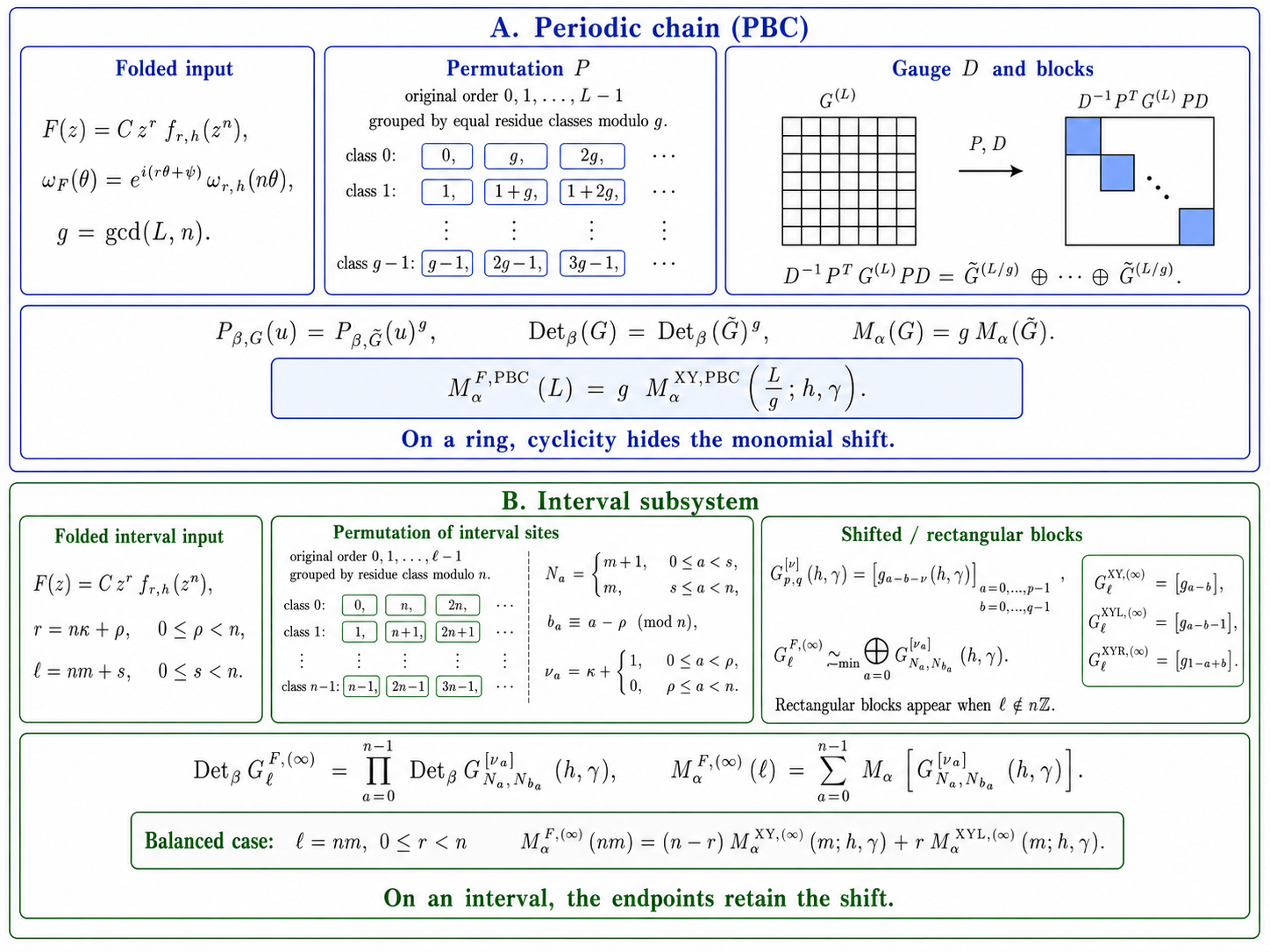
Figure 5: Summary of the exact decimation structure and SRE correspondences, relating folded/factorized models via block decompositions or duality.
Subsystem Geometry: Boundary-Driven Scaling and Crossover
In the infinite-chain interval (subsystem) geometry, SRE displays an even richer scaling structure. The leading term is again a bulk volume law, but the finite-size and finite-interval corrections (including logarithms and boundary constants) are governed entirely by the interval endpoints and cannot be deduced from periodic-chain results by naive substitution α=1/27.
At criticality, the α=1/28-normalized SRE numerator features a universal Fisher-Hartwig-type logarithmic anomaly α=1/29—the hallmark of boundary criticality for nonstabilizerness, in direct analogy with CFT predictions. The coefficient matches the CFT/Fisher–Hartwig value for free fermion systems, and field-theoretic predictions for SRE (Hoshino et al., 17 Mar 2025), but is here derived exactly at the lattice level.
As the subsystem is tuned away from criticality, the critical logarithm does not disappear but is reorganized as a boundary sensitive, correlation-length-dependent contribution,
L0
exhibiting universality in the interpolation from the critical to massive regimes.
The universal scaling variable is L1, and the crossover of the boundary term is captured by a function L2 with asymptotic form L3, fully capturing the logarithmic corrections in the finite-interval entropies. These scaling functions are insensitive to the side of the transition or anisotropy to leading order, with these features entering only in subleading finite-size corrections, confirming universality beyond criticality.
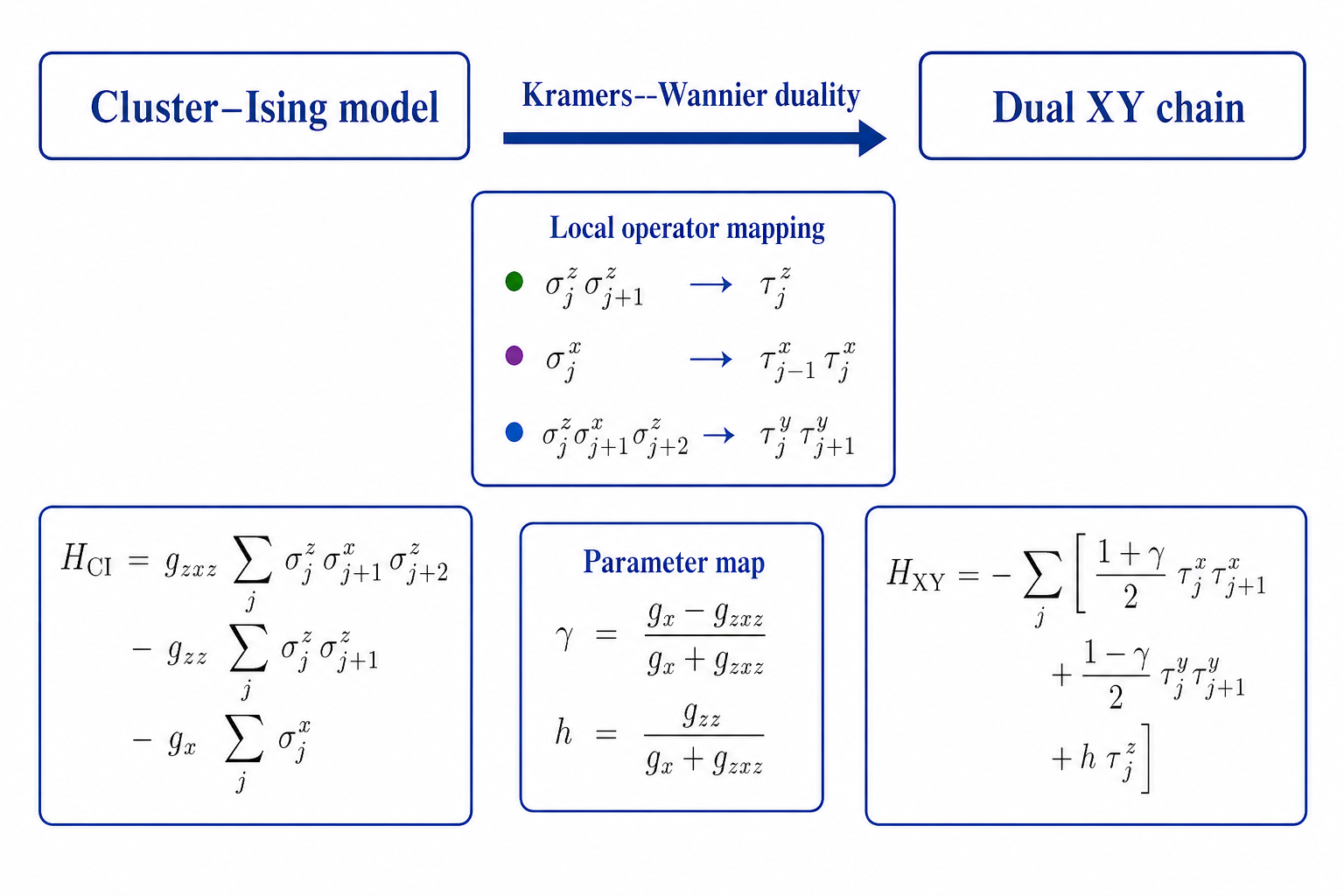
Figure 6: Duality map connections—Kramers–Wannier duality between cluster–Ising and dual XY chains organizes the SRE correspondence.
This precise scaling analysis demonstrates that the SRE in subsystems is strictly more boundary-sensitive than entanglement entropy: different interval embeddings, generated by shifts and dualities, possess the same bulk density and critical data, but differ in finite constants and scaling functions reflecting boundary embeddings—highlighting a new type of universality class for subsystem SRE.
Decimation, Duality, and Cross-Model Correspondence
The analytic block additivity and duality relations play a foundational role in transferring SRE results among a wide class of free-fermion spin chains. Models with folded/factorized symbols or cluster–Ising cluster interactions decimate or dualize into basic XY blocks, with SRE additivity or invariance following at the level of absolute minor generating functions or Pauli algebra duality. This is encoded rigorously at the matrix level.
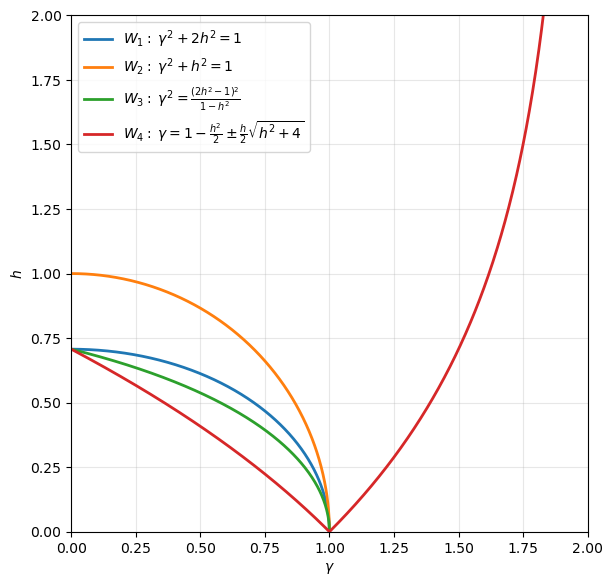
Figure 7: Chamber and minor-wall structure in L4 for finite system size: finite-size sign walls and the stability region for exact SRE product formulas.
The above scaling predictions and chamber boundaries have been validated by extensive brute-force and Pfaffian calculations for moderate system sizes, confirming the boundaries of sign chambers, the correctness of product/Pfaffian formulas, and the location of finite-size walls in parameter space—matching analytical and asymptotic predictions.
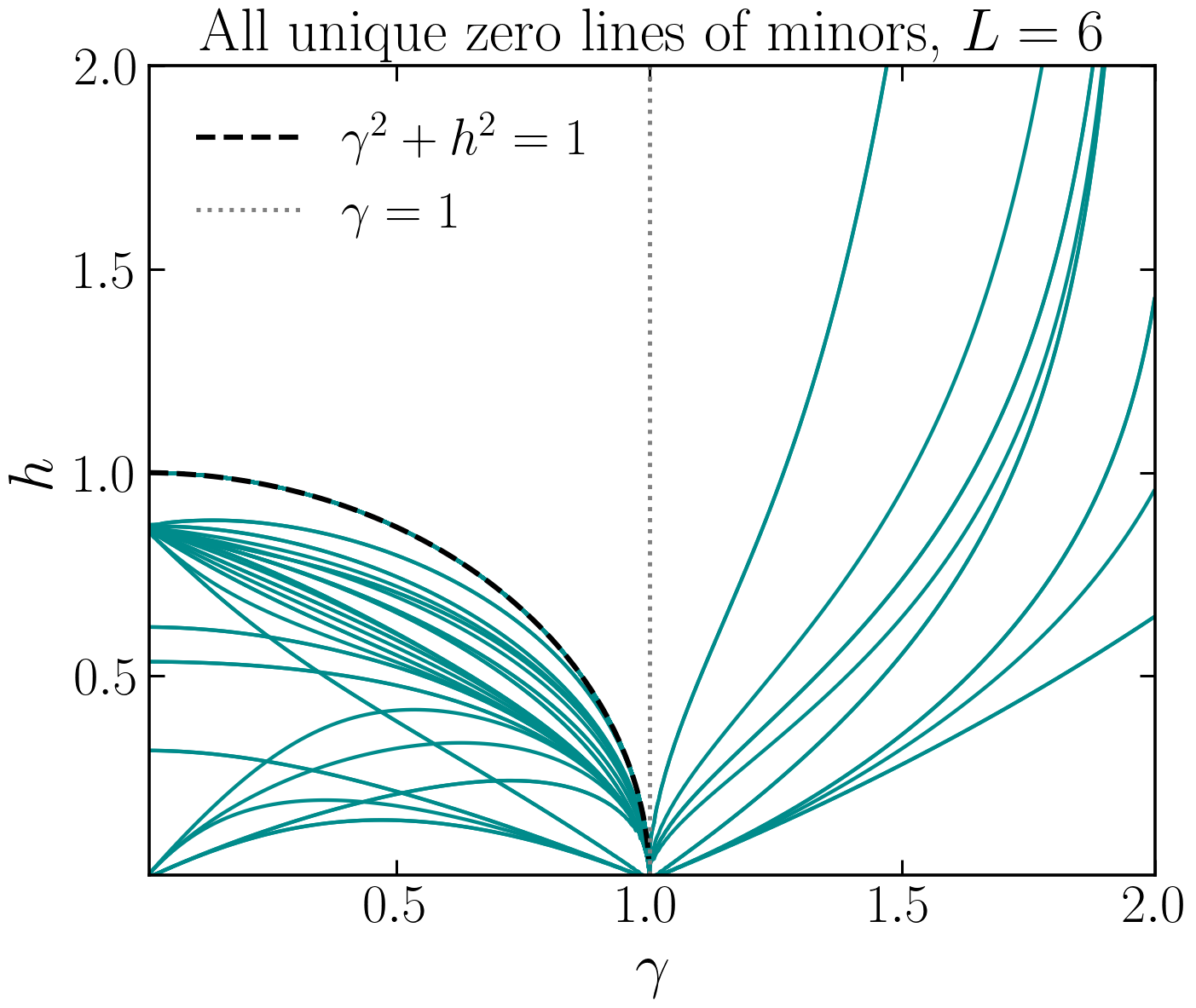
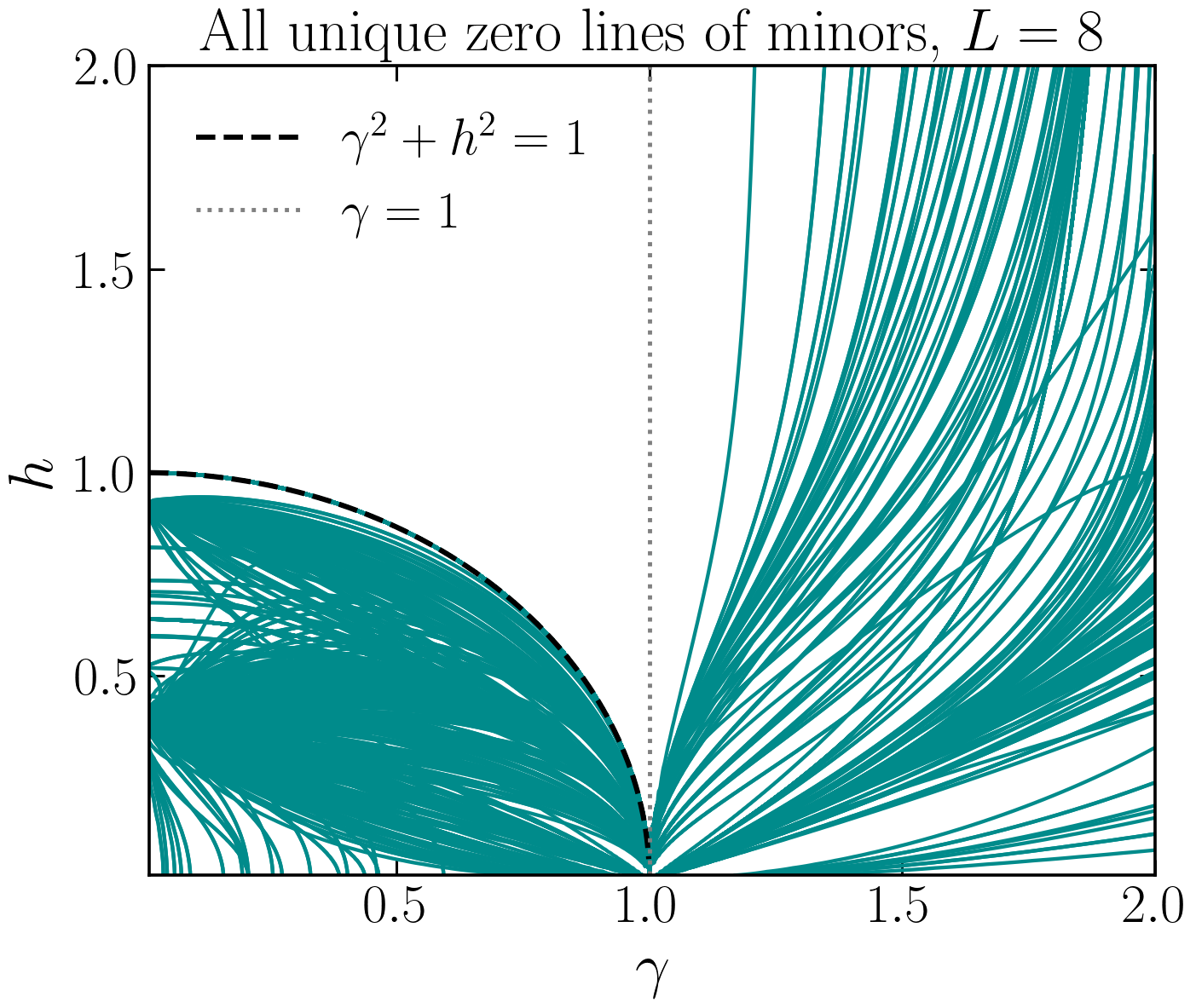
Figure 8: Minor-zero loci of L5 for L6, with orange/blue curves indicating minor sign walls and the principal product chamber.
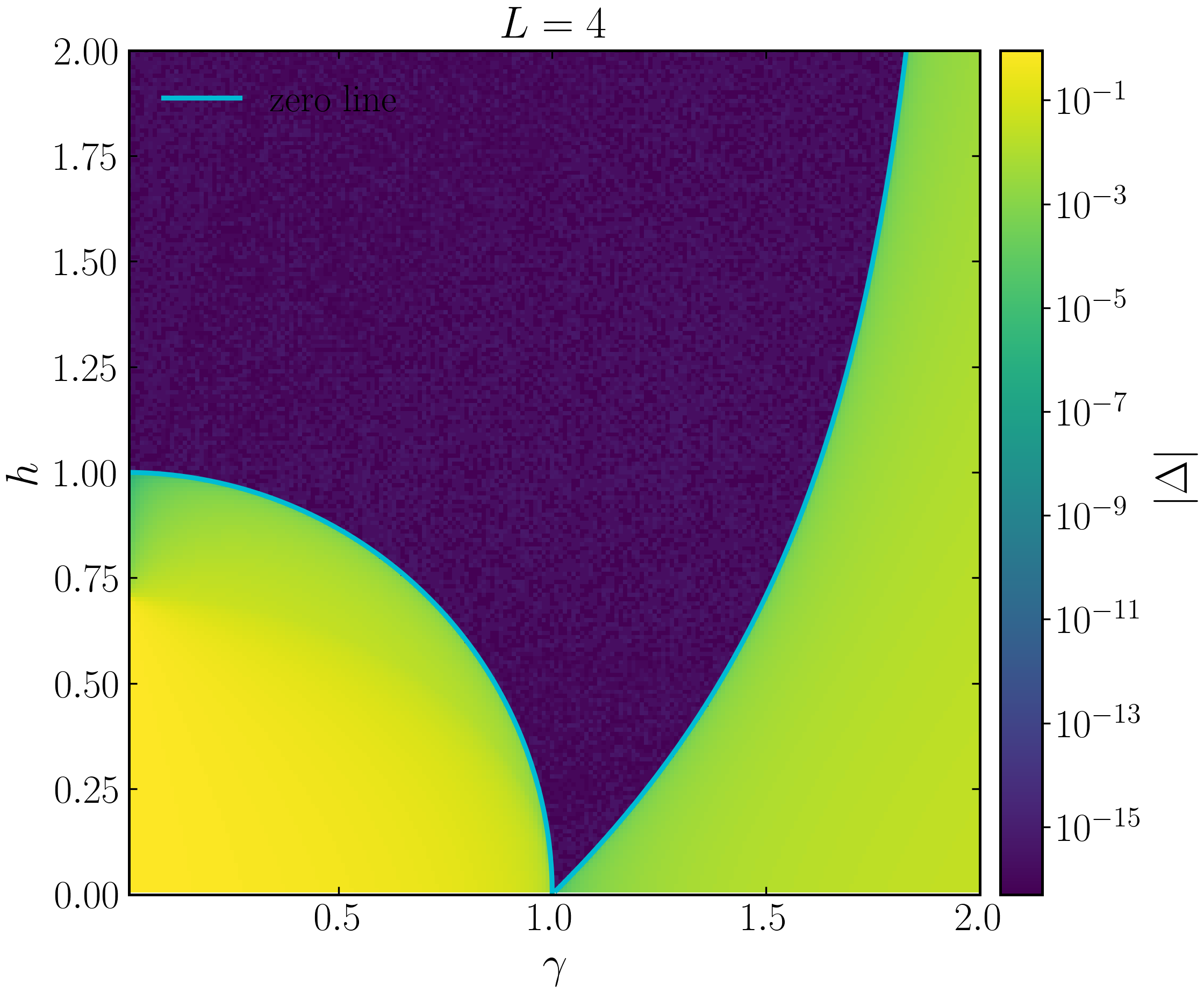
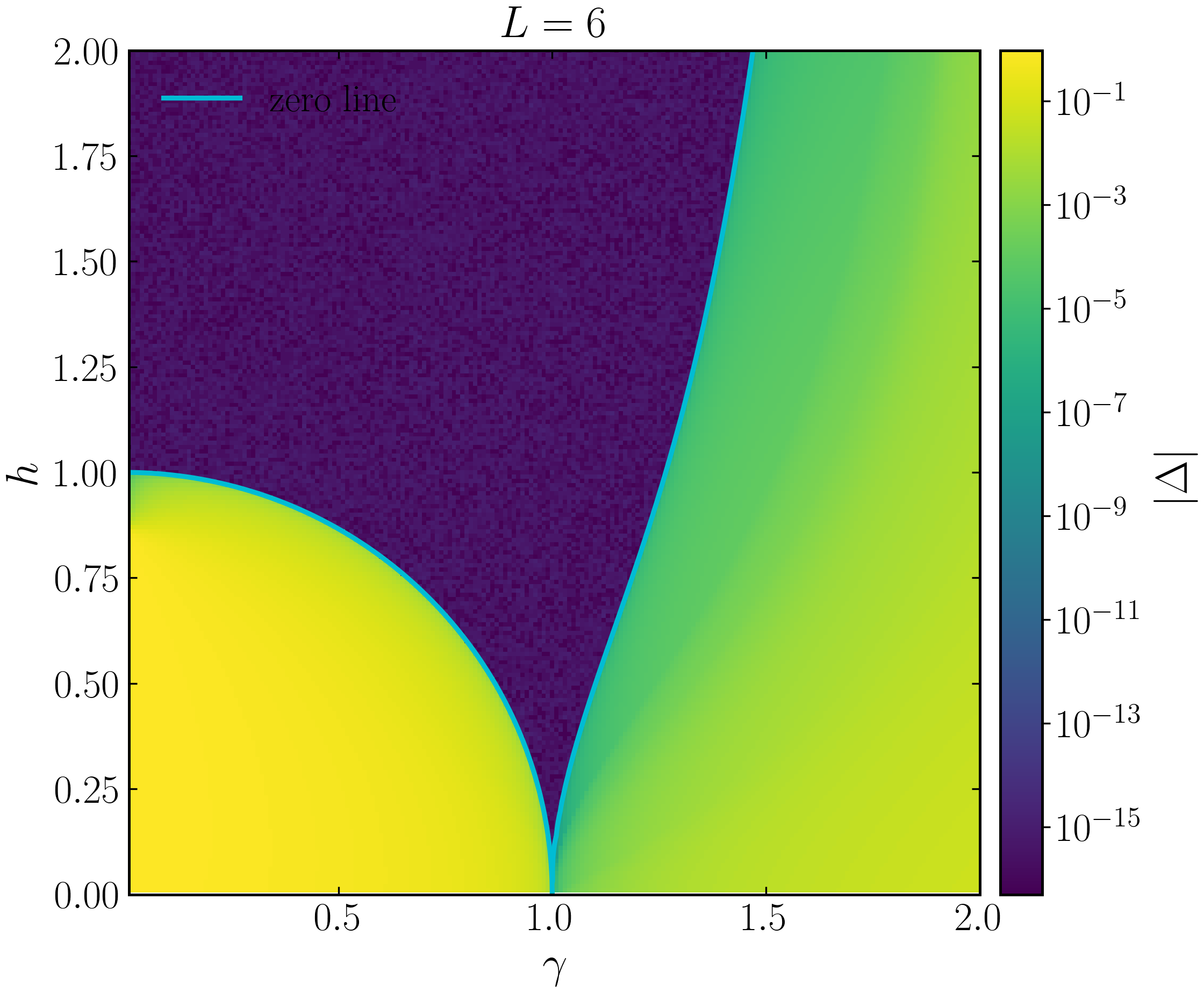
Figure 9: Numerical comparison—direct brute-force versus product formula for SRE; difference is at numerical precision inside chamber.
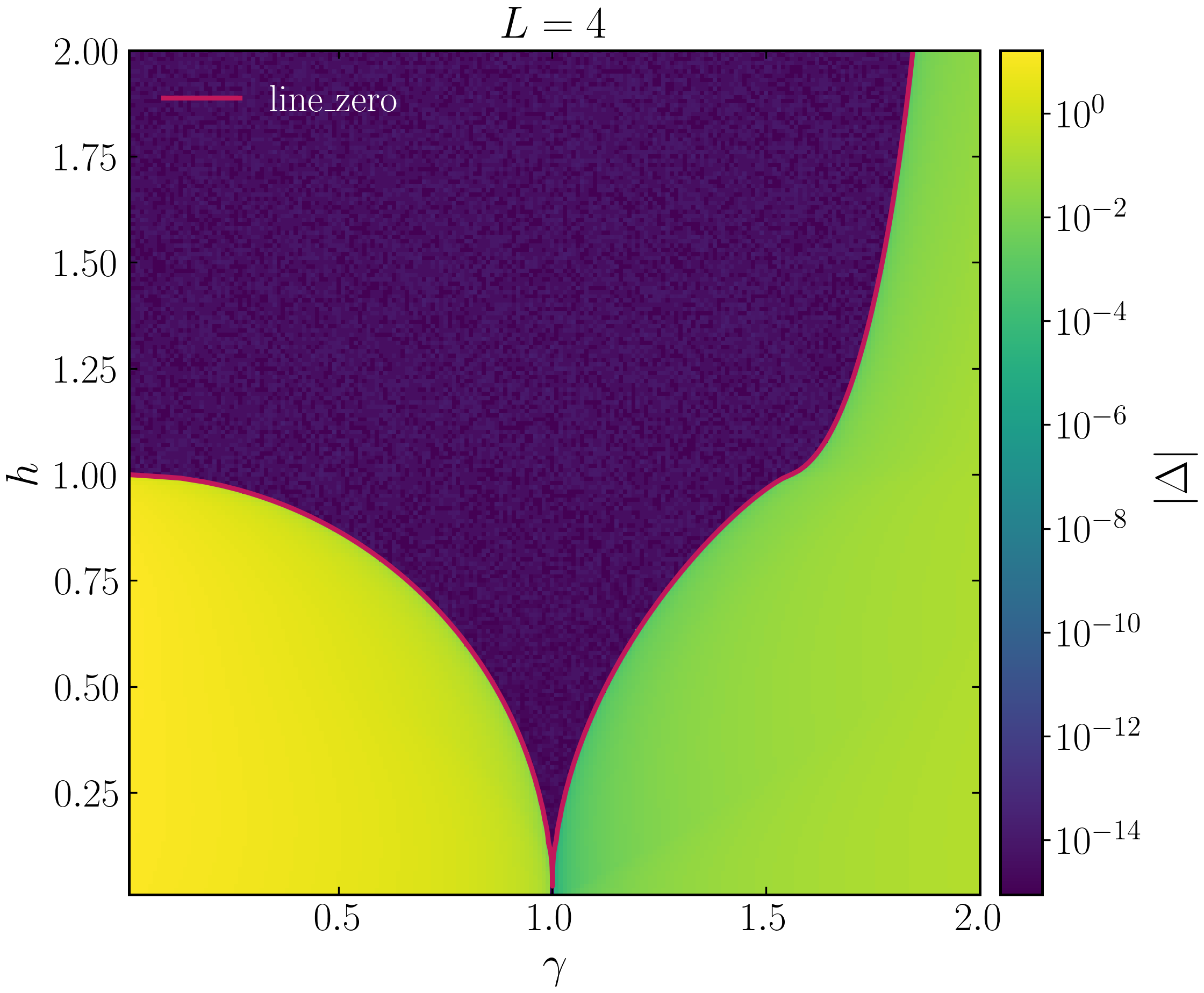
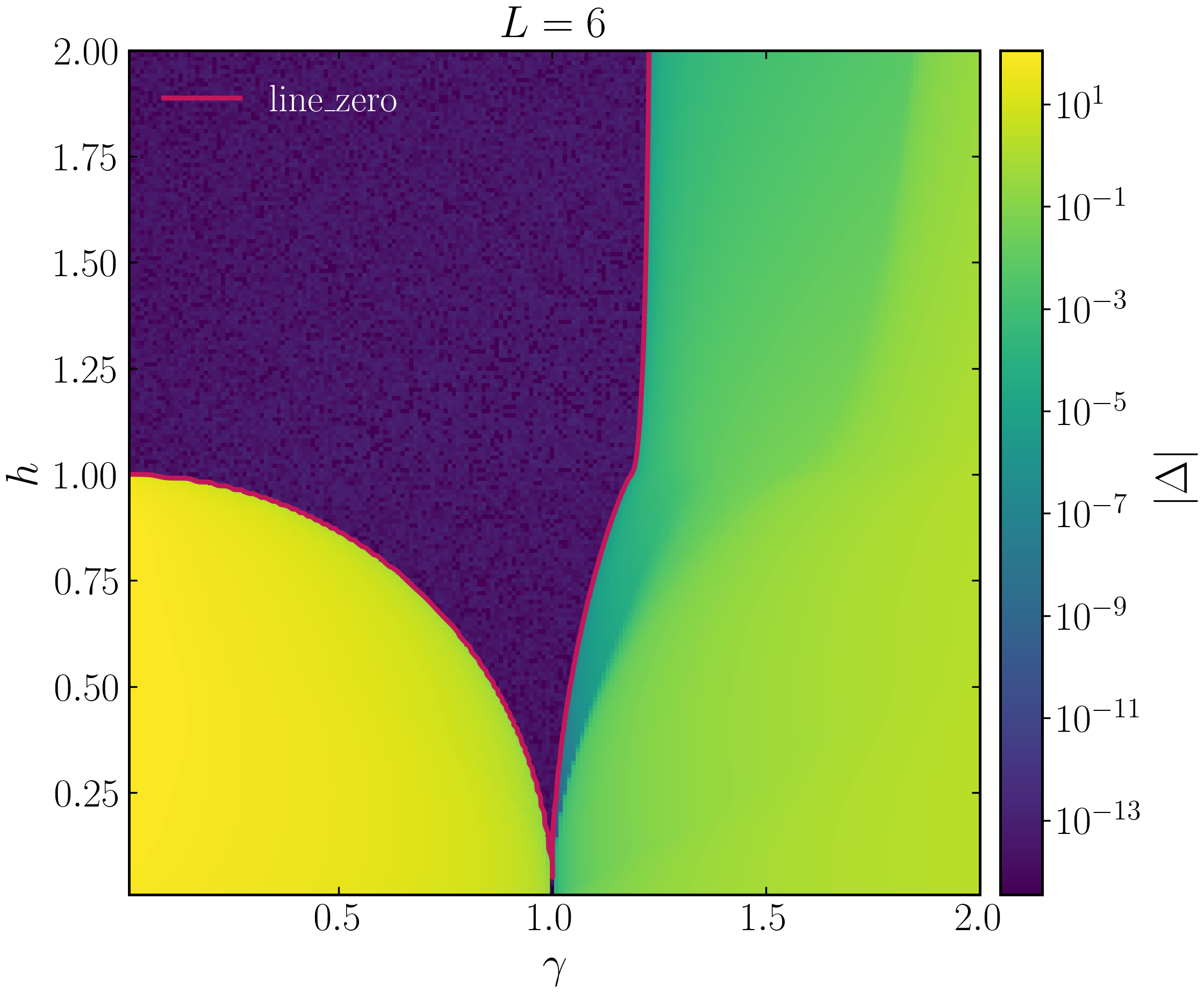
Figure 10: Absolute-minor sum versus Pfaffian representation for the interval SRE numerator, confirming massive regime validity.
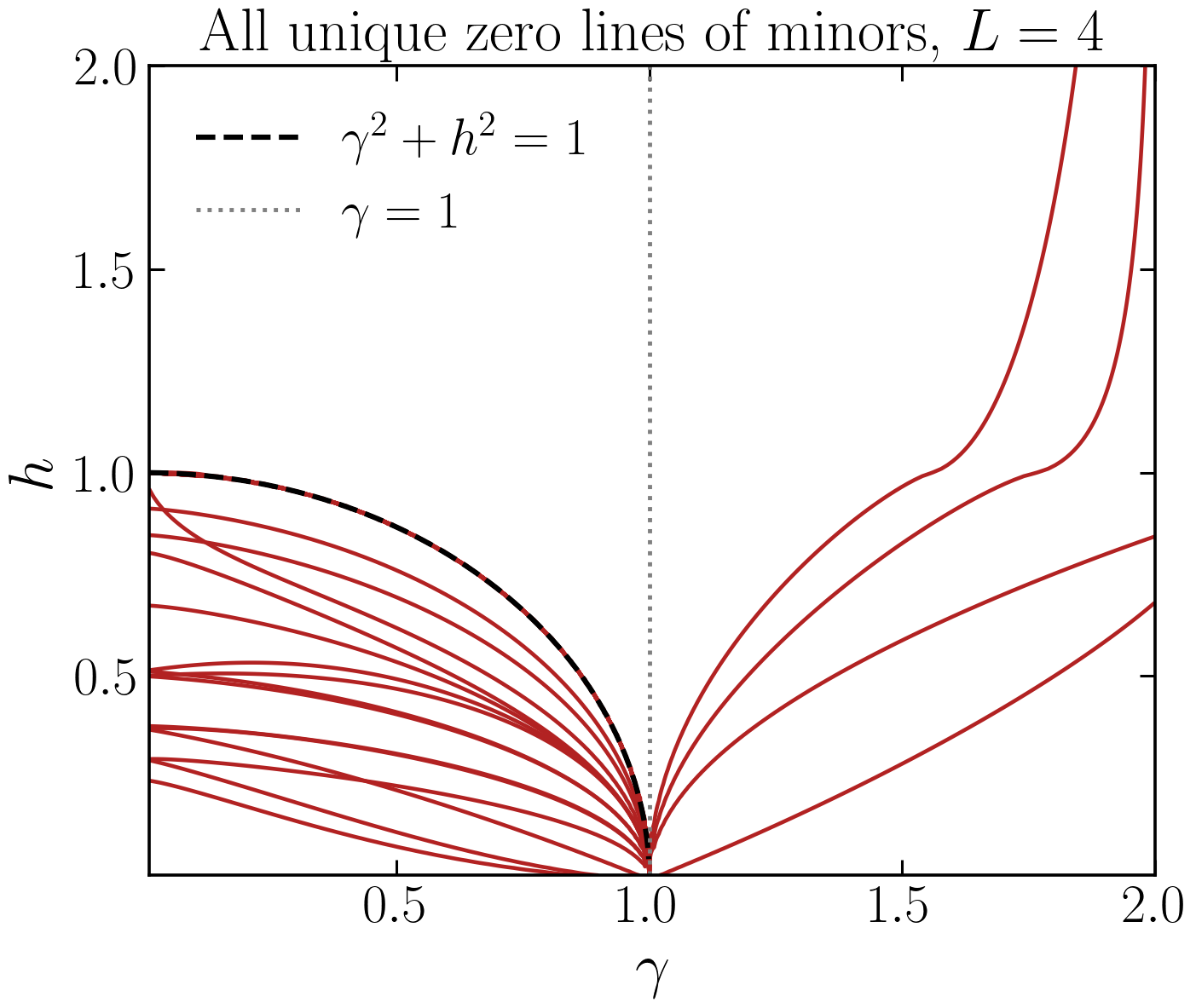
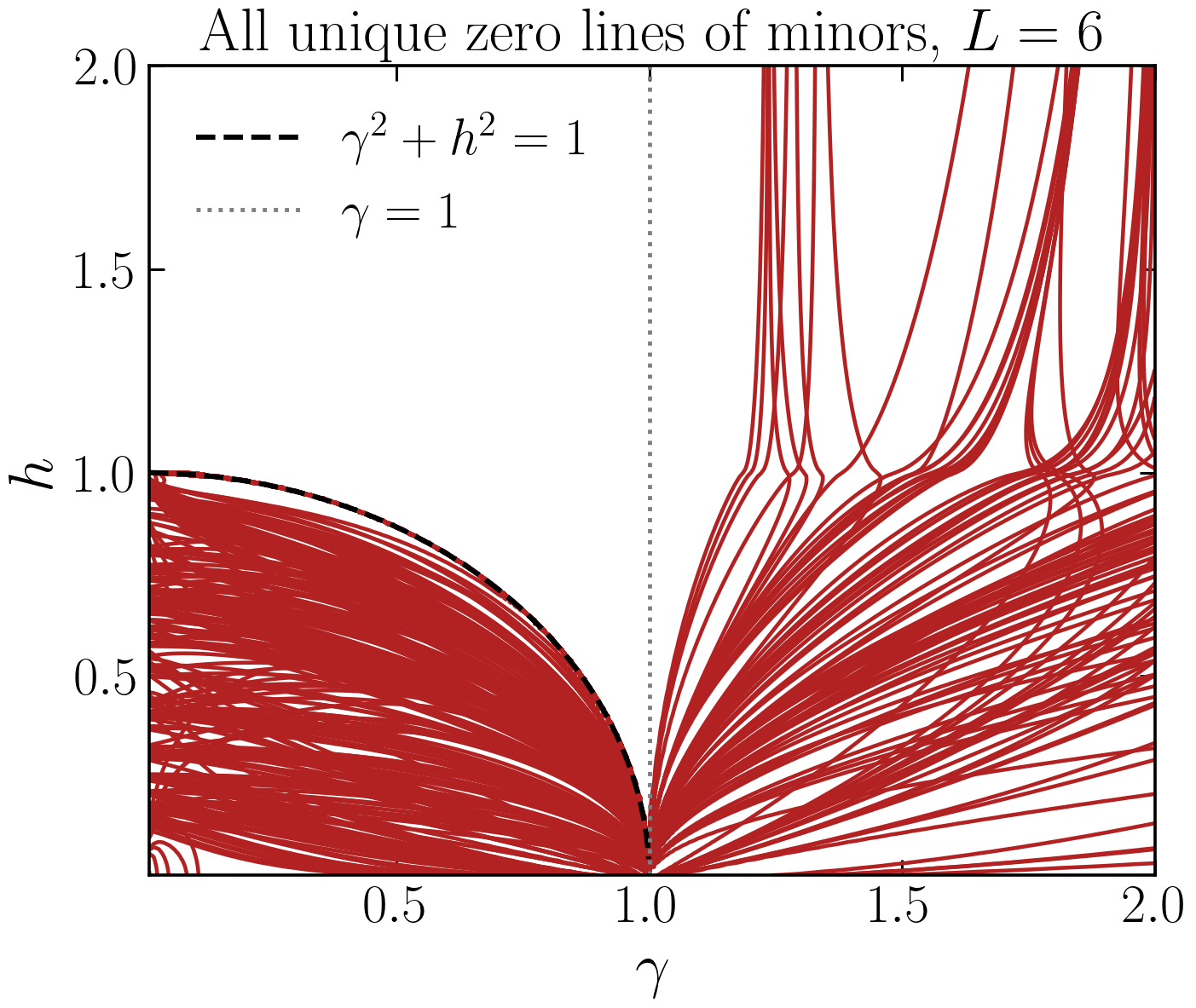
Figure 11: Minor-zero loci for ordinary XY subsystem Toeplitz truncations—confirm structure of sign-stable regimes.
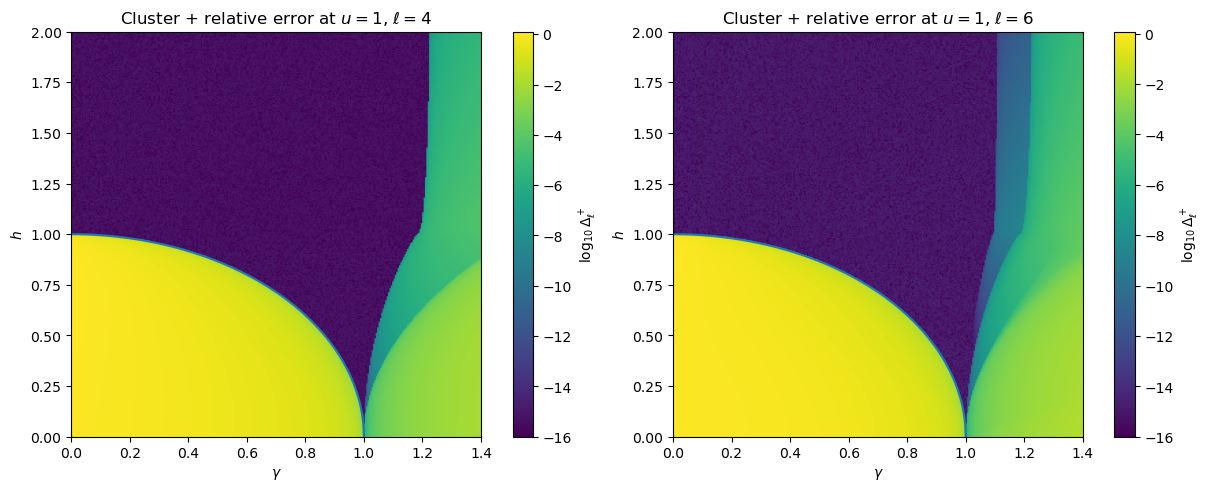
Figure 12: Validation of the L7 Pfaffian formula, confirming uniformity inside the massive chamber.
Implications and Future Directions
These results establish SRE as an exact and universal scaling observable in a broad landscape of solvable spin chains, showing that its critical, massive, crossover, and boundary-sensitive regimes can be accessed analytically and connected to field-theoretic expectations. This provides benchmarks for field theory, matrix product state (MPS) numerics, and quantum Monte Carlo studies, especially for distinguishing volume-law, universal subleading, and boundary/defect-driven terms (Hoshino et al., 17 Mar 2025, Hallam et al., 16 Feb 2026).
Moving forward, extending these exact lattice results to other Rényi indices (L8), higher dimensions, or to interacting (non-free) systems would test the robustness of universality, address the conjectured boundary-sector transitions at L9, and further clarify the role of SRE as a many-body phase and boundary diagnostic, as well as a quantifier of computational resources.
Conclusion
This work provides a complete analytical description of SRE scaling beyond criticality for a wide class of one-dimensional spin chains at index #P0, with exact solutions for periodic and subsystem geometries. The salient findings are:
- Volume law with universal finite-part crossover in periodic geometry;
- Cusp singularity in the SRE bulk density at criticality;
- Critical logarithm and its reorganization as a finite boundary term in subsystems;
- Universal scaling/crossover functions interpolating between massive and critical regimes;
- Explicit additivity and duality correspondences enabling extension to a wide class of models.
These results supply an exact lattice foundation for the quantum field theoretic and resource-theoretic characterization of stabilizer entropy, demonstrating SRE as a sharp and computable observable for diagnosing nonstabilizerness and phase structure in quantum many-body systems (2606.13810).

