- The paper establishes a rigorous Mars relativistic time framework that transforms barycentric time scales to a conventional Mars surface time (T_M) for sub-picosecond clock synchronization.
- It details numerical simulations and analytic corrections showing that low-degree models are inadequate for achieving 0.1 ps precision in low Mars orbits.
- Practical implications include improved Mars GNSS design, precise time transfer, and enhanced support for scientific and navigational operations on Mars.
High-Precision Relativistic Time Scales for Mars Surface and Orbital Clocks
Overview and Context
The paper "High-Precision Relativistic Time Scales for Mars Surface and Orbital Clocks" (2606.13726) constructs a rigorous Mars-centered relativistic framework for transforming and operationalizing coordinate times and proper times for clocks sited anywhere from the Mars surface to highly eccentric relay orbits. The approach extends International Astronomical Union (IAU) post-Newtonian conventions, as previously applied to Barycentric (BCRS/TCB), Geocentric (GCRS/TCG), and Lunar reference frames, to a new Areocentric/Mars-centered system (MCRS/TCA), defining transformations from the barycentric time scales to Mars-centric coordinate time and to a conventional Mars surface scale (TM). The framework is designed for immediate application to Mars clock networks, navigation, Mars-centered GNSS concepts, precise time transfer, and scientific clocks operating at 10−17 or better stabilities.
A Mars-centered celestial reference system (MCRS) is rigorously defined, with Areocentric Coordinate Time (TCA) as the time coordinate, directly analogous to TCG for Earth and TCL for the Moon. The BCRS–MCRS transformation is carefully specialized from the IAU standards, retaining all c−4 (post-Newtonian) terms necessary for the sub-ps timing regime. Event-dependent terms such as the vMa⋅rMa/c2 position correction are shown to be mandatory, affecting clock rates on the Mars surface (∼0.91μs) and especially in high-altitude orbits (5−6μs).
Mars' global time scale, TM, is defined as a conventional coordinate time on a reference areoid, ensuring analogy with Terrestrial Time (TT) for Earth. The distinction is made explicit: TM is not a solar/civil time, but a relativistic coordinate akin to TT. Surface realization corrections, including local topography, gravity anomalies, and especially Mars' considerable seasonal low-degree gravity changes (primarily CO2 deposition/sublimation cycles), are treated as explicit, non-definitional offsets.
Relativistic Proper Times for Mars Clocks
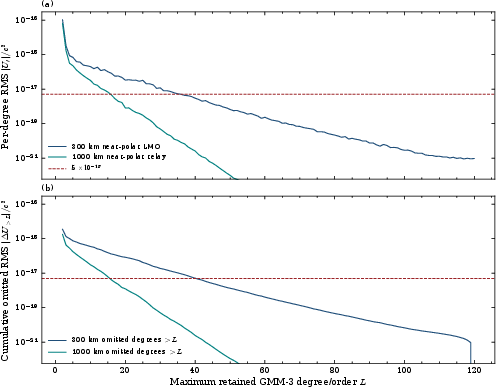
The proper time for any Mars-based or orbiting clock is expressed as a model retaining secular, periodic, and geometric components. The full gravitational potential uses the GMM-3 degree/order-120 static field, plus solar/Phobos/Deimos point-mass tidal potentials. The truncation policy retains any term with fractional frequency effect >5×10⁻¹⁸ or one-way timing amplitude 10−170, resulting in a detailed hierarchy of required corrections by orbit regime.
Key Quantitative Results
Regime Dependence and Model Retention Policy
The retention policy—a central aspect of the paper—makes the required clock correction hierarchy for various operational and mission regimes explicit.
- Low Mars Orbit (LMO): Degree/order 120 models are needed for sub-ps accuracy; degree 16 only marginally suffices for short arcs at 300 km, confirming that 10−177-only models are inadequate.
- Areostationary and High relay orbits: Solar and tesseral terms must be retained, perihelion scaling applied, and the interplay of periodic lines is nontrivial.
- Phobos/Deimos proximity: The moons’ self-potential dominates only in close flybys.
- Highly Elliptical Orbits (HEO): Direct quadrature is required; the periodic proper-time modulations reach hundreds of nanoseconds, with higher harmonics significant.
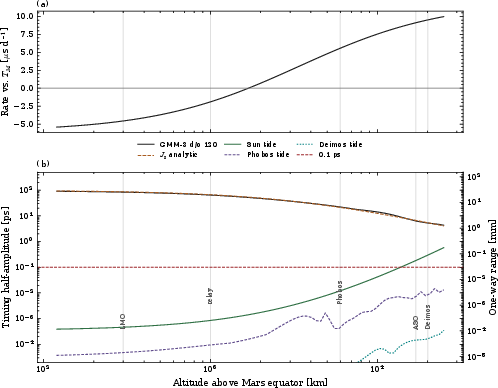
Figure 2: Circular Mars-orbit clock budget, showing secular rates and one-way timing amplitudes from GMM-3, analytic 10−178, and exact point-mass solar and lunar tides.
The paper includes explicit tables and analysis demonstrating the inadequacy of low-degree models in general and the precise truncation degree needed for each regime, as validated by direct differencing against the degree-120 reference.
Numerical Simulations, Diagnostics, and Validation
All analytic results are cross-validated by deterministic, noise-free simulations using the full GMM-3 field and exact point-mass tides. Residuals for various truncations are explicitly calculated and reported. For the 300 km LMO, degree 2 leaves 10−179 residual; only at degree 16 does the timing residual drop below c−40 for the given arc.
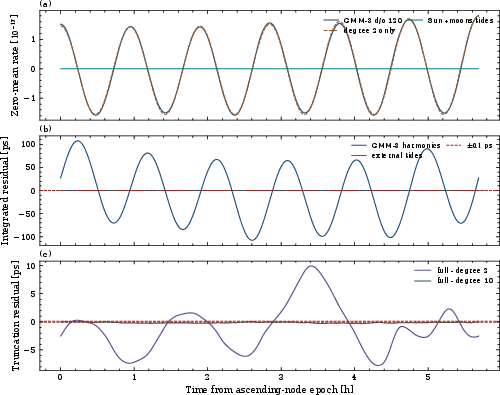
Figure 3: Time-domain simulation for a representative 300 km near-polar low Mars orbit, showing integrated timing signatures and convergence to the timing gate.
A similar exercise is carried out for highly elliptical orbits, demonstrating the necessity of direct time-domain integrations rather than low-eccentricity Fourier/harmonic approximations.
Panel validation is provided for quadrature convergence and for full analytic/numeric closure, confirming that no step in the workflow introduces residuals above the retained physical error budget.
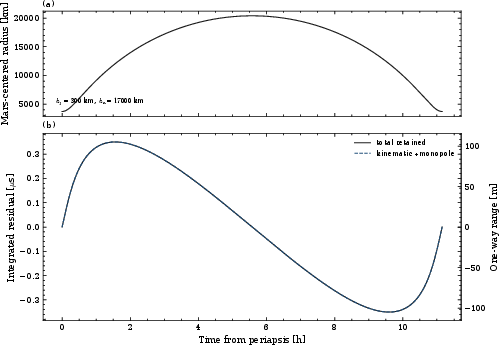
Figure 4: Dominant timing behavior for the representative c−41 highly elliptical relay orbit, with integrated residuals compared to analytic monopole models.
Practical Implementation and Workflow
A complete operational workflow is summarized, from the selection of ephemeris and kernel products, through the numerical construction of the Mars Time Ephemeris (forward and inverse c−42 transformation), the realization of c−43 with site, height, and seasonal corrections, to the onboard or mission analysis integration of proper time along actual trajectories.
- All time transfer/ranging is to be performed in the BCRS, with local Mars coordinate and propagation terms incorporated at conversion.
- Mars Sagnac (up to c−44 for surface–ASO) and Shapiro (c−45 locally, tens-hundreds of c−46s near the Sun) delays are explicitly treated.
- Media/hardware calibration, gravity realization uncertainties, and time-variable low-degree gravity constitute the dominant practical limitations, rather than the formal relativistic transformation.
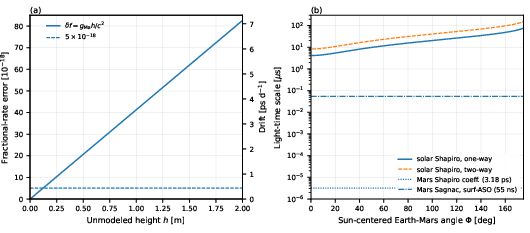
Figure 5: Operational realization scales, converting unmodeled Mars site-height or areoid errors into fractional frequency or accumulated drift, and quantifying Sagnac and Shapiro delays relevant for ranging and synchronization.
Implications and Limitations
The framework enables consistent time transfer, inter-spacecraft synchronization, and geodetic reference frame construction for present and future Mars PNT and communication architectures, including Mars GNSS concepts. It also underpins any scientific endeavor at Mars that requires SI-traceable time intervals, such as clock comparison experiments, tests of gravitational redshift, or ranging experiments.
The theoretical precision—down to c−47—is not the limiting factor in practical realization. Instead, the realization of Mars’ areoid, surface site coordinates, seasonal gravity changes, media calibration, and hardware delays dominate the error budget. For this reason, all model truncations are treated as part of a transparent, reproducible error budget, and the formalism is intended for reference-system and model-retention, not as an instantaneous operational time service.
A consolidated model retention table is provided, detailing which terms are mandatory, which are regime-dependent, and which are safely sub-threshold, for each orbit class and observable.
Future Prospects
The methodology and technical tools here establish the foundation for a Mars Time Ephemeris analogous to TT or TDB for Earth. The analysis anticipates, and is directly applicable to, future Mars networked time-keeping, Mars GNSS system design, clock transport missions, and ultra-stable surface/relay clock deployments. The explicit handling of time-variable low-degree harmonics, and the analytical-numerical workflow for time ephemeris construction, can inform both system design and precision geodetic science programs on Mars and cislunar/extraterrestrial contexts more generally.
Further development of the Mars Time Ephemeris will require real-world ephemeris and gravity model updates, closed-loop spacecraft/lander tracking, and empirical bounding or modeling of seasonal gravity terms at the c−48 to c−49 level.
Conclusion
This work supplies a reproducible, reference Mars-centered relativistic time scale framework capable of supporting sub-picosecond time synchronization and geodetic realization. It will serve as a critical technical foundation for Mars navigation, timing, and scientific operations, with the formal hierarchy and numerical techniques enabling transparent extension to future improvements in clocks, navigation, and orbit determination.