- The paper introduces a rigorous framework for relativistic time scales that unifies the BCRS and GCRS-like systems for all major solar system bodies.
- It details transformation equations with picosecond-level accuracy to compute coordinate and proper times essential for astrometry and spacecraft navigation.
- The study argues against additional scaling of local coordinate times to prevent inconsistencies in ephemerides and maintain robust operational timing.
Relativistic Time Scales and Reference Systems in the Solar System
Theoretical Framework for Relativistic Time Scales
The paper rigorously discusses the mathematical and operational structure of relativistic time scales within the Solar System, as established primarily through the IAU 2000 framework. The Barycentric Celestial Reference System (BCRS) and Geocentric Celestial Reference System (GCRS) form the core reference systems, with the BCRS acting as the global reference frame for solar system dynamics and the GCRS serving as the local frame for phenomena in Earth's vicinity. The author emphasizes that, despite the IAU explicitly defining only two systems initially, the theoretical framework implicitly supports an analogous 'local' GCRS-like reference system for each solar system body—including non-Earth planets and large satellites. This results in a hierarchical reference system structure, mapping one global BCRS to N local reference frames for N massive bodies.
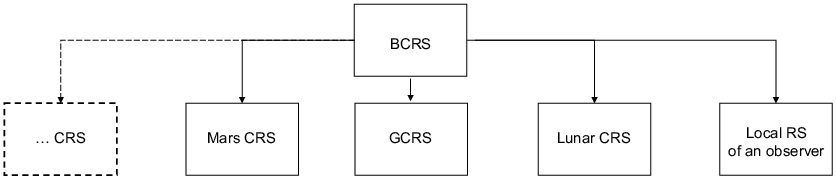
Figure 1: The hierarchy of the relativistic reference systems in the IAU 2000 framework, showing the BCRS at the top and successively nested GCRS-like systems for each major solar system body.
Each reference system is defined by a specific metric tensor gαβ, encoding both the gravitational field of the central body and the relativistic tidal potentials of all external bodies. Key properties of these local systems are the explicit effacement of the external gravitational field (only entering as a tidal potential—second order in local coordinates) and identical internal gravitational field structure as the isolated central body, per the Strong Equivalence Principle.
Operational Definitions and Mathematical Model
Two fundamental relativistic time scales are distinguished: coordinate time (as in BCRS or any GCRS-like system) and proper time of a physical observer. The coordinate time, t for BCRS and T for a GCRS-like reference frame (e.g., TCG for Earth, TCL for the Moon), is defined at all events in the covered domain and linked through explicit transformation equations, which account for the position, velocity, and gravitational environment of the central body: T=t−c21[A(t)+vXirXi]+c41[B(t)+Bi(t)rXi+Bij(t)rXirXj+C(t,x)]+O(c−5)
These equations enable high-fidelity, consistent modeling of time transformations with picosecond-level accuracy, essential for high-precision astrometry, spacecraft navigation, and timing systems. The proper time, in contrast, is the local time measured by an observer’s clock along its worldline, related to the coordinate time by the system’s metric tensor at the observer’s location and velocity. The author highlights the crucial operational distinction: coordinate times provide the foundation for relativistic synchronization protocols, not proper times, and underpin the construction of observational algorithms and ephemerides.
On the Scaling of Coordinate Times
A significant claim advanced is that the practice of scaling local coordinate times (beyond the transformations already implemented for TCB/TCG/TT) is unreasonable and operationally hazardous. The IAU has sanctioned a limited set of such scalings—e.g., TT and TDB—primarily to synchronize terrestrial clocks with coordinate times under constant offsets. However, the introduction of further local reference time scales (e.g., for the Moon, Mars, Mercury, or deep-space missions) would inexorably imply the use of additional sets of scaled parameters, impacting masses, coordinates, and physical constants, which would complicate data management and astronomy standards unnecessarily. Linear drifts among the various time scales cannot be eliminated by further rescalings, and their residuals must be accommodated in any relativistic timing scheme. The paper asserts that further systematic scaling would introduce inconsistency and jeopardize the operational robustness of high-precision timing and ephemeris systems.
The construction of numerical time ephemerides—accurate transformations between TCB and the various local coordinate times at the center of mass—is operationally critical for the Solar System. The author details a practical approach: solve for Δt(t) and ΔT(T), relating local and global coordinate times via ordinary differential equations driven by the function F(t), which incorporates the central body’s barycentric position, velocity, and the monopole gravitational fields: dtdTc=1+F(t)
Time ephemerides are thus computed for all significant bodies using INPOP19a planetary ephemerides for the underlying barycentric dynamics and are made available as Chebyshev polynomial representations. Numerical accuracy is controlled to below 10 picoseconds, sufficient for all practical applications including those involving atomic clock monitoring and the calibration of timing systems aboard high-precision spacecraft (e.g., Gaia).
For the central bodies, the linear drift between TCB and the local coordinate time depends on the body’s orbital parameters and can range (for major planets and satellites) from N0 to N1; the quasi-periodic terms are typically up to tens of milliseconds over century time scales. The method is extendable to calculating the proper time for any observer (treated as a near-zero-mass body), which has practical application in spacecraft clock calibration.
Implications and Prospective Developments
The consistent use of relativistic reference systems under the IAU 2000 (and subsequent) resolutions is crucial for maintaining the integrity of both theoretical modeling and practical astronomical and navigational operations. The extension of GCRS-like systems to all major bodies, with appropriate time ephemerides, enables accurate rotational, surface, and spacecraft dynamics modeling throughout the Solar System. The approach is generalizable for future high-precision deep-space missions, including applications for Mars and Mercury, as increasing mission activity and timing accuracy requirements migrate away from the Earth.
The recommendation against additional systemic scaling of local coordinate times provides clarity for future standards development, particularly in anticipation of expanded lunar and planetary infrastructure. The emphasis on the finite region of validity for GCRS-like systems (vicinity of their central body, typically within N210 radii) underscores continuing reliance on BCRS/TCB for most interplanetary or "cislunar" activity.
Conclusion
This work consolidates and extends the relativistic framework for time scales and reference systems in the Solar System as defined by IAU resolutions. It provides explicit algorithms for time transformations, rigorous arguments against further scaling of local coordinate times, and publicly available, high-precision time ephemerides for all major solar system bodies. The methodology and recommendations are foundational for current and future developments in relativistic astrometry, ephemeris construction, and timekeeping standards across the Solar System.

