- The paper introduces a Planck-suppressed nonlocal memory kernel to extend the semiclassical Wheeler-DeWitt framework.
- It demonstrates that the memory effect results in a blue-tilted k^(3/4) correction to the primordial power spectrum, impacting high-l CMB anisotropies.
- It predicts scale-dependent non-Gaussianities and discusses fine-tuning of the memory coefficient A, with implications for cyclic cosmology.
Non-Markovian Memory-Induced Effects in Quantum Cosmology: An Essay
Introduction and Theoretical Motivation
The paper "Non-Markovian Memory-Induced Effects in Quantum Cosmology" (2606.13716) advances the study of quantum cosmology by introducing history-dependent, nonlocal “memory” corrections to the standard semiclassical Wheeler-DeWitt (WDW) framework. The approach is motivated by the recognition that fundamentally, once gravitational or other environmental degrees of freedom are coarse-grained or integrated out, the remaining effective dynamics are generally nonlocal—resulting in non-Markovian evolution familiar from open quantum systems and nonlocal effective field theories. In the gravitational context, classical and semiclassical memory phenomena related to BMS symmetries and soft theorems further motivate the study of memory effects at the quantum cosmological level.
Traditional semiclassical approaches, particularly via the Kiefer framework, expand the WDW equation in inverse Planck mass and, at subleading order, recover local Schrödinger dynamics for cosmological perturbations. However, there is no fundamental principle ensuring the persistence of locality at all orders once nonlocal gravitational effects are considered. This work systematically extends the semiclassical cosmological perturbation theory to incorporate memory-induced, nonlocal corrections at subleading (Planck-suppressed) order, resulting in physically and observationally distinctive consequences.
The Kiefer Framework and Its Generalization
The starting point is the canonical WDW equation in minisuperspace, whose semiclassical (WKB) expansion yields at leading order the classical background evolution, at next order the Schrödinger equation for linear perturbations (with a time parameter emergent from the background trajectory), and at mP−2 order the first controlled quantum gravitational (QG) corrections.
The established WKB hierarchy for a universe with perturbations is:
- S0 (background action): yields classical Hamilton-Jacobi (Friedmann) equations.
- S1 (first correction): governs perturbation Schrödinger equation.
- S2 (second correction): encodes QG corrections to the perturbation dynamics.
Solutions in de Sitter background for quantum perturbations involve normalized Gaussian wavefunctions propagating with frequency ωk=k2−2/η2. Standard QG corrections yield a k−3-dependent modification in the primordial power spectra, impacting predominantly large-scale (low-l) CMB anisotropies.
Introduction of Memory Kernels and Fractional Evolution
Attempts to incorporate nonlocality by directly replacing derivatives with fractional operators are thwarted by the failure of the WKB expansion in such a nonlocal context. Instead, the memory effects are consistently incorporated via an explicit, causal, Planck-suppressed nonlocal memory kernel added to the WDW equation. This kernel takes a convolution form, typical in non-Markovian quantum dynamics:
mP21∫0ηK(η−η′)∂η′∂Ψ(η′)dη′
For a suitable choice of the kernel—using a plus-distribution with mild scale dependence—this new structure reduces, at low order, to an effective Schrödinger equation with a fractional Caputo derivative, where the fractional order slightly deviates from unity by a Planck-scale, mode-dependent shift. Crucially, the memory-induced effect is subordinate in the semiclassical expansion and consistent with the perturbative hierarchy.
Impact on Primordial Power Spectrum
The analytical computation with a de Sitter background and Gaussian mode ansatz results in a primary numerical result: the memory kernel induces an enhancement to the primordial power spectrum of form k3/4, in contrast to the standard k−3 suppression from local quantum gravity corrections. Specifically, the corrected power spectrum reads
S00
where S01 parametrize the amplitude of the memory effect.
This blue-tilted correction has a distinct observational signature. Calculations propagate these corrections to the CMB angular power spectrum S02. Unlike the local S03 term (affecting low-S04), the memory-induced S05 term is negligible at low multipole but rises with increasing S06 (smaller angular scale), peaking in the high-S07 regime. This is explicitly demonstrated in the numerical evaluation of the relevant integral (see Figure 1 below).
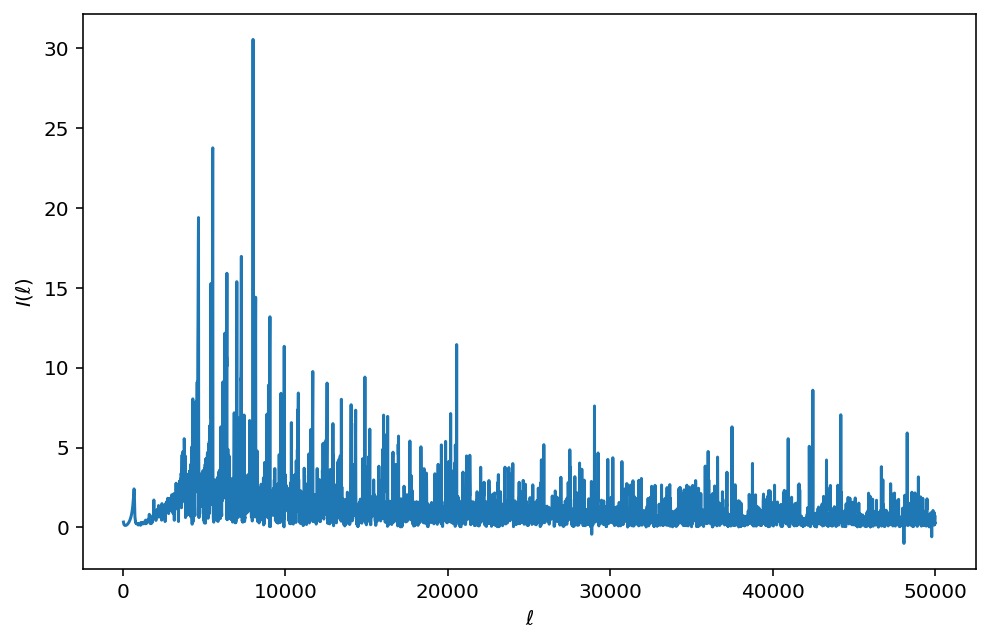
Figure 1: Numerical evaluation of the integral S08 associated with the high-S09 memory-induced correction to the CMB anisotropy, showing pronounced oscillatory features and strong enhancement for S10.
A threshold value S11 places the memory correction at the edge of phenomenological viability, as its blue tilt can be constrained by CMB damping-tail, lensing, and small-scale structure data.
Memory Effects on Primordial Non-Gaussianity
The same memory structure generically impacts higher-order correlators. The correction to the two-point function’s scale dependence feeds into squeezed, equilateral, and folded triangle configurations of the bispectrum.
- Squeezed limit: The correction scales as S12, yielding a blue-tilted, scale-dependent S13. At high-S14 this can become nonperturbatively large, potentially violating Maldacena’s consistency relation and providing a clear signature of nonlocal QG dynamics.
- Equilateral and folded non-Gaussianity: The kernel’s nonlocality yields a logarithmic enhancement in S15 with the same blue tilt, and pronounced folded bispectrum contributions. The running of memory-induced non-Gaussianity is predicted as S16, which is far in excess of the nearly scale-invariant signal expected in slow roll inflation.
These features suggest that memory-induced non-Gaussianities may be best probed with high-S17 observables, S18-distortion anisotropies, PBH statistics, and small-scale structure surveys.
Cosmological and Physical Implications, Parameter Tuning, and Cyclic Cosmology
A crucial cosmological issue is the tuning of the memory coefficient S19. Since S20 predominantly enhances small-scale power, excessively large S21 would ruin the formation of astrophysically stable environments, while excessively small S22 renders the effect negligible. The origin and "selection" of S23 is therefore both an existential and an observational constraint.
To address the fine-tuning problem, the authors speculate that within conformal cyclic cosmology (CCC)—a cyclic extension of the Hawking-Hartle proposal—S24 could evolve across cosmological epochs (aeons), with each transition allowing the memory strength to interpolate toward values compatible with observed structure formation and the presence of observers.
This interconnection of Planck-suppressed memory effects and the global structure of cosmological cycles opens new venues for anthropic bounds and dynamical selection of QG parameters.
Conclusion
This work systematically extends the semiclassical approach to quantum cosmology by implementing nonlocal, memory-induced corrections at subleading Planck-suppressed order, rather than via ad hoc fractional derivatives. The result is a controlled, theoretically motivated extension of the Kiefer-WDW framework producing:
- Blue-tilted, highly scale-dependent corrections to the primordial power spectrum and CMB anisotropies at high-S25;
- Strongly scale-dependent primordial non-Gaussianity violating standard consistency relations;
- A fine-tuning problem for the memory coefficient S26, potentially ameliorated within cyclic cosmological paradigms;
- Opportunities for testing quantum gravity-induced nonlocality with high-precision cosmological and small-scale structure data.
The theoretical framework provides a bridge connecting semiclassical cosmology, fractional calculus, and nonlocal quantum gravitational dynamics, with implications for both the foundations of quantum gravity and phenomenology of the early universe. Future work may focus on detailed numerical constraints, PBH production, and explicit realizations in conformal cyclic cosmology.

