Abstract: We study Cosmological Einsteinian Cubic Gravity (CECG) arXiv:1810.08166v3 in the context of minisuperspace quantum cosmology. CECG is a modification of Einstein's gravity by cubic curvature terms that yield a nontrivial contribution to the dynamics of FRW backgrounds while keeping the Friedmann equations at second order. First, we study the Hamiltonian formulation of the effective one-dimensional FRW CECG action using Ostrogradski's canonical variables and Dirac's algorithm for constrained systems. Since the momentum $p_a$ conjugate to the scale factor is a polynomial of degree five in $\dot{a}$, we implement canonical transformations $(a,p_a)\to (A,P)$ that enable us to write the Hamiltonian constraint explicitly. Second, we perform the Wheeler-DeWitt quantization using the new canonical variables. Although FRW CECG has no extra degree of freedom besides the scale factor, its non-standard Hamiltonian yields a higher-derivative Wheeler-DeWitt equation. We obtain exact solutions for the spatially flat case, and WKB-type solutions for the spatially closed case. Finally, we consider a homogeneous scalar field $φ$ with inflationary potential and obtain WKB wave functions leading to strong correlations between coordinates and momenta.
The paper reveals that cubic curvature terms trigger novel inflationary behavior and modify the Wheeler-DeWitt equation in FRW cosmologies.
The paper employs advanced canonical analysis and nontrivial variable transformations to manage quintic momentum structures arising from the cubic corrections.
The paper uncovers a deformed quantum-classical boundary where higher-curvature corrections enable pure quantum states and effective geometric inflation without scalar fields.
Quantum Wheeler-DeWitt Analysis in Cosmological Einsteinian Cubic Gravity
Introduction and Theoretical Motivation
Cosmological Einsteinian Cubic Gravity (CECG) universally extends four-dimensional General Relativity by introducing specific cubic curvature contributions designed to modify Friedmann-Robertson-Walker (FRW) cosmologies while maintaining second-order equations of motion. Such higher-curvature extensions are motivated both by the UV completion problem of gravity—where higher-curvature operators are required for renormalizability at the perturbative level—and by the quest for geometric inflation scenarios [ARCINIEGA2020135272]. While Lovelock terms in four dimensions reduce to topological invariants, properly engineered cubic densities in ECG (notably 𝒫 and 𝒞) contribute nontrivially to the background dynamics even in D=4, in contrast to quasi-topological and Lovelock schemes.
Within homogeneous and isotropic cosmological backgrounds, the combined cubic terms of CECG permit modifications to the standard cosmological evolution, including the induction of power-law or even exponential expansion (geometric inflation), without relying on scalar degrees of freedom or exotic matter [ARCINIEGA2020135242, PhysRevD.99.123527]. An open problem is the quantization of such theories, specifically how the quantum Wheeler-DeWitt (WDW) equation, and hence the quantum cosmology, are affected by higher-derivative contributions while avoiding standard pathologies such as Ostrogradsky instabilities.
Classical Dynamics: Lagrangian, Hamiltonian, and Modified Friedmann Equations
The CECG action constructed on the FRW background has the schematic form
SCECG=∫d4x−g[2κ2R−2Λ+β(P−8C)],
with 𝜅 the reduced Planck mass, β a length-squared coupling, and P, C representing the cubic curvature densities [PhysRevD.94.104005]. The action reduces in minisuperspace to an effective one-dimensional higher-derivative Lagrangian for the scale factor a(t) and lapse N(t). After integration by parts, a second-order alternative Lagrangian is obtained, yet this introduces a nontrivial kinetic structure, with momenta being quintic polynomials in the scale factor, rendering standard canonical analysis intractable due to the absence of a general quintic solution [Linton].
The resulting modified Friedmann constraint takes the form
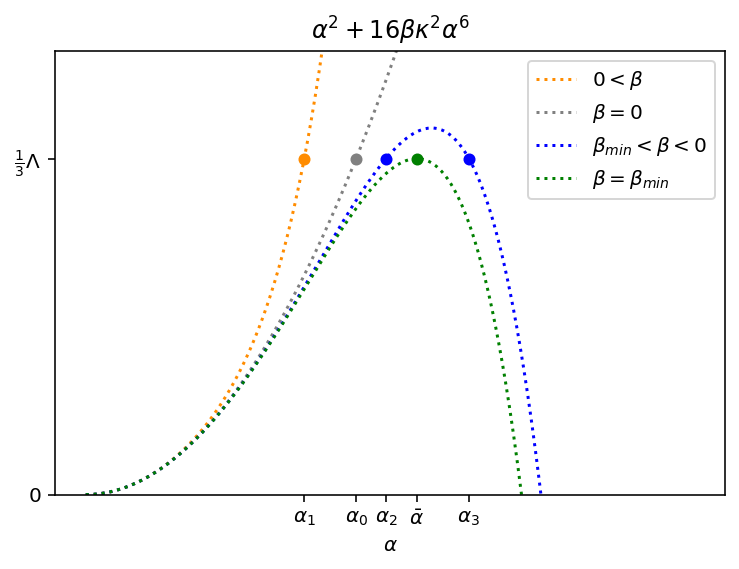
Figure 1: The left-hand side of the modified Friedmann constraint, showing the impact of the cubic correction parameter β.
a2a˙2+a2k+16βκ2(a2a˙2+a2k)3=3Λ
with k the spatial curvature index.
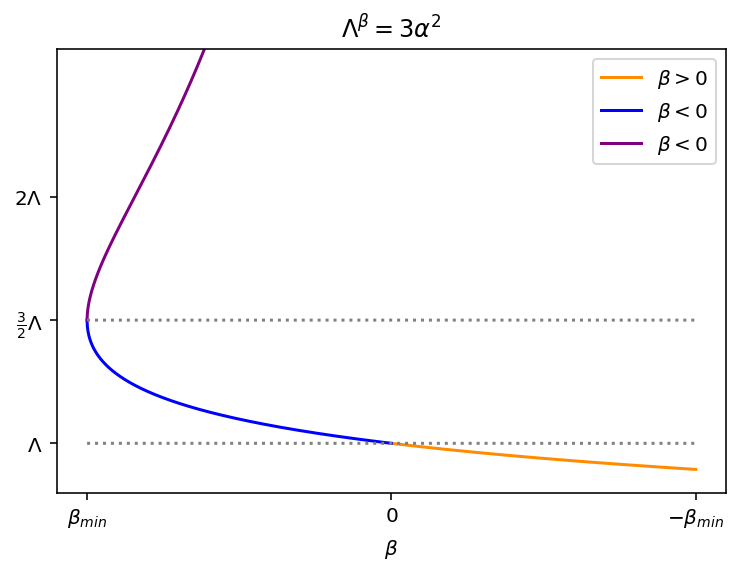
The cubic parameter SCECG=∫d4x−g[2κ2R−2Λ+β(P−8C)],0 induces a nonlinear mapping between the cosmological constant and the effective Hubble rate, fundamentally altering the classical solution structure. In particular, for SCECG=∫d4x−g[2κ2R−2Λ+β(P−8C)],1 and SCECG=∫d4x−g[2κ2R−2Λ+β(P−8C)],2, inflationary behavior can be sourced entirely by the cubic terms via an emergent effective cosmological constant.
Canonical Quantization and Wheeler-DeWitt Dynamics
The Hamiltonian analysis of CECG is made subtle by the presence of higher derivatives and degenerate symplectic structures. The Ostrogradski construction leads to nontrivial (Dirac) Poisson brackets and primary/secondary constraint chains. In the alternative formulation, the canonical variables SCECG=∫d4x−g[2κ2R−2Λ+β(P−8C)],3 are introduced via nontrivial transformations, reducing the complexity of the momentum structure at the expense of a non-polynomial, nonlocal Hamiltonian constraint.
For the spatially flat case (SCECG=∫d4x−g[2κ2R−2Λ+β(P−8C)],4), the WDW equation reduces, with a convenient operator ordering, to a sixth-order ODE in the configuration variable SCECG=∫d4x−g[2κ2R−2Λ+β(P−8C)],5. The general solution is a linear combination of exponentials:
Figure 2: Plot of the effective cosmological constant SCECG=∫d4x−g[2κ2R−2Λ+β(P−8C)],6 as a function of the cubic coupling, illustrating the multivalued structure for negative SCECG=∫d4x−g[2κ2R−2Λ+β(P−8C)],7.
SCECG=∫d4x−g[2κ2R−2Λ+β(P−8C)],8
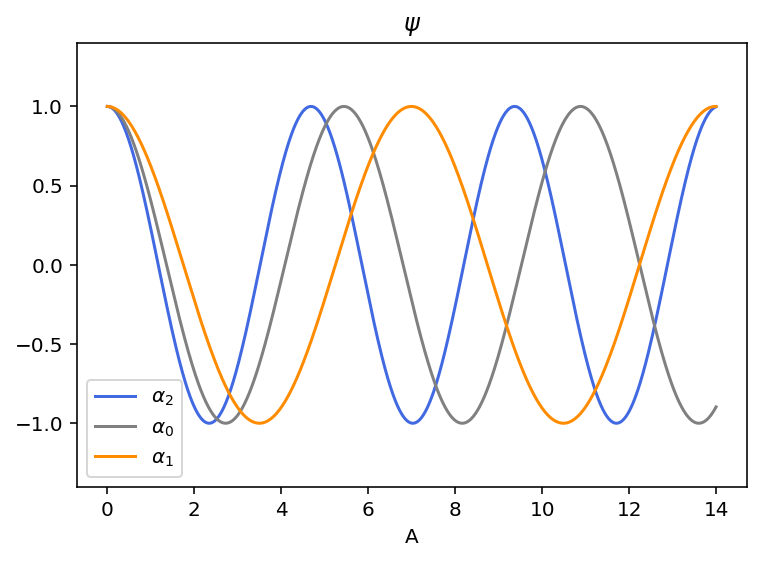
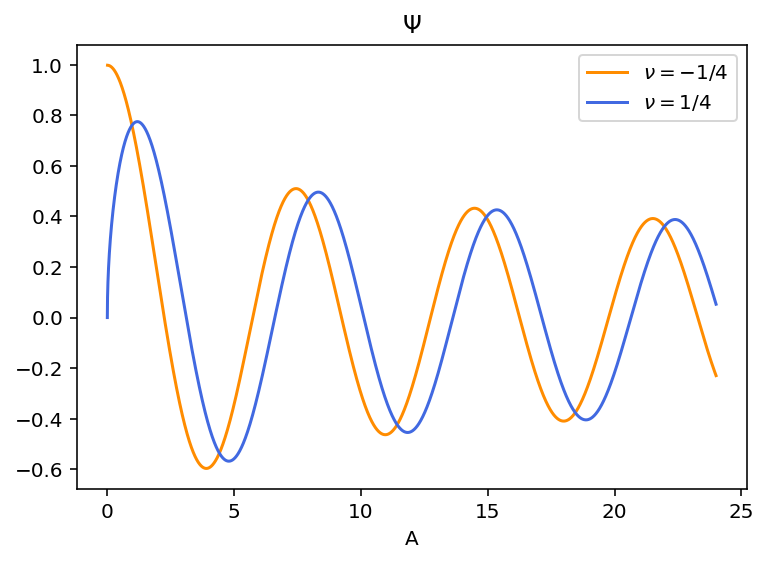
where SCECG=∫d4x−g[2κ2R−2Λ+β(P−8C)],9 are the roots of a sixth-degree algebraic equation encoding the spectrum of the kinetic terms, modified by β0 (see Eq. (6) in the text). For positive β1, this allows both oscillatory and non-normalizable ("pure quantum") solutions without classical analogs. Nontrivial operator ordering (e.g., Laplace-Beltrami quantization) modifies the functional form of these solutions, leading to Bessel functions regular at β2.
Figure 3: The function β3 constructed with the real roots of the characteristic equation, indicating modified oscillation frequencies due to cubic curvature effects.
Figure 4: Analytic Bessel-function solutions of the WDW equation demonstrating suppression for large β4 and explicit sensitivity to the sign and magnitude of β5.
Notably, the WDW equation exhibits a higher-derivative structure even though CECG retains only the scale factor as a dynamical degree of freedom—an artifact of the higher-curvature corrections entering the kinetic sector.
Quantum States, Normalizability, and Novel Features
The emergence of complex and imaginary roots in the characteristic WDW equation for certain parameter regimes enables the construction of damped, normalizable quantum states (absent in textbook FRW quantum cosmology):
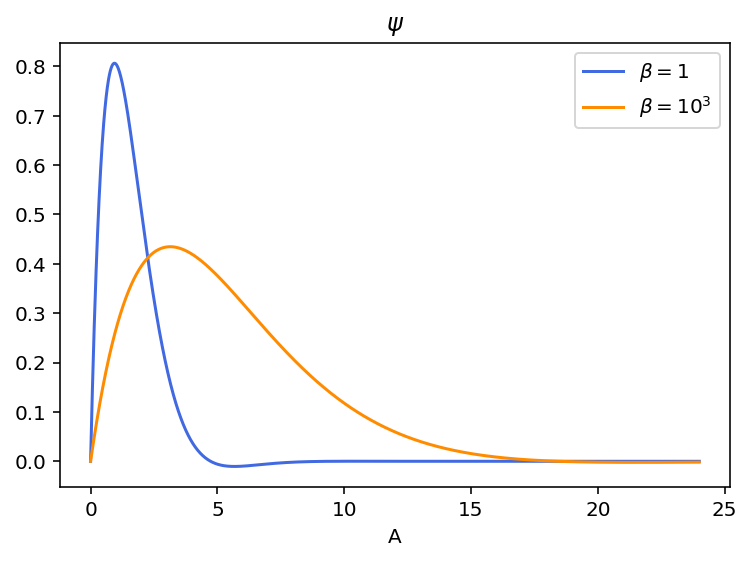
Figure 5: Normalized exponential-damped wave functions for positive β6, showing a pronounced peak at finite β7 and rapid decay.
These pure quantum solutions admit a nontrivial probabilistic interpretation and display a maximum in β8 at finite scale factor, indicating a preferred quantum geometry. Expectation values of β9 can be defined within these states and evolve nontrivially with effective (intrinsic) time prescriptions, particularly when coupled to additional fields.
WKB and Minisuperspace Analyses: Closed Universes and Inflationary Potentials
For P0, new canonical variables P1 allow the WDW reduction to a standard form. The semiclassical (WKB) evaluation leads to wave functions of the form P2, where P3 solves a nonlinear Hamilton-Jacobi equation incorporating all P4-corrections. The classically forbidden region, where the wave function transitions from oscillatory to exponential decay, is marked by a critical value P5 derived from the vanishing of the classical momentum.
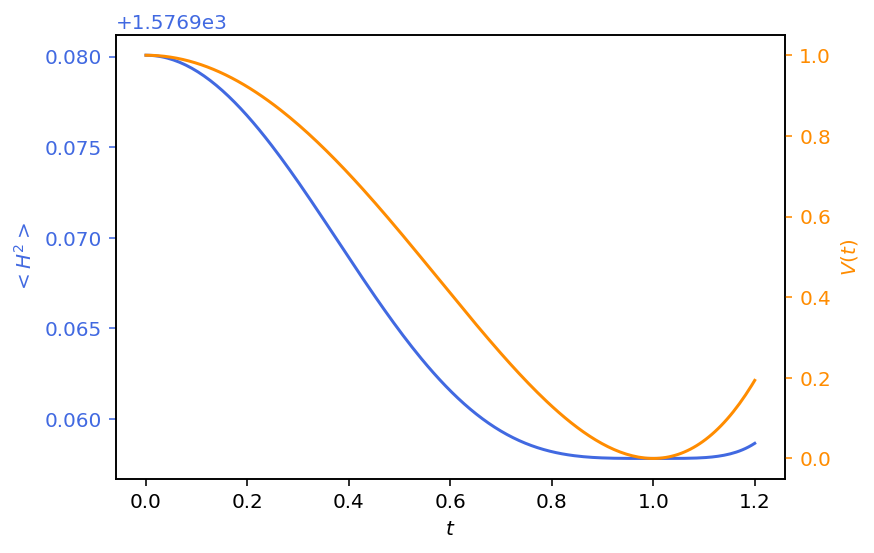
Figure 6: Mean quantum Hubble parameter evolution P6 in the presence of a slowly rolling scalar inflaton, highlighting the structured transition between quantum and quasi-classical behavior.
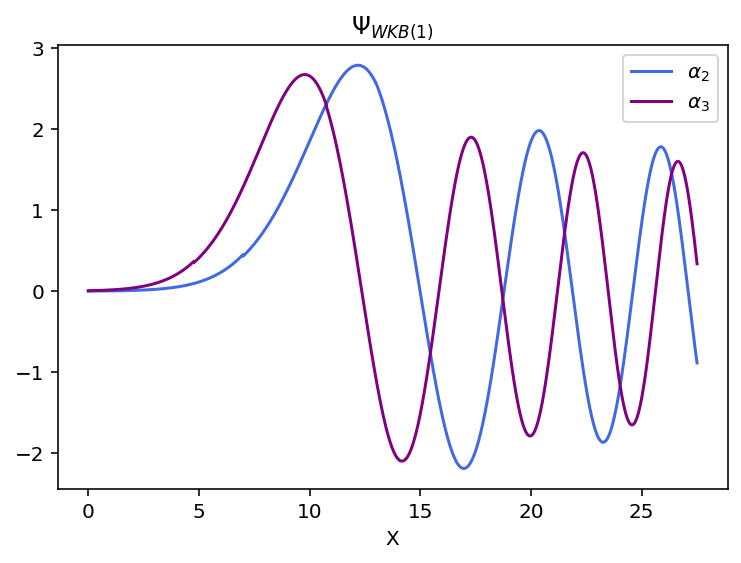
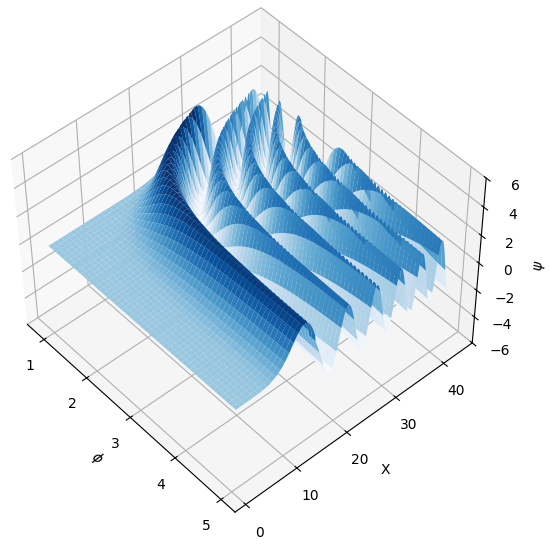
Figure 7: Real WKB solution of the wave function, assembled from Airy function behavior near the turning point P7 and matched to the analytic WKB approximation elsewhere.
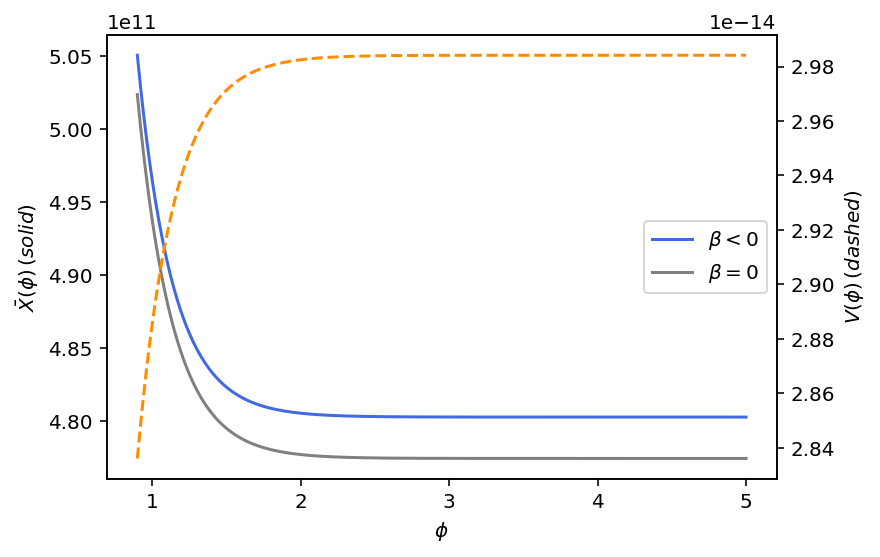
Upon coupling a homogeneous scalar field (e.g., with Starobinsky-type potential), the canonical analysis shows that for slow roll or large field, the quantum sector supports strong correlations between the superspace configuration variables and their canonical momenta. The interface between quantum and classical cosmology is encoded in the trajectory traced by the maxima of P8 and depends explicitly on P9, altering the standard inflationary predictions.
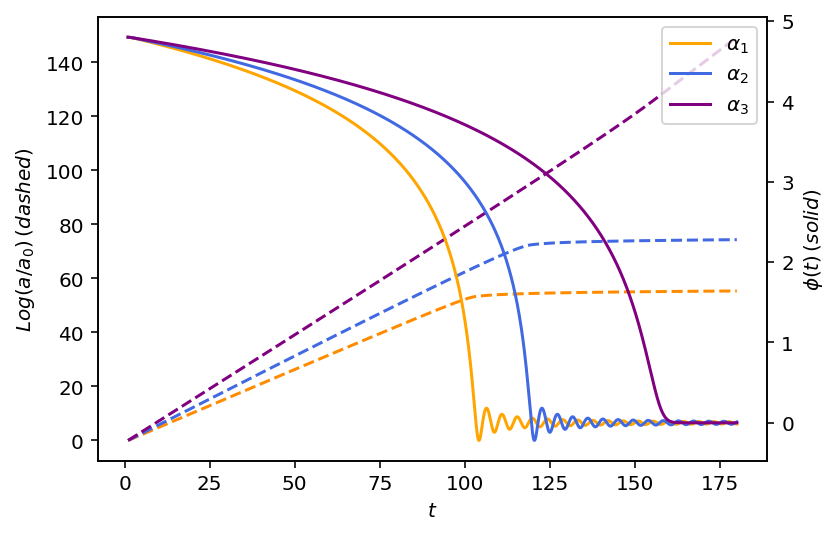
Figure 8: Classical background evolution for different choices of C0, showing the impact of cubic terms on the inflationary phase and rate of field damping.
Figure 9: WKB wave function on the two-dimensional C1 minisuperspace surface, illustrating regions of high probability and quantum-classical transition.
Figure 10: The function C2 marking the quantum-classical boundary in minisuperspace as a function of the inflaton, compared with the potential landscape.
Implications and Open Directions
The paper demonstrates that higher-curvature cubic corrections to cosmological gravity induce significant modifications to the quantum cosmological evolution even in the absence of extra dynamical degrees of freedom. The key theoretical implications include:
Deformed quantum algebra: The canonical structure is fundamentally altered, with nontrivial Dirac brackets and quintic momentum-generation, reflecting in a highly nonstandard quantum constraint structure.
Emergence of novel quantum states: The WDW equation admits additional solutions—both oscillatory and exponentially damped—relative to the standard FRW case, directly tied to the presence and sign of C3.
Modified classical-quantum boundaries: The quantum-classical transition surface in minisuperspace is displaced and deformed relative to the standard picture, with C4 and related quantities now functions of the cubic coupling.
Inflationary dynamics without scalar field: For negative C5, quantum states exist that predict power-law inflation even when the bare cosmological constant vanishes, supporting the geometric inflation paradigm without the need for additional matter content.
Practical implications concern both early universe scenarios (including geometric inflation and quantum creation of the universe) and potential differentiable quantum fingerprints in cosmological observables owing to these higher-curvature quantum modifications.
Future developments could focus on the explicit path integral analysis with boundary proposals (Hartle-Hawking, Vilenkin), rigorous treatment of operator-ordering ambiguities and nonlocal inverse operators, and the extension to models involving an infinite tower of higher-curvature invariants [ARCINIEGA2020135242, arciniega2025geometriccosmology].
Conclusion
Quantum cosmological analysis of CECG demonstrates that cubic curvature modifications fundamentally reshape both canonical structures and quantum solution spaces for the universe's wave function, yielding a richer space of quantum geometries and altering the quantum-classical correspondence. These results emphasize the importance of higher-curvature corrections in quantum gravity phenomenology and serve as groundwork for further explorations in quantum effective gravity and early universe cosmology, particularly in the context of geometric inflation and quantum initial conditions.
“Emergent Mind helps me see which AI papers have caught fire online.”
Philip
Creator, AI Explained on YouTube
Sign up for free to explore the frontiers of research
Discover trending papers, chat with arXiv, and track the latest research shaping the future of science and technology.Discover trending papers, chat with arXiv, and more.