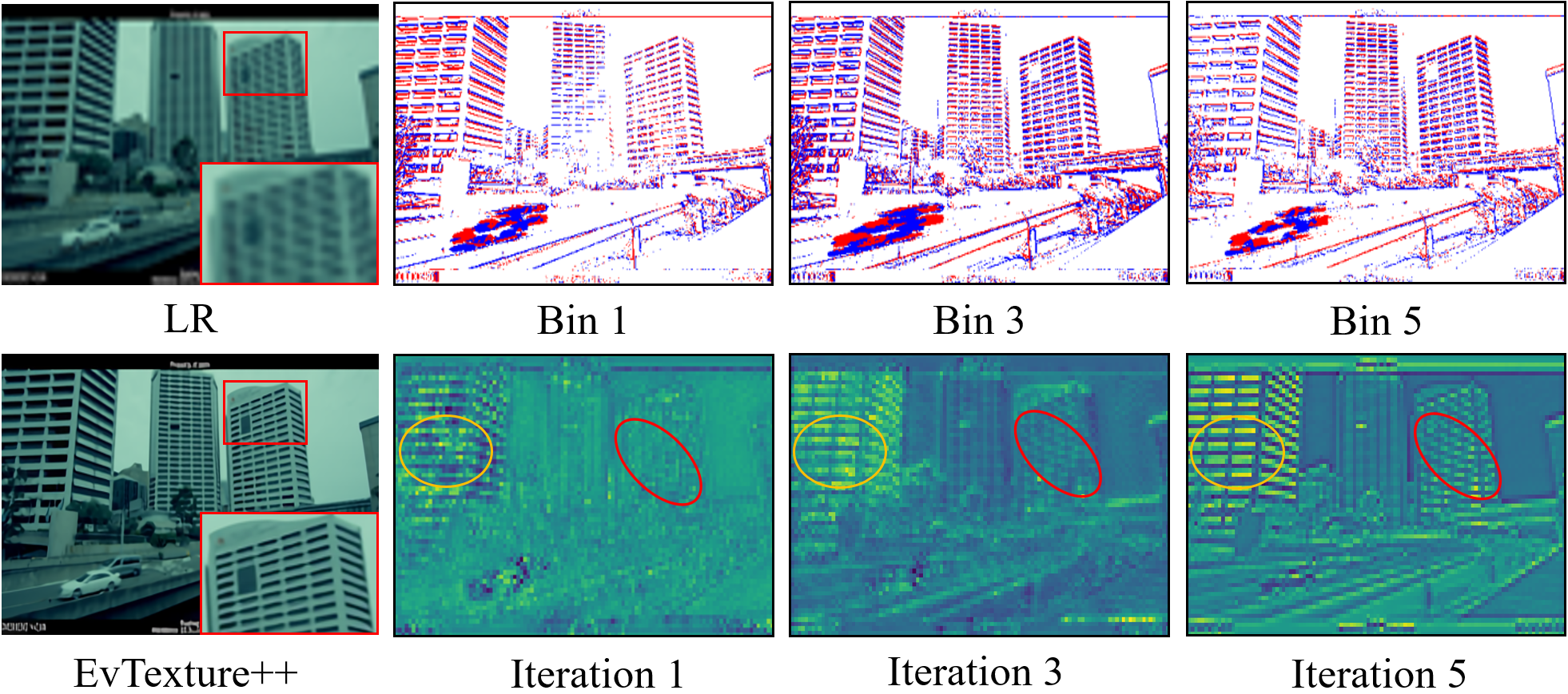
- The paper presents a novel framework that leverages event signals as a direct high-frequency detail source for texture enhancement in video super-resolution.
- It employs a two-branch bidirectional architecture integrating an Iterative Texture Enhancement module and event-guided temporal alignment to reconstruct fine textures.
- Empirical results demonstrate significant gains including a 1.55 dB PSNR increase on Vid4, with plug-and-play integration across diverse backbones.
Event-Driven Texture Enhancement for Video Super-Resolution: A Detailed Technical Analysis of "EvTexture++" (2606.13580)
Introduction and Motivation
The "EvTexture++" framework marks a significant characterization of the role of event-based vision in addressing video super-resolution (VSR) challenges, specifically the persistent bottleneck of fine-grained texture recovery. While conventional RGB-based VSR models have seen incremental advances through more sophisticated temporal propagation and motion alignment, their innate limitations—principally the low temporal sampling of frames—render them insufficient in reconstructing detailed textures, particularly under large inter-frame motions. Similarly, early event-guided VSR techniques have mostly capitalized on the motion cues from event streams, focusing on flow refinement and temporal alignment but neglecting the explicit restoration of spatially high-frequency textural content.
EvTexture++ introduces a paradigm shift: event signals are not merely an auxiliary for motion alignment, but are leveraged as a direct source of high-frequency spatiotemporal detail for dedicated texture enhancement in VSR. The framework incorporates a two-branch bidirectional structure—one for texture (with an Iterative Texture Enhancement module), the other for motion (with an event-guided Temporal Texture Alignment module). Crucially, this design allows for the explicit exploitation of the unique properties of event cameras: ultra-high temporal resolution and direct encoding of dynamic changes, both vital for nuanced texture reconstruction and maintaining temporal coherence.
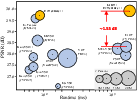
Figure 1: Performance versus runtime on Vid4. EvTexture++ demonstrates a superior accuracy-efficiency trade-off, achieving notable PSNR gain over prior methods, especially when integrated as a plug-in with SOTA backbones.
Framework Architecture and Methodological Innovations
The architecture of EvTexture++ is anchored on a bidirectional recurrent core, processing sequences of low-resolution frames alongside asynchronous event streams discretized as voxel grids. The backbone propagates features forward and backward, with temporal dependencies maintained via bidirectional connectivity, and the pipeline is structured into parallel event-guided texture and motion branches.
Event-Guided Texture Enhancement
At the core of the texture branch lies the Iterative Texture Enhancement (ITE) module. Rather than simplistic fusion, the ITE models temporal dependencies over voxelized event bins through a ConvGRU-based iterative refinement mechanism, sequentially injecting high-frequency event-derived cues, fused with RGB intensity context, into the propagated feature space. The module accumulates residuals within the feature representations, progressively correcting and enhancing textural regions with each iteration.
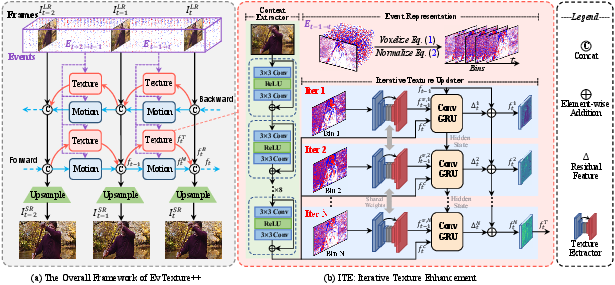
Figure 3: The EvTexture++ pipeline combines a bidirectional recurrent structure with parallel event-guided texture and motion alignment branches; the ITE module iteratively fuses event cues for texture restoration.
This approach addresses two critical signal-processing challenges inherent to events: (1) the lack of absolute intensity baselines (corrected by integrating RGB context), and (2) spatiotemporal misalignment resulting from the asynchronous nature of event streams (mitigated by temporal iteration and alignment refinement within the ITE).
Event-Guided Motion and Temporal Consistency
The motion branch integrates a Temporal Texture Alignment (TTA) module, composed of parallel MEMC units—one leveraging event-based flow, the other RGB-based optical flow. The event-based MEMC estimates fine, high-temporal-precision flows from processed voxel grids via a U-Net-like encoder, while the RGB-based branch employs standard networks (e.g., SpyNet) for conventional flow estimation. Their outputs are fused through a 1×1 convolution, balancing coarse but robust appearance cues with fast, nonlinear motion captured only by events.
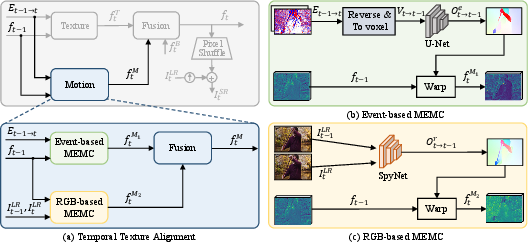
Figure 5: The Event-guided Motion Branch: TTA combines RGB-based and event-based MEMC modules, fusing their respective feature-aligned outputs for robust temporal consistency in texture regions.
Flexible Plug-and-Play Integration
A notable systems engineering advance is the plug-in design of EvTexture++, enabling it to operate atop a frozen backbone (CNN or Transformer-based) without joint retraining. The module refines extracted features between the backbone's temporal propagation and upsampling, significantly boosting performance at negligible computational cost, as attested by empirical ablations against parameter-matched baselines.
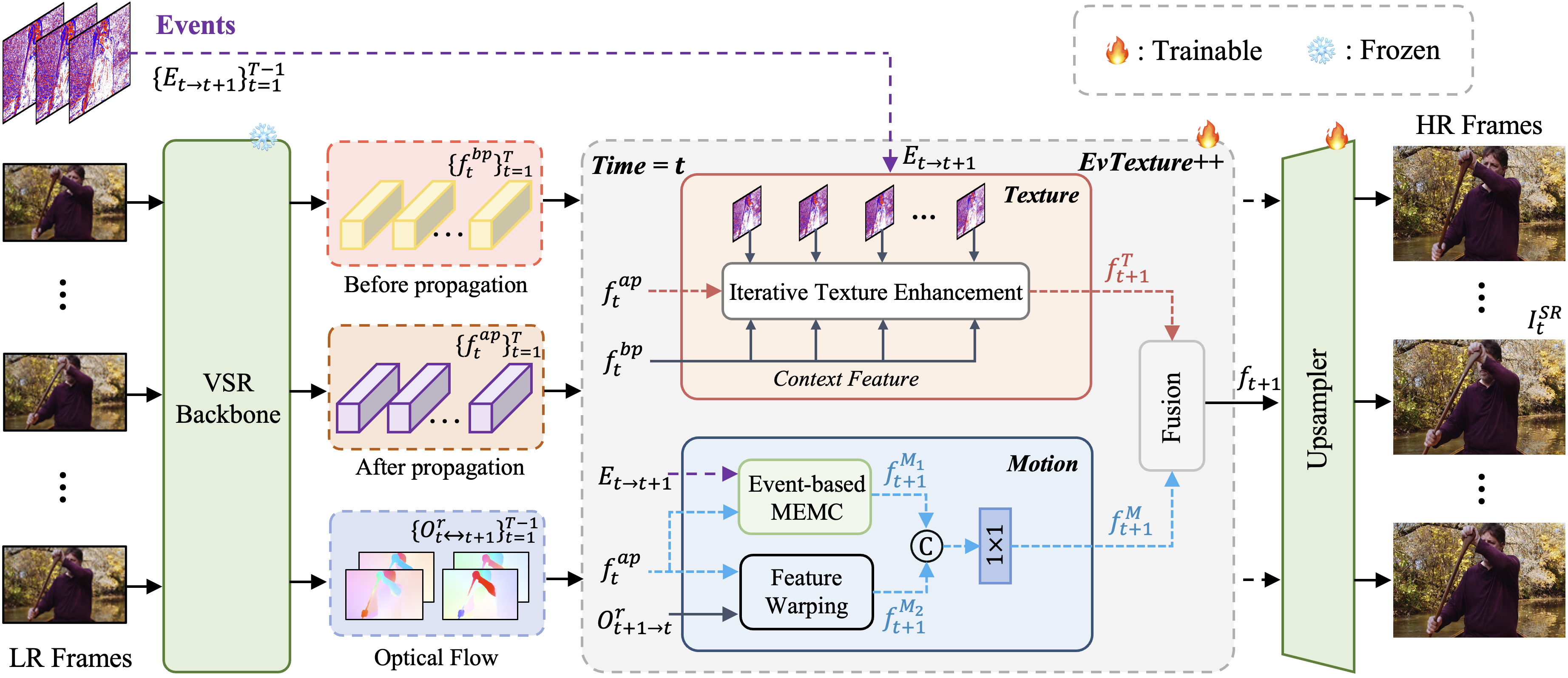
Figure 7: Plug-in integration of EvTexture++—the backbone provides intermediate features and flows, which the event-guided branches refine before upsampling.
Empirical Results and Findings
EvTexture++ establishes new state-of-the-art results across five diverse VSR benchmarks, spanning both synthetic (e.g., Vid4, REDS4, Vimeo-90K-T) and real-world (e.g., CED) datasets.
On the highly texture-rich Vid4 dataset, EvTexture++ achieves a remarkable PSNR gain of 1.55 dB over SOTA RGB-based methods (e.g., Transformer backbones IART and MIA-VSR), and over 1.3 dB compared to other event-driven approaches, with similarly dominant results in SSIM and perceptual (LPIPS) metrics.
This trend persists under challenging regimes—8× upscaling, BD degradation (bicubic downsampling suppression of high-frequencies), and large-motion scenarios (as quantified via flow-magnitude statistics)—demonstrating strong robustness and generalization.
The temporal consistency analysis further reveals substantial reductions in flicker artifacts (as measured by TCC and tOF), extending the advantage from spatial fidelity to stable, perceptually pleasant video streams.
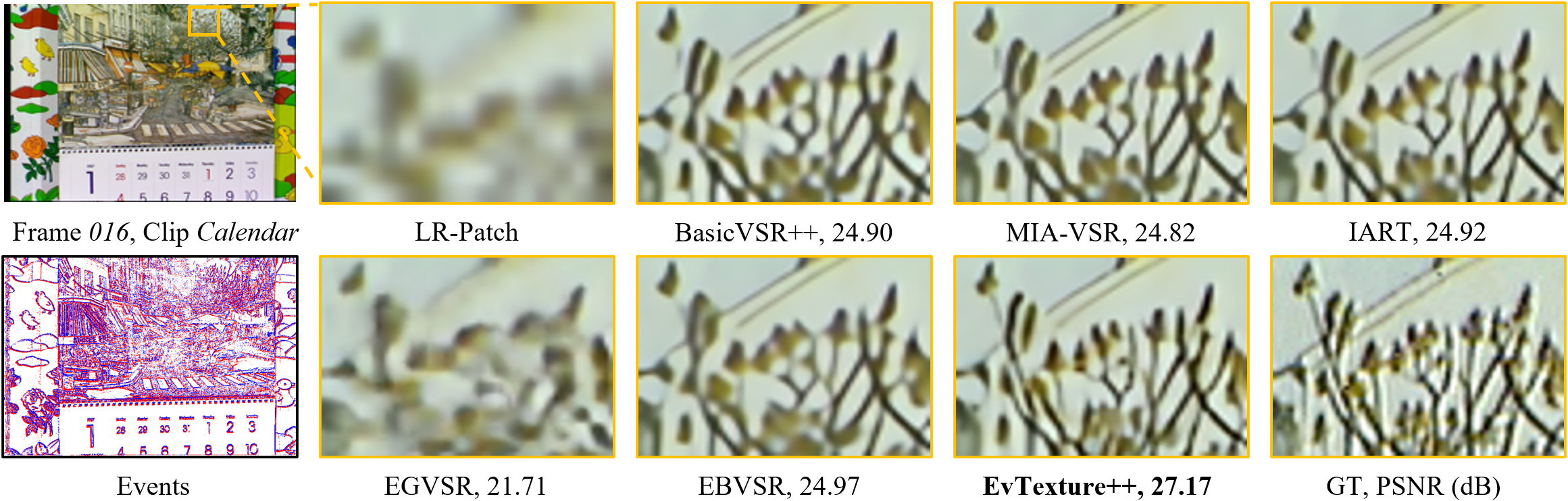
Figure 2: Qualitative comparison on Vid4: EvTexture++ uniquely reconstructs vivid fine branches and leaves where prior methods fail.
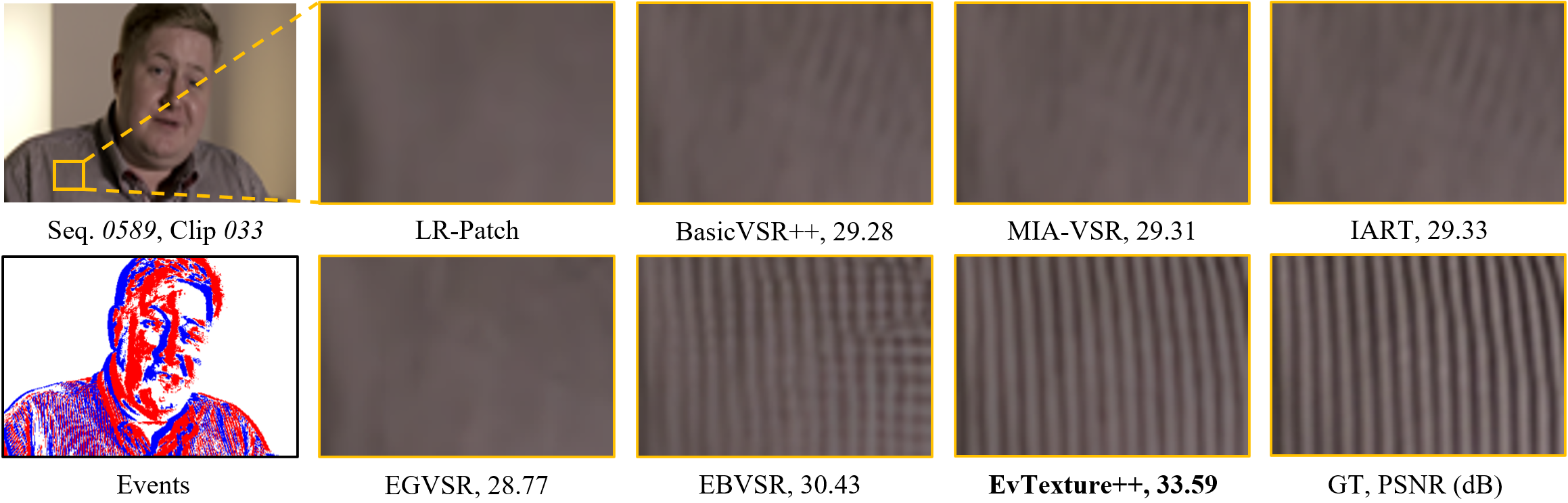
Figure 4: Qualitative comparison on Vimeo-90K-T: only EvTexture++ resolves detailed texture patterns on clothing surfaces.
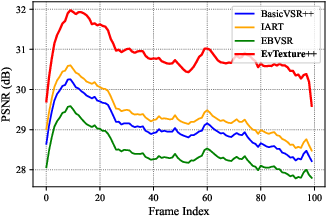
Figure 6: EvTexture++ delivers persistently higher per-frame PSNR over all frames in challenging clips, evidencing temporal stability.
Texture Recovery and Dataset Analysis
The paper introduces a quantitative texture magnitude metric, enabling granulated analysis of model gains as a function of texture complexity. Gains from EvTexture++ are strongly correlated with clip-level texture magnitudes, confirming its tailored effectiveness for complex, high-frequency scenarios—an advantage not observed in RGB-based or prior event-driven frameworks.
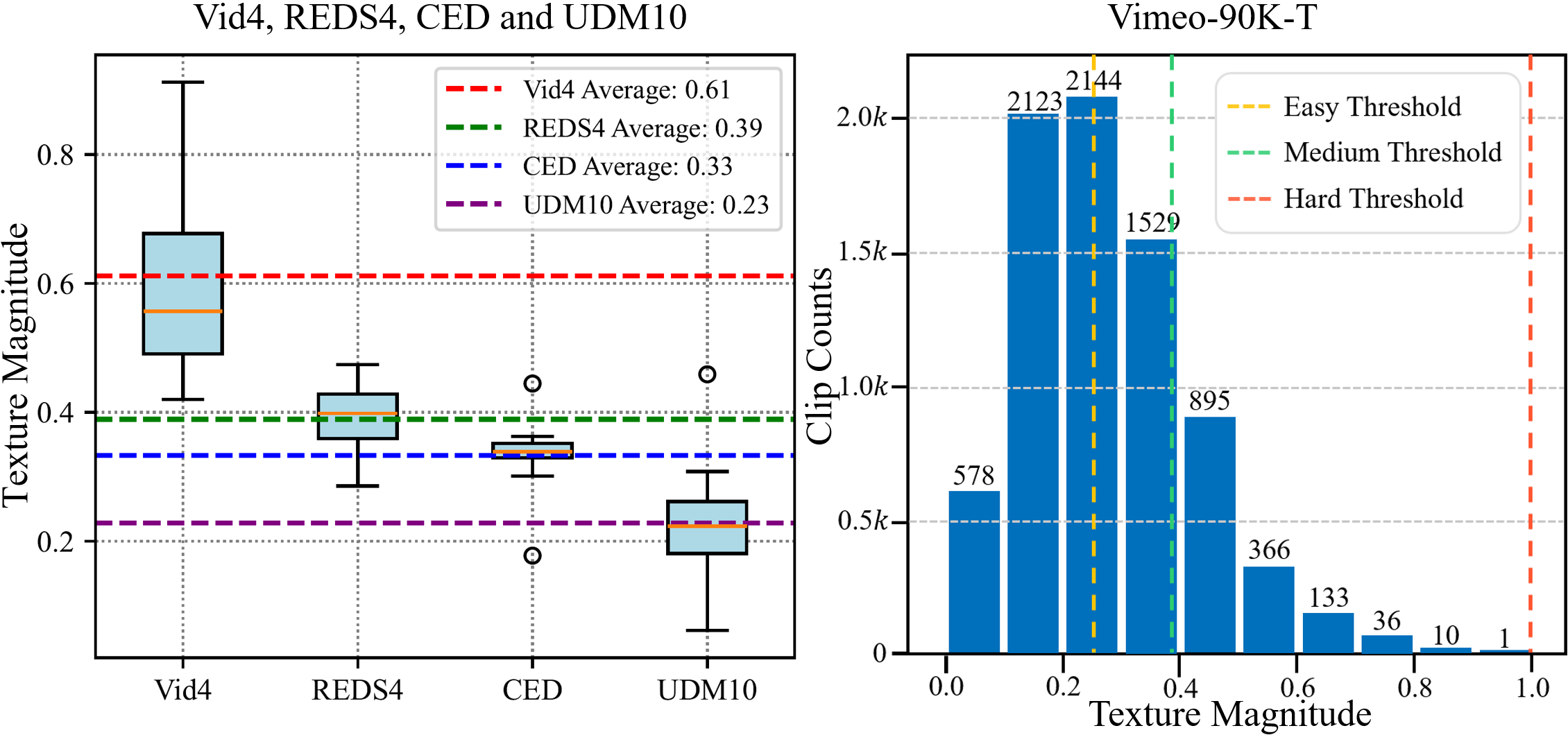
Figure 8: Dataset-wide texture magnitude analysis—Vid4 exhibits the highest complexity, contextually explaining the outsized gains of EvTexture++ in this regime.
Plug-in Efficacy Across Architectures
EvTexture++ as a plug-in provides orthogonal performance improvements across both CNN and Transformer-based VSR models without retraining the backbone, validated against parameter-matched controls. This demonstrates that the observed gains are attributable to the introduction of event-domain signals, not mere architectural overparameterization.
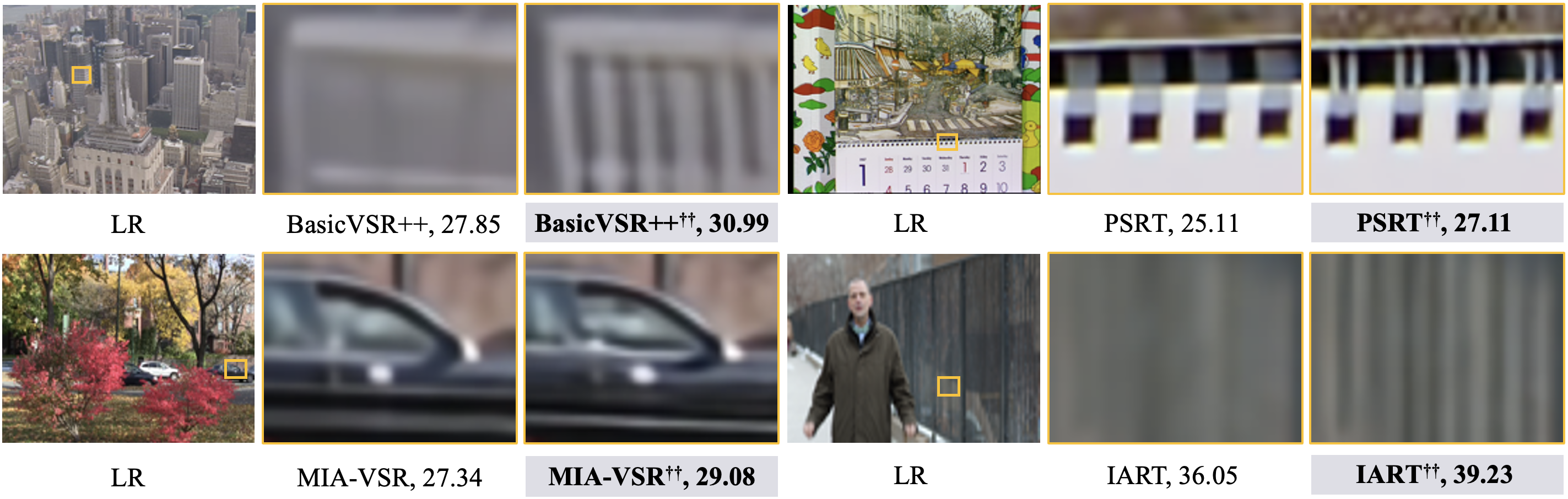
Figure 9: Before/after visual results on backbone models with EvTexture++ as plug-in: sharper, more naturalistic textures are consistently recovered.
Ablation Studies
A rigorous ablation suite quantifies component contributions:
Practical and Theoretical Implications
Practical Applications: The demonstration that event cameras supply critical information for restoring high-frequency and dynamic scene content in VSR has immediate implications for surveillance, broadcasting, AR/VR streaming, and autonomous systems—domains where motion, detail, and real-time constraints intersect. Importantly, the plug-and-play paradigm dramatically lowers integration barriers for existing deployments.
Theoretical Perspective: By explicitly decoupling the roles of event streams as both motion cues and as carriers of spatially localized temporal detail, EvTexture++ extends the modeling capability of multi-modal fusion architectures. The success of iterative, sequence-aligned enhancement modules sets a precedent for similar designs in other spatiotemporal restoration tasks and frames a research pathway for leveraging asynchronous sensory data in neural generative or restorational models.
Limitations and Prospective Extensions
Two limitations are noted:
- The current assumption of co-registered, isoresolution event/RGB inputs restricts applicability to tightly integrated sensors; future work must address misregistration and resolution heterogeneity, likely involving cross-modal spatial transformers or self-supervised alignment.
- While the method is verified for deterministic (CNN/Transformer) backbones, integration into diffusion-based VSR models remains unexplored and computationally nontrivial, but represents a fertile extension.
Conclusion
EvTexture++ redefines event-guided VSR by positioning event streams as primary enablers of high-fidelity texture restoration, validated both numerically and qualitatively across benchmark scenarios including those with severe texture loss, large motion, or low-light conditions. Its modular, architecture-agnostic design ensures extensibility and practical community impact. This work lays the groundwork for further integration of asynchronous vision in video restoration and broader sequence modeling tasks.