- The paper establishes sharp differential geometric criteria for determining Koopman linearizability in control-affine systems.
- It employs Lie bracket invariance and flow-box theorem generalizations to transform nonlinear dynamics into exact linear representations.
- The results delineate when Koopman-based control methods succeed or fail, clarifying their limitations compared to feedback linearization.
Differential Geometric Characterization of Koopman Linearizability in Control-Affine Systems
Introduction
The paper "Differential Geometric Conditions for Koopman Linearizability of Control-Affine Systems" (2606.13577) provides a mathematically rigorous treatment of the exact Koopman linearization problem for control-affine nonlinear systems. The primary focus is on deriving necessary and sufficient conditions, directly in terms of the system’s drift and control vector fields, for the existence of a (potentially higher-dimensional) diffeomorphic embedding that transforms the nonlinear closed-loop behavior into linear, control-affine dynamics via Koopman operator theory.
The work positions itself at the interface of geometric control theory and the spectral approach facilitated by Koopman operators, undertaking a structural analysis rather than merely considering data-driven or approximation perspectives. This theoretical clarity is critical, as it delineates the fundamental limitations and capabilities of Koopman-based linear representations—a rapidly evolving paradigm in modern nonlinear control and learning.
The central object of study is the continuous-time, smooth control-affine nonlinear system:
x˙=f(x)+i=1∑mgi(x)ui,x∈X⊆Rn
where f,gi:X→Rn are smooth and ui∈R are controls.
Koopman linearizability is defined as the existence of a diffeomorphism Φ:X0→RN (for some N≥n and X0⊆X open) and constant matrices A,B such that, for any solution x(t) of the original system starting from X0, the lifted state z(t)=Φ(x(t)) satisfies
f,gi:X→Rn0
with f,gi:X→Rn1.
The operational question is: What direct, checkable conditions on f,gi:X→Rn2 and f,gi:X→Rn3 guarantee the existence of such a Koopman embedding?
Main Theoretical Results
Lie Bracket Invariance and Flow-Box Conditions
A key ingredient is the invariance of Lie brackets under diffeomorphic (including lifting) coordinate changes: for a diffeomorphism f,gi:X→Rn4 and vector fields f,gi:X→Rn5, the Lie bracket transforms as
f,gi:X→Rn6
with f,gi:X→Rn7.
The flow-box theorem generalization is used to ensure that sets of independent, commuting vector fields can be straightened by a coordinate transformation—fundamental for rectifying the system into a form where the control directions are made constant.
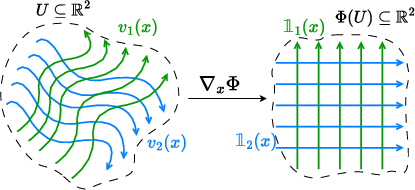
Figure 1: For independent, commuting vector fields, the flow-box transformation straightens the fields, a core component in achieving local linearity through Koopman embedding.
Necessary Conditions for Koopman Linearization
Theorem 1 in the paper provides necessary conditions for Koopman linearizability around an equilibrium f,gi:X→Rn8 (with f,gi:X→Rn9):
- Constant Rank Condition: The dimension of ui∈R0 is constant in a neighborhood.
- Bracket Commutativity: All brackets ui∈R1 vanish everywhere in that neighborhood.
These establish that the structure generated by repeated Lie derivatives of the control fields must not only be invariantly spanned but also involutive and Abelian.
Sufficient Condition and Invariant Manifold Linearization
Theorem 2 further asserts that these same conditions are sufficient for the existence of a Koopman transformation, but possibly only on a lower-dimensional, control-invariant manifold ui∈R2, rather than the entire state space.
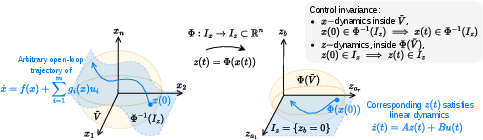
Figure 3: Sufficient conditions yield a Koopman linearization on a control-invariant manifold, with the dynamics projected onto a rectified, lower-dimensional subspace.
This subtlety—restriction to control-invariant submanifolds—reflects the geometric constraints imposed by the flow-box theorem and by the rank condition, limiting linearizability unless additional algebraic relations hold.
Controllable Koopman Linearization
A conclusive result—Corollary 1—states that if the dimension in the rank condition is maximal (i.e., equals ui∈R3), then the system is Koopman linearizable to a controllable linear system on the entire open neighborhood, and this is both necessary and sufficient. Thus, the introduction of controllability aligns the theory of Koopman linearization with the well-known feedback linearization canonical forms from geometric control.
Relationship to Feedback Linearization
The work rigorously contrasts Koopman linearization (which lifts only state, not input) with feedback linearization. For single-input systems (ui∈R4), the Koopman conditions are shown to imply those for feedback linearization, but not vice versa; moreover, feedback linearizable systems are not necessarily Koopman linearizable, especially when input transformations are required.
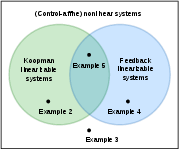
Figure 2: Schematic Venn diagramming the inclusion relations between the sets of Koopman-linearizable systems and feedback-linearizable systems.
Illustrative Examples
Three families of explicit, analytically tractable examples contrast the two forms of linearization:
- A system that is Koopman-linearizable but not feedback-linearizable;
- A system violating the bracket commutativity and/or constant rank, exhibiting nonlinear obstruction to Koopman embedding;
- A system feedback-linearizable via input transformation but not Koopman-linearizable, demonstrating the stricter requirements for a pure state-space Koopman lift.
These examples clarify how the geometric perspective provides a diagnostic toolkit for recognizing when operator-theoretic learning algorithms—or control synthesis based on such embeddings—will inevitably fail due to structural obstructions.
Implications and Future Directions
The results deliver explicit, direct obstructions to Koopman linearizability, beyond those inherited from the feedback or static linearization literature. Importantly, they show that:
- Koopman linearization, as an exact property, is strictly more restrictive than classical coordinate linearization with input transformation.
- Existing data-driven algorithms that learn Koopman embeddings must contend with these fundamental limitations: if a system does not admit a finite-dimensional linearizing lift as described, any approximate embedding will incur intrinsic modeling error.
- The necessity for all controllable directions to generate an Abelian, involutive distribution highlights a gap between algebraic geometric methods (e.g., identifying invariant observables subspaces for the autonomous dynamics) and operator-theoretic control.
Practically, these results delimit the class of nonlinear systems for which Koopman MPC and similar operator-based methods can be expected to yield true linear prediction and control. Any attempt at algorithmic discovery of Koopman lifts from data must, implicitly or explicitly, address the satisfaction of these geometric criteria.
From a theoretical standpoint, these conditions invite further work on data-driven identification of bracket relations, geometric structure learning, and the extension of these concepts to stochastic dynamics, set-valued inclusions, and singularly perturbed systems.
Conclusion
This paper delivers a comprehensive set of necessary and sufficient differential geometric conditions for Koopman linearizability of control-affine nonlinear systems, explicitly in terms of the system’s drift and input vector fields. By unifying operator-theoretic embedding with geometric control theory, it both clarifies the structural foundations of the Koopman approach and demarcates its fundamental limitations relative to classical linearization theory. The results have decisive implications for the design, analysis, and learning of finite-dimensional Koopman representations and guide the development of both theoretical and practical algorithms in nonlinear control.

