- The paper integrates equilibrium propagation with analog photonic hardware by leveraging the natural relaxation dynamics of spatial photonic Ising machines.
- The paper employs a focal plane division encoding method to parallelize evaluation of Mattis Hamiltonians, achieving an average test accuracy of 89.7% on the Wine dataset.
- The paper validates scalability through numerical studies on MNIST, showing competitive performance with low-rank parametrizations and minimal precision loss.
Optical Implementation of Equilibrium Propagation Using Spatial Photonic Ising Machines
Introduction and Context
The paper "Optical Implementation of Equilibrium Propagation Using Spatial Photonic Ising Machines" (2606.13454) addresses the integration of Equilibrium Propagation (EP), an energy-based supervised learning algorithm, with analog photonic hardware. Conventional training via backpropagation is challenged by the physical constraints of analog substrates, particularly in photonics, due to requirements for bidirectional signal flow and precise phase alignment. EP offers an alternative, leveraging the physical relaxation dynamics of energy-based networks, estimating gradients through nudged equilibrium states without explicit backpropagation. The authors introduce a hybrid optical-digital realization of EP employing a Spatial Photonic Ising Machine (SPIM) as the core computational engine.
Theoretical Foundations
The central formalism is an energy-based model in which a network’s state s evolves under a tunable energy function E(s,u,θ) with input u and parameters θ. The energy comprises a quadratic interaction term I(s) and input bias B(s,u), with the nonlinearity given by ρ(s)=sin(s) within a bounded interval. The trainable parameters are the couplings of all-to-all interactions, encoded efficiently via a decomposition into rank-one Mattis patterns.
EP proceeds via bi-level optimization: (i) inner-phase relaxation to local energy minima (inference) and (ii) outer-loop updates based on finite-difference gradients between free and nudged states. Importantly, the gradient estimation in EP—the computational bottleneck—requires O(Nd2) operations in digital hardware.
The authors circumvent this by interfacing with a SPIM, which encodes both neuron states and Mattis patterns as phase modulations on a spatial light modulator (SLM), permitting optical evaluation of the Ising Hamiltonian and certain gradients. The system supports continuous neuron states via a gauge transformation, while the trainable pattern variables remain binary.
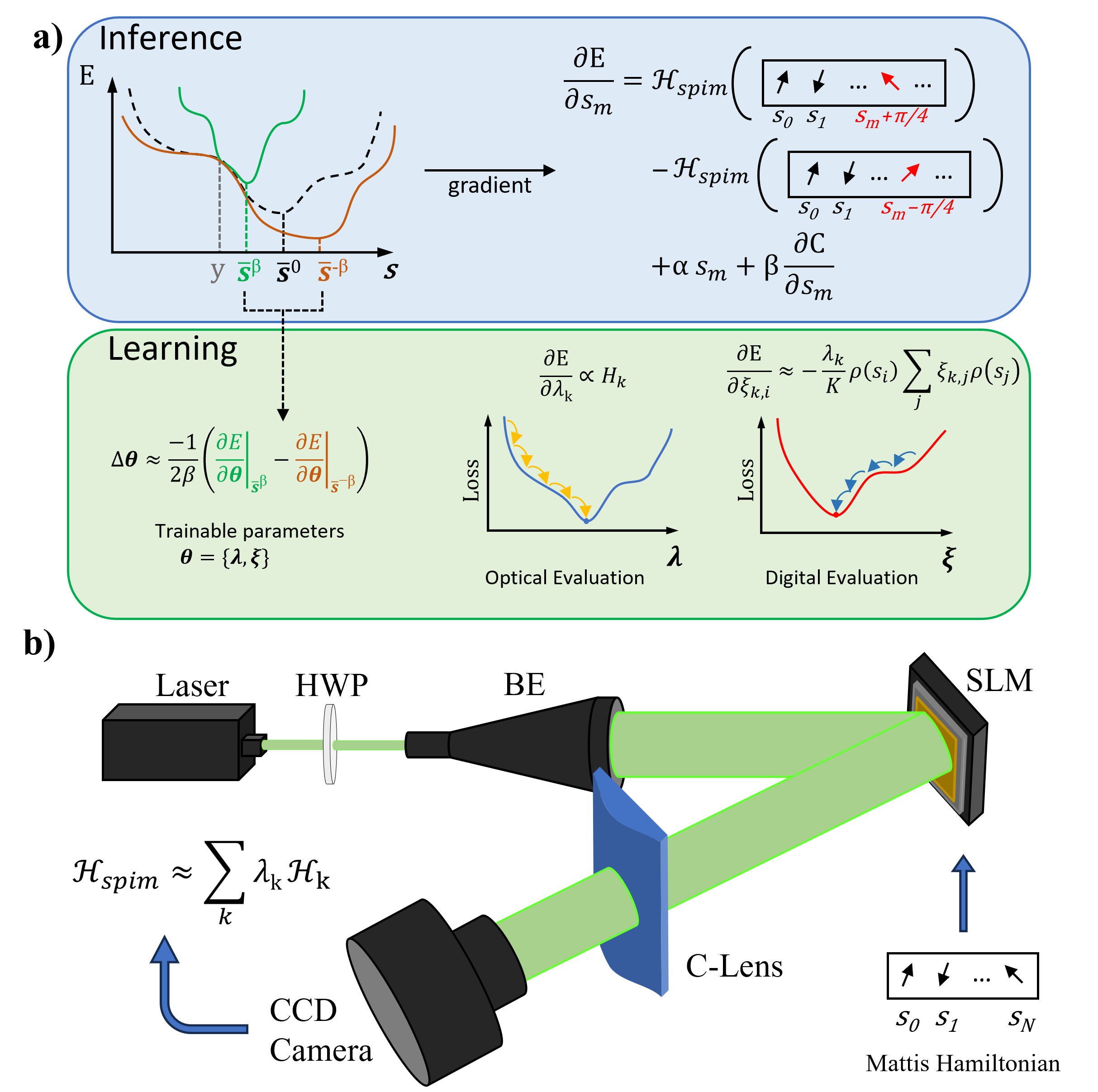
Figure 1: Schematic description of EP implemented in the SPIM framework, detailing optical and digital evaluation steps during inference and learning.
Experimental Implementation
The SPIM setup enables parallel evaluation of multiple Mattis Hamiltonians using a Focal Plane Division (FPD) encoding scheme, where each Mattis pattern is mapped to a distinct region of the SLM. Optical free-space propagation and a cylindrical lens yield Fourier transforms of the encoded fields, and the intensities at the focal plane are measured to retrieve the energy values.
The experimental protocol demonstrated EP training on the Wine dataset (3 classes, 13 features). Network parameters include binary Mattis pattern vectors and continuous coupling amplitudes; the training uses stochastic gradient descent (SGD) for the continuous parameters and the Binary Optimizer (BOP) for discrete updates. The training protocol leverages the FPD scheme to parallelize computations and balances batch size against SNR constraints.
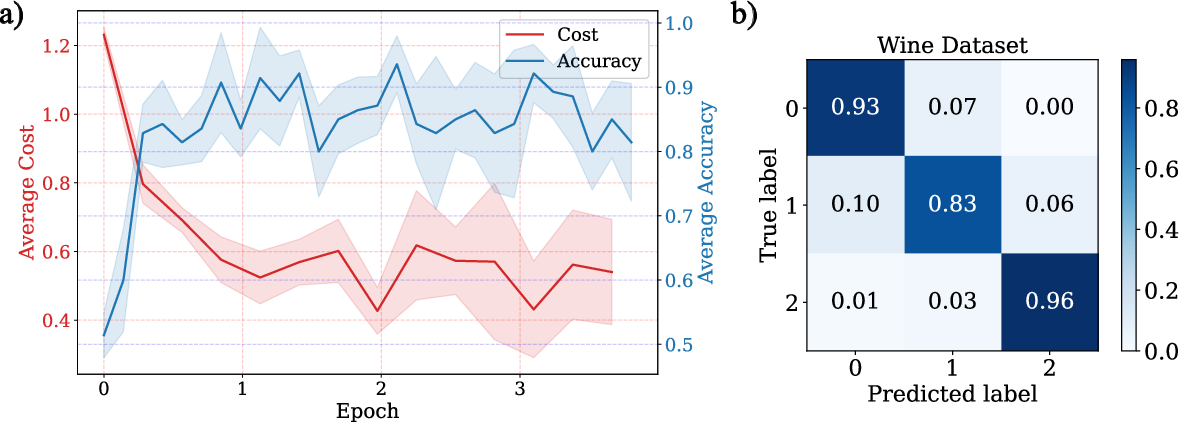
Figure 2: Experimental learning curves (cost and accuracy) and test-set confusion matrix over multiple independent runs.
The system attained an average test accuracy of 89.7%±3.2% across 7 runs. The simulated model, excluding experimental noise, achieves 98.2%±0.4%. The performance gap is attributed primarily to noise in the optical hardware (detector shot noise, SLM phase fluctuations, laser instability), manifesting as an effective temperature that perturbs equilibrium states and gradient quality.
Numerical Evaluation and Scaling
To investigate the full potential of the architecture beyond hardware constraints, the authors present comprehensive numerical studies on the MNIST dataset (60k train / 10k test), assuming all couplings are continuous and optimizing with Adam. The architecture is all-to-all, with up to E(s,u,θ)0 dynamical variables and rank E(s,u,θ)1 for the coupling matrix.
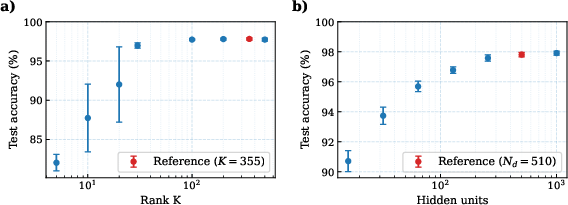
Figure 3: (Left) Test accuracy as a function of coupling rank E(s,u,θ)2; (Right) test accuracy versus the number of hidden units, highlighting expressivity and resource scaling.
The results show that at E(s,u,θ)3 and E(s,u,θ)4, test accuracy reaches E(s,u,θ)5, matching standard digital EP implementations and other analog surrogate architectures. A notable architectural observation is that low-rank parametrizations suffice for competitive performance, and precision constraints (down to 8 bits) incurred negligible degradation, suggesting compatibility with typical SLM resolution limits.
The authors further demonstrate that even minimal configurations (e.g., E(s,u,θ)6, E(s,u,θ)7) outperform linear classifiers. They also validate structured, layered network topologies using multiple SPIM modules to decouple input, hidden, and output units.
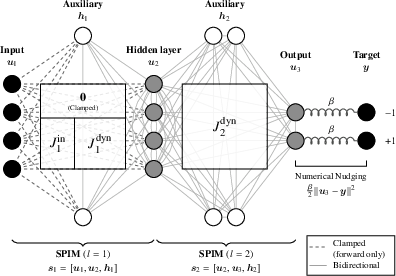
Figure 4: Schematic of a two-layer SPIM architecture, promoting scalable, structured connectivity.
Methodological and Architectural Details
A key innovation is the focal plane division encoding, allowing simultaneous evaluation of parallel Mattis problems within the constraints of typical SLMs. This design is compatible with hardware scaling via (e.g.) wavelength multiplexing. The gauge transformation approach enables the mapping of continuous neuron states onto the SLM. The finite-difference procedure for gradient estimation is adapted to minimize the number of optical measurements per step without significant loss in accuracy.
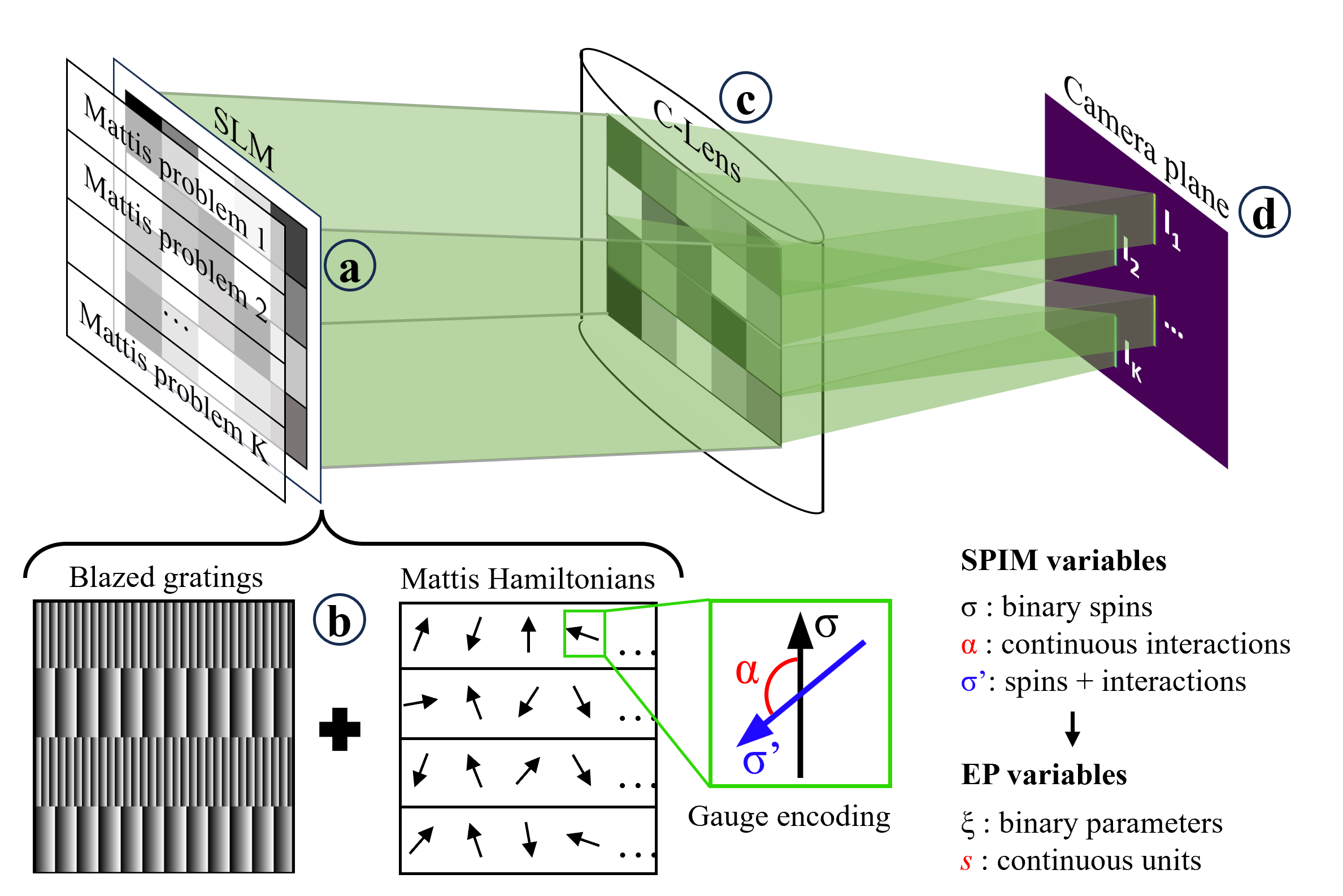
Figure 5: Illustration of the FPD method for encoding multiple Mattis problems on a single SLM to enable efficient parallel optical computing.
Implications and Future Prospects
The results demonstrate the feasibility of hybrid analog-digital EP training using SPIMs for nontrivial ML tasks. The practical impact is twofold: (1) substantial reduction of digital compute requirements for gradient evaluation, directly leveraging the natural physics of photonic hardware, and (2) the integration of scalable, programmable photonic devices with ML workflows while mitigating the need for complex bidirectional or time-reversal optical circuits.
Theoretically, these findings substantiate the equivalence (subject to bounded noise) between energy-based physical neural dynamics and modern ML learning frameworks and motivate new avenues for the development of energy-efficient analog AI accelerators. Open technical prospects include full analog encoding of all parameters (eliminating the current binary constraint), scaling to larger SLM formats, and the deployment of physically deeper—multi-layer—architectures.
Conclusion
This work offers a concrete demonstration and systematic analysis of Equilibrium Propagation realized via photonic Ising hardware. The study positions SPIMs as viable candidates for energy-based learning in neuromorphic photonic computing, delineating both current limitations and clear trajectories for scaling and improved expressivity. Advances in SLM technology and integrated photonics are expected to further expand the application scope and efficiency of EP-based physical learning systems.

