- The paper demonstrates that including inelastic gluon-radiation processes moderately reduces transport coefficients relative to elastic-only dynamics.
- It utilizes the Dynamical Quasiparticle Model (DQPM) with lattice QCD constraints to compute shear viscosity, bulk viscosity, electric conductivity, and baryon diffusion.
- Results confirm that elastic scatterings dominate QGP relaxation, validating hydrodynamic models for heavy-ion experiments.
Transport Coefficients of Strongly Interacting Quark-Gluon Plasma with Elastic and Inelastic Scattering in the DQPM
Introduction
The quark-gluon plasma (QGP), produced under extreme conditions in relativistic heavy-ion collisions, is characterized by nontrivial transport properties—shear viscosity (η), bulk viscosity (ζ), electric conductivity (σQ), and baryon diffusion coefficient (κB)—that dictate its response to gradients and external perturbations. Determining these coefficients from quantum chromodynamics (QCD) remains challenging due to the difficulties of extracting real-time information from lattice QCD, especially at finite baryon chemical potential (μB), where the sign problem impedes first-principles calculations. Effective models, particularly those grounded in quasiparticle physics and constrained by lattice data, are critical for predicting QGP transport in both equilibrium and baryon-rich regimes.
This essay presents an expert summary of "Transport coefficients of strongly interacting quark-gluon plasma including elastic and inelastic scattering within the dynamical quasiparticle model" (2606.13363), which utilizes the Dynamical Quasiparticle Model (DQPM) to systematically analyze the impact of inelastic gluon-radiation (2→3) processes on QGP transport coefficients, complementing the conventional elastic (2→2) baseline. The study spans the (T,μB) plane and provides quantitative predictions that are essential for hydrodynamic and transport modeling in heavy-ion experiments.
The Dynamical Quasiparticle Model
DQPM models the QGP as an ensemble of strongly interacting quarks, antiquarks, and gluons endowed with medium-dependent masses and spectral widths, constructed such that thermodynamic observables agree with lattice QCD at μB=0. Quasiparticle propagators feature complex self-energies, with real parts encoding dynamically generated masses and imaginary parts defining reaction rates.
DQPM's coupling constant, g2(T,μB), is extracted via a parameterization that matches entropy density to lattice QCD; the extension to finite ζ0 employs a scaling hypothesis based on effective temperature ζ1 and a ζ2-dependent critical temperature. The quasiparticle spectral functions, masses, and widths are tuned accordingly, enabling the consistent calculation of thermal quantities and transport coefficients.
Microscopic Scattering Processes
Elastic (ζ3) and Inelastic (ζ4) Channels
The study includes all elastic and inelastic channels relevant for light and strange quarks, antiquarks, and gluons. Leading-order Feynman diagrams are computed explicitly for:
- Elastic: ζ5, ζ6, ζ7
- Inelastic (gluon emission): ζ8, ζ9
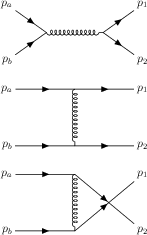
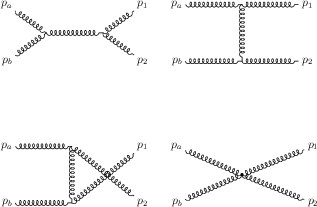
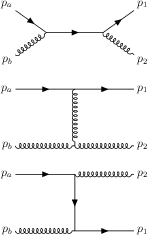
Figure 1: Leading-order Feynman diagrams for σQ0 (left), σQ1 (center), and σQ2 (right) processes.
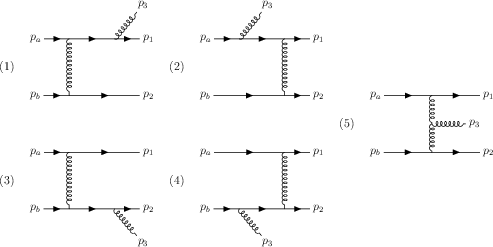
Figure 2: Leading-order Feynman diagrams for σQ3 in the σQ4 channel, capturing gluon radiation.
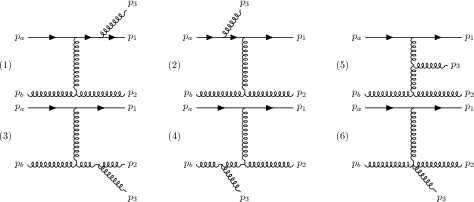
Figure 3: Leading-order Feynman diagrams for σQ5 in the σQ6 channel, representing inelastic emission.
Matrix elements are calculated using modified propagators and vertices consistent with DQPM's effective masses and widths. The σQ7 processes specifically focus on gluon-radiation with massive outgoing gluons. All possible interference terms are included, and the σQ8 process is estimated via scaling relations due to the complexity of its diagrammatic representation.
Relaxation Times and Interaction Rates
Relaxation times σQ9 are determined via momentum-dependent interaction rates:
κB0
where the full set of elastic and inelastic contributions is considered. While the formalism does not include the inverse κB1 channels (required for detailed balance in the collision operator), their contribution is argued to be subleading due to thermal mass and phase-space suppression.
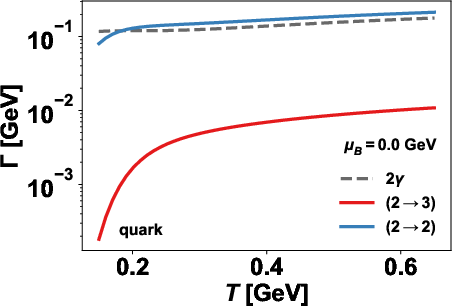
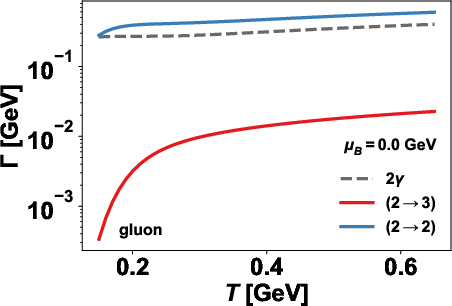
Figure 4: Momentum-averaged on-shell interaction rates for light quarks (upper plot) and gluons (lower plot) as a function of κB2, at fixed κB3. κB4 processes dominate over κB5.
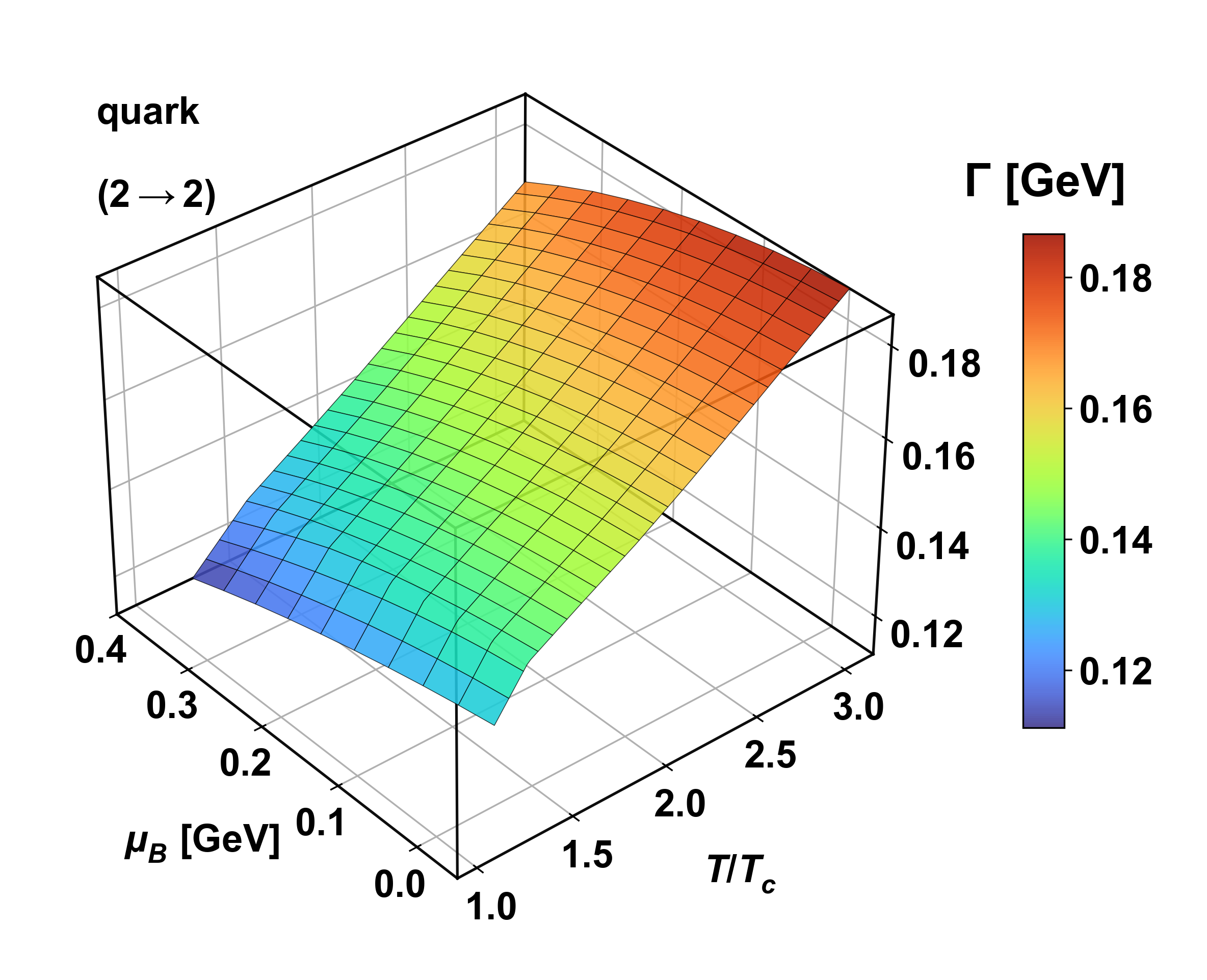
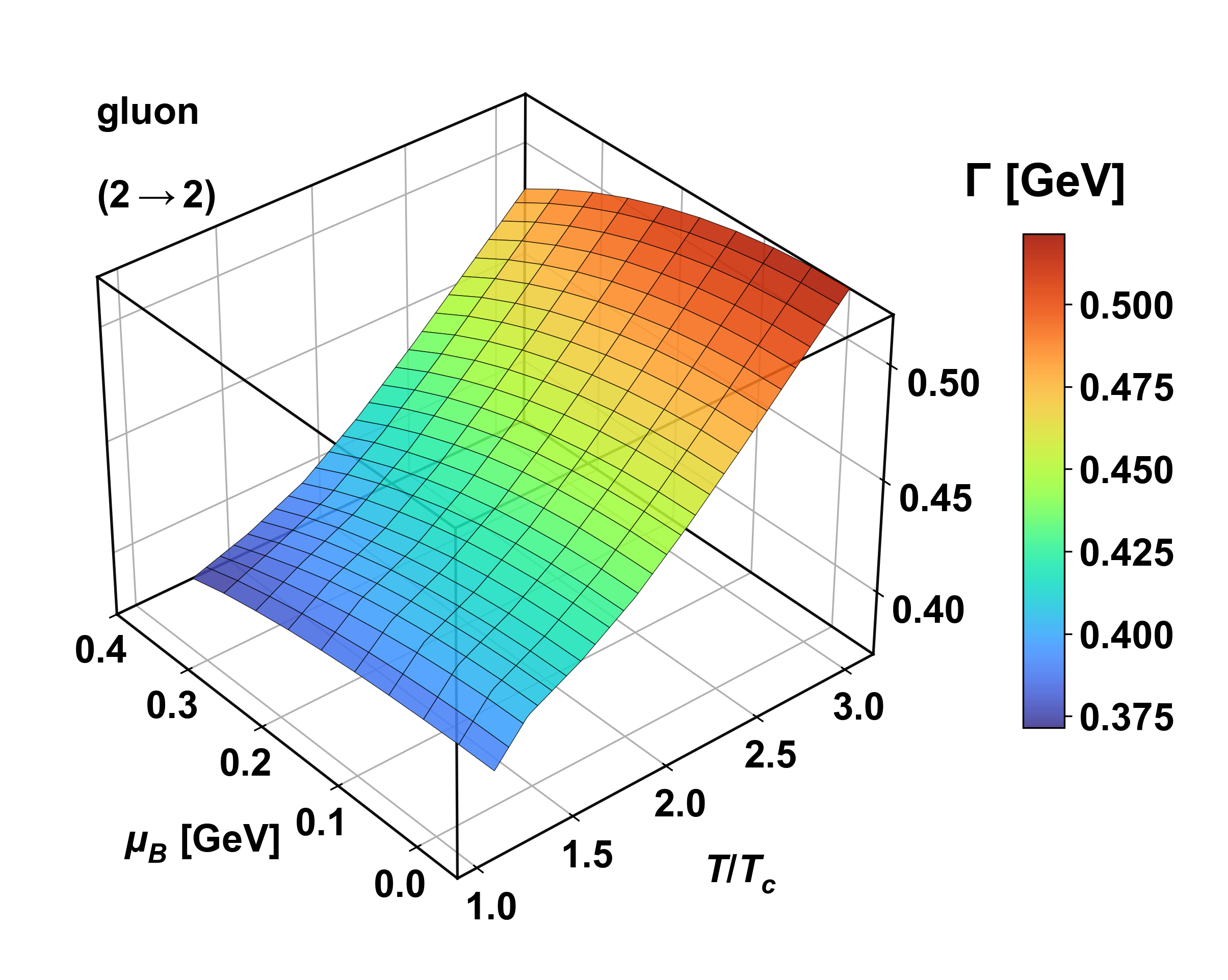
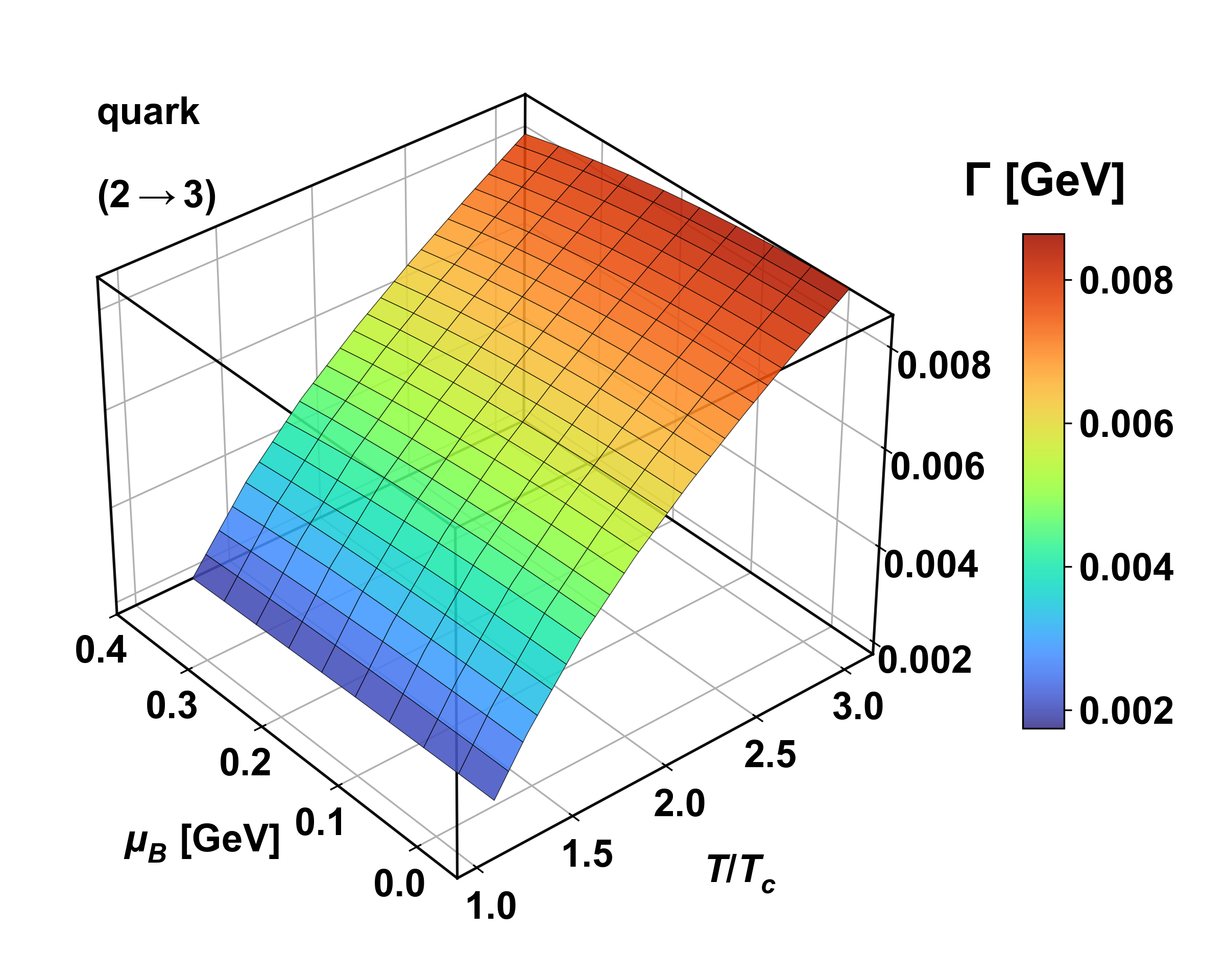
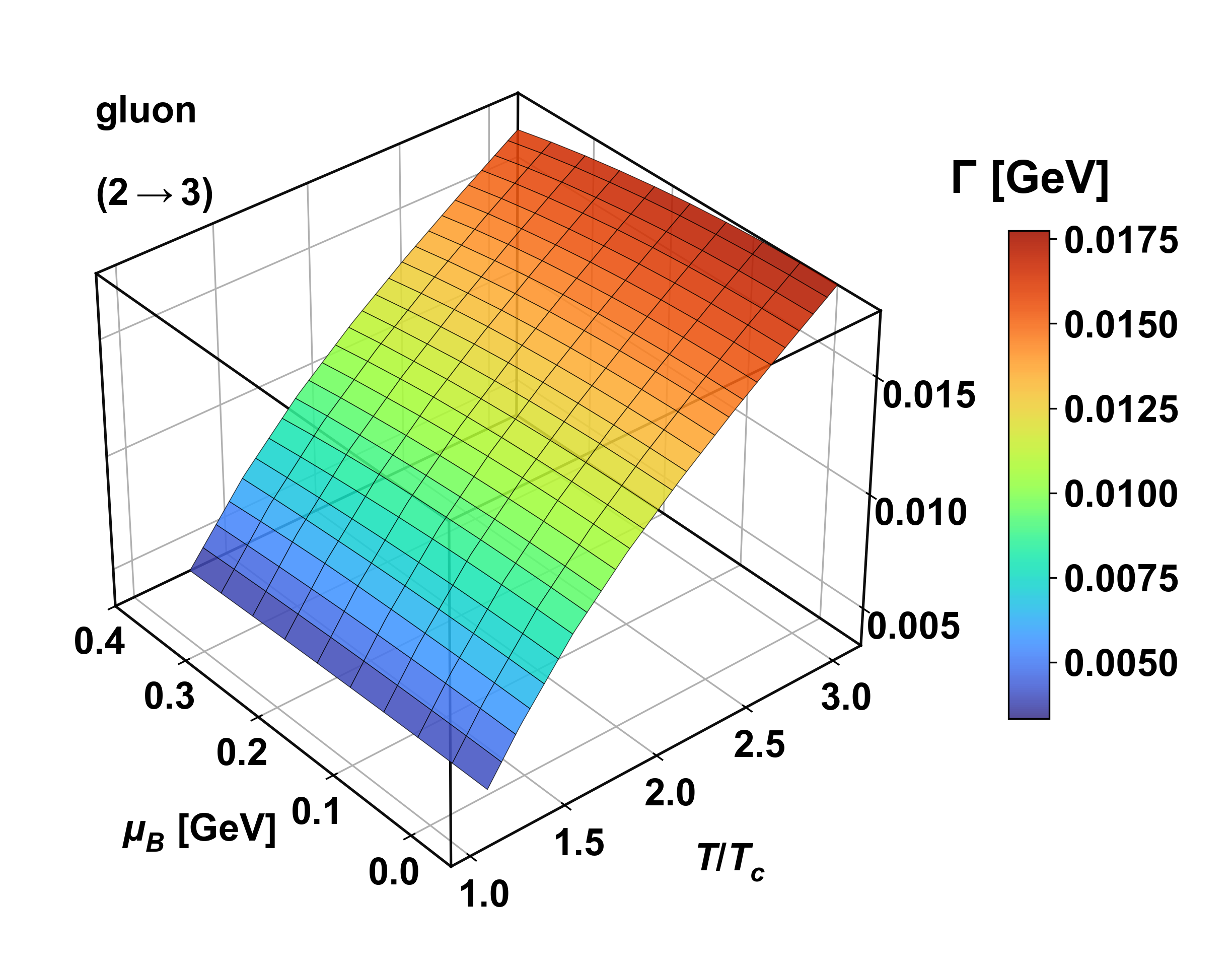
Figure 5: Interaction rates for quarks (left) and gluons (right), showing κB6 (upper plots) and κB7 (lower plots) processes as functions of κB8 and κB9.
Numerically, μB0 rates are an order of magnitude lower than elastic scattering rates, especially in the thermal domain. Their significance increases mainly at higher momenta, but these are suppressed in a strongly interacting QGP.
Calculation of Transport Coefficients
All transport coefficients—shear viscosity, bulk viscosity, electric conductivity, and baryon diffusion—are evaluated in the relaxation-time approximation (RTA), which is numerically consistent with one-loop Kubo-type calculations in this context.
- Shear viscosity (μB1): Quantifies momentum diffusion; evaluated via RTA utilizing momentum-dependent relaxation times.
- Bulk viscosity (μB2): Sensitive to deviation from conformal symmetry; also computed with RTA, weighted by a non-conformal term.
- Electric conductivity (μB3): Governs charge transport and electromagnetic field response; only quarks and antiquarks contribute directly.
- Baryon diffusion (μB4): Describes baryon number transport; gluons affect only indirectly through their influence on quark relaxation times.
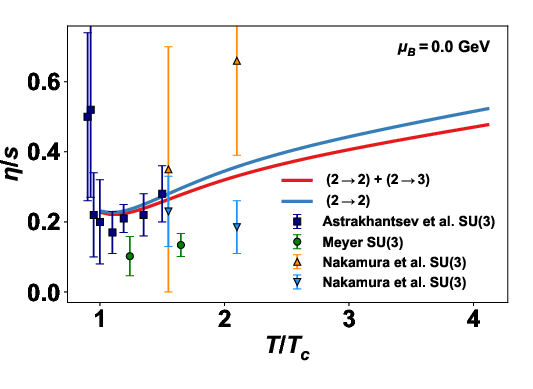
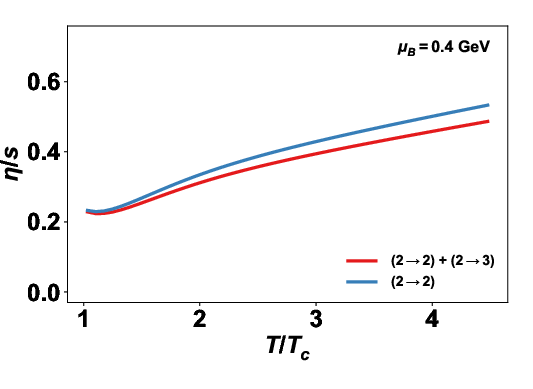
Figure 6: μB5 vs μB6 at μB7 (upper) and μB8 GeV (lower). Inclusion of μB9 processes reduces 2→30 moderately; lattice QCD values included for comparison.
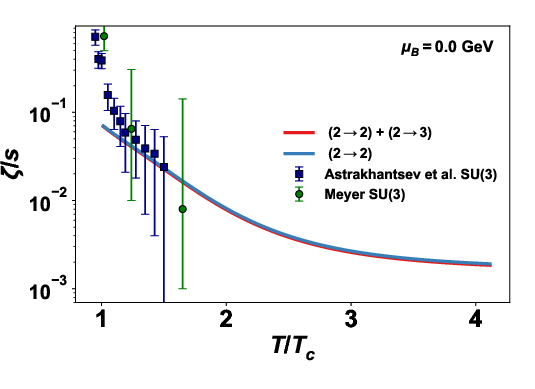
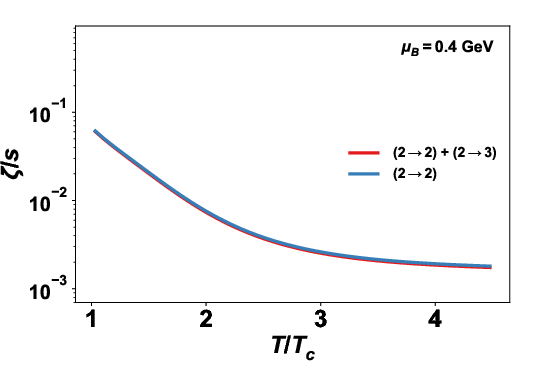
Figure 7: 2→31 vs 2→32 at 2→33 (upper) and 2→34 GeV (lower). 2→35 processes yield negligible corrections; calculations agree with pure SU(3) lattice results.
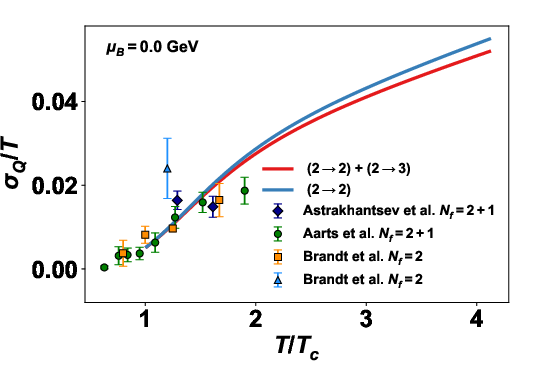
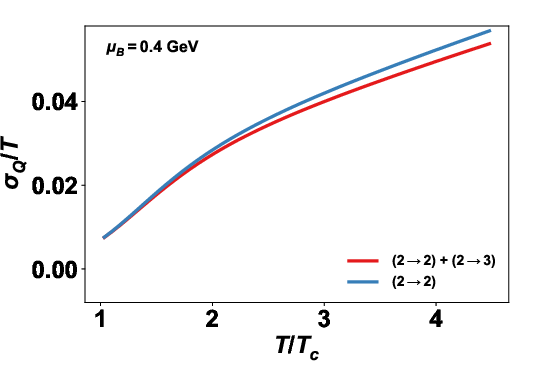
Figure 8: 2→36 vs 2→37 at 2→38 (upper) and 2→39 GeV (lower). 2→20 inclusion leads to a modest reduction, consistent with lattice QCD results.
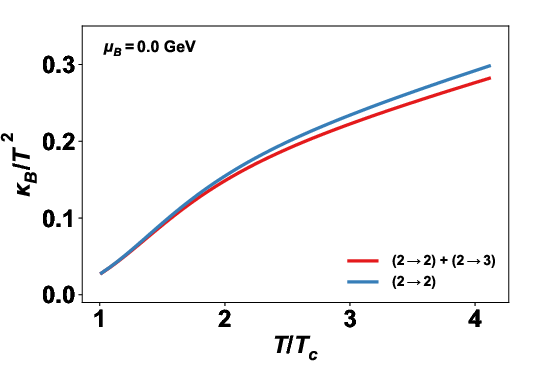
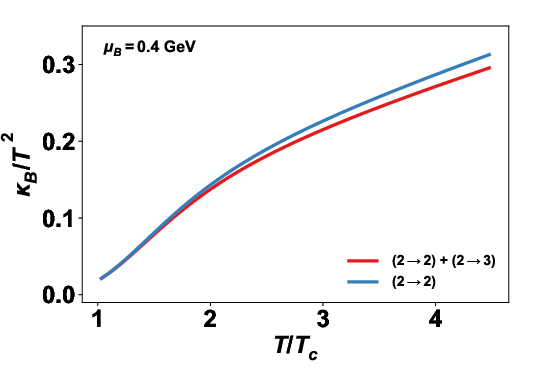
Figure 9: 2→21 vs 2→22 at 2→23 (upper) and 2→24 GeV (lower). The effect of inelastic processes is minor across the temperature and density ranges.
Results demonstrate that radiative inelastic channels systematically reduce all transport coefficients relative to the elastic-only baseline, but these reductions are moderate. The dominant contribution stems from elastic scatterings, and the qualitative temperature and 2→25 dependence remains unchanged. Agreement with lattice QCD is observed at 2→26 for 2→27, 2→28, and 2→29.
Implications and Future Directions
The study reinforces the robustness of DQPM-based transport calculations against the inclusion of inelastic radiative channels. For practical purposes, the moderate reduction indicates that hydrodynamic and transport models employing only elastic rates remain quantitatively reliable. At finite (T,μB)0, the results extend predictive capability to baryon-rich regimes relevant for RHIC-BES, FAIR, and NICA experiments.
Theoretically, the negligible contribution from (T,μB)1 processes (apart from high-momentum tails) asserts the dominance of quasiparticle-based elastic dynamics in strongly coupled QGP. The approach underlines the importance of model consistency with lattice constraints and dynamical propagator structure.
Prospects for future improvements include:
- Incorporation of full detailed balance with inverse (T,μB)2 channels.
- Extensions to include critical phenomena near the QCD critical endpoint (CEP).
- Applications to jet quenching and early-time non-equilibrium QGP evolution.
- Comparison against Bayesian extractions of transport coefficients from experimental data.
Conclusion
This analysis establishes that inelastic gluon-radiation ((T,μB)3) processes provide only a minor quantitative correction to QGP transport coefficients in the DQPM framework; elastic scatterings overwhelmingly dictate thermodynamic relaxation and transport. Results are consistent with lattice QCD constraints at zero and finite baryon chemical potential, validating DQPM for use in phenomenological modeling of heavy-ion collisions. The study expands the microscopic foundation for hydrodynamic simulations and offers theoretical guidance for future explorations of non-perturbative QCD matter (2606.13363).