- The paper identifies a connected operating band in a dissipative quantum reservoir that consistently achieves top-quartile performance across diverse tasks.
- It employs a three-dimensional parameter search over input drive, coupling, and damping, demonstrating that controlled forgetting is key to memory capacity.
- Task-free diagnostics like memory capacity and information-processing capacity reliably forecast the operational regime, streamlining hyperparameter tuning for QRC.
Transferable Operating Regimes in Dissipative Quantum Reservoir Computing
Introduction and Motivation
Quantum Reservoir Computing (QRC) leverages the intrinsic, high-dimensional dynamics of fixed quantum systems for temporal machine learning tasks, while training is restricted to a simple linear readout. This paradigm is suited to contemporary quantum hardware, as the quantum dynamics are unoptimized and robust to hardware noise but critically depend on the ongoing selection of dynamical parameters. However, a key unresolved issue concerns the demarcation of those regions in a system’s control parameter space that consistently yield strong computational performance, independent of particular tasks or stochastic initializations. The focal contribution of this work is a comprehensive empirical and mechanistic mapping of such operating regimes in a canonical dissipative gate-model quantum reservoir, emphasizing their transferability and mechanistic origin (2606.13284).
Methodology and Protocol
Reservoir Model and Controls
The reservoir consists of a small ring of qubits subject to recurrent updates. On each input cycle, a scalar value is encoded across all qubits by a global Ry rotation with strength β, followed by L layers of static random local mixers (Rx rotations), nearest-neighbor ZZ coupling of strength λ, and local amplitude damping parametrized by γ. The full state is propagated without resets, embedding a memory of the past trajectory in the quantum state ρt,L after each step. Only linear regression over local Z and ZZ expectation values is trained.
Three physical controls frame the search space:
- Input drive (β0): Controls input injection without full overwrite.
- Coupling (β1): Mediates nonlinear internal mixing.
- Damping (β2): Enables controlled (partial) forgetting in the temporal memory.
A three-dimensional grid over these parameters is explored, with rigorous splits ensuring that operating regions are defined entirely on validation data.
Evaluation Strategy
Performance is benchmarked over four diverse time-series tasks: Mackey–Glass, Lorenz, NARMA, and sunspot predictions, which span smooth chaos, nonlinear memory, and irregular, real-world data. Normalized mean squared error (NMSE) is used, and comparisons are based on within-seed, within-task percentile ranks to avoid artifacts from scale differences across tasks.
An “operating band” is defined by aggregating those hyperparameter settings that land in the top percentile of performance for the majority of task/seed replicates, formalizing the notion of a robust and transferable regime. Transferability is measured by leave-one-out across both tasks and reservoir initializations. Mechanistic grounding is sought through systematic ablations, where individual dynamical elements (damping, mixing, readout structure) are removed.
Mapping and Characterization of the Operating Band
The central finding is the empirical identification of a connected operating region—the “band”—in which the quantum reservoir operates consistently well across all tested tasks. Notably, the location and extent of this region are not sensitive to the exclusion of any individual task or initialization.
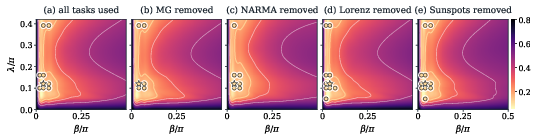
Figure 1: The operating region (bright area) in the β3 plane at β4 remains unchanged even as different tasks are withheld, signifying transferability.
The operating band is strongly dependent on the damping parameter: negligible damping yields no stable region, while moderate β5 (typically β6) is optimal. This highlights the necessity for “controlled forgetting” akin to the fading memory property in classical reservoirs.
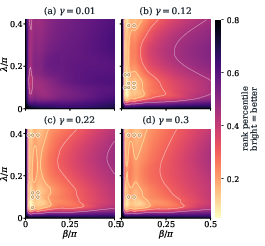
Figure 2: Controlled forgetting through intermediate damping rates is essential; the band appears only at moderate values of β7.
Quantitatively, the band identified on validation data retains mean ranks in the top quartile on holdout splits and under leave-one-out evaluations. Specifically, the mean held-out rank when dropping one task or seed is 0.193 and 0.151, respectively (chance is 0.5). Variations in architecture (e.g., extra layers) shift the precise locations but not the existence or qualitative features of the band, indicating the persistence of the underlying regime.
Mechanistic Origin and Ablations
Mechanism ablation studies confirm that the operating band arises from the joint action of the three physical controls:
- No damping (β8): The region disappears; no robust operating band is observed.
- Removing the recurrent mixer or replacing amplitude damping with dephasing/depolarizing noise: Likewise destroys or dilutes the regime.
- Readout restriction (to β9-only or L0-only observables): Results in no coordinates satisfying the stable band criterion.
In all cases, former high-performing coordinates experience substantial rank loss, often dropping performance to chance. Hence, the combinatorial presence of nonlinear mixing, partial input overwrite, and engineered dissipation is required for the emergence of a robust QRC regime.
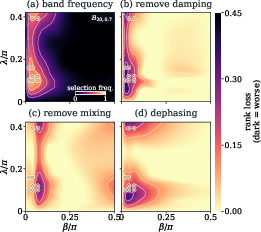
Figure 3: Mechanism ablation studies reveal the destruction of the operating band under removal of damping, mixing, or specific quantum noise mechanisms.
Task-Free Band Identification and Capacity Diagnostics
A salient practical feature is that the location of the band can be predicted purely from task-free memory diagnostics. Both memory capacity (MC) and general information-processing capacity (IPC) accurately recover the band structures in advance, whereas simple feature diversity does not correlate with computational utility. The task-free L1 map directly mirrors the operating band, and higher MC corresponds to lower validation rank (Spearman L2).
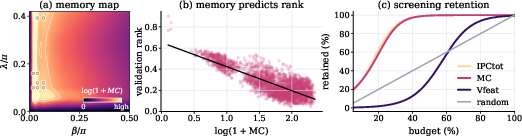
Figure 4: Task-free memory capacity accurately forecasts the region of high computational performance, offering ultra-efficient band screening.
Implications and Future Directions
The existence of a transferable, mechanistically anchored operating regime has several theoretical and practical implications:
- Theoretical: The observed regimes parallel the role of fading memory and echo state properties in classical RC, but are here mediated by quantum dynamical resources. The study demonstrates that mere Hilbert space growth or diversity increase does not guarantee computational efficacy; strong memory effects and nonlinearity, delicately balanced via dissipation and coupling, are the operative ingredients.
- Practical: The bulk of hyperparameter tuning in near-term QRC architectures can be circumvented. A single calibration of memory capacity, using no task-specific data, is predictive of the reservoir’s suitability across a range of tasks and initializations. This streamlines deployment and enables platform-agnostic operating manuals for QRC devices.
- Further Work: The present findings pertain to idealized simulations (exact density matrix propagation, noiseless measurement). Extending these results to noisy and finite-shot experiments, and in particular analyzing the effect of realistic device noise and measurement backaction, presents promising avenues for future research. Additionally, the extension to larger systems and different QRC architectures remains open.
Conclusion
This paper establishes that consistent, high-performance quantum reservoir computing is attributable to a transferable operating band delineated by specific dynamical balances of input drive, coupling, and engineered dissipation. The region is mechanistically supported and robust to architectural variability, and can be located using only unsupervised memory diagnostics. These findings clarify both the principles underlying quantum dynamical AI and offer practical protocols for the operation and calibration of QRC hardware.

