- The paper demonstrates that topological zero modes induce a period-doubling in the interference oscillations of zero-mode transfer probabilities compared to bulk excitations.
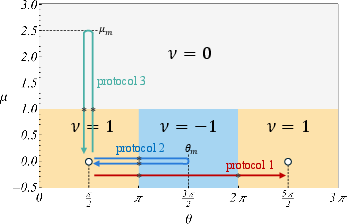
- It employs three distinct closed quench protocols in the generalized Creutz ladder model to quantify how phase accumulation and topological sectors affect dynamical interference.
- A WKB analysis links a halved energy gap in nontrivial sectors to the observed oscillation behavior, providing a measurable connection to edge-local particle number deviations.
Interference of Critical Dynamics Associated with Topological Zero Modes
Introduction and Motivation
The nonequilibrium dynamics of topological quantum systems undergoing phase transitions is a significant topic for understanding fundamental aspects of quantum matter and developing protocols for quantum control. This paper systematically studies interference phenomena arising from critical dynamics associated with topological zero modes (ZM) in the generalized Creutz ladder model. By leveraging closed quench protocols crossing two successive critical points, the work reveals how interference signatures—traditionally associated with bulk excitations—are uniquely modified by the presence of topological boundary zero modes. The central observables are the zero-mode transfer probability and its direct connection to edge-local particle number deviations, both serving as highly sensitive probes of topological dynamical processes.
Model: Generalized Creutz Ladder and Quench Protocols
The generalized Creutz ladder Hamiltonian incorporates leg, rung, and diagonal hopping parameters and associated phases, expanding the parameter space to enable detailed exploration of various quench paths and topological regimes. Open boundary condition (OBC) spectra host exponentially localized zero modes within the topological sectors, with the winding number classifying the system's bulk phase.
Three distinct closed quench protocols are employed (see (Figure 1) below):
Numerical Results: Zero-Mode Transfer and Interference Patterns
The core observable is the zero-mode transfer probability, π/26, which quantifies occupation transfer between initially filled and partner zero modes due to dynamical evolution. For each protocol, both π/27 and the bulk excitation density π/28 are measured as functions of the primary sweep time π/29. Each is decomposed into a smooth background and oscillatory term reflecting interference from two Landau-Zener passages:
5π/20
Major findings include:
- Protocol 1: 5π/21 exhibits an anomalous power-law envelope (5π/22) on top of a clear oscillatory component, with the oscillation period doubled compared to the bulk excitation density. This period doubling is a direct manifestation of topological zero-mode physics disrupting the canonical Stueckelberg interference period observed for bulk states.
- Protocol 2: While 5π/23 also decays rapidly, its oscillatory component is strongly suppressed; no stable oscillations are identified in the zero-mode channel, despite ongoing oscillations in 5π/24.
- Protocol 3: 5π/25 stabilizes near 5π/26 for all 5π/27, with oscillations at the same period as the bulk. The zero-mode sector, being embedded in the trivial region during the ramp, behaves analogously to the bulk.
These observations indicate that the pattern of interference in zero-mode observables depends delicately not only on the presence of successive critical crossings but also on the topological sector and whether phase accumulation occurs within trivial or nontrivial regions.
WKB Analysis: Period Doubling and Energy Gap Structure
To explain these phenomena, the authors use a WKB-based analysis. The key technical insight is that the interference phase responsible for oscillations in observable probabilities is obtained by integrating the relevant energy gap along the segment of the quench path between the two critical points.
For the bulk sectors, the phase accumulation is governed by the energy splitting across the full single-particle gap. For OBC zero modes, however, the relevant energy splitting is halved in the nontrivial sector, as demonstrated in (Figure 2). This robustly explains the period doubling observed in protocol 1: the phase accumulation rate is halved, so oscillations in 5π/28 have double the period compared to 5π/29.
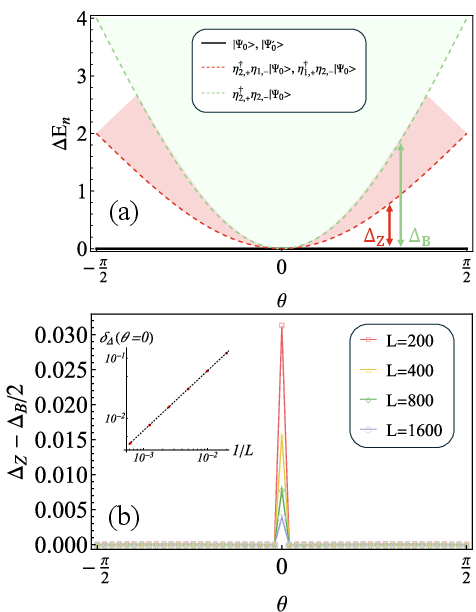
Figure 2: Comparison between the OBC energy gap (red) and the corresponding bulk PBC gap (green). In the topological phase, the zero-mode gap is half the bulk gap, leading to period doubling in interference patterns.
When the central portion of the protocol lies within the trivial phase, as in protocol 3, the zero-mode pair merges with bulk states, resulting in no such reduction in phase accumulation, and the periods coincide.
Moreover, the analytical form of the interference phase follows the LZS and Stueckelberg paradigm, but is selectively modified by the topological protection and localization properties of the zero modes, providing clear evidence for the unique role of topology in quantum dynamical interferometry.
Boundary Observables and Experimental Relevance
The zero-mode transfer probability is not a directly local observable but can be inferred from the change in edge-local particle numbers—effectively the deviation of the boundary occupation from its initial fractional value. This connection is visualized in (Figure 3) and (Figure 4):
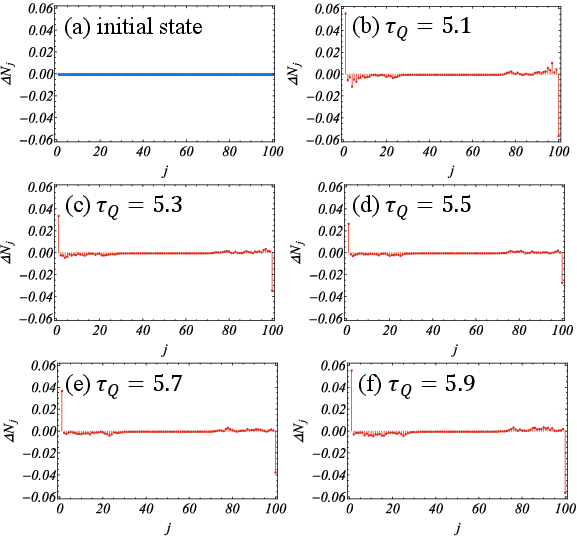
Figure 3: Deviation profiles for boundary and bulk rungs after protocol 1 for various sweep times μ=00. The edge defect is primarily localized at the left boundary.
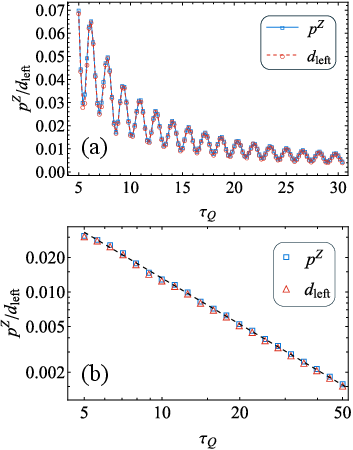
Figure 4: Direct comparison of the zero-mode transfer probability μ=01 and the left edge defect μ=02 as a function of μ=03; both show matching period-doubled oscillations.
This direct, local marker is critical for current quantum-simulation experiments (e.g., cold-atom quantum microscopes, Rydberg arrays), where site-resolved number measurements are accessible. Thus, the dynamical signatures predicted for edge defects are directly measurable and provide a practical diagnostic for detecting interference effects tied to topological zero modes.
Implications and Outlook
- Theoretical Insight: The connection between zero-mode dynamics and nontrivial modifications to quantum critical interference generalizes the standard Kibble-Zurek and LZS-Stueckelberg paradigms, establishing new universality classes of edge defect production and interference when topology is present.
- Experimental Accessibility: The edge-local observables are compatible with high-fidelity, site-resolved quantum simulation platforms, suggesting that these predictions can be directly tested in engineered ladder geometries, photonic systems, or synthetic dimensions.
- Quantum Control: The sensitive dependence of zero-mode interference on topological sector and quench path provides a powerful method to probe and manipulate edge state populations, with implications for robust quantum information storage and readout in topological devices.
Future directions include extending these concepts to interacting systems, exploring the interplay with disorder-induced topological zero modes, and designing multi-path interferometry protocols in more complex or higher-dimensional topological systems.
Conclusion
This work provides a comprehensive account of the interference of critical dynamics associated with zero modes in the generalized Creutz ladder. By combining numerics, WKB analysis, and explicit connection to boundary observables, it characterizes how topological zero modes induce unique modifications to dynamical interference phenomena—most strikingly, period doubling of interference oscillations and the emergence of robust, measurable edge signatures. These results both clarify the interplay between topology and nonequilibrium quantum criticality, and open new avenues for probing nonadiabatic quantum dynamics in engineered systems.
Reference: "Interference of critical dynamics associated with zero modes" (2606.13200)