- The paper introduces an exact propagator formalism showing that multiple weak links excite quantum interference, undermining standard hydrodynamic predictions.
- It employs Bessel function expansions and semiclassical paths to detail density oscillations and deviations from ballistic behavior.
- Numerical validation demonstrates that coherent scattering between defects restores classical hydrodynamics only in the infinite-time limit.
Double-Weak-Link Interferometry of Hard-Core Bosons: Quantum-Interference Dominated Hydrodynamic Breakdown
Physical System and Motivation
The study centers on the non-equilibrium dynamics of a one-dimensional hard-core bosonic lattice gas initialized in a domain-wall configuration and evolving under Hamiltonians featuring two spatially separated weak links—conformal defects characterized by transmission amplitudes independent of wavelength. The precise microscopic implementation utilizes the XX spin chain mapped to free fermions via Jordan-Wigner transformation, with defects introduced as staggered local potentials and modified nearest-neighbor hopping terms.
A key operational motivation is probing the boundaries of generalized hydrodynamics (GHD), whose utility for integrable quantum gases hinges on an emergent classical ballistic quasi-particle picture. Existing GHD frameworks adequately describe single defect scenarios, but the dynamical interplay of multiple weak links—a double-defect interferometric setup—remains analytically unexplored.
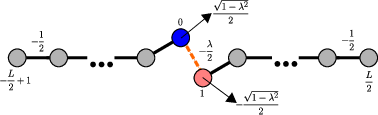
Figure 1: Sketch of the nearest-neighbor hopping Hamiltonian H^ with a single conformal defect.
The propagator Kt(x,y) correlates the evolution of fermion operators under the defect-laden Hamiltonian. By explicit diagonalization in the single-particle sector, the analysis yields a series expansion in Bessel functions, with structure determined by classical paths involving transmissions and reflections at the defects.
The critical result is that for two defects, the propagator is expressed as a sum over infinite sequences of paths corresponding to particles undergoing multiple reflections between the defects, each weighted by defect-dependent amplitudes and phase factors. Analytical expressions are derived for all combinations of spatial positions relative to defect locations (left, center, right), capturing comprehensive quantum coherence effects beyond the scope of local hydrodynamic boundary conditions.
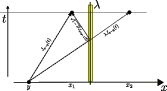
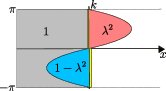
Figure 2: Quasi-particle picture and hydrodynamic description for a single defect; transmission/reflection amplitudes T(λ) and R(λ) dictate path weights.
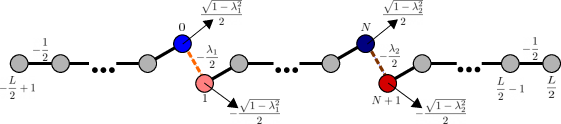
Figure 3: Schematic of the system with Hamiltonian H^ for two defects, showing spatial separation and local modifications.
Density Dynamics: Quantum vs Euler-scale Hydrodynamics
Post-quench dynamics from the domain-wall initial state are computed via both the propagator and corresponding phase-space occupation functions. Strong quantum-interference effects manifest at the level of the density profile, particularly in regions adjacent to the defects and within the inter-defect interval.
The exact density profiles, evaluated via sums and products of Bessel functions, and compared to numerically exact simulations, demonstrate marked deviations from hydrodynamic predictions. The latter, using only diagonal terms, fail to capture emergent coherent oscillatory features—interference fringes—arising from repeated multiple reflections.
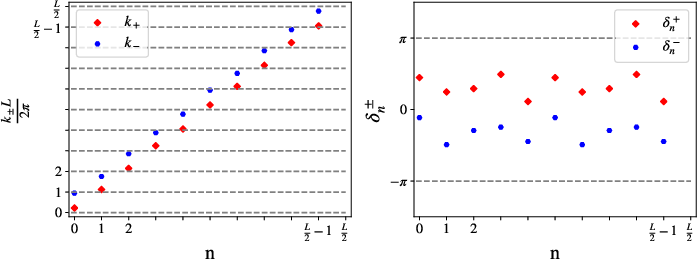
Figure 4: Quasi-momentum quantization for double defect scenario; allowed values k+ (red) and k− (blue) compared to clean chain spectrum.
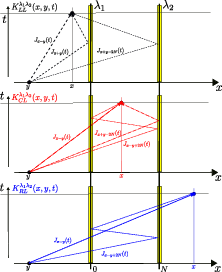
Figure 5: Semiclassical picture of propagators for different regions (L, C, R), illustrating classical paths for multiple scattering at defects.
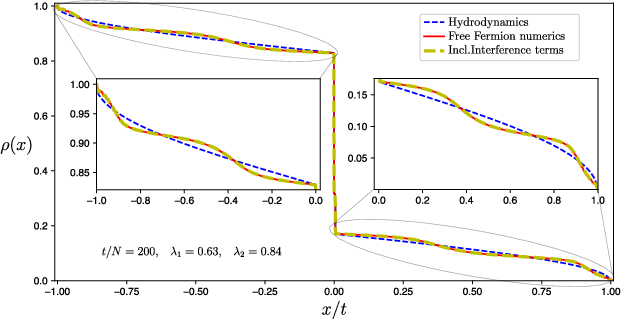
Figure 6: Density profile for the free expansion from domain-wall initial state, analytic vs numerical results for two defects; quantum interference manifests as oscillatory deviations from Euler-scale hydrodynamics.
Asymptotic Transmission and Classicalization at Infinite Times
At long times, the system approaches a classical regime where interference-induced corrections are washed out by averaging over many paths. The effect of the two defects combines into a composite transmission amplitude Tλ(k), which is quasimomentum dependent and admits explicit analytic form. This composite defect in the asymptotic limit restores an effectively classical hydrodynamic description, with density profiles predicted via momentum integration over Tλ(k).
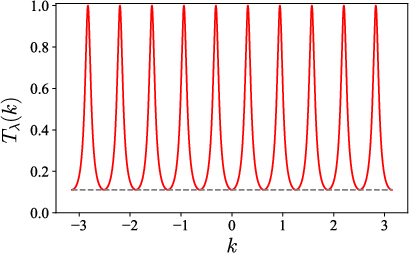
Figure 7: Transmission amplitude Tλ(k) vs. quasimomentum for two defects; minima and maxima at discrete Kt(x,y)0 values.
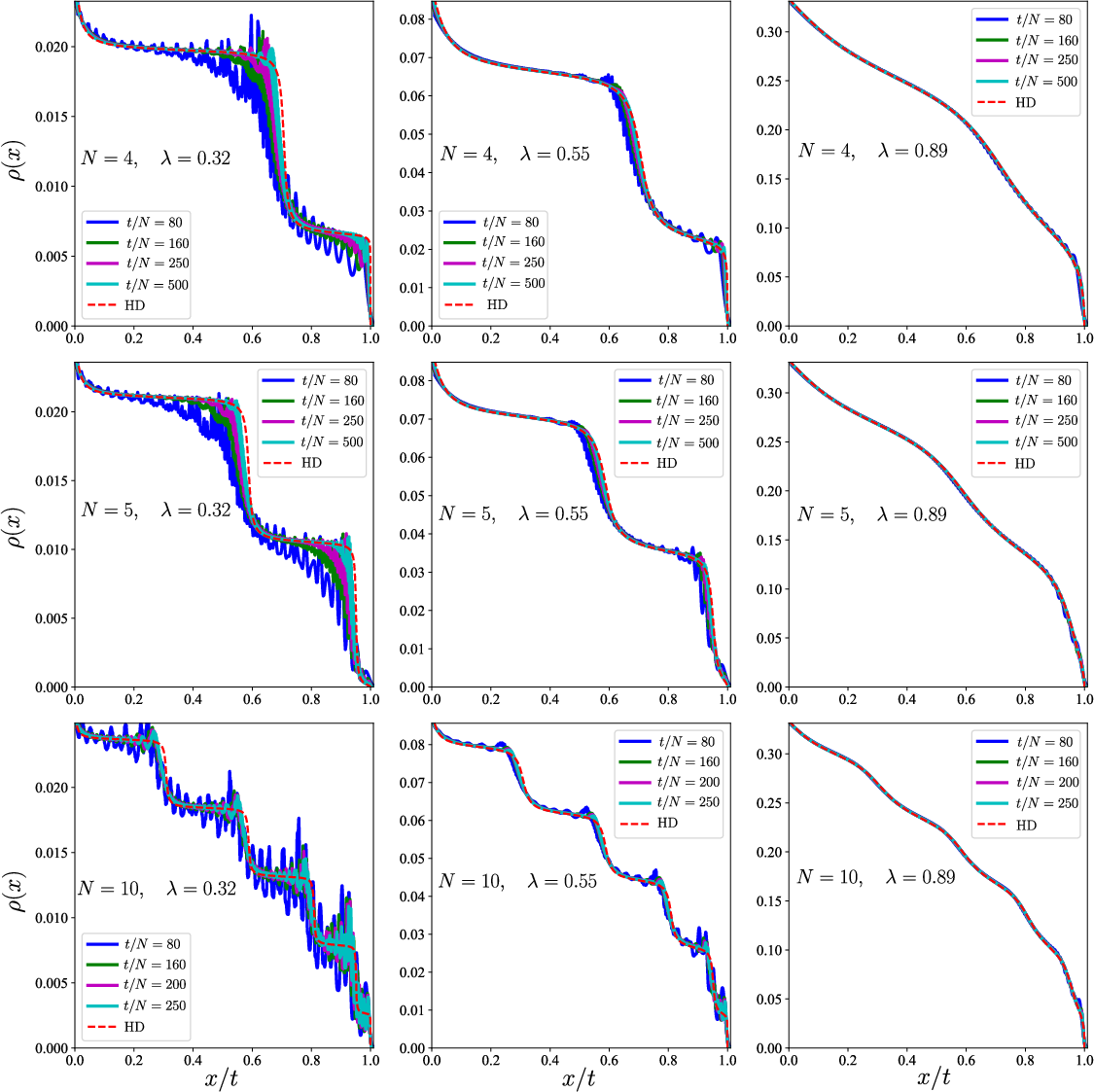
Figure 8: Convergence of density profiles to infinite-time asymptotics on the right side of the composite defect, contrasting different defect separations and strengths; numerical results approach hydrodynamic predictions.
Numerical Validation and Strong Results
The propagator formalism, analytical density profile expressions, and semiclassical interpretations are benchmarked against numerically exact free-fermion simulations. The correspondence is perfect, confirming the necessity and sufficiency of quantum interference corrections for accurately capturing system dynamics at all finite times. The hydrodynamic approach, by contrast, systematically fails when multiple defects are present, confirming an explicit breakdown except in the infinite-time regime.
Contradictory to standard GHD expectations, the presence of multiple conformal defects causes strong quantum deviations from ballistic hydrodynamics, already in the density observable—typically regarded as classical in free models. Closed-form analytic expressions, validated numerically, establish that coherent interference is not a minor correction but a leading-order effect.
Implications and Future Directions
The analytical treatment generalizes semiclassical hydrodynamic intuition by incorporating multiple-scattering coherence effects, creating a bridge between microscopic quantum propagators and emergent classical hydrodynamics. These results imply fundamental limitations for GHD-based methods in systems with multiple defects and suggest that operator coherence, even in free systems, can dominate large-scale non-equilibrium observables.
Open theoretical avenues include systematic incorporation of interference corrections into hydrodynamic frameworks, generalization to non-conformal and strongly interacting defects, and application to higher-order correlation observables (e.g., entanglement entropy, negativity). The techniques developed are extensible, offering analytical control for a broader class of quantum impurity and interface problems in integrable many-body dynamics.
Conclusion
This investigation rigorously establishes that the hydrodynamic description of domain-wall melting for hard-core bosons in one dimension breaks down in the presence of two conformal defects. Quantum interference arising from repeated defect-mediated scattering yields coherent spatial density oscillations and non-trivial dynamics, inaccessible to classical GHD approaches except at infinite times. The exact propagator formalism and semiclassical interpretation provide quantitative and qualitative understanding, opening new perspectives for quantum transport and interface problems in integrable systems (2603.29583).