- The paper introduces an operator-based framework demonstrating that causal propagating gravitons induce entanglement between spatially separated masses.
- It derives an effective entanglement generator with a retarded kernel, yielding concurrence that scales as (G•ω_m²/d)(t–d) and is enhanced by squeezed state initialization.
- The analysis clarifies quantum gravity's role by contrasting unitary entanglement generation from commutators with negligible decoherence effects from anti-commutators.
Quantum Gravity Induced Entanglement via Causal Graviton Propagation
Introduction and Motivation
The quantization of gravity remains a central challenge in theoretical physics. Given the non-classical nature of entanglement—its impossibility through LOCC or classical mediators—a promising avenue for revealing the quantum origin of gravity is the generation of entanglement solely via gravitational interactions. The "Quantum Gravity Induced Entanglement of Masses" (QGEM) proposal investigates this concept. Prior treatments predominantly focused on static, non-propagating graviton sectors, encapsulating gravitational influence in effective, often instantaneous, Hamiltonians. The explicit role of propagating degrees of freedom, i.e., causally retarded graviton modes, has not been subject to a detailed operator-based analysis.
This work introduces a framework to probe the causal quantum dynamics of graviton-mediated entanglement. Using the operator formulation within the Feynman–Vernon influence functional, the authors analyze two spatially separated massive quantum oscillators, each confined in harmonic traps and interacting exclusively via quantized gravitational waves. This analysis is conducted in the weak-coupling, non-relativistic regime, and highlights both the generator of entanglement (via the commutator structure) and decoherence (via the anti-commutator structure) in the reduced system dynamics.
System Hamiltonian and Quantization Scheme
The composite system comprises two non-relativistic particles, labeled A and B, each confined to a one-dimensional harmonic oscillator potential separated by distance d:
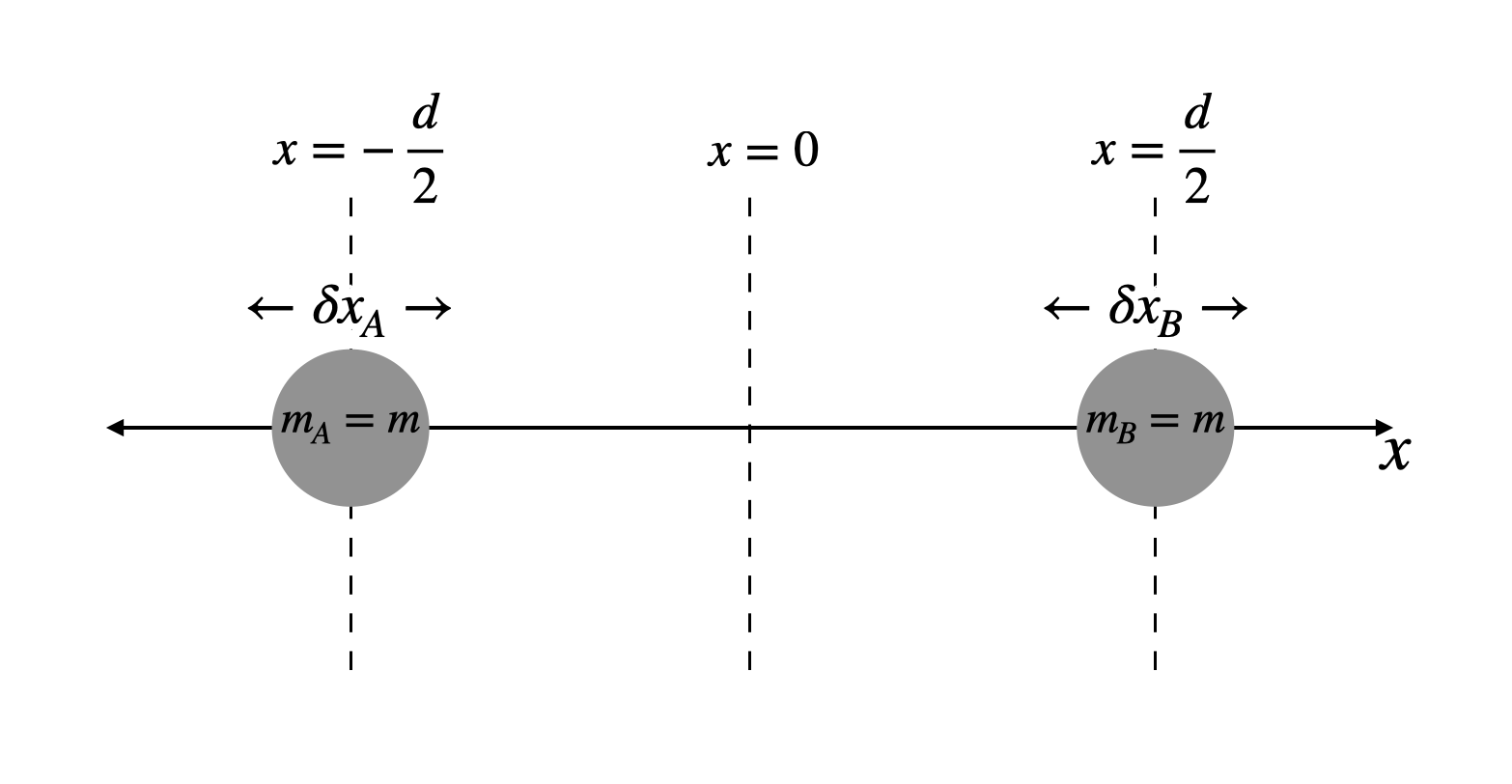
Figure 1: Positions of particles A and B confined in harmonic traps separated by a distance d.
The governing Hamiltonian incorporates: (i) the free oscillator energies for both particles, (ii) a quantized, linearized gravitational field (in the TT gauge), and (iii) their interaction via the energy-momentum tensor coupling to the metric perturbation. In Fock space, each Fourier graviton mode is quantized as a bosonic harmonic oscillator with polarization indices s=+,×.
The effective interaction Hamiltonian between the matter and graviton fields concentrates on the dominant component T11, relevant due to unidirectional oscillator motion. This yields a coupling that is sensitive to particle momentum fluctuations along the oscillator axis and includes explicit spatial dependence through Fourier factors.
Operator-Influence Functional Approach
The reduced dynamics of the particles is derived by tracing out the gravitational vacuum in the joint unitary evolution and resumming via the cumulant expansion. The environmental influence is fully encoded in the two-point (time-ordered) correlation functions of the gravitational field. The evolution is exactly non-Markovian, with explicit two-time integrals, but the Markovian (short-memory) limit is adopted subsequently, justified when the field correlation time is far shorter than characteristic system scales.
The system dynamics separates into two generators:
- K^(−): Arising from commutators of the graviton field, yields unitary, coherent nonlocal interactions. This term is exclusively responsible for the emergence of graviton-induced entanglement.
- K^(+): Arising from anti-commutators, implements decoherence via quantum noise, i.e., field-induced diffusion.
For entanglement generation, only K^(−) is retained; decoherence effects are neglected in this work but constitute a crucial avenue for extension.
Causal Structure and Effective Dynamics
Carrying out the field-theoretic computations with explicit inclusion of the graviton propagator yields a non-instantaneous (retarded) response. After integrating over the quantum metric fluctuations and focusing on cross-terms, the effective generator for entanglement acquires a Dirac delta retarded kernel, enforcing causal order: the cross terms between A and B0 only contribute once a signal traversing distance B1 can mediate their mutual influence. Concretely, the time delay appears as an explicit lower bound in the resulting time integrals.
The resultant effective evolution operator for the joint state is
B2
where B3 is explicitly nonlocal and retarded by a time B4, and proportional to B5 in the weak coupling, non-relativistic regime.
Quantitative Results: Entanglement Generation
Ground State Initialization
When both particles begin in separable oscillator vacuum states, the propagating graviton interaction induces transitions into the second excited states, resulting in a weakly entangled superposition over B6. The concurrence—a direct entanglement monotone—scales as
B7
after accounting for the time delay B8 due to causal propagation. Numerical estimates under reasonable experimental parameters (B9 m, d0 Hz, d1 s) yield values of concurrence on the order of d2, consistent with the expected minute magnitude of gravitationally-induced effects in the quantum regime.
Squeezed State Initialization
Entanglement generation is substantially enhanced if the oscillators are initialized in separable squeezed vacuum states. The concurrence retains the same scaling as in the ground-state case, but multiplied by an exponential factor:
d3
where d4 is the squeezing parameter. For d5 (within current experimental reach), the enhancement brings concurrence up to d6, still profoundly suppressed, but theoretically demonstrating the mechanism for quantum state engineering to amplify gravitationally-induced quantum correlations.
Theoretical and Practical Implications
This paper provides explicit operator-level evidence that quantum features (entanglement) between two massive bodies are induced solely by the propagation of quantized gravitational waves, not by static or effective classical gravitational fields. The delay in the onset of entanglement directly reflects the field-theoretic requirement of causal propagation, distinguishing this regime from instantaneous or static graviton-induced effective interactions.
These results strictly require a quantum field description of gravity: in the classical field limit, the graviton commutator vanishes, precluding any such entanglement generation. This strongly supports the necessity of quantum gravity for realizing physically observable nonlocal quantum correlations via gravity, even if practical detection is, in the foreseeable future, unachievable due to the extreme weakness of the effect.
The enhancement via squeezed states points to the potential for quantum control and state engineering as a lever for experimental access, should future advances enable larger squeezing parameters or detection sensitivity. The framework developed also provides a pathway to include time-dependent decoherence, many-body extensions, or alternative probing scenarios.
Conclusion
By rigorously treating two harmonically-trapped massive particles interacting through causally propagating gravitons, this work clarifies the essential role of quantum gravity in entanglement generation and establishes the strict causal structure enforced by relativistic field propagation. While the induced concurrence remains minuscule, even with optimal initial states and long interaction times, the analytic structure and retardation effects derived here are general. Future research directions include incorporating decoherence dynamics, exploring non-Markovianity, and identifying experimental regimes or analog systems where such quantum gravitational effects can be detected or bounded.