- The paper introduces an end-to-end SE(3)-equivariant generative flow that jointly predicts wrist pose, joint angles, contacts, normals, and forces with strict physical guarantees.
- It employs a VN-DGCNN encoder and multiple flow decoders to ensure friction-cone compliance and contact feasibility, achieving near-zero friction violations and sub-0.04° wrist pose error.
- The approach demonstrates successful retargeting to various robotic hands and robust performance in both simulated and hardware experiments for practical dexterous manipulation.
SE(3)-Equivariant Force-Grounded Dexterous Grasp Generation via Generative Flows
Introduction and Problem Setup
The paper "EquiDexFlow: Contact-Grounded SE(3)-Equivariant Dexterous Grasp Generative Flows" (2606.12728) presents a method for generating dexterous, physically feasible grasps with end-to-end SE(3) equivariance. In dexterous manipulation, generating stable grasps requires not just plausible hand configurations but also physically viable contact forces that satisfy friction and stability constraints—an aspect neglected by most prior learning-based methods, which often treat forces as an afterthought to kinematically determined poses.
The core problem is formulated as learning a distribution over grasp parameters—wrist pose, joint configuration, contacts, surface normals, and contact forces—conditioned on an object point cloud, ensuring two key properties: (1) strict SE(3) equivariance (so the output grasp transforms naturally with the object), and (2) physical feasibility (all contacts lie on the object surface, and all forces are within the local Coulomb friction cone and achieve wrench balance for the object under gravity).
Architectural Overview
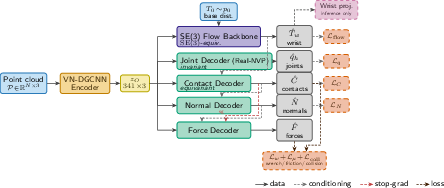
Figure 1: A VN-DGCNN encoder produces equivariant features zO that drive five heads: an SE(3) wrist-pose flow and joint, contact, normal, and force decoders with built-in architecture-level physical guarantees.
The generator is instantiated as a joint generative flow model with a VN-DGCNN [deng2021vn] point cloud encoder maintaining SO(3) equivariance, followed by five output heads:
- Wrist flow: SE(3) flow-matching backbone that generates the wrist pose by integrating a velocity field on SE(3).
- Joint flow: Conditional Real-NVP flow for hand joint angles, producing a multimodal distribution.
- Contact decoder: Predicts contact offsets and surface-projection ensures all contacts lie on the object.
- Normal decoder: Predicts inward surface normals, decoupled from contact centroids.
- Force decoder: Generates per-contact forces in the local contact frame, with a cone-projection layer guaranteeing friction-cone compliance by construction.
A pivotal architectural innovation is the force decoder, which projects the predicted forces into the local Coulomb friction cone relative to the normal at each contact, and the differentiable surface projection which grounds contacts directly on the object mesh. This system is trained with losses enforcing flow matching, contact/normals/forces accuracy, friction feasibility, wrench balance, and collision avoidance. Since all coordinate-dependent geometric features are treated with explicit equivariance or invariance, the network is SE(3)-equivariant by design.
Theoretical Properties and Guarantees
The paper provides a formal treatment of equivariance at the network, loss, and criterion levels. Notably:
- End-to-end SE(3) equivariance: Every component (encoder, decoders, force projection, and contact refinement) is proven to commute with the SE(3) group action, so rotating/translating the input object induces an identical transformation of the predicted grasp. On the full test suite of $200$ SO(3) rotations, empirical wrist-pose residual is <0.04∘, and per-joint deviation is exactly zero, confirming the theoretical guarantee.
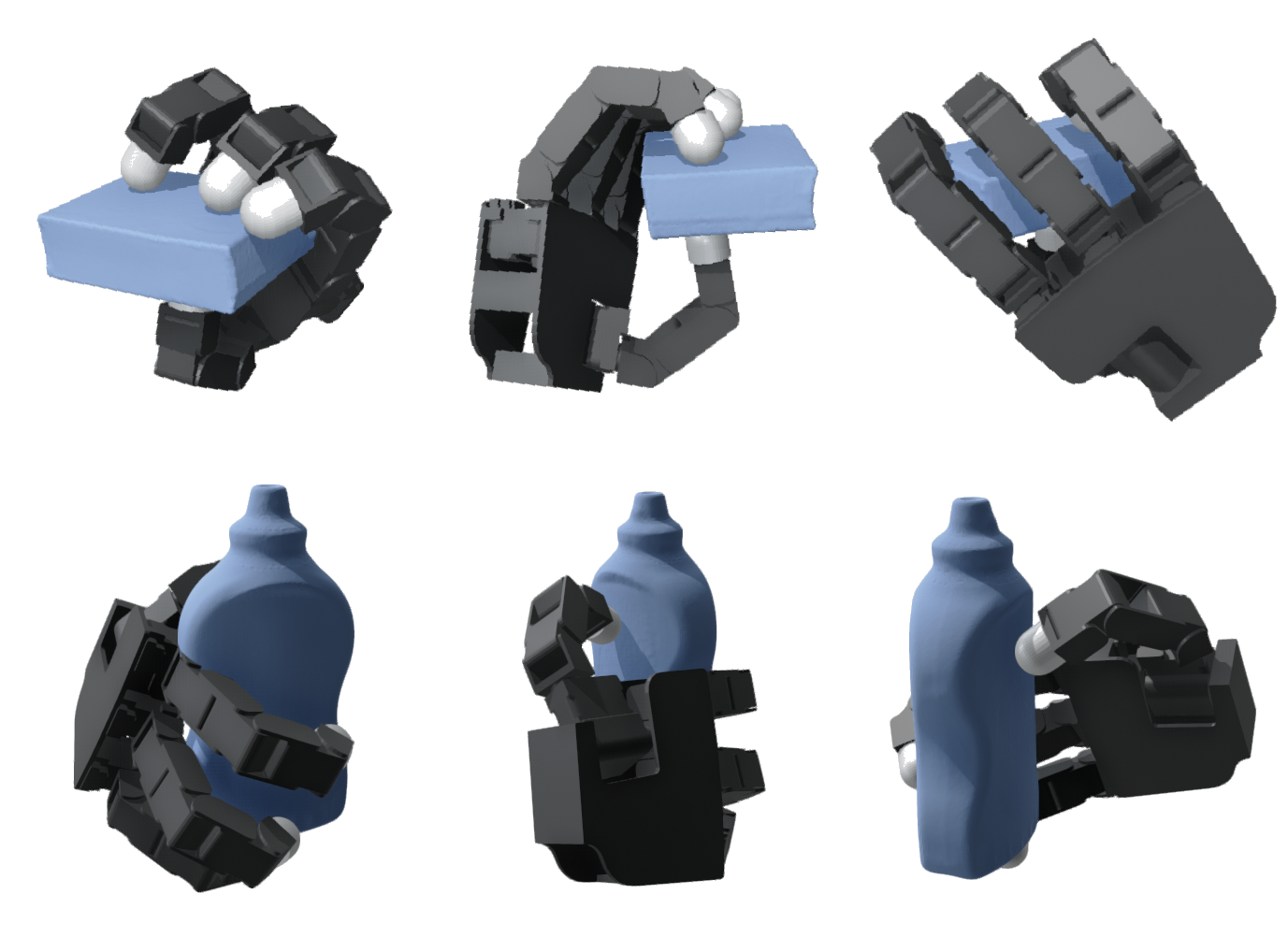
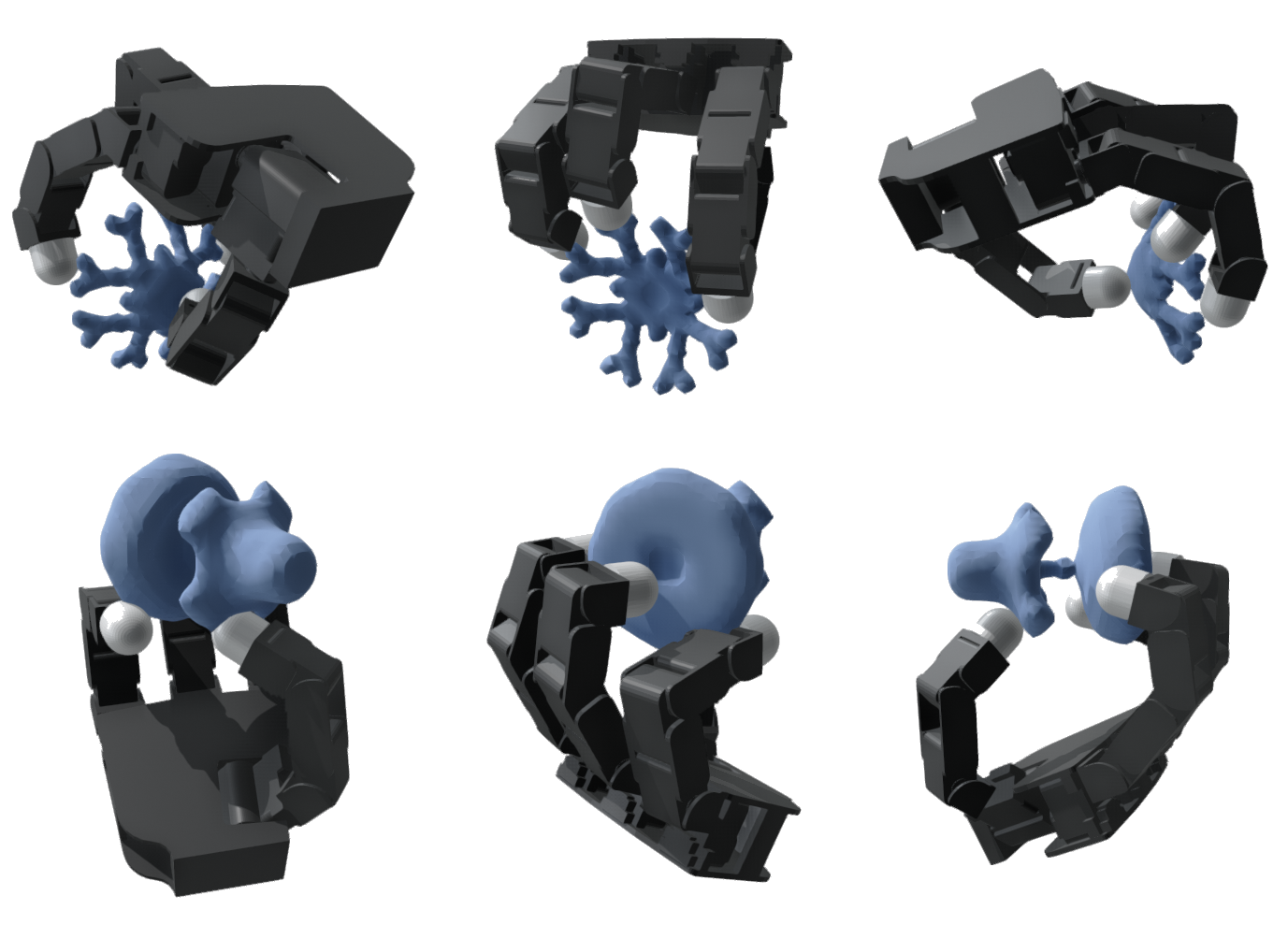
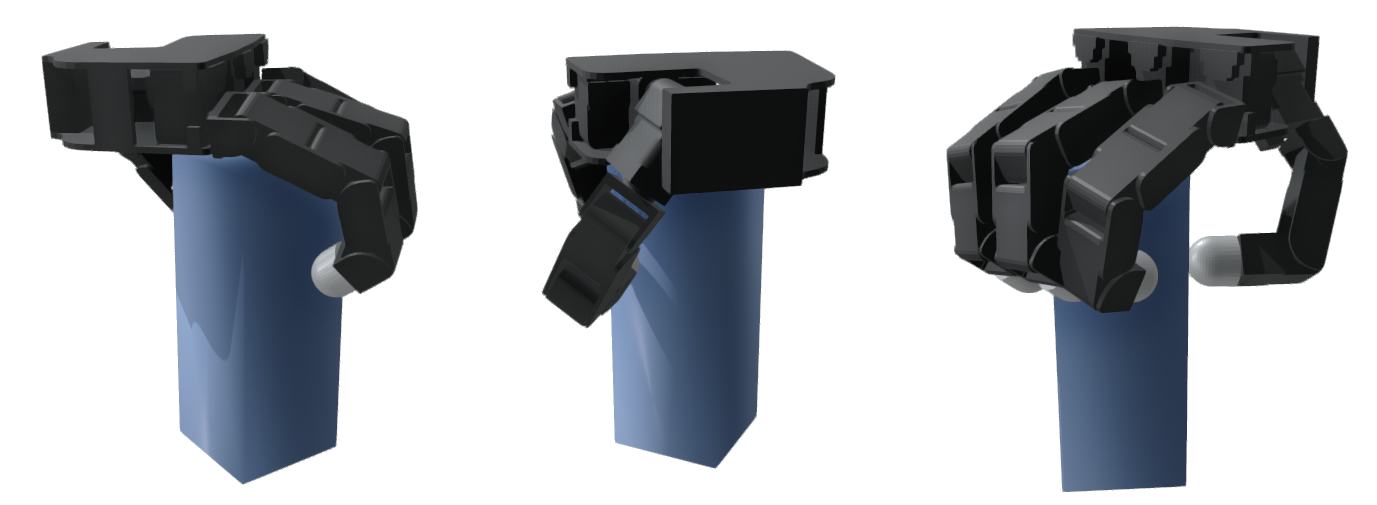
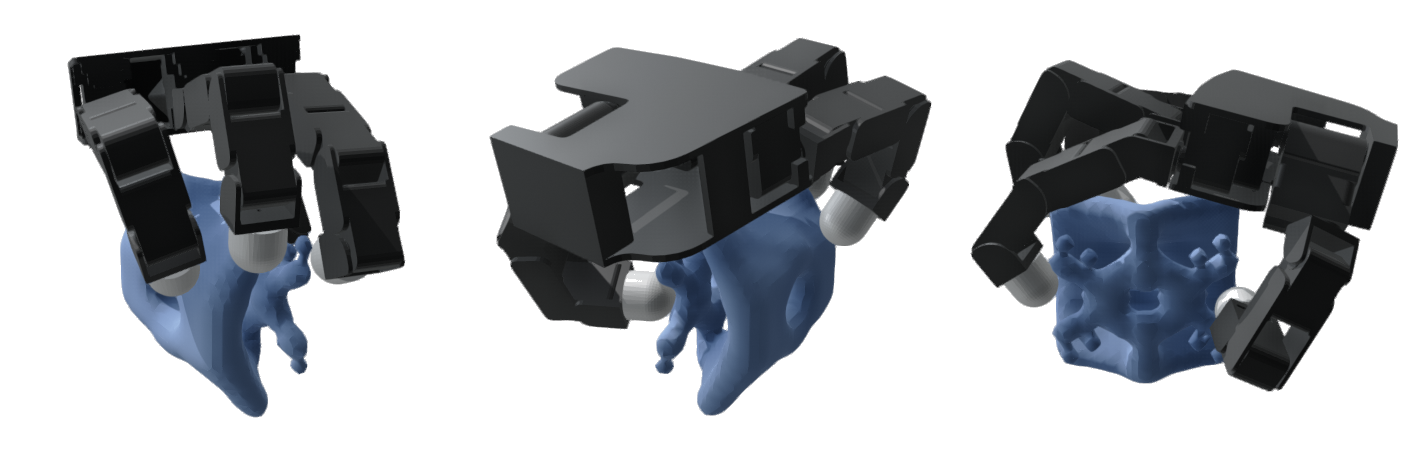
Figure 2: SE(3)-equivariance—wrist pose and joint angles co-rotate with the object across yawed inputs, with sub-0.04∘ pose error and zero joint deviation.
- Friction-cone compliance by construction: The cone-projection layer in the force decoder enforces that all generated contact forces are compressive (fn,i≥0) and within frictional bounds (∥ft,i∥≤μfn,i) in the decoder's chosen contact frame. If test-time normals differ from training normals, friction feasibility is only guaranteed in the construction frame, highlighting the importance of frame consistency (elaborated in Proposition 2).
- Embodiment-agnostic generation: The model can be retargeted to distinct hands (e.g., Allegro to LEAP) by per-finger inverse kinematics without retraining, since the representation is object-relative.
Data, Training Protocol, and Evaluation
Training leverages 8,100 force-closure grasps (from FRoGGeR), distributed over $81$ objects (EGAD!, YCB, geometric primitives), augmented via SO(3) transformations. Each record includes a point cloud, hand configuration, contacts, normals, and force-closure-certified forces.
Losses drive not only geometric accuracy (contact, normal, force regression), but also continuous physical feasibility (wrench balance, friction satisfaction, collision avoidance). Validation curves demonstrate tight convergence in all targeted loss components (e.g., collision, friction losses remain near zero).
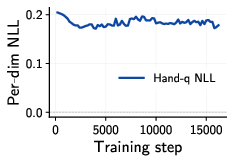
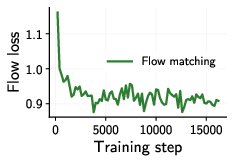
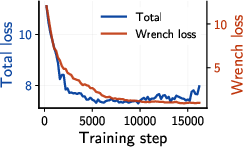
Figure 3: Validation curves showing convergence of joint-angle NLL, SE(3) flow-matching loss, and total/wrench losses for the full model.
Experimental Results
The method is evaluated over three metric families: contact fidelity, force fidelity, and composite "physics score" metrics (see Table 1 in the paper).
- Zero friction violations are achieved across all ablations when the architectural cone projection is active. Disabling it at test time increases the violation rate to SO(3)0 and degrades scores by SO(3)1.
- Composite physical score (incorporating collision, wrench, and task metrics) is highest for the full model (Top-1: SO(3)2, Top-3: SO(3)3), with the lowest wrench residual (SO(3)4), outperforming ablations that omit the physics losses or architectural guarantees.
Sample Diversity and Coverage
Candidate diversity (in translation, rotation, joint-angle, contacts) is preserved across variants, reflecting the generative model's ability to sample the multi-modal grasp space. The full model attains SO(3)5 coverage@1 (one of SO(3)6 candidates clears the quality threshold on all test objects).
Hardware Execution
In the physical setup, Allegro-to-LEAP retargeting is performed by mapping the predicted contacts through per-finger IK, achieving mean fingertip residuals of SO(3)7. All four asymmetric objects tested completed open-loop pick-and-hold at canonical and SO(3)8-rotated poses, demonstrating hardware realization of equivariant generation.
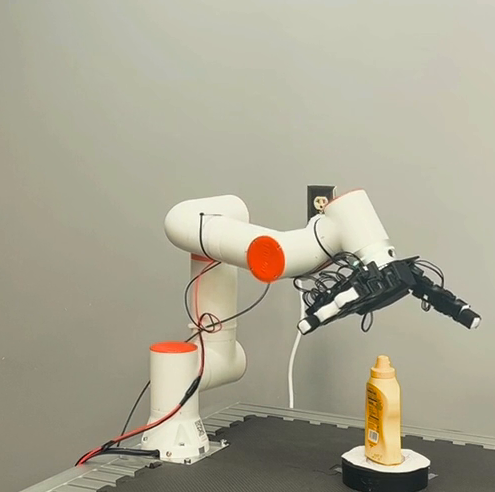
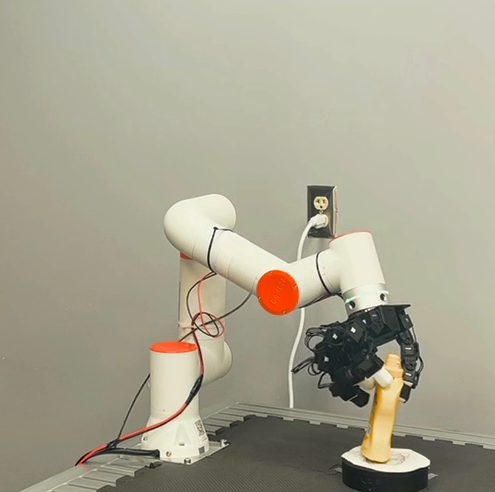
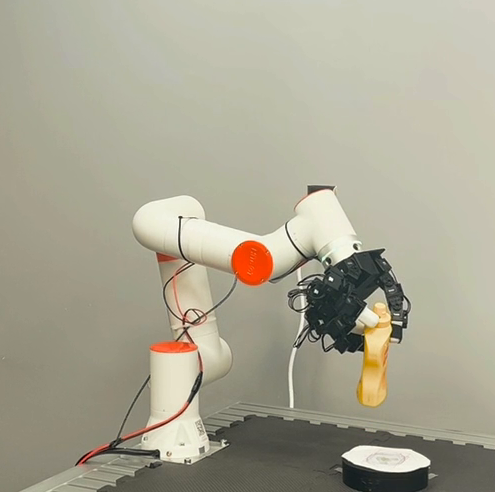
Figure 4: Hardware setup and equvariant executions: grasps generated and retargeted to the LEAP hand execute robustly at multiple object orientations.
Visualizations
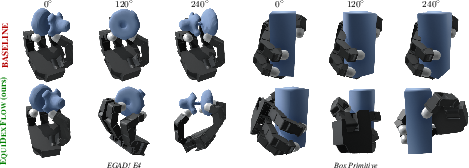
Figure 5: SE(3)-equivariant grasps preserve contact placement under object rotation, contrasting naive application of canonical grasp (top: failure) versus predicted, co-rotated grasp (bottom: success).
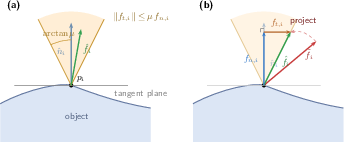
Figure 6: Illustration of contact geometry; force vector decomposed and projected into the local Coulomb friction cone.
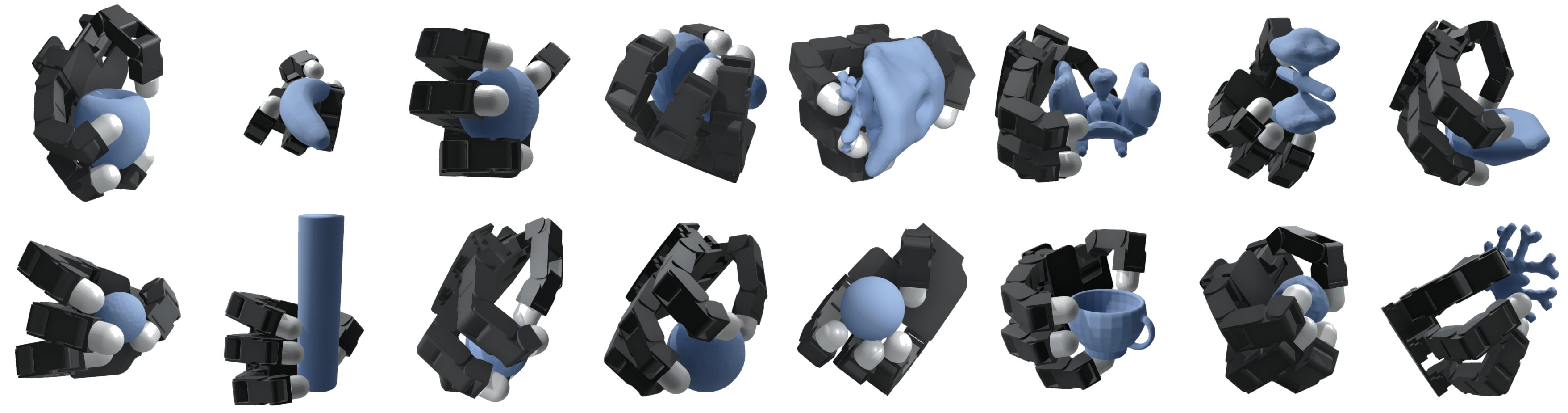
Figure 7: Representative Allegro Hand grasps decoding from the network on a variety of test objects.
Implications and Future Directions
The introduction of architecturally enforced physical constraints (via cone and surface projection in the decoder) eliminates the reliance on penalty terms for friction and contact feasibility—yielding strict compliance regardless of loss weight, and zero post-hoc rejection. This method closes a critical gap by jointly generating force-closure grasp descriptors, with transformations co-varying consistently under SE(3) actions. The demonstration of practical retargeting to a real robotic hand underscores the model's utility for real-world deployment.
Practically, the approach advances the deployability of vision-to-grasp pipelines for dexterous manipulation in unstructured environments, where unknown object poses and geometries are common. Theoretically, it substantiates how group-equivariant deep network architectures (here, leveraging VN layers and Lie-group ODE integration) can enforce physically meaningful symmetries in robotic prediction tasks.
Future research trajectories include:
- Lifting the normal-estimation ceiling via high-fidelity sensor normals at inference.
- Extending the training corpus to real-world and deformable objects.
- Scaling up closed-loop manipulation and fine manipulation strategies.
- Developing exact SE(3)-equivariant refinement operators for numerical precision beyond floating-point constraints.
- Integrating online adaptation or differentiable physics backpropagation during learning.
Conclusion
This work provides an end-to-end SE(3)-equivariant generative model for dexterous grasp synthesis, with physical feasibility baked into the network architecture, and validates its effectiveness on both simulated and hardware platforms. With strict equivariance, exact frictional feasibility, and embodiment-agnostic output, EquiDexFlow defines a strong foundation for next-generation autonomous dexterous robots.