Roto-Reflection Geometry of Pure Two-Qubit Entanglement
Published 10 Jun 2026 in quant-ph | (2606.12637v1)
Abstract: Pure two-qubit entanglement is usually characterized by scalar quantities such as concurrence. Here we show that it also has a natural geometric form. In the Pauli correlation tensor, maximally entangled states appear as improper orthogonal maps between two local Bloch spheres. These maps are roto-reflections. For partially entangled pure states, the same roto-reflection geometry is recovered after separating the contraction associated with concurrence. We call the corresponding geometric object the Entanglement Roto-Reflection Plane (ERRP). It organizes the maximally correlated directions of the two-qubit state and provides a covariant geometric complement to the scalar magnitude of entanglement.
The paper introduces the ERRP as a geometric invariant from the Pauli correlation tensor for pure two-qubit entanglement.
It employs a decomposition that separates local Bloch vector contributions from the nonlocal roto-reflection transformation.
The ERRP framework offers new insights for quantum process tomography and gate design by visualizing entanglement geometry.
Roto-Reflection Structure of Pure Two-Qubit Entanglement
Introduction
The geometric characterization of quantum entanglement, especially in bipartite qubit systems, continues to challenge and enrich the conceptual foundations of quantum information theory. Traditionally, pure two-qubit entanglement is quantified by scalar measures such as concurrence, which encapsulate the nonlocal content of the quantum state as a real number. However, the scalar perspective omits the intrastate structure of quantum correlations. The paper "Roto-Reflection Geometry of Pure Two-Qubit Entanglement" (2606.12637) introduces the Entanglement Roto-Reflection Plane (ERRP) as a geometric invariant: an explicit improper orthogonal transformation associated with the Pauli correlation tensor, organizing the directional content of entanglement in a covariant fashion.
Pauli Correlation Tensor and Geometric Decomposition
The foundational element in the approach is the Pauli correlation tensor decomposition of the two-qubit density matrix, in which scalar, local, and correlation blocks are extracted:
ρ=41μ,ν=0∑3Rμνσμ⊗σν,R=(1bTaT)
Here, a and b denote the reduced-state Bloch vectors, while T is the 3×3 real correlation tensor. The crucial insight is the visualization of T as a geometric map between the local Bloch spheres. This is not a generic mapping: for pure maximally entangled states, T constitutes an improper orthogonal transformation—specifically, a roto-reflection—whereas for general pure states, T becomes a contracted version of such a transformation.
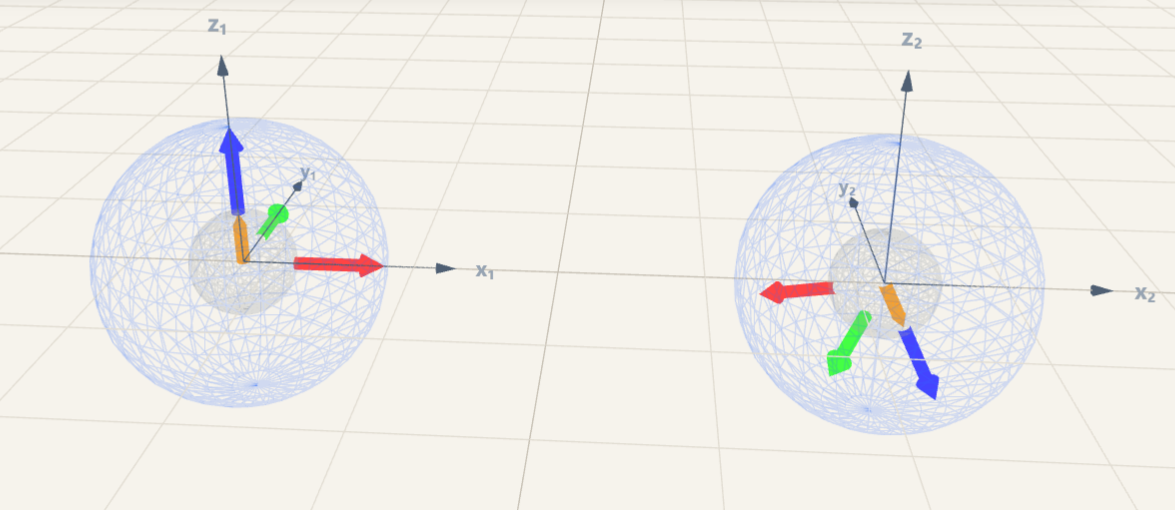
Figure 1: Arbitrary pure partially entangled two-qubit state. Inner spheres with reduced Bloch vectors represent the local reduced-state information while outer shells with correlated triads represent entangled part of the state. Arrows of the same color represent maximally correlated directions.
This schematic clarifies the distinction between local structure (inner spheres, Bloch vectors) and entanglement-induced nonlocal correlations (outer paired triads).
Maximally Entangled States and Improper Orthogonal Maps
For maximally entangled states, such as the Bell state Φ+=21(∣00⟩+∣11⟩), the correlation tensor is
TΦ+=diag(1,−1,1)
This matrix represents an orientation-reversing transformation—reflection in the a0-plane. Any maximally entangled pure state correlation tensor is locally equivalent to a generic improper orthogonal transformation:
a1
where a2. The ERRP is here defined by the plane of reflection and the rotation angle in the associated roto-reflection. These quantities can be directly computed from the eigenstructure and trace of a3, with the unique plane normal a4 specified by a5 and the rotation angle a6 via a7.
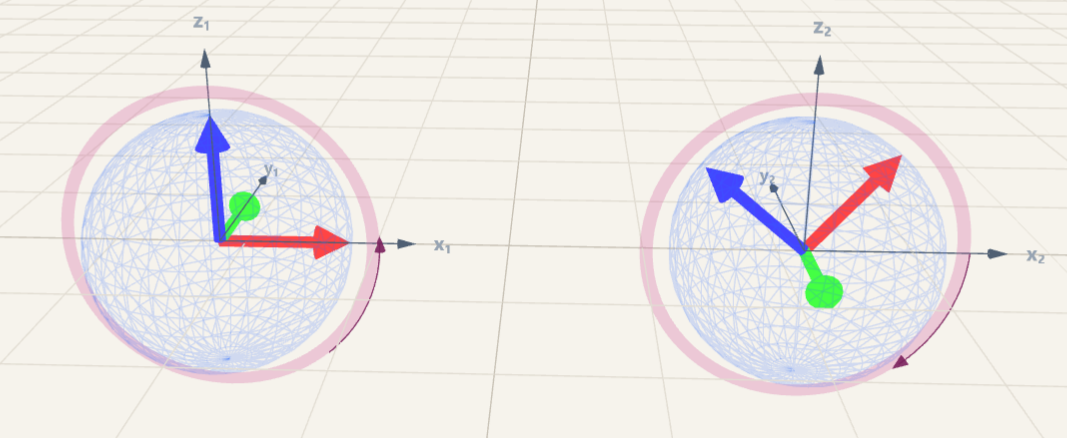
Figure 2: Maximally entangled state with ERRP equal to the a8-plane and a nonzero in-plane rotation resulting from a local unitary transformation.
This figure shows the geometric transformation induced by a maximally entangled state, with the ERRP fully specifying the orientation-reversing map.
Partially Entangled Pure States: ERRP Extraction
For partially entangled pure states in Schmidt form:
a9
the correlation tensor is
b0
The essential structure persists: b1 can be factorized as a product of an improper orthogonal map and a contraction, reflecting concurrence b2:
b3
For an arbitrary pure state, the global b4 is built from local rotations of this canonical form. The main decomposition, central to the ERRP framework, is:
b5
where b6 is the improper orthogonal component (roto-reflection), and b7 denotes the local Bloch vector directions.
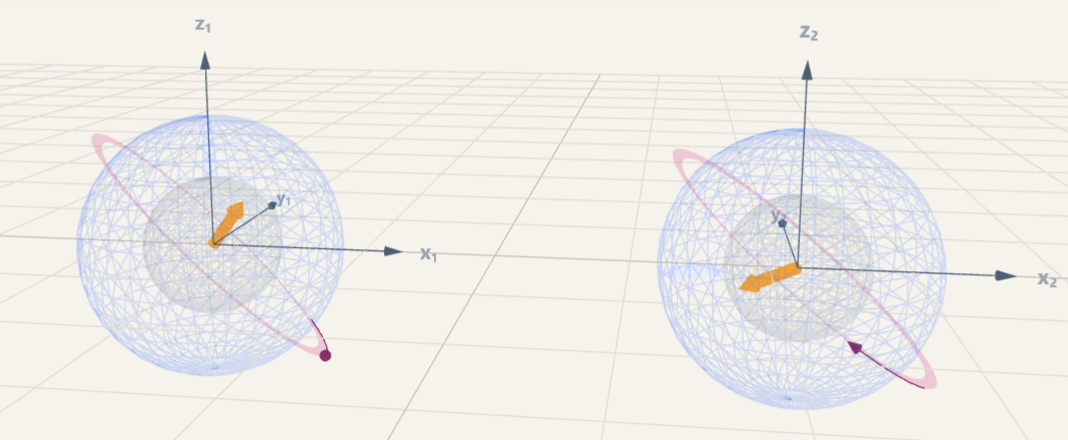
Figure 3: Representation of an arbitrary pure partially entangled state where entanglement geometry is described through an ERRP.
This succinct geometric object (ERRP) encodes the full entangled correlational content, separating the isotropic contraction from the underlying roto-reflection.
Covariance, Invariants, and Scalar-Vector Entanglement Structure
The ERRP’s defining features are:
Covariance under local unitaries: The ERRP transforms as b8, preserving its improper orthogonality (b9).
Separation of magnitude and geometry: The determinant T0 is the concurrence, while T1 encapsulates all directional (rotational and reflective) aspects of the entanglement.
Computational tractability:T2 can be extracted by either direct decomposition, T3, or via polar decomposition T4 with T5 improper orthogonal and T6 positive semidefinite.
For maximally entangled states, the entire nonlocal structure is geometric; for separable states T7, ERRP is undefined as there is no nontrivial correlational geometry.
Implications and Future Directions
The ERRP framework provides a geometric invariant complementing scalar entanglement measures. Practically, this allows for richer visualizations where not only the amount, but the "orientation" and "reflection" nature of quantum correlations is apparent and can be manipulated under local operations. This structure may be harnessed for:
Quantum process tomography: ERRP extraction supplies geometric diagnostics beyond concurrence, supporting visualization and fault analysis in experiments.
Gate and circuit representation: Two-qubit gates can be composed and interpreted as manipulations of ERRPs, with local and nonlocal gates inducing well-defined transformations of these geometric entities.
Extensions to mixed states and multipartite systems: While the present ERRP is strictly defined for pure states, analogous geometric decompositions for mixed two-qubit states (e.g., via dominant ERRP extraction from T8’s polar or SVD) or multipartite quantization (e.g., via higher-dimensional correlation tensors and improper orthogonal maps) are promising directions. Theoretical constraints and operational meanings in such cases remain open.
Conclusion
Pure two-qubit entanglement exhibits a dual structure: concurrence quantifies its magnitude, while the ERRP encodes the geometric map linking locally maximally correlated directions under entanglement. The ERRP is a covariant improper orthogonal transformation extracted from the Pauli correlation tensor, present in all non-separable pure bipartite qubit states, and provides a geometric complement to conventional entanglement measures.
The ERRP formalism opens possibilities for nuanced theoretical analysis, advanced visualization, and potential generalizations in entanglement studies and quantum information processing.
Reference:
"Roto-Reflection Geometry of Pure Two-Qubit Entanglement" (2606.12637)
“Emergent Mind helps me see which AI papers have caught fire online.”
Philip
Creator, AI Explained on YouTube
Sign up for free to explore the frontiers of research
Discover trending papers, chat with arXiv, and track the latest research shaping the future of science and technology.Discover trending papers, chat with arXiv, and more.