- The paper introduces a nonperturbative framework that reconstructs the conformal spectrum using a symmetry-averaged entanglement Hamiltonian.
- It employs the Vector Fixed Point Equation (VFPE) to cancel UV boundary contributions and extract scaling dimensions with high precision.
- Numerical experiments on spherical regularizations validate the method, demonstrating convergence to analytically predicted RG monotones.
Entanglement Bootstrap for CFTs Beyond 1+1D: Conceptual Framework and Numerical Realization
Introduction and Motivation
The classification and enumeration of RG fixed points—namely, CFTs—remain central challenges of modern quantum field theory and many-body physics. Recent advances suggest that an entanglement-centric perspective can both unify and operationalize this search. The so-called "Entanglement Bootstrap" inspires an approach in which universal data of a CFT are directly extracted from entanglement properties of a single groundstate wavefunction. Previously, this program yielded robust characterizations in gapped topological phases and in 1+1D CFTs. The present work aims to generalize these techniques to CFTs in any dimension, providing a nonperturbative and systematic framework for detecting and improving quantum critical groundstates.
Entanglement Structure and Operator Reconstruction
A salient property of CFT groundstates is the form of the modular (entanglement) Hamiltonian of a round region A. On Sd, this entanglement Hamiltonian admits a local expression:
KACFT=∫AddxβA(x)T00(x)+fA
where βA(x) depends explicitly on the geometry, and T00 is the energy density. The universal part of the entanglement spectrum encodes both the scaling dimensions of primary operators and the RG monotone (e.g., the sphere free energy F in 2+1D).
However, when working with regulated or discretized CFTs (via lattices, fuzzy spheres, or other UV regularizations), KA receives additional non-universal, boundary-localized contributions. The key innovation of this work is the construction of specific linear combinations and averages of modular Hamiltonians that systematically cancel these short-distance corrections, realizing effective "reconstructed" dilatation operators.
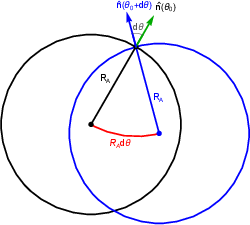
Figure 2: The geometric construction for determining the contribution of normal vector components to the averaged modular Hamiltonian.
The Vector Fixed Point Equation (VFPE)
The paper introduces a robust "vector fixed-point equation" (VFPE). By averaging KA over the symmetry group of Sd and forming appropriate linear combinations, the authors construct an operator:
Drec=∑iλiKAi
where the coefficients Sd0 are chosen to enforce the cancellation of leading UV boundary terms. For 2+1D systems, two regions (Sd1) suffice; for each, the boundary law term in the modular Hamiltonian cancels, yielding a combination whose action on the groundstate approaches that of the true dilatation operator as system size increases. Explicitly, the VFPE becomes:
Sd2
with Sd3 defined via UV-canceling coefficients and Sd4 identified with the RG monotone.
This construction leads to a natural objective: numerical minimization of
Sd5
on candidate wavefunctions. Minimizing this error drives the state toward the conformal fixed point.
Numerical Results: Icosahedron and Fuzzy Sphere
The framework is instantiated on two classes of spherical regularizations: the platonic icosahedron and the fuzzy sphere. The critical transverse field Ising model (TFIM) on the icosahedron and regularized fuzzy sphere exhibits groundstates well-approximating those of the continuum CFT. The area law scaling for entanglement entropy is validated, yielding RG monotone values closely matching field-theoretic expectations.
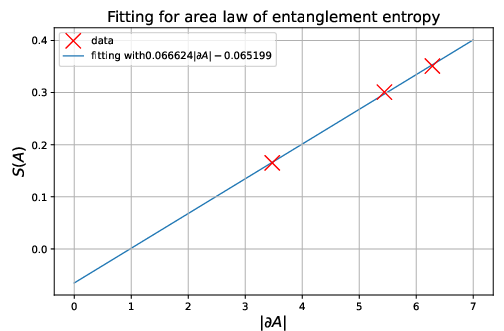
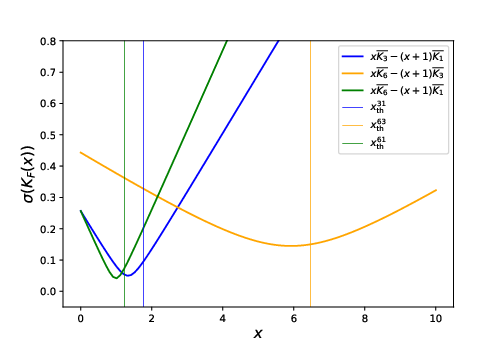
Figure 4: Left—fit to the area law for entanglement entropy in the critical Ising icosahedron model; Right—error of VFPE versus parameter Sd6 demonstrating minimal variance at the predicted coefficient ratio.
The authors demonstrate that at the critical point, the error of the VFPE is minimized to machine precision, and the spectrum of the reconstructed Hamiltonian closely matches the conformal bootstrap predictions for low-lying scaling dimensions.
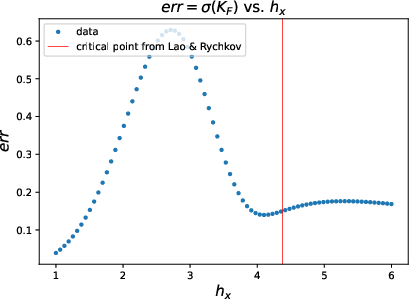
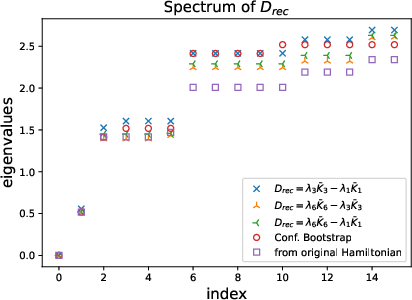
Figure 1: Left—Error of the VFPE in the critical Ising icosahedron as a function of Sd7; Right—reconstructed spectrum compared with both the original Hamiltonian and conformal bootstrap values.
The results generalize to the fuzzy sphere regularization, where averaging and coefficient selection fully leverage Sd8 symmetry. Systematic scaling analysis demonstrates that as system size increases, the numerically determined optimal parameters for the UV-canceling linear combination move toward their analytic predictions, and the error of the VFPE continues to decrease.
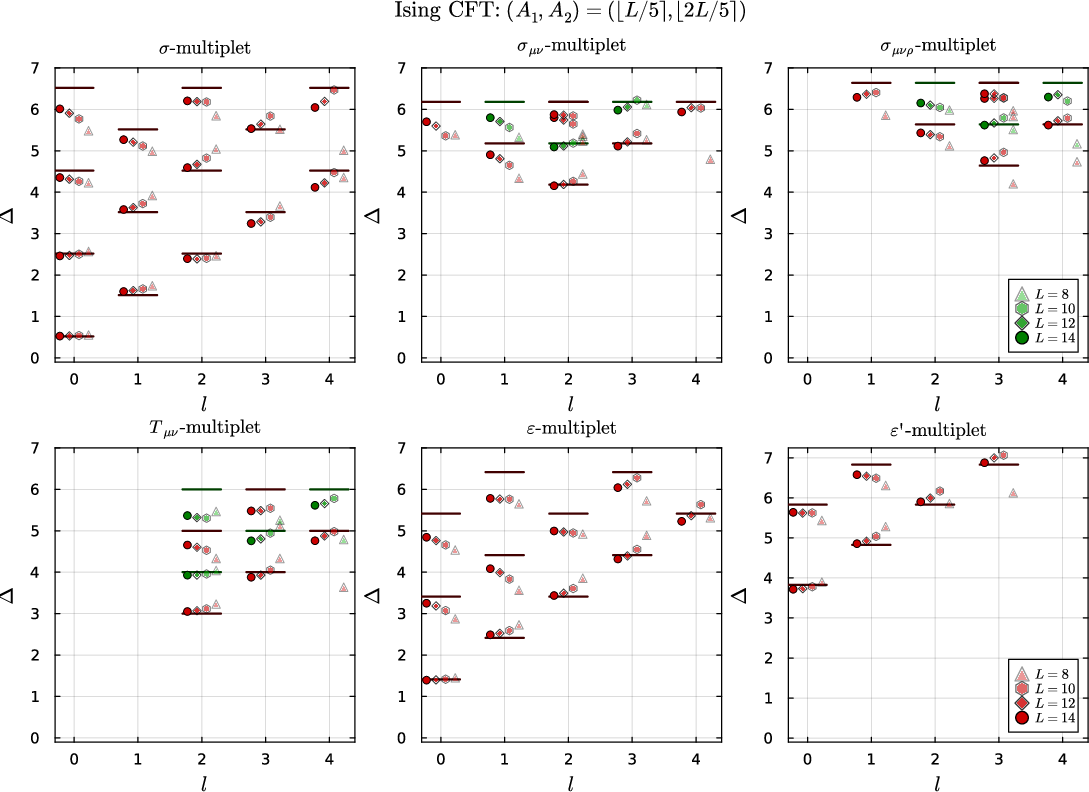
Figure 3: Reconstructed spectrum (angular-momentum resolved) from the fuzzy sphere critical Ising model for multiple system sizes; the agreement with CB predictions tightens with system size, including degeneracies and parity quantum numbers.
Phase Diagram, Spectrum Optimization, and Gradient Flows
The VFPE error surface over the Hamiltonian parameter space faithfully tracks the phase diagram, exhibiting sharp minima in both symmetry-broken and symmetric phases and a pronounced minimum at the critical point.
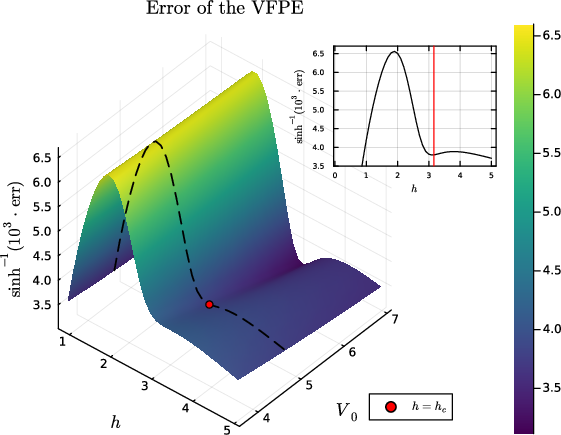
Figure 5: Heatmap of VFPE error in the fuzzy sphere TFIM model as functions of coupling constants Sd9, demonstrating critical region identification.
The work further demonstrates that gradient descent in state space with VFPE error as cost not only finds conformal groundstates but also improves their spectra relative to both conformal symmetry and known CB results. Starting from quantum critical groundstates (or even trial wavefunctions), optimization converges to fixed points with spectra matching those of the relevant CFT.
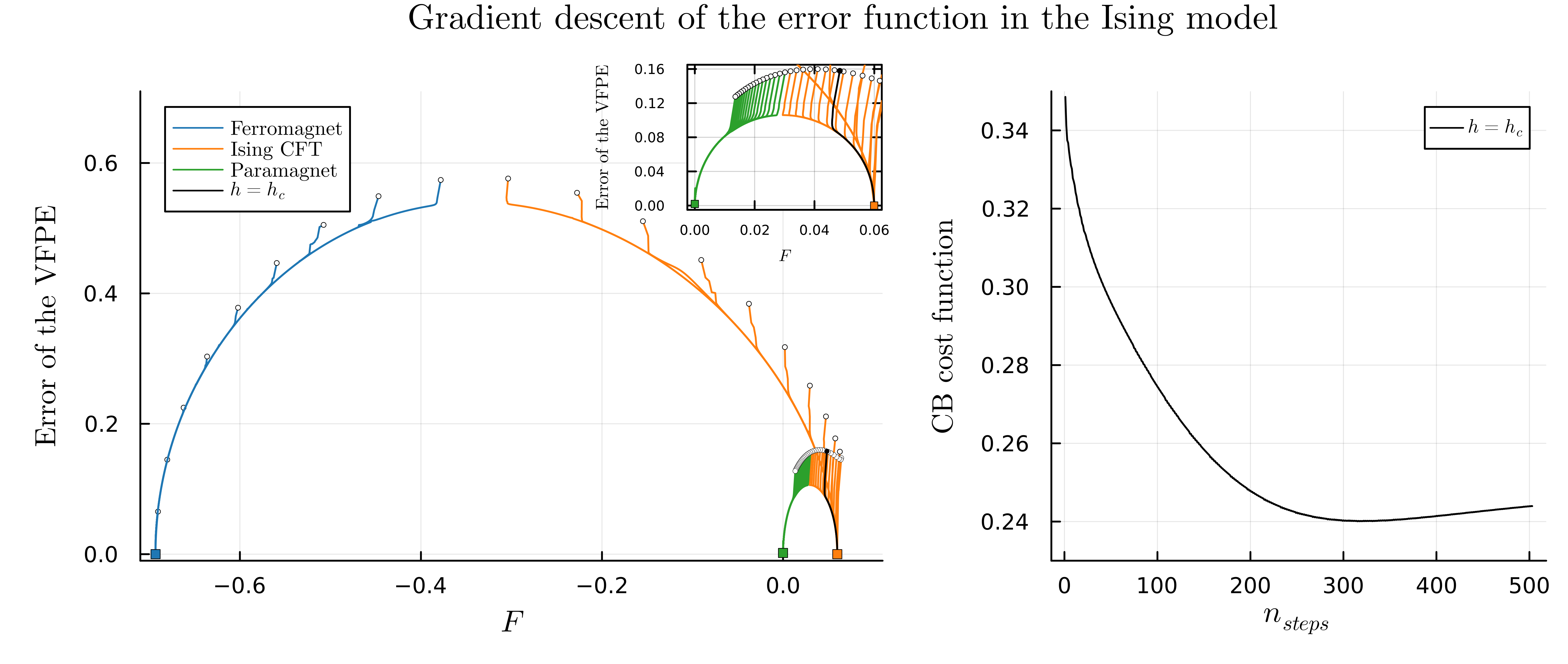
Figure 9: Left—gradient descent trajectories on VFPE error starting from TFIM groundstates, delineating RG flows toward ferro, paramagnetic, and critical fixed points; inset visualizes forbidden regions and convergence; Right—the cost function for the reconstructed spectrum along such descent, confirming improvement.
The numerically extracted RG monotone KACFT=∫AddxβA(x)T00(x)+fA0 converges to theoretical values previously obtained by the KACFT=∫AddxβA(x)T00(x)+fA1-expansion and field-theoretic calculation.
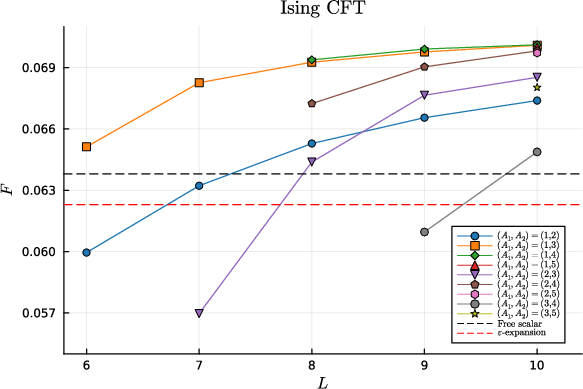
Figure 6: Converged values of KACFT=∫AddxβA(x)T00(x)+fA2 after minimization, extrapolated against system size and compared to free scalar and Ising CFT predictions.
Implications, Applications, and Extensions
The method provides a nonperturbative, symmetry-respecting prescription for reconstructing the conformal spectrum from a single representative wavefunction, sidestepping assumptions about underlying microscopic Hamiltonians. The approach extends to a variety of 2+1D CFTs, including free scalar, Majorana, and KACFT=∫AddxβA(x)T00(x)+fA3 Wilson-Fisher points, yielding strongly concordant spectra with analytic CB results and facilitating systematic improvement of trial or variational groundstates.
Theoretically, this program enables a definition of universal CFT data—scaling dimensions, RG monotones, OPE coefficients—directly in the language of quantum information, amenable to both numerical and variational variational optimization. Its error diagnostics supply a readily computable quantitative measure for the fidelity of a given state to a fixed point CFT in any dimension.
Moreover, the VFPE provides a potentially practical alternative to conventional finite-size scaling analyses, offering a mechanism to reduce finite-size artifacts by enforcing entanglement-based constraints. The findings motivate further investigation into higher-dimensional extensions, interactions, and bootstrapping in non-relativistic or non-unitary critical points.
Conclusion
This work systematically extends the Entanglement Bootstrap program to CFTs in arbitrary dimension, presenting an explicit operational construction for the conformal dilatation operator and spectrum from the groundstate entanglement structure. The numerical results validate the cancellation of UV contributions, accurate spectrum extraction, and improved optimization strategies for critical groundstates, all through symmetry-averaged entanglement Hamiltonian combinations. The approach has broad implications for CFT discovery, variational methods, and the foundational relationship between quantum information and field theory.
Reference: "Toward Entanglement Bootstrap for Conformal Field Theory in Any Dimension" (2606.12540)