- The paper develops a unified spacetime quantum mechanics framework by introducing spacetime states and a quantum action operator to overcome the asymmetric treatment of time.
- It rigorously reconciles approaches like path integrals, pseudo-density matrices, and superdensity operators within an enlarged Hilbert space representation.
- The work demonstrates practical implications for simulating causal, entanglement, and scrambling phenomena using tensor network methods.
Motivation and Context
Efforts to reconcile the foundational structures of quantum mechanics (QM) and relativistic physics have historically been hampered by the privileged role of time in the standard quantum formalism. In conventional QM, states are assigned to spacelike slices, with an external classical parameter driving evolution. This approach is at odds with the relativistic perspective where space and time are on equal footing—a dissonance that becomes especially acute in quantum gravity and information-theoretic settings. The absence of a canonical quantum object encoding spacetime correlations has prompted proposals such as path integrals, pseudo-density matrices, superdensity operators, states-over-time, quantum clocks, and timelike entanglement constructs.
The paper "Unifying spacetime approaches to quantum mechanics" (2606.12539) develops and generalizes the Spacetime Quantum Mechanics (SQM) framework, rigorously unifying these disparate approaches. Central to the work is the notion of spacetime states: operators on an enlarged Hilbert space with independent degrees of freedom for every spacetime point. This formalism enables a genuine quantum-information-theoretic description of histories, not just instantaneous states, and resolves the missing symmetry between space and time.
Spacetime Hilbert Space and Operators
The kinematic foundation of SQM is the assignment of a local Hilbert space h to each time slice, forming a spacetime Hilbert space H=h⊗N for N time steps. Each copy ht represents the system at time t, and operators are assigned spacetime indices. This Hilbert space is the arena on which all subsequent objects are defined.
Two distinct sets of translation operators are introduced:
- Translations Across Slices (P): Generated as products of SWAP operations, these implement discrete cyclic shifts through time, treating time as an internal index.
- Translations Within Slices (K): Generated by applying the system Hamiltonian independently to each time slice.
The mismatch between these two translations encodes the dynamics, inspiring the construction of a quantum action operator S=ϵ(P−K), whose exponential plays the role of eiS in the path integral.
Spacetime States and Expectation Values
A central construct is the spacetime state R=ρ0eiS~, with H=h⊗N0 the initial density matrix, and H=h⊗N1 a variant of the quantum action adapted for boundary conditions. Operators at different times act on corresponding Hilbert space factors, and correlation functions (“expectation values”) are computed as traces over H=h⊗N2:
H=h⊗N3
This formalism recovers all standard time-ordered Wightman functions and fixed-slice density matrices as marginals of H=h⊗N4.
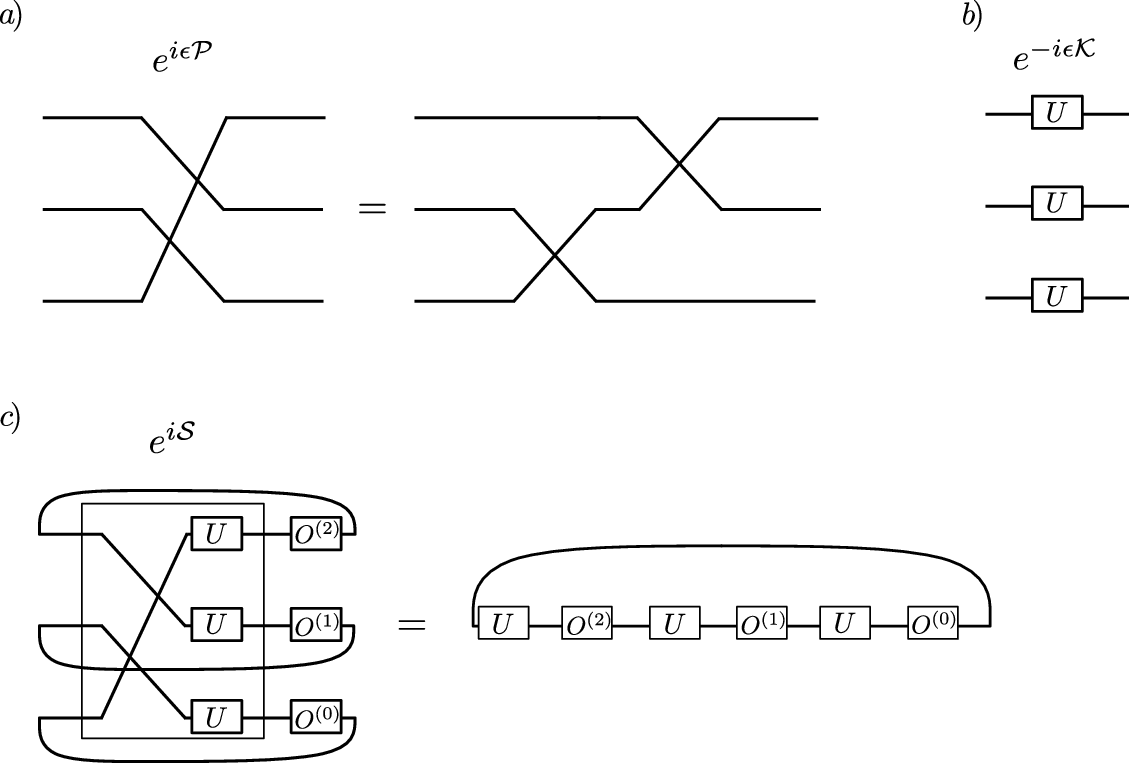
Figure 1: Tensor network representation of the main objects of the formalism for H=h⊗N5. Panel a) Time translations across slices and corresponding SWAP decomposition. Panel b) Time translations within slices. Panel c) The quantum action operator and a particular case of Theorem 1.
Spectral and Entropic Properties
Spacetime states associated with pure initial conditions and closed evolution (unitary dynamics) are “pseudo-pure”: their pseudo-Rényi entropies vanish (H=h⊗N6), but their singular values encode nontrivial causal structure. Importantly, reduced spacetime states (arising from partial traces over arbitrary regions—even disjoint spacetime subregions) demonstrate isospectrality across bipartitions, generalizing the Schmidt decomposition to non-Hermitian biorthogonal forms. The departure from Hermiticity reflects causal asymmetry and enables quantification of time-dependent quantum effects.
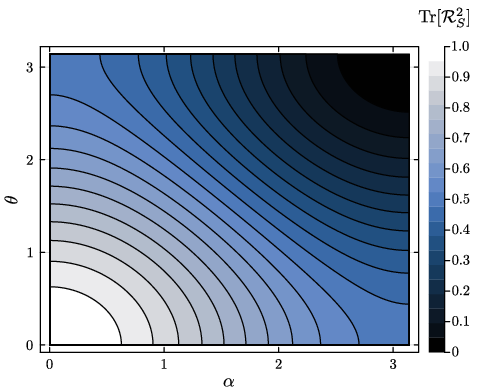
Figure 2: Contour plot of the pseudo-purity H=h⊗N7 for a two-qubit system under global unitary evolution, demonstrating the control of pseudo-purity via system-environment entanglement.
Marginals and Channels
For two times (H=h⊗N8), the reduced spacetime state associated with a quantum channel H=h⊗N9 is given by N0, where N1 is the Jamiołkowski operator. The partial traces satisfy:
N2
This demonstrates that spacetime states simultaneously encode initial and evolved system properties, thereby generalizing Choi and process tensor formalisms.
Unification of Spacetime Approaches
The paper systematically demonstrates that all major spacetime-oriented approaches are specializations or reductions of SQM spacetime states.
| Approach |
Core Object |
Relation to SQM |
| Path Integral |
N3 weights on histories |
Matrix elements of N4 in trajectory basis |
| Pseudo-density matrix (PDM) |
Joint probabilities for sequential measurements |
Linear map (unimodal twirl) acting on N5 |
| Superdensity operator (SO) |
Density matrix on operator space |
Rearranged, partially transposed version of extended N6 |
| State-over-time (QSOT) |
Bivariant operator matching channel and marginals |
N7 under congruence/symmetry operations |
| PW mechanism |
Quantum clock plus system |
Single-particle sector of Fock space in SQM |
| Timelike entanglement |
Entropy of cross-temporal subregions |
Partial trace over N8 (including arbitrary spacetime regions) |
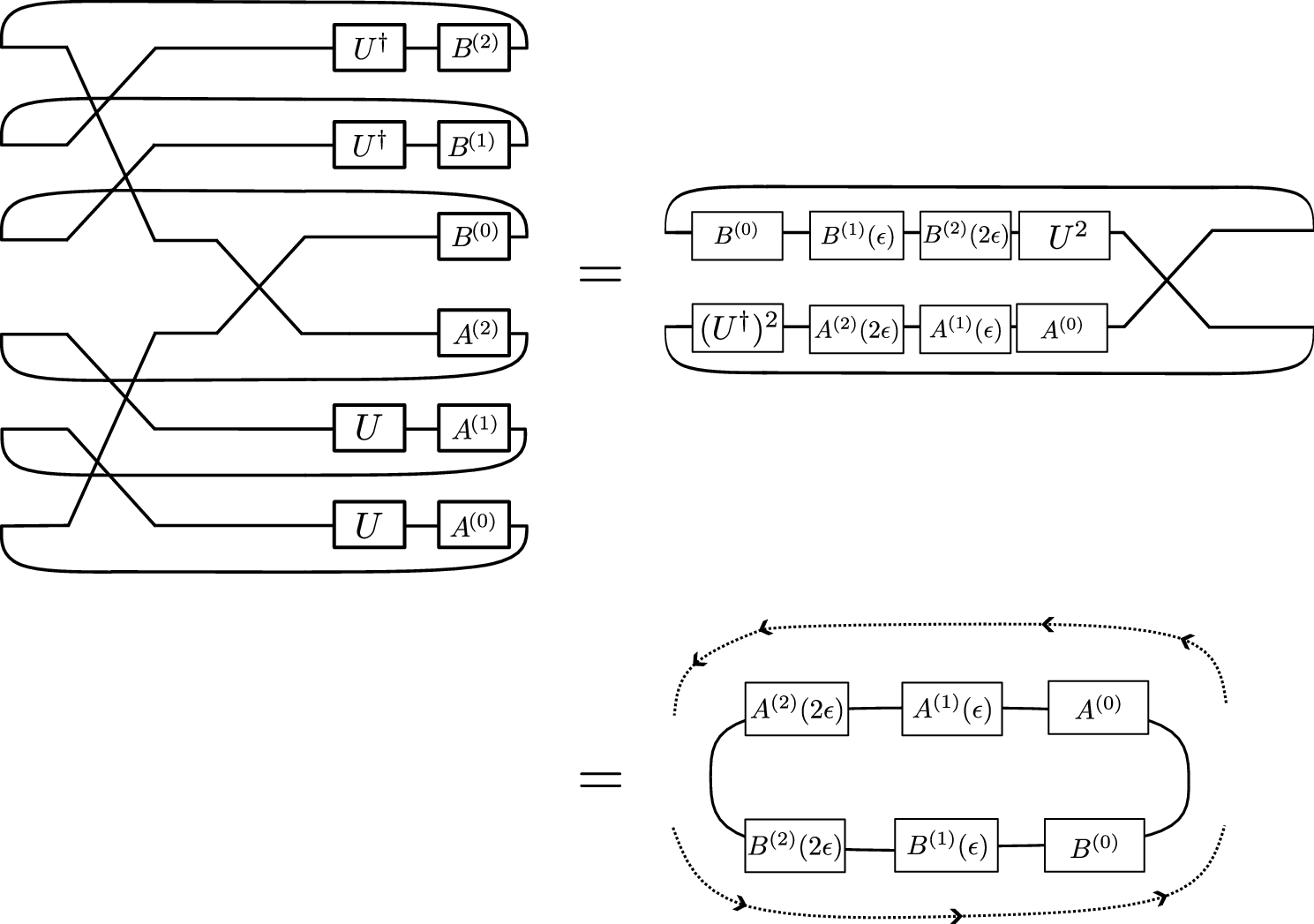
Figure 3: Graphical representation of the mapping between folded time contour constructions and spacetime state-based correlators.
Path Integrals and Operator Embedding
Matrix elements of N9 in the product basis ht0 directly yield the Feynman path integral weights, providing a Hilbert-space embedding of Feynman’s sum-over-histories formalism.
PDMs and Sequential Statistics
PDMs, originally encoding classical-like joint probabilities for sequences of measurements, are realized as specific quantum channels (unimodal permutations/twirls) acting on the spacetime state ht1, ensuring correct time-local marginals and nonclassical temporal correlations. Extensions to general observables and higher-dimensional systems manifest as structurally constrained linear maps.
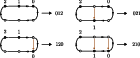
Figure 4: Channel ht2 defined by SWAPs between Hilbert space factors enacting the unimodal twirl needed to construct the PDM from the spacetime state.
Superdensity Operators
Superdensity operators, defined on the space of operators (operator-valued density matrices), can be constructed via a combination of partial transpose and realignment maps acting on the extended spacetime state. This reveals the direct operational content of superdensity operators as functionals of ht3, extending the process matrix formalism into the fully quantum regime.
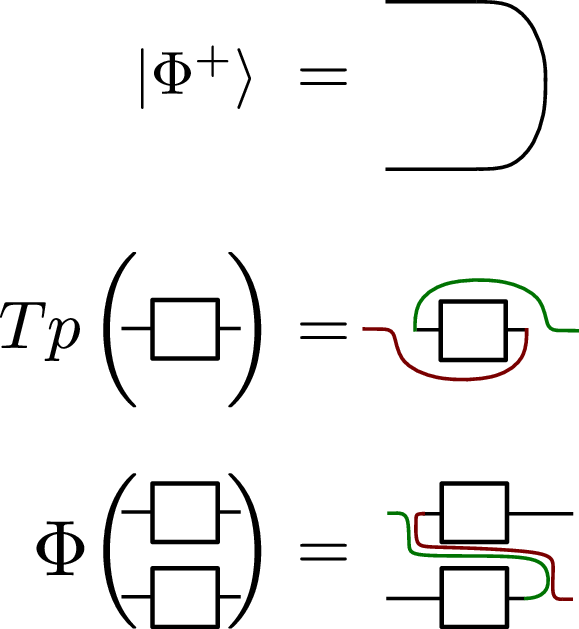
Figure 5: Pictorial representations of the index mapping and physical realignment needed to construct the superdensity operator from the extended spacetime state.
Timelike Entanglement and QFT
Timelike entanglement and “pseudo-entropies”—entropic functionals of reduced cross-temporal regions—arise as partial traces of ht4 over arbitrary (possibly non-contiguous) spacetime regions. This directly reproduces and generalizes the holographic pseudoentropy constructions in AdS/dS contexts.
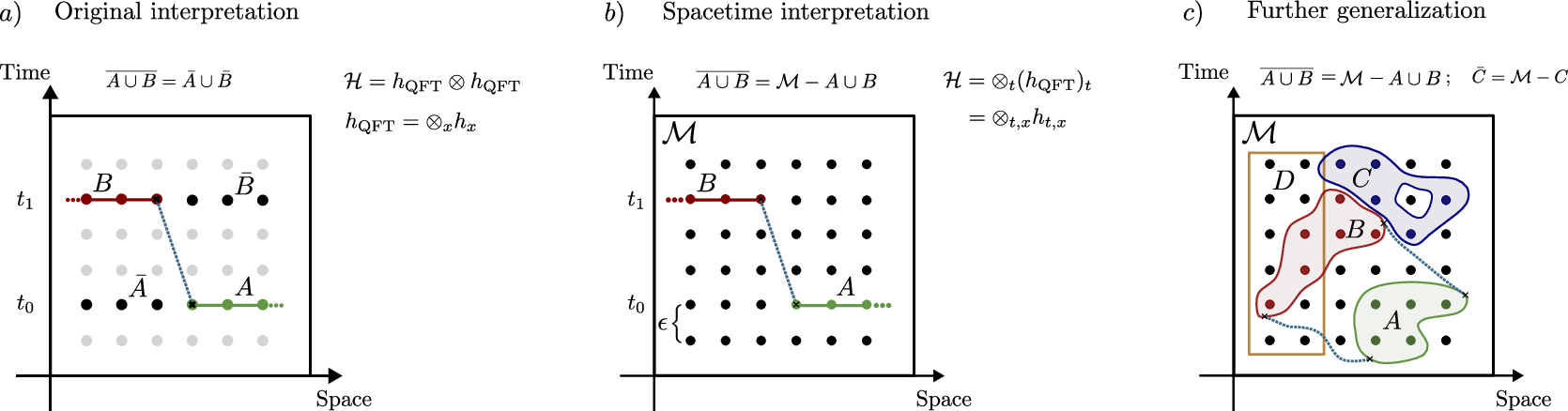
Figure 6: Pictorial comparison of standard, SQM, and general partial trace regions for timelike entanglement calculations in spacetime.
Causality, Leggett-Garg Inequalities, and OTOCs
Spacetime states enable new insight into causality diagnostics:
- Imagitivity: ht5 quantifies violation of commutativity across time, and supports tight matrix-norm bounds on unequal-time commutators (generalizing "butterfly velocities" in many-body systems).
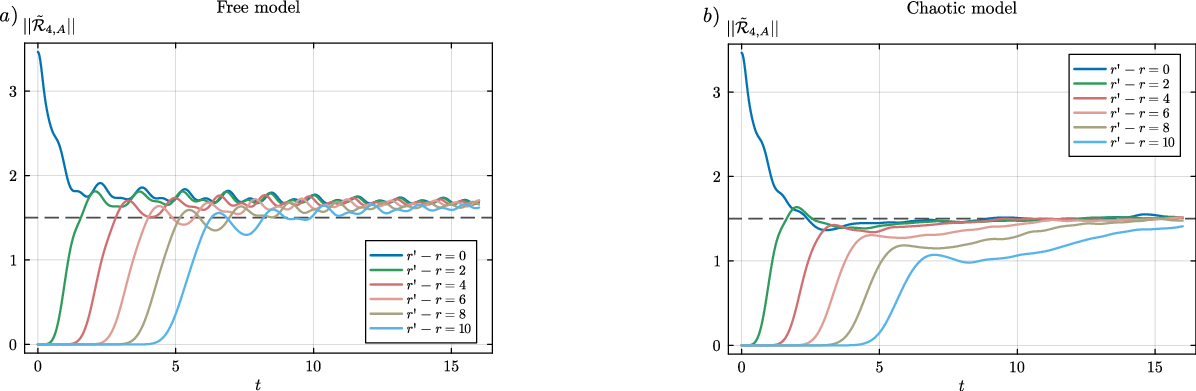
Figure 7: Spacetime light cone in imagitivity for a critical spin chain as a function of space-time separation, visualizing emergent causal structure.
- Leggett-Garg Violations: Only nonpositive (nonphysical in the standard sense) marginals ht6 permit Leggett-Garg inequality violations, linking genuinely quantum temporal correlations to negativity beyond any conventional density matrix.
- OTOCs and Scrambling: Folded spacetime states ht7 (with ht8) naturally encode out-of-time-ordered correlators and support Gram-matrix diagnostics distinguishing chaotic from nonchaotic dynamics.
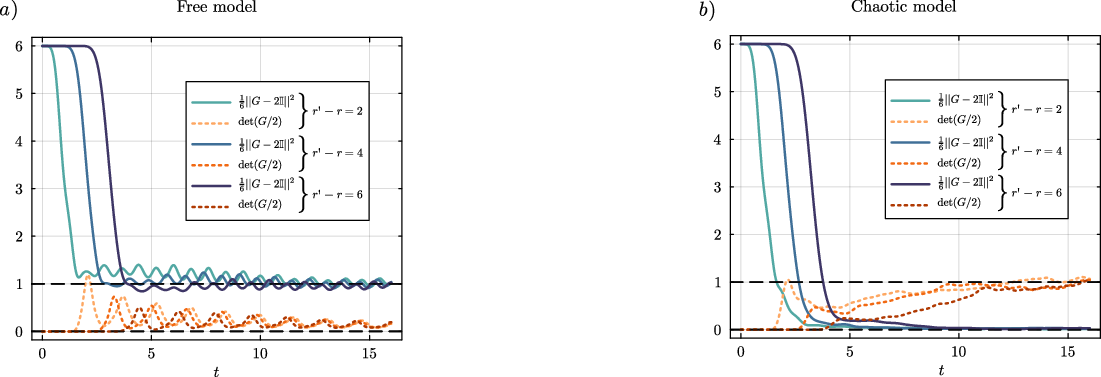
Figure 8: Late-time Gram matrix diagnostics from folded spacetime states, revealing isotropic operator scrambling in the chaotic model and singular structure in the free model.
Tensor-Network Representations and Computation
The tensor network structure of spacetime states aligns with influence-functional and MPO/MPS techniques. Contractions along spatial or temporal cuts support flexible simulation strategies, enable efficient extraction of temporal correlation functions, and naturally generalize temporal entanglement to arbitrary spacetime regions.
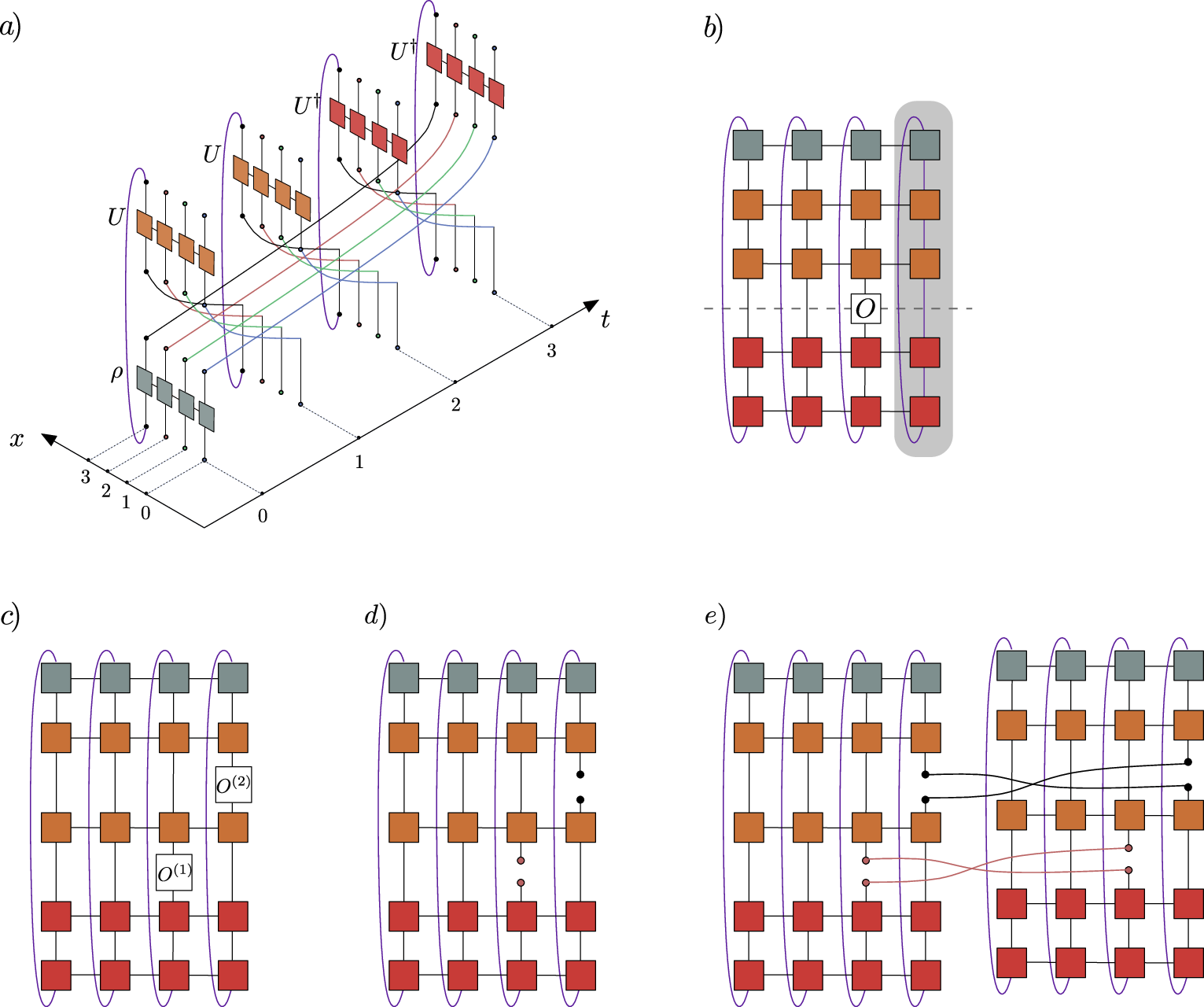
Figure 9: Example of partial traces and pseudo-entropy calculations for spacetime states using tensor network contractions, linking PEPO methods and spacetime quantum information.
Extensions to Fermions, QFT, and Reference Frames
The formalism robustly incorporates fermionic statistics by adjusting the underlying algebra and introducing string parity factors, ensuring correct (anti)commutation structures in both operator content and spatial/temporal bipartitions.
The continuum and QFT limits are well-defined: the canonical algebra ht9 is elevated to “covariant kinematics,” with the spacetime state machinery yielding all standard quantum field-theoretic correlation functions, while elevating the Hamiltonian-patched foliation (and even observer frame) to a quantum degree of freedom if desired.
Theoretical and Practical Implications
Theoretical:
- The paper establishes—uniquely among competing frameworks—a fully quantum, spacetime-symmetric formalism that recovers all known approaches as reductions, maps, or partial evaluations.
- Non-Hermiticity, pseudo-entropies, and causal asymmetry in t0 are not artifacts, but indispensable features enabling quantification and recovery of causal, temporal, and process-nonclassicality (e.g., temporal entanglement, indefinite causal order, OTOC structure, Leggett-Garg violation).
- Demonstrates that the classical action principle admits a precise quantum operator counterpart, unifying variational and algebraic perspectives.
Numerical/Practical:
- The tensor network formalism invites algorithmic development for simulating spacetime quantum correlations, including those inaccessible via standard MPS/PEPS approaches.
- Quantum simulation and experimental probes of genuine spacetime entanglement (beyond spatial analogues) are put on a rigorous operational footing.
Future Outlook
- Analysis of indefinite causal order and controllable spacetime foldings using coherently controlled t1 presents a direct avenue for generalizing the process matrix approach with clear operational meaning.
- Extension of the operator-space formalism to gauge theories, curved spacetime, and quantum reference frames can rigorously address open problems in covariant quantization and quantum gravity.
- The axiomatic characterization of spacetime states, perhaps paralleling the role of the density operator in standard QM, is an open mathematical challenge with profound foundational implications.
Conclusion
The spacetime state formalism rigorously unifies previously disconnected spacetime approaches to quantum mechanics, assigning a clear operational and informational meaning to temporal quantum correlations. It provides new technical tools for probing causality, scrambling, and entanglement in general quantum systems, both theoretically and computationally. Its structure not only retains full physical generality but transcends limitations of prior formalisms by systematically encoding and quantifying spatiotemporal quantum phenomena unattainable in standard formulations.
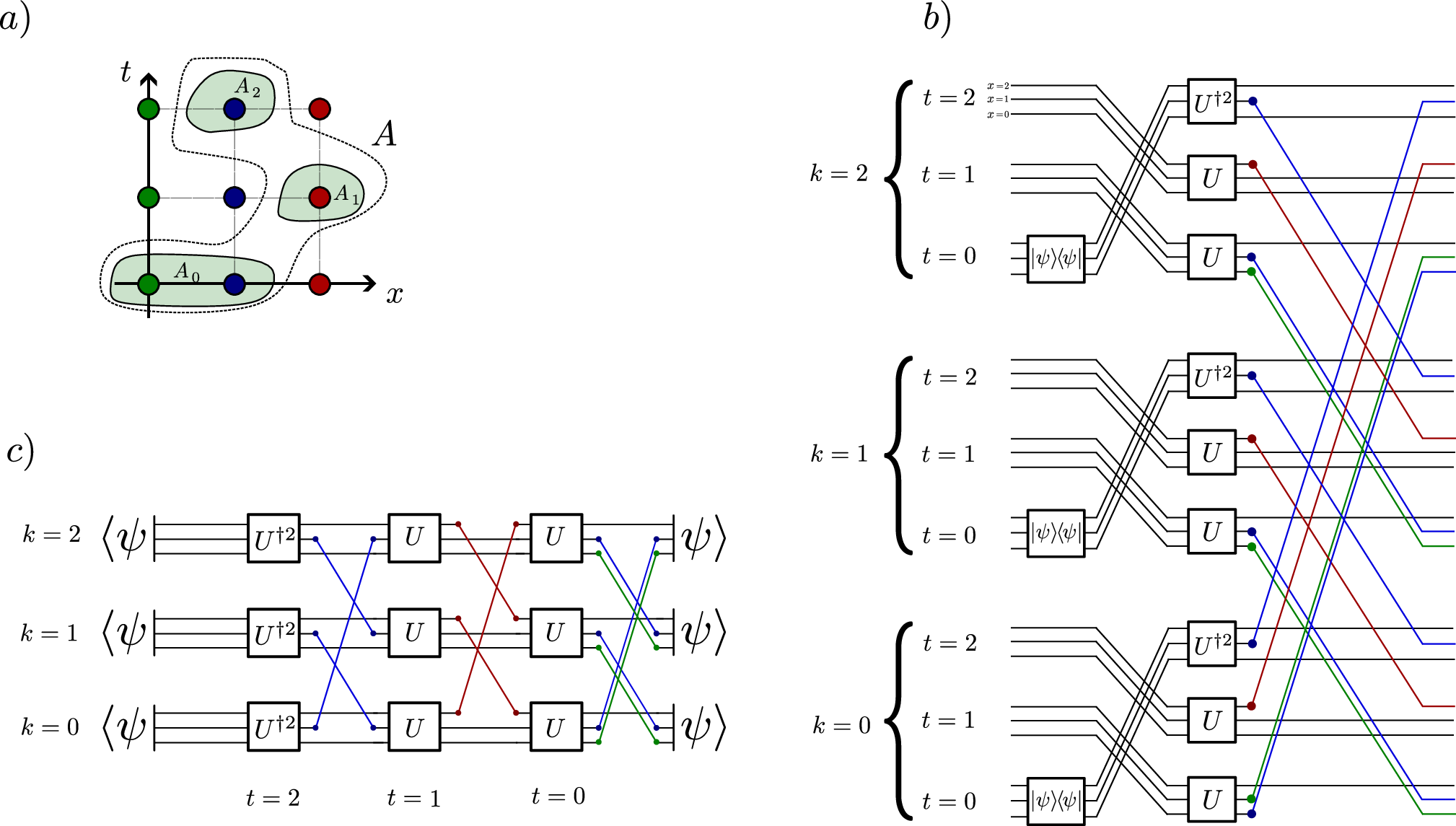
Figure 10: Pseudo-purity of a reduced spacetime state under a nontrivial spatial-temporal partition, illustrating the structural richness captured by the spacetime formalism.
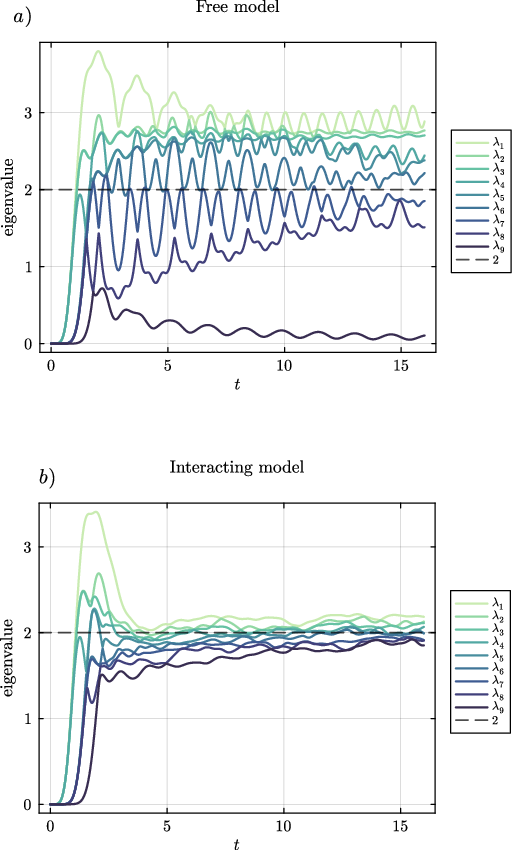
Figure 11: Eigenvalue spectrum of the OTOC Gram matrix in the late-time regime for different models, visualizing the distinction between chaotic mixing and non-scrambling behavior.