- The paper introduces DPOP, enhancing DPO by penalizing the model’s greedy responses to improve alignment with human preferences.
- Its methodology extends pairwise loss with a gated penalty based on the reference model's output, with SimNPO-style penalization yielding the best performance.
- Experimental results show notable improvements in length-controlled win rates across multiple models, highlighting DPOP’s potential for refining LLM alignment.
Boosting Direct Preference Optimization with Penalization: An Authoritative Analysis
Introduction
Direct Preference Optimization (DPO) has established itself as a central method for aligning LLMs with human preferences, offering a streamlined, offline alternative to RLHF that forgoes the need for a reward model and relies solely on pairwise preference data. However, DPO and its major variants are constrained to using only the stored chosen and rejected responses for each prompt in their objectives, discarding additional information that could be extracted from the reference model itself. "Boosting Direct Preference Optimization with Penalization" (2606.12505) advances the DPO paradigm by introducing Direct Preference Optimization with Penalization (DPOP), which leverages the reference model’s greedy response as a penalization target. This extension introduces a principled, gated negative signal, aiming to accelerate and improve preference optimization in LLMs.
Methodology
The DPOP framework operates by extending the pairwise DPO loss with a gated penalty on the likelihood that the policy assigns to the reference model’s greedy response. For each training triple (x,yw,yl) (prompt, preferred, and rejected responses), DPOP performs the standard DPO update, then penalizes the current policy’s likelihood of the reference-greedy response yg, but only when the policy marginally prefers the rejected over the chosen response. The penalty is modulated by a weight function f(r) proportional to severity of the policy’s misalignment, with several families (linear, constant, square root, quadratic) evaluated.
DPOP supports multiple penalization objectives for yg, including token-level unlikelihood, a reference-relative NPO penalty, and a SimNPO-style, reference-free, length-normalized penalty. Empirical evidence in the paper, based on ablation studies, demonstrates that SimNPO-style penalization yields consistently superior results, both in stability and absolute performance.
Experimental Results
Evaluation is conducted on AlpacaEval 2.0 using two SFT-initialized models: Llama-3-8B-Instruct and Gemma-2-9B-IT, with preference data sourced from UltraFeedback datasets. Key metrics are the raw win rate (WR) and the length-controlled win rate (LC-WR), the latter being more robust to confounding by response length.
DPOP demonstrates consistent, substantial improvements over DPO, SimPO, and AlphaDPO on both model families in LC-WR.
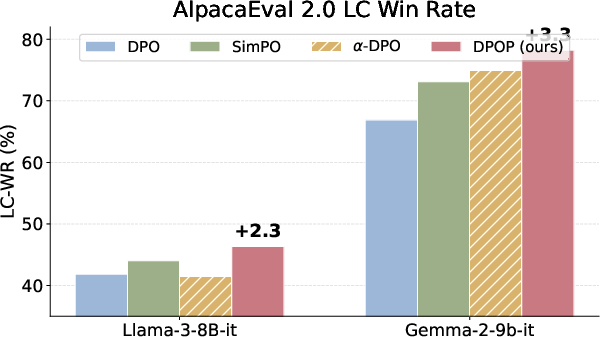
Figure 1: AlpacaEval 2.0 length-controlled win rate. DPOP improves over DPO, SimPO, and AlphaDPO on both Llama-3-8B-IT and Gemma-2-9B-IT. The numbers above DPOP bars are improvements over the best non-DPOP baseline for the same model.
On Llama-3-8B-It, DPOP reaches a LC-WR of 46.35, a gain of 5.3% over SimPO (44.01) and an even larger margin over AlphaDPO and DPO. On Gemma-2-9B-IT, DPOP attains 78.22 LC-WR compared to 74.90 for AlphaDPO (+4.4%) and 73.08 for SimPO. These improvements persist across hyperparameter sweeps and weight functions, with the best linear weight function yielding the largest gains.
Further penalty ablation shows SimNPO is the dominant penalty family, outperforming both the reference-relative NPO penalty and token-level unlikelihood. This outcome underlines the principal takeaway: leveraging reference-greedy responses using a length-normalized, reference-free penalization sharply enhances the fidelity and efficiency of offline preference learning.
Implications and Discussion
The introduction of penalization on the reference model’s greedy output in DPOP addresses a previously underutilized signal in offline preference optimization. This approach effectively regularizes against undesirable local optima to which the policy may otherwise drift, particularly in off-policy, static datasets, or when teacher-filtered data is prevalent. The selective, gated application of penalties ensures that the optimization signal is concentrated precisely where the policy fails to recover the desired ranking between the chosen and rejected responses.
Numerical results robustly support the claim that DPOP, particularly with SimNPO penalization and linear weight gating, outperforms all previously published pairwise preference optimization baselines in alignment quality as measured by LC-WR on strong open-source LLM backbones. These results invite a re-examination of standard practice in offline preference alignment, highlighting the utility of cached model-generated responses and opening further directions in preference learning beyond pairwise loss formulations.
Looking forward, integration of DPOP with a broader suite of benchmarks—including reasoning, factuality, and safety tasks—will be necessary to ensure that gains in preference alignment do not come at the expense of other critical attributes. Another critical research direction involves understanding the circumstances under which the reference-greedy response faithfully represents undesirable model behavior versus innocuous modes—thus informing when its penalization is most effective or appropriate.
Conclusion
DPOP represents an incremental yet impactful refinement to the DPO family, demonstrating that selectively penalizing the reference model’s own greedy predictions—using a gated, length-normalized, reference-free penalty—is an effective and practical method to improve alignment with human preferences. These findings have direct implications for future preference optimization pipelines in LLM alignment, suggesting that richer, context-dependent optimization targets can and should supplement standard pairwise preference data. Further exploration into the interpretability and transferability of DPOP-like objectives may yield additional advances in the theory and practice of LLM alignment.
(2606.12505)