- The paper demonstrates that precise uniaxial strain can reversibly tune quantum transport in SWCNT-QDs by mechanically modulating doping and band structure.
- The study employs clean, suspended nanotube devices with controlled electromigration and low-temperature measurements to capture Coulomb blockade behavior and Fermi energy shifts.
- The methodology distinguishes intrinsic strain effects from capacitive tunneling by using strain-induced scalar and vector potentials to modify nanotube electronic properties.
Mechanically Controlled Quantum Transport in Single-Wall Carbon Nanotube Quantum Dots
Introduction
The paper "Experimental straintronics in nanotube quantum dots" (2606.12180) establishes a robust experimental framework for quantum transport straintronics (QTS) using single-wall carbon nanotube quantum dot (SWCNT-QD) transistors. It addresses longstanding challenges in controlling disorder and strain in low-dimensional quantum devices by leveraging the unique properties of SWCNTs: single transport subbands and atomically defined edges. The study quantitatively demonstrates and models the mechanical modulation of doping and band structure in suspended SWCNT-QDs subjected to in-situ tunable, reversible uniaxial strain, coupling precise fabrication with detailed quantum transport measurements.
Device Architecture, Fabrication, and Strain Control
The experimental setup utilizes suspended SWCNTs with channel lengths ∼30 nm and diameters ∼2 nm, fabricated via electron-beam lithography and controlled gold break-junction electromigration. Gold clamps provide slippage-free anchoring with micron-scale overlaps. The entire system is incorporated into a low-temperature cryostat, enabling precise uniaxial strain application via substrate bending. Electromigration allows for the creation of clean, residue-free, open or closed QDs (distinguished by transport signatures), while transport characterization occurs at 4 K.
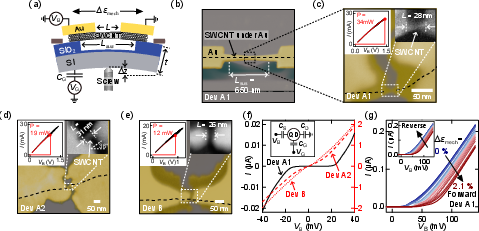
Figure 1: Experimental setup, fabrication steps, and initial electrical/strain characterization of SWCNT-QD devices, demonstrating strain-tunable and reversible quantum transport.
The mechanical strain Δεmech is precisely controlled to span 0–3%, with no observed slippage or mechanical hysteresis as confirmed by repeatable forward and reverse sweeps of conductance characteristics.
Observation of Mechanically Induced Quantum Transport Modulation
The devices exhibit archetypal Coulomb blockade and open quantum dot transport, verified by I-VB and differential conductance spectroscopy. Upon increasing mechanical strain, pronounced, systematic, and reversible horizontal shifts of Coulomb diamond features are recorded in dI/dV vs VB−VG maps, indicating tunable doping of the QD solely via mechanical means.
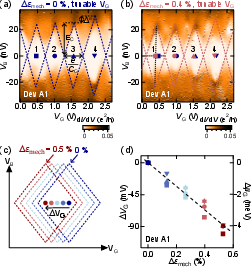
Figure 2: Coulomb diamond evolution under increasing uniaxial strain demonstrates mechanical gating characterized by linear ΔVG (gate shift) and corresponding Fermi energy modulation.
For Device A1, the Fermi energy shift is linear in strain with a slope ΔμG=7.5±0.3 meV/%; Devices A2 and B exhibit analogous behavior, with the direction and magnitude dependent on SWCNT chirality.
Mechanically induced doping in open QDs is evidenced in Devices A2 and B, where sweeping strain at constant VG changes the average occupancy by a full electron, with ∼0 exceeding 13 meV across accessible strain.
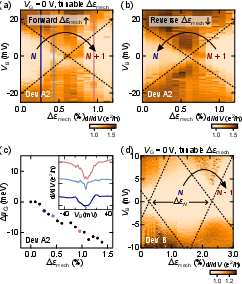
Figure 3: Differential conductance as a function of ∼1 and strain reveals fully reversible, mechanically controlled charge occupancy and Fermi energy tuning in QDs.
Disentanglement of Capacitance Versus Band Structure Effects
A critical finding is that the mechanical modulation of QD occupation and transport is not a result of capacitive tuning, as in conventional mechanically controlled break-junctions. Unlike those prior systems, these SWCNT-QDs are rigidly clamped at both ends, which is verified by the constancy of Coulomb diamond slopes, unchanged capacitances, and lack of shape deformation with displacement in the ∼2-∼3 characteristics.
Instead, the mechanical gating effect is traced to strain-induced modification of the SWCNT electronic band structure, accurately captured by theoretical models incorporating a strain-induced scalar potential (work function shift) and a vector potential (chirality-dependent bandgap tuning). Specifically, the scalar potential ∼4 produces a uniform energy shift, while the vector potential ∼5 modulates the bandgap, both producing Fermi level shifts closely matching experimental observations.
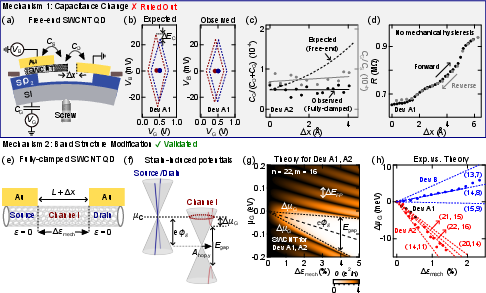
Figure 4: Comparison of mechanical gating mechanisms, rigorous quantification of strain-modified band structure, and quantitative validation of theory–experiment correspondence for all SWCNT-QD devices.
Chirality assignment from combined diameter and ∼6 data constrains Devices A1/A2 to (22,16) or (21,15), and Device B to (14,8), with theory showing excellent agreement for both magnitude and sign of Fermi energy modulation.
Implications and Prospects in Straintronics and Quantum Devices
These results substantiate a key claim: mechanical strain—rather than capacitive effects—enables deterministic, quantitative tuning of quantum transport properties in SWCNT-QDs in close accordance with theoretical predictions. The approach eliminates edge disorder and subband-multimode complications endemic to 2DMs, enabling single-subband precision control.
Numerical results demonstrate wide charge tunability (shifts exceeding 13 meV and whole-electron occupancy changes per QD), reversibility across repeated cycles, and extractable band structure parameters, evidencing the robustness and control in these devices.
The implications span several domains:
- Quantum computation: Mechanically tunable qubits, especially where electrostatic gating is infeasible due to environmental screening or integration constraints.
- Condensed matter and molecular electronics: Reliable single-molecule gating, strain-tunable homojunctions, and exploration of mechanical Aharonov-Bohm effects.
- Spin and valleytronics, superconductivity, and topological transitions: The platform enables direct testing of predictions for strain-sensitive quantum phases and coupling constants in one-dimensional systems.
Future developments may leverage these SWCNT-QT devices for noise-resilient qubits, strain-driven control in hybrid quantum architectures, and scalable molecular logic elements. Multi-strain/field configurations and integration with 2DM/TMD heterostructures could further expand the functional parameter space and quantum device capabilities.
Conclusion
The paper presents a technically rigorous, experimentally validated demonstration of mechanically controlled quantum transport in SWCNT quantum dots, definitively distinguishing intrinsic band structure effects from extrinsic capacitive mechanisms. The ability to achieve fully reversible, quantitatively predictable QD doping and bandgap modulation through uniaxial strain—robustly modeled and confirmed at the device level—positions SWCNT-QDs as an outstanding platform for both fundamental QTS studies and emergent quantum electronic applications.

