- The paper presents exact analytic expressions for spin- and valley-resolved transmission in strained WSe₂.
- It employs a low-energy Dirac Hamiltonian with strain-induced gauge fields to modify band dispersion and resonant tunneling conditions.
- The study demonstrates strain-driven conductance oscillations and spin filtering, highlighting its potential for spintronic and valleytronic devices.
Introduction
The paper "Tuning quantum tunneling in WSe2 via strain engineering" (2605.24851) presents a rigorous theoretical study of quantum transport phenomena in monolayer tungsten diselenide (WSe2), subjected to a combination of uniaxial mechanical strain and an external scalar electrostatic potential. Utilizing a low-energy Dirac Hamiltonian tailored for monolayer WSe2 with strong spin--orbit coupling, the authors investigate how strain and electrostatic gating act as independent tuning parameters affecting spin- and valley-resolved transmission, conductance, and polarization. The study delivers exact analytic expressions for transport coefficients, permitting a quantitative assessment of the efficacy of strain engineering for future device applications in the context of spintronics and valleytronics.
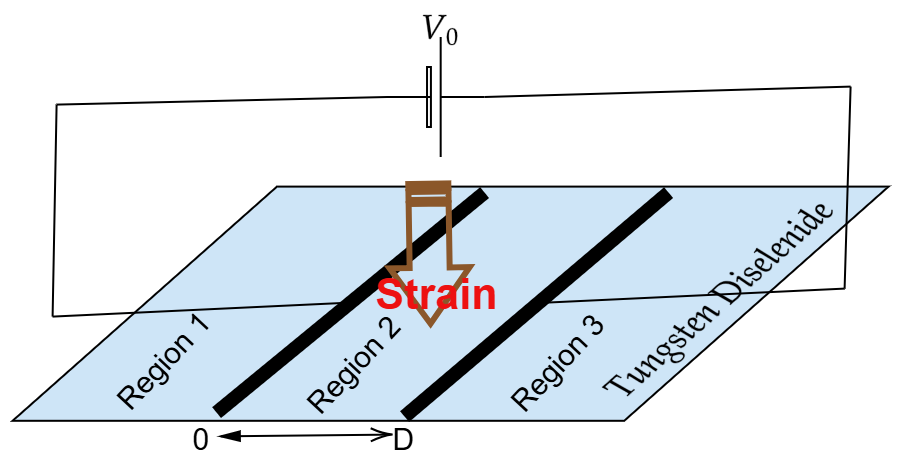
Figure 1: Schematic depiction of a WSe2 monolayer under uniaxial strain and a rectangular scalar potential barrier of height V0 and width D.
Theoretical Framework
The system is modeled as three consecutive regions: two pristine (unstrained) WSe2 leads and a central region subjected to both uniaxial strain and a scalar electrostatic potential. The low-energy Dirac equation captures the essential physics, incorporating the effects of strain via an effective valley-dependent gauge field. This modification results in altered band dispersion and effective longitudinal momentum inside the barrier, fundamentally influencing phase accumulation and quantum interference.
Boundary matching of two-component spinor solutions at the interfaces yields closed analytic forms for transmission and reflection amplitudes. The formalism enables computation of the spin- and valley-dependent current densities, crucial for determining transmission probabilities and conductance via the Landauer–Büttiker approach.
Transmission Properties and Quantum Interference
Transmission calculations reveal that at normal incidence, the transmission approaches unity, confirming the robust persistence of Klein tunneling even in the presence of the spin–orbit-induced band gap. The angle-dependent transmission demonstrates rapid suppression past a critical angle tied intrinsically to strain and incident energy, and pronounced oscillatory behavior emerges for increased barrier widths due to Fabry–Pérot–type quantum interference.
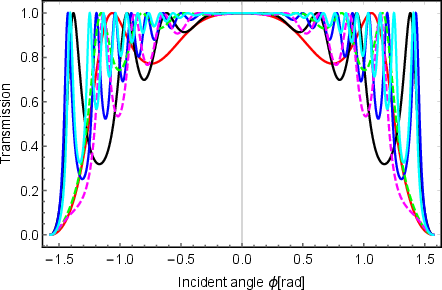
Figure 2: Transmission probability in the K valley as a function of incident angle ϕ for multiple incident energies, demonstrating spin and energy dependence with strong oscillations.
Strain acts as a non-trivial control parameter; it shifts the resonant conditions within the barrier and modulates the transmission oscillations. Distinct differences in spin-up and spin-down transmission profiles arise from the interplay of spin–orbit coupling and strain-induced gauge fields, yielding spin-resolved transport characteristics.
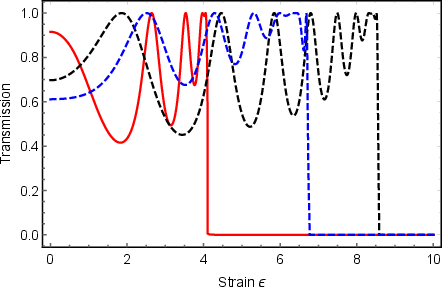
Figure 3: Spin-up transmission in the K valley as a function of strain ε for fixed 20 and multiple incident energies, elucidating strain-driven resonant oscillations.
Variation of the barrier height generates threshold and oscillatory behavior, corresponding to the emergence of quasi-bound states and quantum interference resonances. Spin–orbit coupling generates a notable splitting of transmission thresholds between spin species, highlighting the possibility of spin-selective transport modulation.
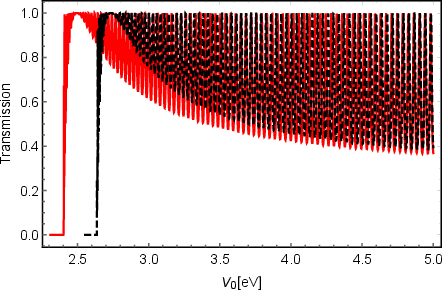
Figure 4: Spin-up and spin-down transmission as functions of barrier height 21, illustrating spin splitting and resonant tunneling thresholds.
Conductance Analysis
Conductance is evaluated by integrating the total transmission probability over angular or transverse momentum channels. The system exhibits oscillatory conductance traces mirroring underlying transmission resonances, especially as strain is varied. Enhanced modulation is observed at lower energies due to the limited number of contributing transport modes. Increasing incident energy smooths the oscillatory structure due to mode averaging.
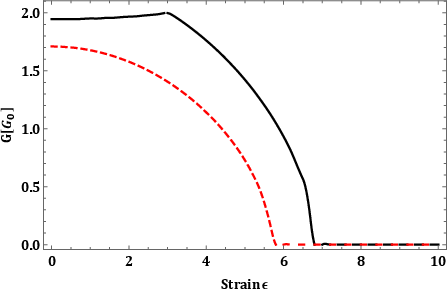
Figure 5: Conductance versus strain for both spin channels at fixed 22 and 23, revealing oscillatory and strain-driven polarization patterns.
The split between spin-up and spin-down conductance signals strain-induced spin filtering, attributable to modifications in spin degeneracy and band edge positions by strain and spin–orbit interaction.
Spin and Valley Polarizations
Spin and valley polarizations are formulated in terms of conductance differences between respective channels. Tunability of both polarizations is demonstrated against variations in barrier width and strain. Polarization oscillations are tied to coherent quantum interference mechanisms, specifically Fabry–Pérot-type modulation, and show enhancement at specific barrier dimensions and strain values. Maximum polarization amplitudes occur at small barrier widths due to strong confinement and coherence.
Downstream analysis reveals strong valley-dependent spin polarization asymmetries, allowing for selective resonance enhancement or suppression in the 24 or 25 valley. Strain-dependent gauge fields shift longitudinal momentum differentially for each valley, introducing asymmetry not accessible in unstrained configurations. The system allows simultaneous control over spin- and valley-filtering, an essential feature for advanced valleytronic and spintronic architectures.
Physical Mechanisms and Interpretation
The combination of strain, barrier geometry, and scalar potential provides a highly tunable mechanism for quantum transport manipulation in WSe26. Uniaxial strain operates as a valley-selective gauge field, shifting resonance conditions and introducing phase-dependent oscillatory features in transmission and conductance. The presence of Fabry–Pérot interference and the persistence of Klein tunneling confirm the coherence and relativistic nature of transport in strained WSe27 monolayer systems.
The oscillatory features in transport metrics are fundamentally quantum in origin, reflecting phase-coherent propagation and constructive/destructive interference under mechanical deformation. Comparison with unstrained transport regimes highlights the strain-induced emergence of strong spin and valley filtering, underscoring the utility of strain engineering in Dirac-like two-dimensional semiconductors.
Implications and Outlook
The results underscore the efficacy of uniaxial strain and electrostatic barrier engineering for controlling tunnel transport, conductance, and spin–valley polarization in monolayer WSe28. The demonstrated tunability is relevant for the design and optimization of spintronic, valleytronic, and nanoelectronic devices leveraging quantum interference and coherent transport. The theoretical predictions are consistent with available experimental platforms, suggesting immediate applicability in practical device fabrication employing 2D materials.
Future research directions may explore dynamic and spatially varying strain profiles, coupling to external fields, or multi-barrier architectures for enhanced quantum control. Theoretical extensions could incorporate disorder, phonon coupling, or non-equilibrium effects to bridge the gap toward real-world implementation in robust optoelectronic and valleytronic technologies.
Conclusion
This formal analysis establishes that mechanical strain and electrostatic gating are sophisticated, effective means of modulating quantum transport in WSe29 monolayers. Strain engineering brings rich structure to spin–valley-resolved tunneling, conductance oscillations, and quantum interference patterns. The ability to realize tunable spin and valley polarization via coherent transport mechanisms proposes a versatile platform for advanced device applications in two-dimensional transition-metal dichalcogenides. The findings confirm the central role of strain engineering in future quantum transport technologies, with implications well beyond WSe20.