- The paper develops a tensor-network algorithm using Zolotarev rational approximations to achieve exponential convergence in trace norm computations.
- It employs a DMRG-inspired variational approach to efficiently evaluate entanglement negativity, fidelity, and quantum Fisher information in many-body systems.
- Benchmark tests on decohered cluster states and random separable mixed states demonstrate controlled error bounds and scalability beyond exact diagonalization.
Tensor-Network Algorithm for Many-Body Trace Norms
Introduction
Trace-norm-based quantities such as state distinguishability (trace distance), entanglement negativity, and quantum fidelity are fundamental to quantum information theory and many-body physics. However, direct evaluation of trace norms is computationally prohibitive for generic many-body mixed states due to the exponential scaling of the Hilbert space and the non-analyticity of the absolute-value function. Matrix product operator (MPO) representations mitigate storage costs for many physically relevant operators, but computing trace-norms of large MPOs remains challenging—exact diagonalization is limited to small systems, and existing tensor-network functionals (e.g., polynomial-based Lanczos methods) suffer from limited accuracy and poor convergence for non-analytic functions.
This work develops a controlled, scalable tensor-network algorithm for estimating the trace norm of MPOs based on Zolotarev's rational approximation of the sign function, combined with a variational approach inspired by DMRG. The method realizes exponential convergence in the rational approximation degree, explicit error bounds, and applicability to both Hermitian and non-Hermitian MPOs. This framework makes negativity, fidelity, and quantum Fisher information (QFI) computable tensor-network observables for large systems.
Methodology: Zolotarev Rational Approximation and Variational Optimization
The core methodology exploits the identity ∣x∣=xsgn(x) and the availability of exponentially accurate rational approximations to the sign function, as constructed by Zolotarev. For a Hermitian MPO A with bounded spectrum, the trace norm is estimated via
∥A∥1≈fℓ,r(A)=Tr[AZℓ,r(A)],
where Zℓ,r is Zolotarev's rational function tailored by spectral cutoff ℓ and degree r. The approximation error is exponentially suppressed in r and can be made arbitrarily small for physically relevant spectra, with explicit error bounds determined by rational approximation and the spectral weight near zero.
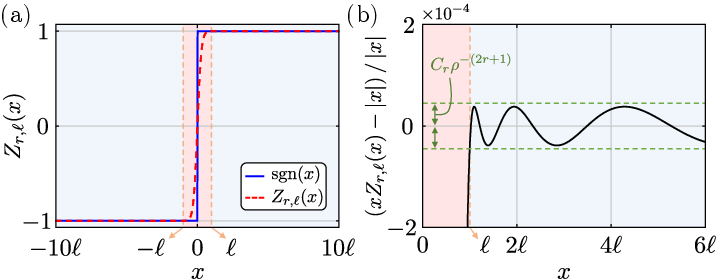
Figure 1: Zolotarev's rational approximation Zℓ,r(x) to the sign function, highlighting exponential accuracy except within ∣x∣<ℓ.
To evaluate the rational function of an MPO, the trace terms Tr[A2(A2+c2j−1I)−1] are recast as variational problems in a doubled Hilbert space, enabling solution via a DMRG-like alternating optimization over an MPS ansatz. The required local update for each MPS tensor amounts to solving linear systems built from local environment tensors, allowing the systematic contraction and control of bond dimensions.

Figure 2: DMRG-like local update step for the variational MPS, showing the linear system to be solved for each tensor.
For non-Hermitian MPOs A0, the construction is extended by embedding A1 in a Hermitian block-matrix A2, ensuring the trace-norm computation is always reducible to the Hermitian case.
Numerical Benchmarks
Entanglement Negativity in Decohered Cluster States
To demonstrate accuracy and scalability, the algorithm is benchmarked on analytically solvable models. The half-chain entanglement negativity is computed for a 1D cluster state subjected to phase-flip noise, with the mixed state admitting an exact MPO representation. The algorithm reproduces the analytic transition in negativity across the critical noise rate A3, including convergence properties as a function of system size A4 and algorithmic parameters.
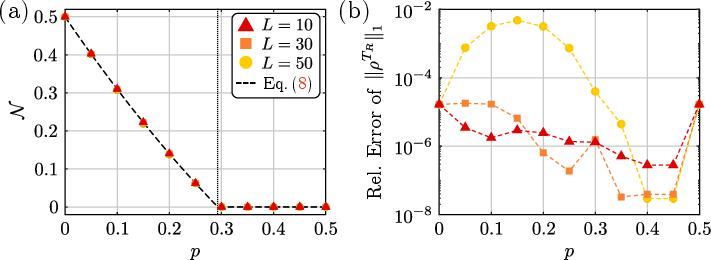
Figure 3: Estimated negativity for the decohered cluster state across a range of noise rates, compared against the analytic result.
The observed relative error is governed by the rational approximation (A5, A6), the spectral structure of the partially transposed density matrix, and the variational ansatz bond dimension A7. As A8 increases, the fraction of eigenvalues below the cutoff A9 causes a controlled rise in error, but this is systematic and quantified by the derived bounds.
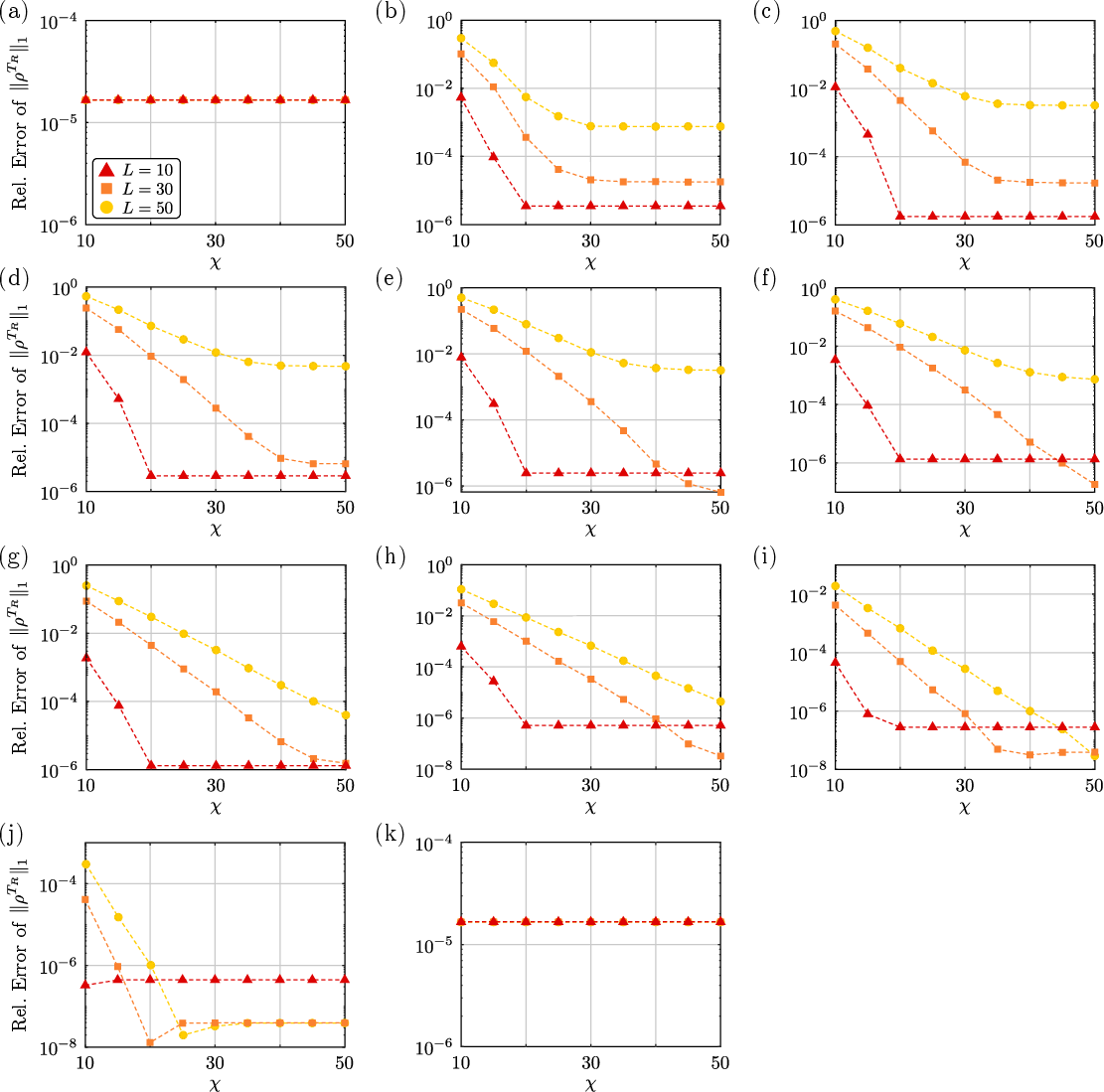
Figure 4: Convergence of the trace-norm error as a function of the MPS bond dimension ∥A∥1≈fℓ,r(A)=Tr[AZℓ,r(A)],0, evidencing rapid saturation.
Random Separable Mixed States
The method is further tested on MPOs representing random separable mixed states where exact diagonalization is infeasible. Across multiple random realizations, the estimated negativities are clustered tightly around zero, in agreement with separability.
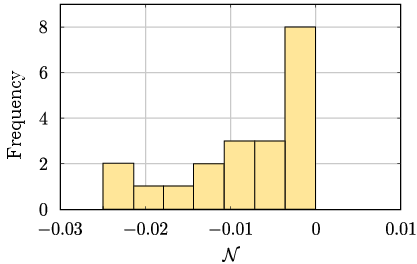
Figure 5: Distribution of negativity estimates for random separable mixed state MPOs demonstrating vanishing negativity as expected.
The framework also enables computation of fidelity between general mixed states given their MPS purifications, via the trace norm of an ancillary MPO constructed from the purifications. From fidelities evaluated at small parameter shifts, the QFI of noisy GHZ states under amplitude damping noise is estimated. The numerical QFI closely matches analytic expressions and demonstrates controlled accuracy for large systems.
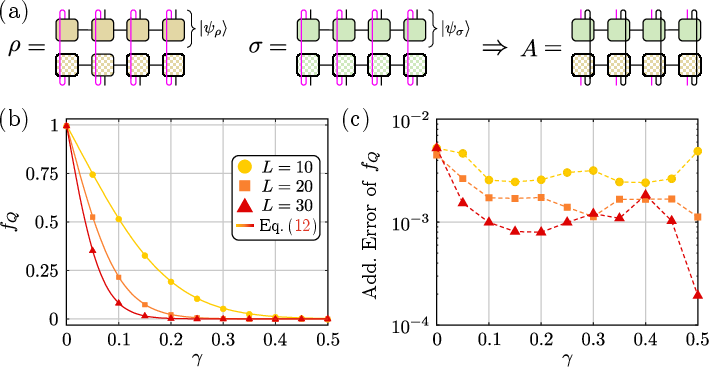
Figure 6: Fidelity estimation between mixed-state purifications as an MPO contraction problem.
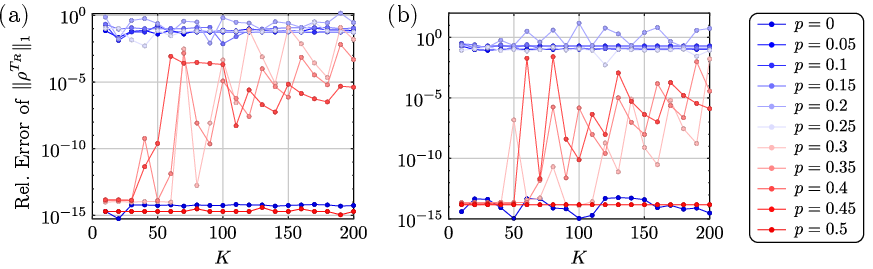
Figure 7: Relative estimation error of the trace norm (and thus negativity/fidelity) as a function of computation parameters.
Comparison with Existing Methods
Polynomial-based approaches (e.g., global Lanczos for ∥A∥1≈fℓ,r(A)=Tr[AZℓ,r(A)],1) suffer from algebraic convergence and lack controlled error bounds for nonsmooth functions, while the Zolotarev rational framework achieves exponential convergence and explicit control. The tensor-network method here is not limited to pure states or specific bipartition geometries and systematically outperforms polynomial methods in both generality and accuracy.
Implications and Future Prospects
By transforming trace-norm-based quantities into practical tensor-network observables, this approach extends the range of computable information measures in many-body systems to moderate and large system sizes, both numerically and experimentally. Coupling with recent advances in MPO learning from quantum experiments will enable direct measurement of negativity and fidelity for mixed states in realistic settings. The controlled-error rational function methodology is extensible to other non-linear observables and potentially to higher-dimensional PEPS tensor networks, contingent on further advances in efficient contractions and optimization methods.
Potential future developments include extending the approach to general tensor-network ansatzes, exploiting symmetries for further acceleration, and refining numerical stability for systems with dense low-lying spectra.
Conclusion
This work establishes a rigorously controlled and scalable tensor-network algorithm for estimating the trace norm of MPOs, enabling efficient computation of entanglement negativity, quantum fidelity, and quantum Fisher information in one-dimensional many-body mixed states. By leveraging the properties of Zolotarev rational approximations and variational MPO methods, the approach achieves exponential accuracy and practical applicability beyond the reach of exact diagonalization and polynomial approximations. Theoretical and experimental quantum information studies of mixed states stand to benefit directly from this advancement.
(2606.11882)