- The paper shows that local NOT gates applied at specific intervals can delay or entirely avoid entanglement sudden death in multipartite quantum states.
- It presents closed-form analyses for genuine multipartite concurrence and teleportation fidelity under amplitude damping conditions.
- The study highlights that optimal NOT-gate strategies can differ between maximizing entanglement and ensuring high controlled teleportation fidelity.
Decoherence Mitigation with Local NOT Gates in Multipartite Systems
Introduction and Motivation
Decoherence-induced destruction of entanglement—particularly entanglement sudden death (ESD)—remains a major bottleneck for practical quantum information processing in multipartite systems. This work systematically studies the entanglement and teleportation dynamics of n-qubit Bell- and GHZ-type states subjected to amplitude damping channels (ADCs). The authors quantitatively analyze genuine multipartite concurrence (GMC), Bell nonlocality, controlled quantum teleportation (CQT) fidelity, and localizable entanglement (LE) under ADCs, and provide an analytic treatment of entanglement evolution when local NOT gates are inserted at specific points in the dissipative dynamics.
A key contribution is the demonstration that carefully timed local NOT operations can significantly alter and delay—or in some cases entirely avoid—ESD of multipartite entanglement, with protocol-dependent distinctions between maximizing GMC and optimizing teleportation fidelity. The paper further leverages GHZ-symmetric parametrization to elucidate SLOCC class evolution and the operational consequences of these protocols.
Entanglement and Decoherence in Multipartite States
The fragility of GHZ-type states to amplitude damping noise is starkly characterized. For an n-qubit GHZ-type state ∣GHZn(α)⟩=α∣0...0⟩+β∣1...1⟩ subjected to ADC, the entanglement death threshold rises steeply with n: for maximally entangled cases, ESD is observed in three- and four-qubit states, while two-qubit Bell states only exhibit asymptotic decay (ADE) for comparable parametric regimes.
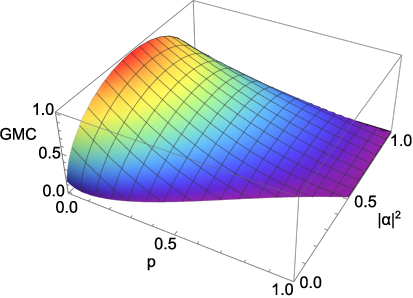
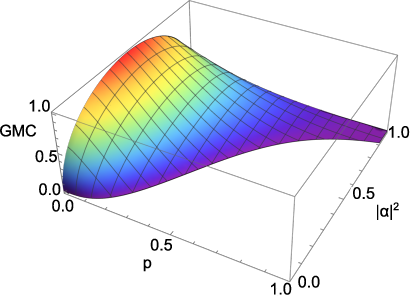
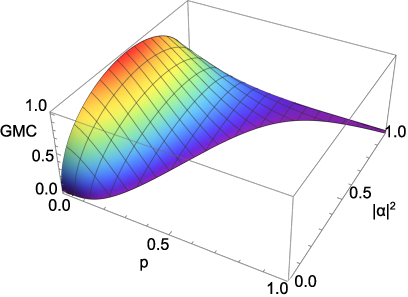
Figure 2: Evolution of GMC for two-, three-, and four-qubit GHZ-type states under ADC, illustrating accelerated ESD onset as n increases.
The analytic expressions for GMC capture this vulnerability, and direct calculation reveals that GHZ states with small ∣α∣2 experience abrupt entanglement loss, while higher ∣α∣2 admits ADE over wider parameter ranges. This scaling underscores the challenge of resource preservation in relevant real-world protocols employing GHZ resources.
Local NOT-Gate Protocols: Mechanism and Efficacy
Building on earlier bipartite findings, the authors derive closed-form GMC dynamics for n-qubit Bell- and GHZ-type states when local NOT (σx) gates are applied to m≤n qubits between two ADC intervals. This gate swaps population between computational basis states, effectively reinjecting amplitude into decoherence-prone subspaces or redistributing population so as to mitigate further coherence depletion during subsequent ADC intervals.
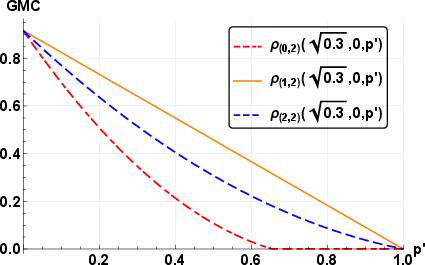
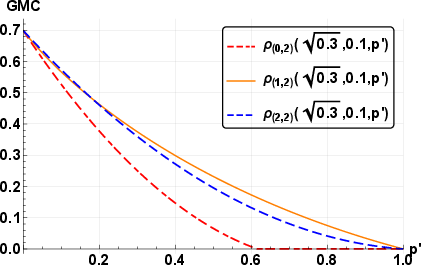
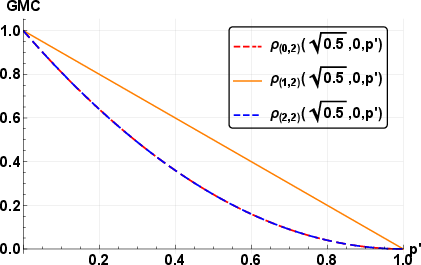
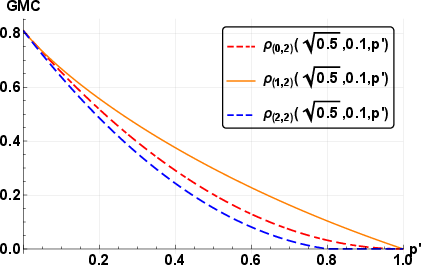
Figure 4: Comparative GMC evolution for bipartite Bell states with 0-, 1-, and 2-qubit NOT operations during double ADC exposure. A single NOT application is optimal for entanglement preservation.
Remarkably, a single NOT gate on any qubit often suffices to transform ESD in multipartite (GHZ-type, n0) states into ADE, even though the residual entanglement itself becomes progressively smaller with increasing n1. This protocol requires only site-selective n2-pulses and is platform-agnostic (applicable to superconducting qubits, NV centers, photonic qubits, etc.), with operation times much shorter than relaxation times, justifying the idealization of instantaneous gate application.
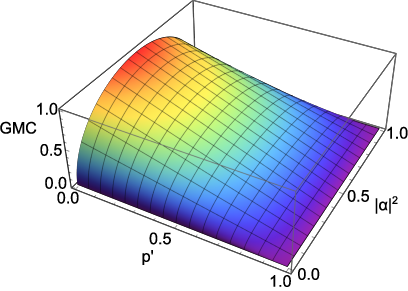
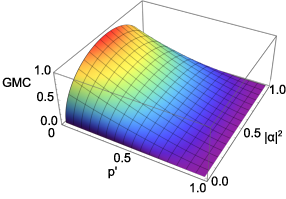
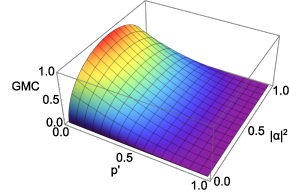
Figure 6: ADE behaviour across 2-, 3-, and 4-qubit GHZ states with a single NOT operation, over a 2D sweep of n3, clearly avoiding ESD in all cases.
For specific initial configurations and noise strengths, multi-NOT strategies (two or more qubits flipped in higher-party states) may outperform the single-NOT approach in preserving GMC when n4, but a universal trend emerges: flipping all qubits always hastens ESD, while partial NOT operations optimally extend entanglement lifetimes.
Controlled Quantum Teleportation and Fidelity Analysis
The operational relevance of entanglement is probed through teleportation and CQT fidelities, analyzed via both full protocol and circuit-level models.
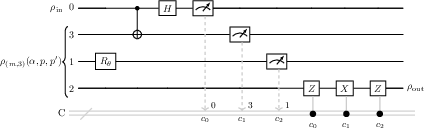
Figure 7: Schematic and circuit (part b) for CQT using a three-qubit GHZ-type state with a single controller; generalizes to multipartite settings (2604.23556).
It is shown that optimal entanglement engineering does not always guarantee optimal teleportation performance. For bipartite resources, a single NOT that maximizes entanglement can in fact reduce teleportation fidelity, confirming and extending previous observations [NoisyTeleport_Fortes2015]. For GHZ resources used in three- or four-party CQT, flipping all qubits (for n5) is maximally effective in delaying fidelity decay to the classical threshold, but submaximal NOT strategies are preferable for entanglement lifetime.
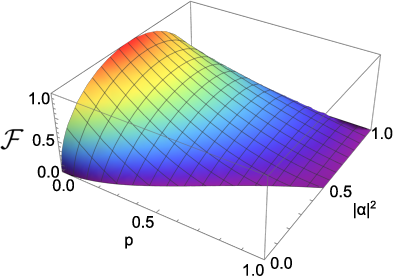
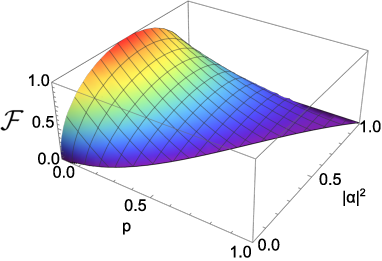
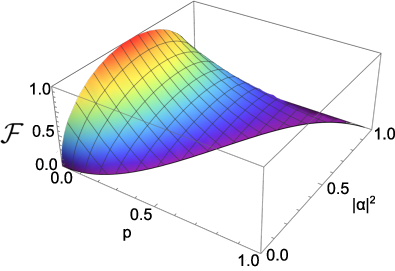
Figure 1: Teleportation fidelity surfaces vs.\ n6 for two-, three-, and four-qubit states. Fidelity crosses to the classical threshold at lower n7 as n8 increases.
Crucially, there is an explicit numerical hierarchy: the classical (measure-and-prepare) fidelity limit (n9) is crossed before the vanishing of GMC in various scenarios, and fidelity exceeding ∣GHZn(α)⟩=α∣0...0⟩+β∣1...1⟩0 certifies Bell nonlocality.
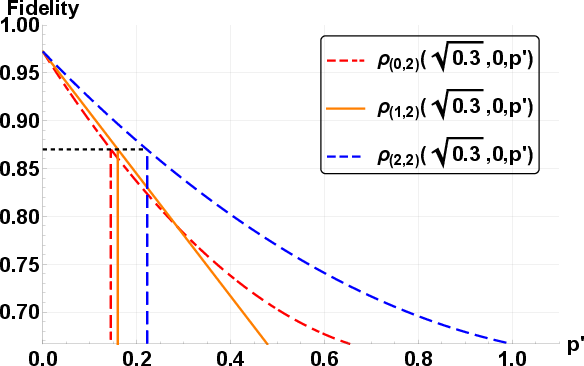
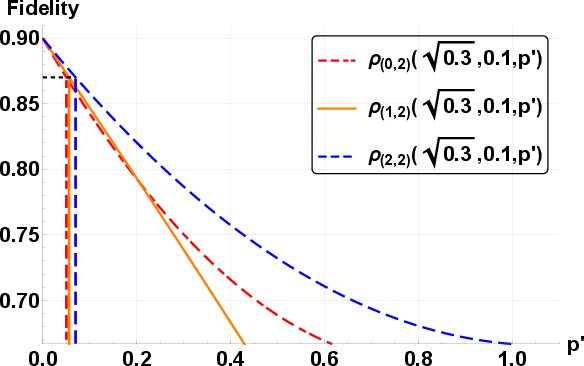
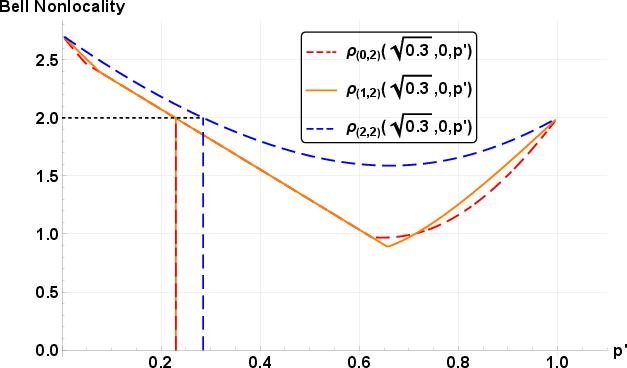
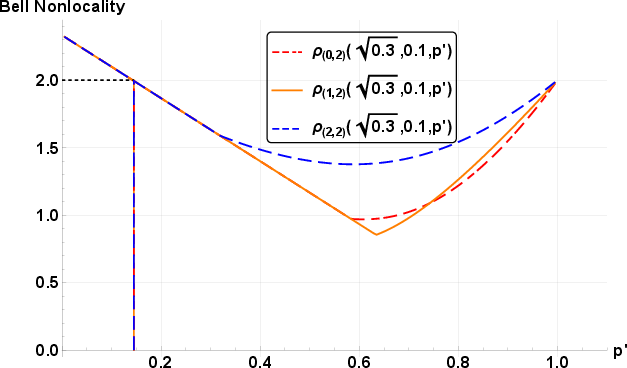
Figure 3: Fidelity and Bell-CHSH violation for bipartite, double-NOT qubit states, demonstrating the strict hierarchy: Bell locality loss (CHSH) precedes loss of teleportation advantage, which precedes GMC vanishing.
Resource Dynamics, SLOCC Classes, and Localizable Entanglement
The authors employ GHZ-symmetric parametrization [GHZ-Sym_Eltschka2012, TripartiteEnt_Siewert2012, GHZ-SymClass_Park2014] to map the dissipative state evolution in an operational metric over the SLOCC entanglement-class landscape. For two qubits, the separable/entangled boundary is traversed as ADC noise increases; for three qubits, numerical trajectories across the GHZ, W, and biseparable regions are calculated, explicitly locating the loss of genuine multipartite entanglement and the later degradation of CQT fidelity.
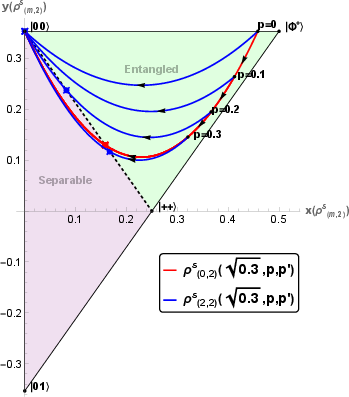
Figure 11: Trajectories of GHZ-symmetrized two-qubit states under NOT-gate/ADC protocols, indicating entangled/separable boundaries and points of fidelity/entanglement loss.
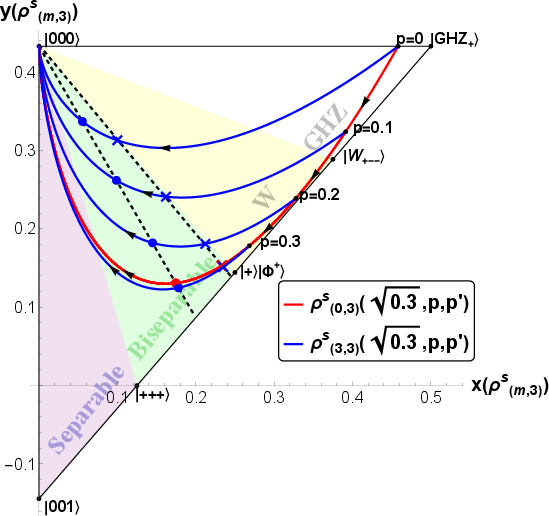
Figure 13: Three-qubit GHZ-symmetric SLOCC mapping. GME loss (cross) generically precedes loss of CQT utility (dot), with substantial regions of biseparable (non-GME) states still useful for CQT.
The W-class can support non-classical CQT even in the absence of genuine multipartite entanglement, as certified by nonzero localizable concurrence and direct calculation of LE. This aligns with recent experimental demonstrations [CQT-PRL_Barasinski2019, CQT-PRA_Barasinski2019, CQT_Barasinski2018].
For four-qubit systems, trajectories are visualized in ∣GHZn(α)⟩=α∣0...0⟩+β∣1...1⟩1 GHZ-symmetric space, but the absence of a complete SLOCC-classification limits the direct mapping of fidelity or GMC thresholds onto entanglement classes. Nevertheless, the generic ordering of fidelity/entanglement loss persists.
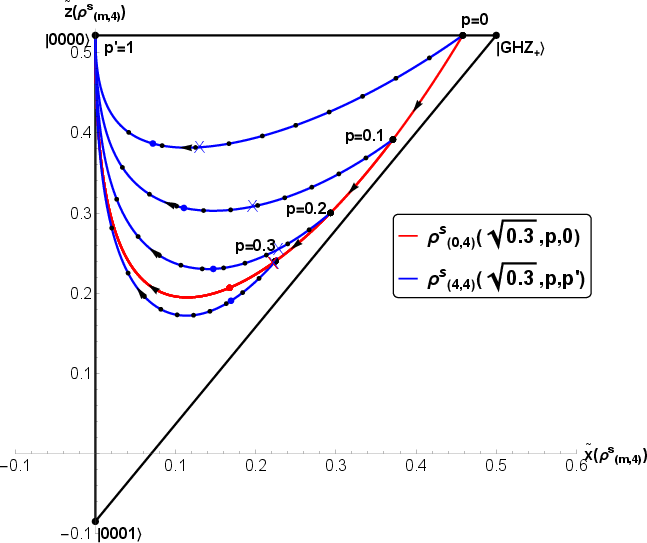
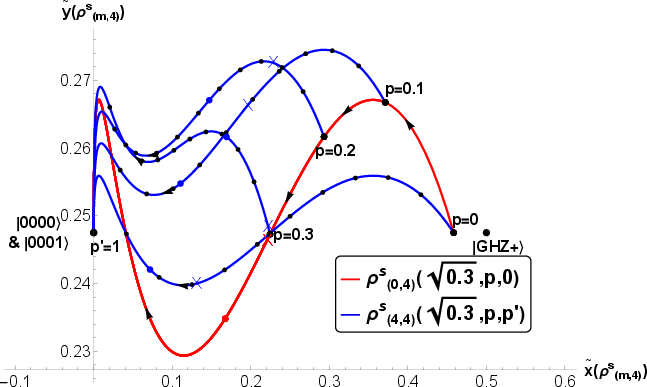
Figure 5: Four-qubit GHZ-symmetric state trajectory under ADC + NOT strategies visualized in ∣GHZn(α)⟩=α∣0...0⟩+β∣1...1⟩2 space, with GMC loss always preceding CQT fidelity decay to the classical value.
Practical and Theoretical Implications
The demonstration that local, unitary NOT operations—simple, deterministic, and platform-agnostic—can efficiently delay or avoid ESD and operational degradation in multipartite entangled systems has substantial implications:
- Experimental Accessibility: Only standard ∣GHZn(α)⟩=α∣0...0⟩+β∣1...1⟩3-pulses (spin flips) are required, making protocol implementation straightforward in a variety of hardware.
- Protocol Choice: The optimal NOT strategy is task-dependent (entanglement vs teleportation), and must account for the initial state population.
- Resource Hierarchy: Preservation of GME is not always the most stringent requirement for quantum information tasks. Localizable entanglement and CQT operational thresholds can endure well beyond the vanishing of global entanglement measures.
- Multipartite Discord: Extension of the NOT protocol to discord-like correlations (which are even more robust under ADC) is speculated as a practical future direction, potentially enabling enhanced preservation of quantum advantage in realistic environments.
Conclusion
This work provides an analytic and operational toolkit for decoherence mitigation in multipartite quantum systems. It establishes the practical utility and precise limits of local NOT gates for entanglement and teleportation resource preservation under amplitude damping, bridges the gap between entanglement quantification and practical quantum information throughput, and advances our understanding of multipartite resource dynamics under decoherence. The findings have significant implications for near-term experiments leveraging GHZ-type entanglement for quantum communications, distributed sensing, and scalable quantum architectures.
References
(2604.23556)

