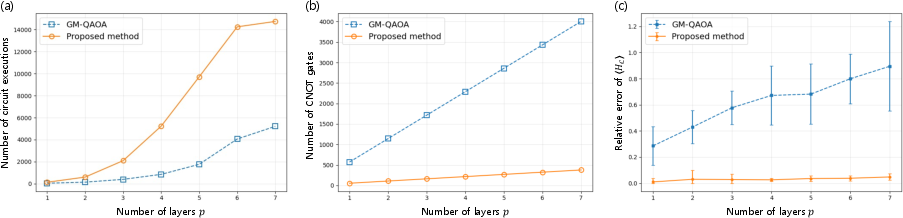
- The paper introduces a locally acting Grover mixer framework that decomposes the global mixing operation into efficient, independent local operations.
- It demonstrates significant resource reductions—such as lowering CNOT counts from 218 to 28—while maintaining competitive convergence on exact-cover and TSP instances.
- The approach enhances noise resilience and scalability on NISQ platforms, making constraint-preserving quantum optimization more practical.
Locally Acting Grover Mixers for Constraint-Preserving QAOA
Overview of GM-QAOA and Motivation for Local Mixers
Quantum approximate optimization algorithms (QAOA) constitute a principal framework for tackling combinatorial optimization problems on noisy intermediate-scale quantum (NISQ) devices. The Grover mixer QAOA (GM-QAOA) specifically leverages a mixing unitary generated by a projector onto the initial state, structurally analogous to the diffusion operator in Grover's search, thus ensuring that quantum evolution remains confined to the feasible subspace defined by problem constraints. This guarantees constraint preservation, crucial for solving discrete optimization tasks such as TSP and exact-cover problems.
Nonetheless, the central challenge in GM-QAOA is the circuit overhead induced by the mixer’s implementation. The required global multi-controlled phase-shift gate acting on all qubits results in resource-heavy circuits, which are not compatible with the limited depth and noise susceptibility of current hardware. The paper proposes a solution: locally acting Grover mixers that exploit product-structured initial states—made possible by encoding only a subset of constraints—enabling more efficient circuits by decomposing the mixer into independent local operations.
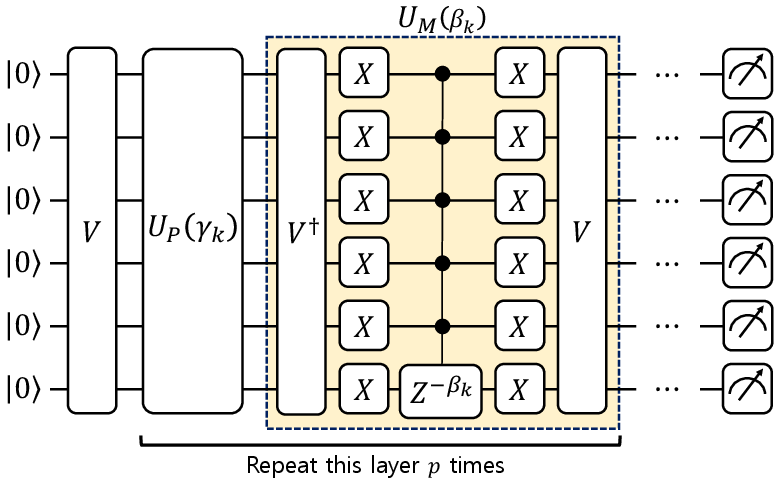
Figure 1: Schematic illustration of GM-QAOA, highlighting alternating phase-separation unitaries and the global mixing unitary implemented via multi-controlled phase-shift gates.
Product-Structured Mixers and Circuit Efficiency
The proposed method targets initial states factorized across disjoint qubit subsystems. By encoding partial constraints, the feasible space admits a decomposition, allowing both the state preparation and the Grover mixer to be split into independent blocks acting on qubit subsets. Each block employs its own local multi-controlled phase-shift, drastically reducing resource requirements relative to the global operation.
Mathematically, the mixing unitary becomes a tensor product:
$U_{M}(\beta^{(1)}, \dots, \beta^{(\ell)})=\bigotimes_{j=1}^{\ell} e^{-i\beta^{(j)}\ket{\psi^{(j)}_{0}\bra{\psi^{(j)}_{0}}$
This approach increases the number of variational parameters (from $2p$ in GM-QAOA to p(ℓ+1) for p layers and ℓ subsystems), but the implementation cost—especially in terms of entangling gates and circuit depth—is substantially lowered.
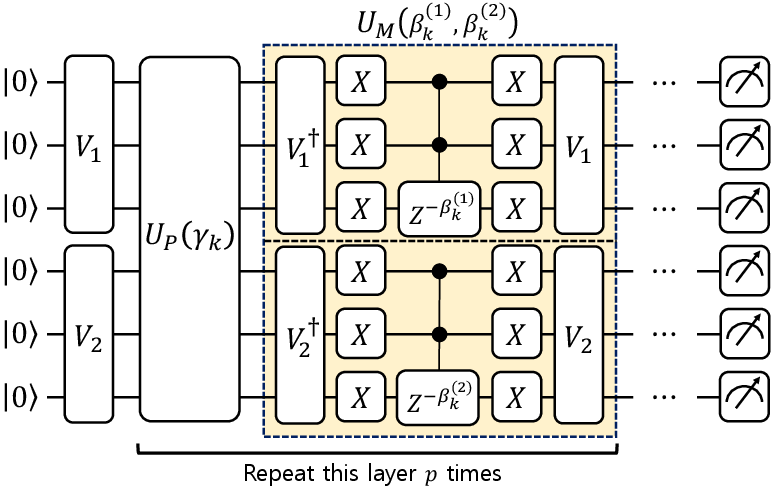
Figure 2: Local Grover mixers for product-form initial states; mixer unitaries decompose into parallel blocks acting on independent subsystems.
Numerical Analysis: Exact-Cover and TSP
Exact-Cover Problem
For a seven-qubit exact-cover instance, the product structure ∣W3⟩⊗∣W2⟩⊗∣++⟩ enables preparation with linear depth per subset. Simulations demonstrate comparable convergence behavior between GM-QAOA and the local mixer variant, despite more parameters in the latter. Critically, the CNOT count for mixing operations is reduced from 218 to 28—a substantial resource reduction.
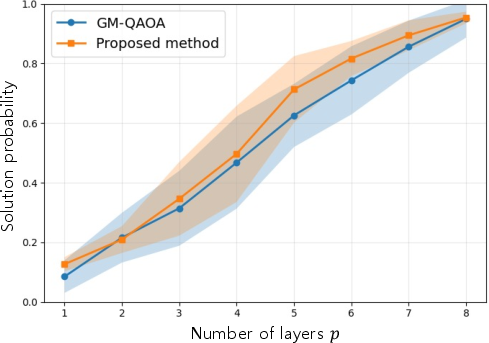
Figure 3: Solution probability versus layers p for exact-cover; local mixers achieve similar convergence as global GM-QAOA.
Traveling Salesman Problem (TSP)
For TSP instances (four cities, nine qubits), partial encoding of time-step constraints yields an initial state as a product of ∣W3⟩ blocks. The local Grover mixer exploits this structure, leading to n local phase-shift gates versus a single nine-qubit controlled gate. Across multiple city arrangements, solution quality remains comparable.
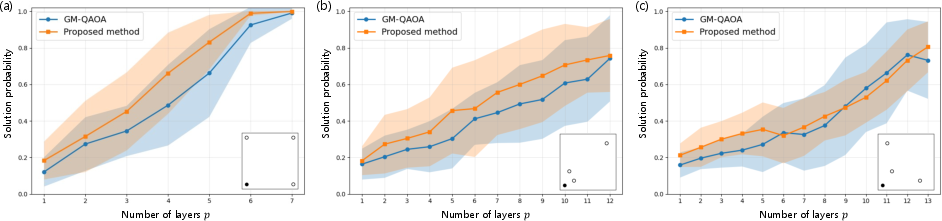
Figure 4: Convergence in solution probability for three TSP instances; performance equivalence between the methods across diverse cases.
Resource analysis reveals key trade-offs:
Constraint Encoding Strategies and Scalability
Encoding all TSP constraints into the initial state reduces the search space significantly (n! vs $2p$0), enabling high solution probability at shallow circuits. However, the complexity of state preparation and mixing unitaries increases drastically—full constraint encoding incurs circuit depth and gate counts nearly an order of magnitude higher than partial encoding, even at optimal layer counts. For larger systems, the product-structured approach scales linearly with $2p$1, outperforming the $2p$2 depth/$2p$3 gate requirements of the fully encoded variant.
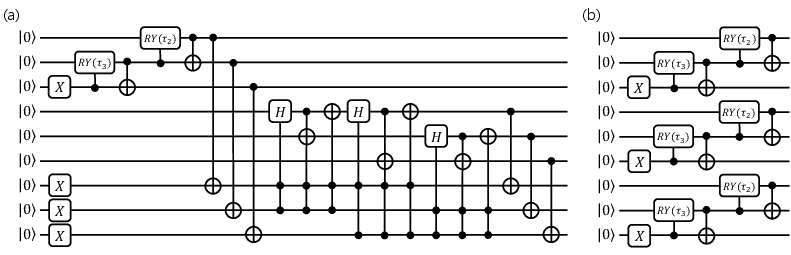
Figure 6: Comparison of state preparation circuits for full and partial constraint encoding; product structure yields dramatically simpler circuits.
| Encoding |
Optimal $2p$4 |
1-qubit gates |
2-qubit gates |
Circuit depth |
| Full ($2p$5 & $2p$6) |
1 |
4233 |
2082 |
4142 |
| Partial ($2p$7 only) |
7 |
834 |
690 |
450 |
Full constraint encoding achieves reduced layers but at severe increase in circuit complexity, underscoring the practical advantage of partial constraint encoding plus local mixers.
Implications and Future Perspectives
The locally acting Grover mixer framework yields a practical path for constraint-preserving quantum optimization on NISQ platforms. The trade-off between parameter count and circuit complexity enables flexible adaptation based on hardware capabilities, with strong noise resilience due to minimized entangling operations. The approach generalizes to constraints yielding product-form feasible spaces and may be extended to other constraint-preserving QAOA ansatzes, such as $2p$8-mixer variants.
Key open avenues include:
- Efficient gradient-based or gradient-free optimization strategies to handle the increased parameter space.
- Rigorous trainability analysis, particularly regarding the prevalence of barren plateaus in optimization landscapes.
- Systematic benchmarking on larger and structurally diverse optimization problems.
- Theoretical analysis explaining convergence behavior parity between global and local mixers, despite their fundamentally distinct mixing dynamics.
Conclusion
Locally acting Grover mixers for QAOA offer a methodologically sound and resource-efficient approach for quantum combinatorial optimization under constraints. By tailoring mixer and state preparation to the product structure of the feasible space, significant reductions in gate count, circuit depth, and noise sensitivity are achieved while maintaining competitive convergence to high-quality solutions. The method is practically suited for NISQ hardware and scalable to larger problem instances, with theoretical investigations into its optimization landscape and generalizations to broader constraint-preserving algorithms representing compelling directions for future research.