- The paper reports that using post-selection to combine narrow spectral preparation with sharp temporal localization significantly enhances single-photon cross-phase shifts.
- It employs weak-value amplification in a cold Rb atomic ensemble to achieve phase shifts up to -148 μrad at an optical depth of 4.7, outperforming conventional methods.
- The approach challenges traditional time-energy limits and opens new avenues for practical photon-photon interactions in quantum nonlinear optics.
Enhancement of Single-Photon Cross-Phase Shifts via Joint Frequency and Temporal Localization
Introduction and Theoretical Background
Single-photon nonlinearities underpin a range of protocols in quantum information, notably facilitating photon-photon gates via cross-phase shifts (XPS). Traditionally, maximizing XPS entails preparing photons with narrow bandwidth for optimal resonance with a two-level system—such as an atomic vapor—while simultaneously requiring high temporal localization to boost intensity. This approach is fundamentally constrained by the time-energy uncertainty relation: narrow spectral preparation implies long coherence times with weak peak intensity, and vice versa.
This work (2606.11516) interrogates and experimentally circumvents this limitation through the technique of post-selection. Specifically, by preparing a photon in a narrow-band, resonant state and then post-selecting in a sharply defined temporal mode after the interaction, it is possible to simultaneously achieve both strong resonance and high intensity for the effective system-photon interaction. The theoretical foundation relies on weak-value amplification, where distinct pre- and post-selections lead to anomalously large expectation values for weakly coupled observables (here, atomic excitation producing the XPS). The formal analytic derivation in the appendix predicts an exponential scaling of the maximal atomic excitation—1−exp(−OD/2)—with optical depth (OD), a regime inaccessible through traditional means.
Experimental Methodology
The experiment utilizes cold 85Rb atoms, with both probe and signal beams derived from narrow-linewidth lasers tuned near the 5S1/2∣F=3⟩→5P3/2∣F=4⟩ transition. The probe phase is monitored via interference with a reference sideband, allowing rapid, high-resolution readout of phase shifts induced by signal photon-excited population in the atomic ensemble.
Signal photons, prepared as a continuous-wave (CW), resonant, narrow-band mode, traverse the cloud, and transmitted events are time-tagged with high-resolution single-photon detectors. The probe phase trace is post-processed: phase readouts are windowed around detected photon events and averaged to extract the conditional weak-value-induced XPS. Multiple ODs (1.0–4.7) and signal intensities are explored to delineate the enhancement landscape.
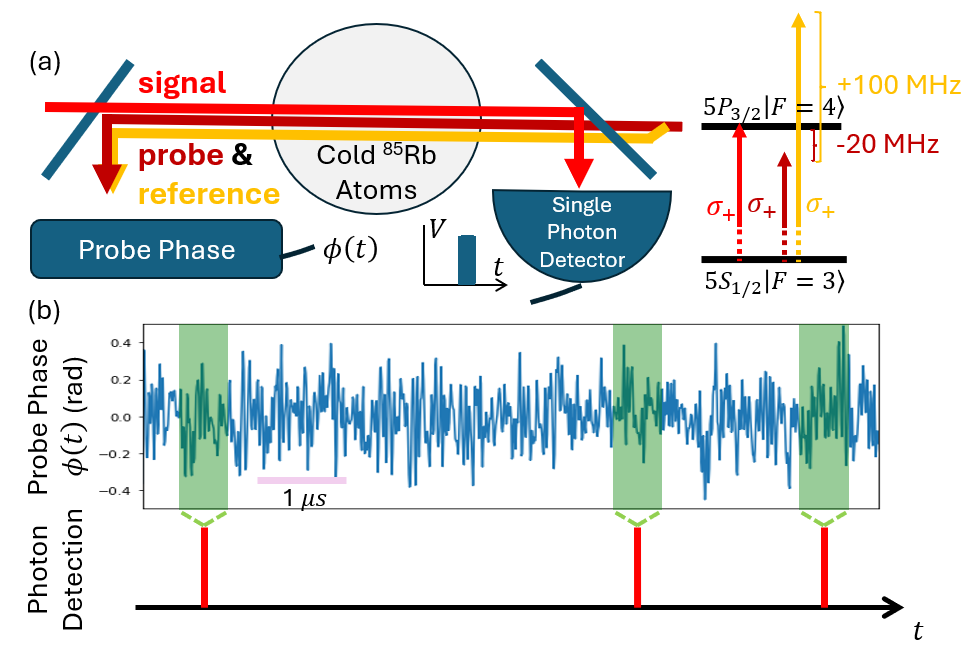
Figure 1: (a) Schematic of the experimental setup, showing cross-phase interaction in cold atoms; (b) data analysis protocol illustrating phase windowing and event-based averaging.
Principal Results
Observation of Enhancement via Post-selection
The analysis reveals peak XPS values per post-selected photon of up to −148±20 μrad at OD=4.7±0.4, significantly exceeding the optimal non-post-selected results (cf. previous studies using Gaussian or rising exponential pulses). The experimental enhancements reach factors of at least 6±1 at modest OD (2.4±0.1), in line with the exponential dependence predicted by weak-value theory.
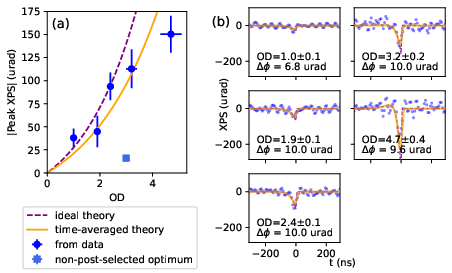
Figure 2: Peak XPS versus OD, showing both experimental values and theoretical curves, as well as time traces of XPS signatures at several ODs.
Comparison with Non-Post-Selected Regimes
Experiments with conventional, non-post-selected single-photon pulses of varying duration show the expected trade-off: as pulse duration decreases (more intense, less resonant), the phase shift peaks at a finite value, in agreement with theoretical predictions. No combination yields values matching the post-selected enhancement at comparable OD.
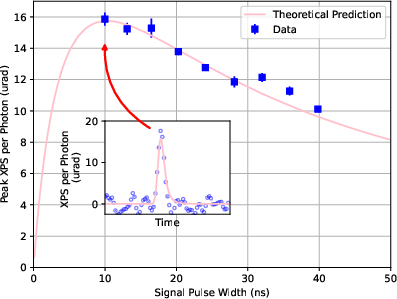
Figure 3: Peak XPS per photon versus pulse duration; post-selection provides a clear advantage over the pulsed (non-post-selected) case.
The enhancement is rooted in the fundamental quantum structure of the measurement. By preparing the photon in a narrow frequency state (delocalized in time) and post-selecting in a narrow temporal window (delocalized in frequency), the effective system state encompasses portions of both conjugate variables, in line with the two-state vector formalism.
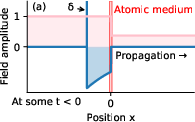
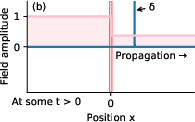
Figure 4: Visualization of the forward (pink) and backward (blue) quantum states, encoding preparation in frequency and post-selection in time, respectively.
Robustness and Control
Dedicated measurements confirm the post-selection enhancement persists over a range of experimental parameters, including probe and signal powers. The conditional XPS is established to be independent of coherent state input power, provided the single-photon limit is never exceeded and background normalization is correctly handled.
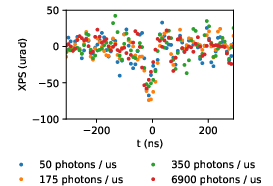
Figure 5: Signal power dependence for the XPS at fixed OD demonstrates independence from probe beam power, confirming the single-photon regime.
Implications and Outlook
The findings challenge established intuition regarding the limits of single-photon nonlinearities in atomic ensembles. The capacity to exploit both time and frequency localization via incompatible pre- and post-selections opens new experimental and theoretical directions. For quantum optics, this work implies that non-classical correlations and effective nonlinearities can be systematically amplified without recourse to higher excitation densities or cavity enhancement—potentially impacting deterministic photon-photon gates, boson-sampling hardware, and precision metrology using post-selected weak values.
Theoretically, the approach motivates further examination of the interplay between measurement backaction, retrodictive quantum formalism, and weak values in complex multi-photon or multi-level systems. Exponential scaling with OD marks this effect as potentially useful in mesoscopic ensembles, obviating the need for giant cavities or high-finesse setups for large nonlinearities. However, the negative weak values and the interpretational subtleties of post-selection merit continued attention, especially regarding the operational utility and trade-offs in practical quantum information protocols.
Conclusion
This study demonstrates and quantifies the enhancement of single-photon-induced cross-phase shifts via joint localization in frequency (preparation) and time (post-selection), far exceeding limits established by the time-energy uncertainty trade-off. This is enabled by the weak-value amplification framework and is supported by robust experimental evidence and theoretical modeling over a range of ODs, pulse durations, and powers. The work lays the foundation for novel quantum nonlinear optics experiments in which incompatible measurement bases are systematically harnessed for practical advantage and for further explorations into the consequences of simultaneous knowledge of non-commuting observables in quantum systems.

