Three-fold coincidence by stimulated parametric down-conversion
Published 26 May 2026 in quant-ph | (2605.27653v1)
Abstract: Parametric down-conversion is a widely used source of nonclassical light in quantum optics and photonic quantum technologies. While stimulated parametric down-conversion with strong classical seeds is well studied, the regime in which stimulation occurs at the single-photon level has hitherto remained largely unexplored experimentally. Here, we study continuous-wave, low-gain down-conversion seeded by a weak coherent field with an average photon number well below one per coherence time. By measuring third-order temporal correlations, we observe a clear enhancement that cannot be accounted for by spontaneous processes or accidental coincidences alone, and is consistent with stimulation involving the seed and the generated photon pair. These results provide time-domain evidence of seed-induced three-photon correlations and suggest new ways to engineer and probe multi-photon states for quantum imaging, sensing, and information processing.
The paper demonstrates that a single-photon seed can stimulate the emission of a signal-idler pair, producing photon triplets with a measured g³ₙ(0,0) of 12.5, close to the theoretical prediction of 10.
The paper details an experimental regime using ultra-weak seeding in low-gain PDC with a continuous-wave diode laser, precise spectral filtering, and time-resolved detection.
The paper outlines the implications for quantum metrology and information processing by enabling the engineering of multiphoton states through controlled, seed-induced three-photon correlations.
Stimulated Photon-Triplet Generation in Weakly Seeded Parametric Down-Conversion
Introduction and Scientific Context
Parametric down-conversion (PDC) in a χ(2) nonlinear medium remains a foundational process for generating nonclassical light, supporting pivotal protocols in quantum optics, imaging, and information processing. Traditionally, spontaneous PDC (SPDC) leverages vacuum fluctuations to yield correlated photon pairs, enabling phenomena such as Hong--Ou--Mandel interference and entanglement distribution. Stimulated PDC (StPDC), usually invoked in high-gain optical parametric amplification (OPA) with classical seed fields, has facilitated devices for quantum cloning, macroscopic superpositions, and state tomography. Here, the seed's amplitude is large and stimulation mechanisms are adequately described by semiclassical models.
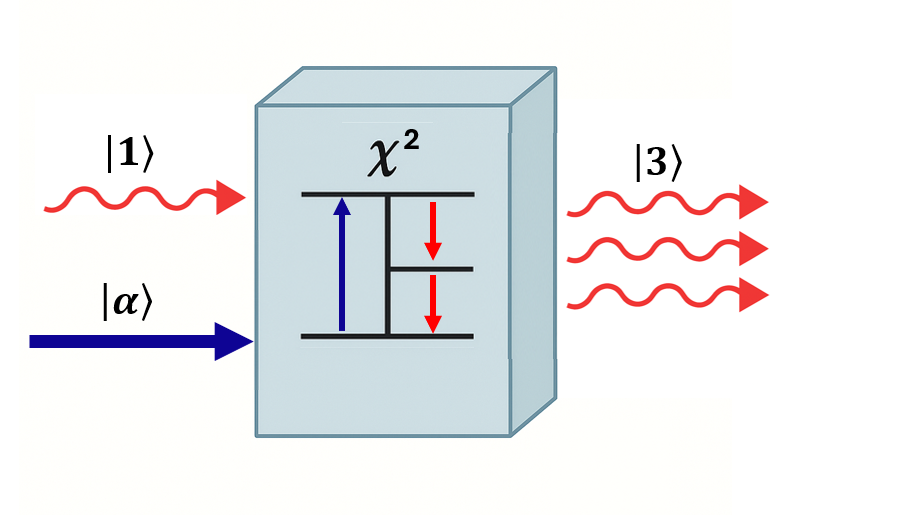
This paper explores an experimentally distinct StPDC regime: low gain, ultra-weak seed (∣β∣2≪1), such that the average seed photon occupation per coherence time is far below unity. Unlike SPDC or classical-seed OPA, quantum stimulation manifests intrinsically at the single-photon level, yielding a correlated photon triplet generated within a restricted temporal window. This triplet emerges via direct interaction of a single seed photon stimulating the emission of a signal-idler pair from the pump, enabling the first time-domain evidence of seed-induced three-photon correlations in PDC. These results suggest novel architectures for engineering multiphoton states relevant for quantum metrology beyond second-order coherence.
Figure 1: Concept of stimulated photon-triplet generation in a χ(2) medium—where a single seed photon stimulates emission of a signal-idler pair, forming a correlated three-photon event.
Theoretical Framework
The interaction is modeled under a frequency-degenerate, single-mode approximation with weak gain. For unseeded SPDC, the PDC output state consists predominantly of photon pairs, yielding second-order correlations scaling as G(2)(0)∝4∣γ∣2 with γ the dimensionless interaction parameter. When a weak coherent seed (β, ∣β∣2≪1) is injected, the output acquires a three-photon Fock component ∼γβ6∣3⟩, directly representing the seed-induced triplet event.
The third-order correlation function, G(3)(0,0)≃36∣γ∣2∣β∣2, quantifies triplet generation scaling with both γ and ∣β∣2≪10. Notably, the triplet rate in this regime can dominate over higher-order spontaneous emission (∣β∣2≪11) and seed-only Poissonian events (∣β∣2≪12) for ∣β∣2≪13, enabling clear identification of the seed-induced process within a narrow operating window. Accidental coincidences, primarily arising from overlaps between two-fold SPDC and uncorrelated seed clicks, are mitigated via background normalization.
Experimental Realization
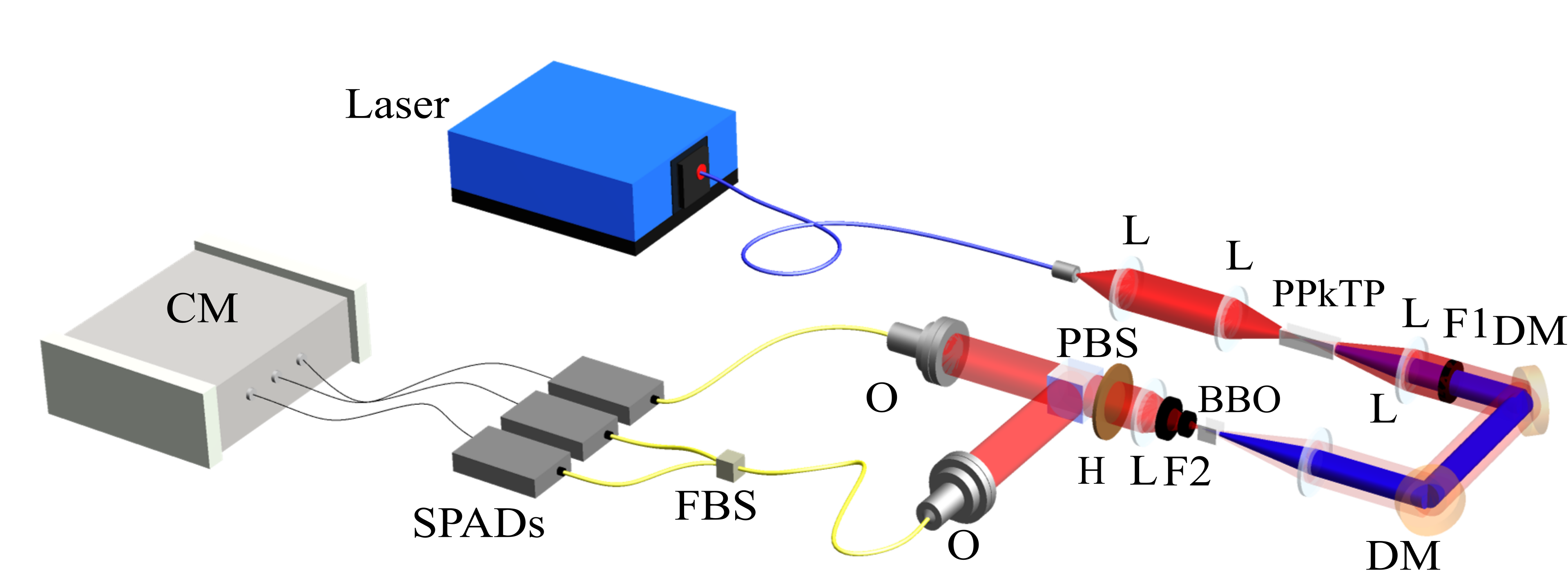
The experiment employs a continuous-wave external-cavity diode laser at ∣β∣2≪14, frequency-doubled in a monolithic PPKTP cavity to yield a ∣β∣2≪15 pump for SPDC in a 1-mm BBO crystal. The residual fundamental is attenuated and mode-matched as an ultra-weak seed; spectral filtering and single-mode fiber coupling ensure single-mode operation. Detection events from three output channels are registered by single-photon avalanche diodes and time-tagging electronics with 500 ps resolution. The total detected SPDC rate is ∣β∣2≪16 pairs/s, and the seed detection probability per bin is ∣β∣2≪17, corresponding to ∣β∣2≪18 photon occupation per coherence time.
Figure 2: Experimental setup illustrating weakly seeded StPDC—seed and SPDC photons are mode-matched and detected across three channels for full third-order correlation analysis.
Temporal correlations ∣β∣2≪19 are measured over all channel combinations, revealing localized enhancement at zero delay uniquely attributable to the seed-stimulated process.
Results: Three-Fold Coincidence and Quantum Signatures
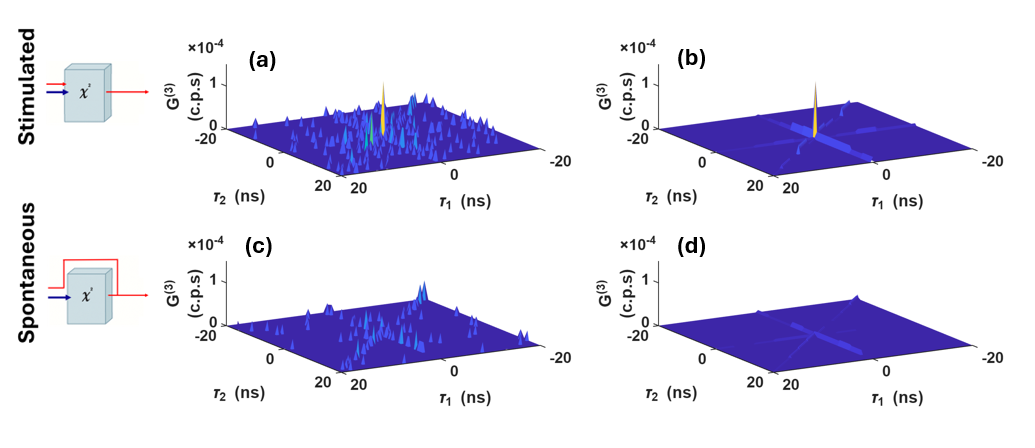
Experimental three-fold histograms manifest a pronounced peak at χ(2)0, demonstrating temporally localized three-photon events that exceed accidental coincidences and spontaneous backgrounds. Monte Carlo simulations incorporating only accidentals and SPDC reproduce the broader correlation structure and accidental ridges, but fail to reproduce the enhancement at the origin, confirming the quantum nature of the triplet contribution.
Figure 3: Pre-normalized three-fold correlations—experimental data with weak seed reveal a central peak absent in purely accidental simulations.
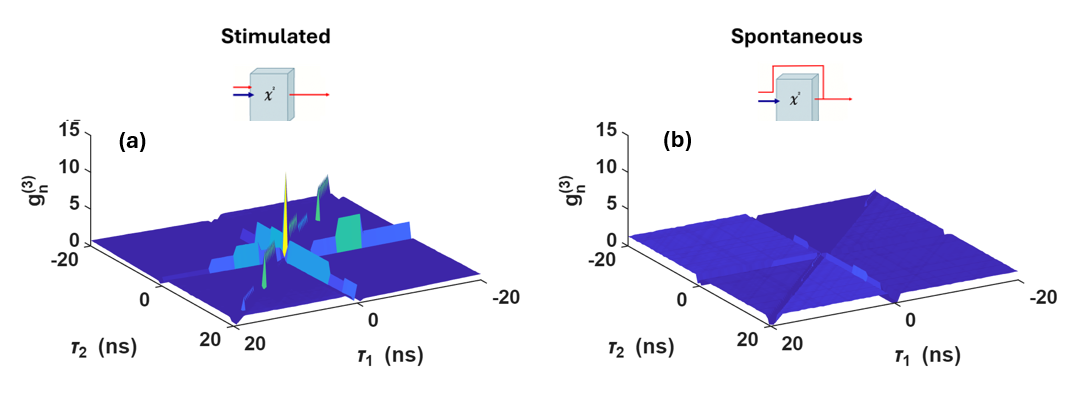
Quantitative normalization via χ(2)1 isolates genuine triplet contributions. The measured χ(2)2 reaches 12.5, in close agreement with theoretical prediction (χ(2)3), substantiating the presence of seed-induced higher-order quantum correlations. The enhancement is tightly confined, evidencing direct stimulation by a single photon rather than intensity-driven classical effects.
Figure 4: Normalized three-fold correlations—experimental χ(2)4 exhibits a clear peak at zero delay, while accidentals-only simulations remain flat near unity.
Implications and Future Perspectives
Observation of seed-induced three-photon correlations in weakly seeded StPDC fundamentally extends the accessible parameter space for quantum optical processes. By stimulating emission at the single-photon level and directly probing χ(2)5 in the time domain, this work establishes a robust platform for generating and studying multi-photon quantum correlations without reliance on high-gain or cascaded processes.
Practically, the ability to manipulate higher-order temporal correlations suggests applications in correlation-enhanced imaging, spectroscopy, and quantum sensing, where photon triplets can encode additional phase and timing information. The phase coherence of the seed adds a phase reference, enabling potential interferometric schemes exploiting χ(2)6 sensitivity. Extensions to polarization-entangled sources and multipartite GHZ states with tailored seeding are conceivable, providing versatile tools for quantum information protocols in photonic networks.
Theoretically, the results clarify the transition from spontaneous to stimulated emission in low-gain PDC, motivating refined models for multiphoton generation under weak stimulation. Advanced detection techniques and improved temporal resolution could further resolve the microscopic dynamics underlying triplet events and facilitate the investigation of non-Gaussian state generation.
Conclusion
This work delineates the quantum regime of stimulated parametric down-conversion with ultra-weak seeding, revealing direct time-domain evidence for seed-induced three-photon correlations. The results rigorously demonstrate that even a single-photon seed can stimulate the emission of a photon pair, generating temporally localized triplets detectable via higher-order correlation functions. The findings suggest new directions for engineering and probing quantum states in nonlinear optics, with broad implications for imaging, sensing, and quantum information science.
“Emergent Mind helps me see which AI papers have caught fire online.”
Philip
Creator, AI Explained on YouTube
Sign up for free to explore the frontiers of research
Discover trending papers, chat with arXiv, and track the latest research shaping the future of science and technology.Discover trending papers, chat with arXiv, and more.