Spatially Masked Regression Reveals Local and Distributed Predictability in Electrophysiological Recordings
Published 9 Jun 2026 in q-bio.NC, cs.LG, physics.data-an, and q-bio.QM | (2606.11415v1)
Abstract: Neural recordings are often interpreted as local measurements, yet the signal at any one sensor can also reflect structured activity distributed across the broader network. This raises a basic question: to what extent does an electrode's signal reflect local versus distributed information in the underlying system? More specifically, how much of an electrode's activity is carried by its immediate neighborhood, and how much is embedded more broadly across the array? We address this with a Spatially Masked Regression (SMR) framework that reconstructs each electrode's timeseries from the remaining electrodes while excluding a configurable neighborhood around the target. By progressively increasing this mask, spatial locality becomes an experimental control for quantifying how much predictive information survives after nearby channels are withheld. We apply SMR to intracranial EEG with heterogeneous electrode coverage and to scalp EEG with standardized montages over sensorimotor cortex. Using distance correlation between original and reconstructed signals, we find strong within-subject reconstruction in both modalities, substantial residual predictability even when local neighbors are excluded, and markedly stronger cross-subject transfer in EEG than in iEEG. Masking shows that nearby electrodes contribute strongly to reconstruction but do not account for all of it, indicating that individual channels reflect both local redundancy and broader distributed structure. Surrogates that preserve selected marginal or spectral properties while disrupting phase structure or temporal ordering substantially reduce performance, supporting the conclusion that SMR depends on structured temporal and cross-channel organization rather than on marginal statistics alone. These results position SMR as an interpretable framework for quantifying the balance between local and distributed information in recordings.
The paper introduces a Spatially Masked Regression framework that dissociates local and distributed contributions in electrophysiological recordings.
It demonstrates that local electrode signals yield high-fidelity reconstructions while distant electrodes add unique, complementary predictive information.
Findings reveal modality-specific outcomes, with EEG showing robust cross-subject transfer compared to the more idiosyncratic iEEG signals.
Spatially Masked Regression Quantifies Local and Distributed Predictability in Electrophysiological Signals
Introduction
The paper "Spatially Masked Regression Reveals Local and Distributed Predictability in Electrophysiological Recordings" (2606.11415) addresses the quantification of local versus distributed information content in multichannel electrophysiological data, focusing on intracranial EEG (iEEG) and scalp EEG. The study introduces a Spatially Masked Regression (SMR) framework to explicitly dissociate the predictive contributions of local neighboring electrodes from those distributed across the recording array. This operationally defines and experimentally manipulates the degree of local redundancy versus distributed embedding in neural timeseries, a question of theoretical significance for interpreting functional connectivity and field potential measurements.
Spatially Masked Regression Framework
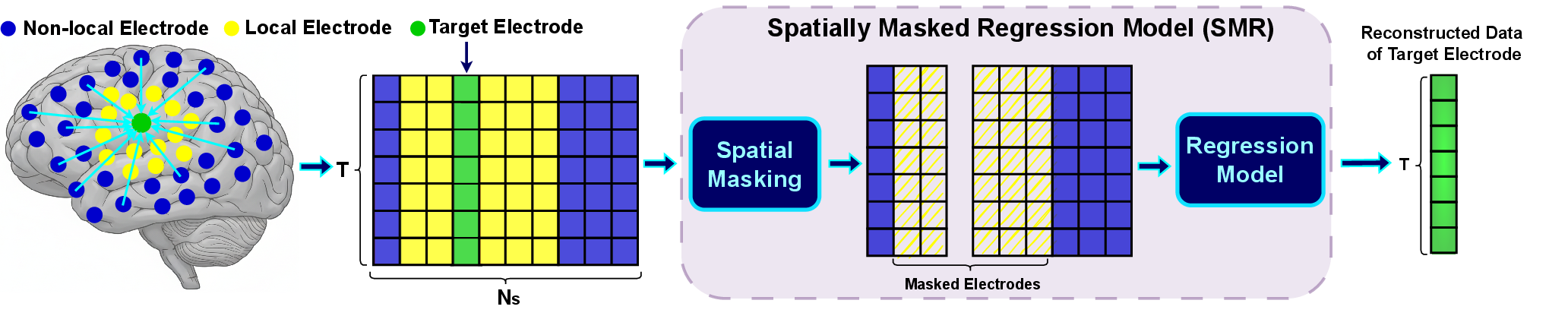
SMR reconstructs the time series of a target electrode from all remaining electrodes, using a spatial binary mask to exclude signals from electrodes in the target's predefined local neighborhood. By systematically varying the size of this mask, the analysis controls the degree to which the model is forced to rely on distant rather than local predictors.
Figure 1: The SMR architecture excludes local neighborhoods to probe the balance between local and distributed information in predicting each electrode’s signal.
For each electrode i in subject s, the reconstruction is linear with the form:
xi(s)=j=1∑Ns(1−Kij(s))wij(s)xj(s)
where Kij(s) indicates the spatial mask and wij(s) are the learnable weights. The mask size parameterizes locality, with zero masking corresponding to all non-target neighbors contributing, and full masking representing the exclusion of the entire predefined neighborhood.
Model training uses mini-batch Adam optimization with L1 and L2 regularization on weights (elastic net). Model performance is evaluated by distance correlation (DistCorr) on held-out data, providing a dependence metric sensitive to both linear and nonlinear statistical relationships.
Datasets and Experimental Protocol
The SMR approach is applied to two heterogeneous datasets: (i) AJILE12 long-term iEEG with variable, subject-specific grid placements, and (ii) a standardized 61-channel EEG dataset spanning sensorimotor cortex. For each, intra-subject (fitting and evaluation within the same subject) and cross-subject (transferring learned models between subjects) analyses are performed. For iEEG, cross-subject assessment leverages a correlation-based electrode mapping (CBEM) aligning electrode sets via optimal assignment.
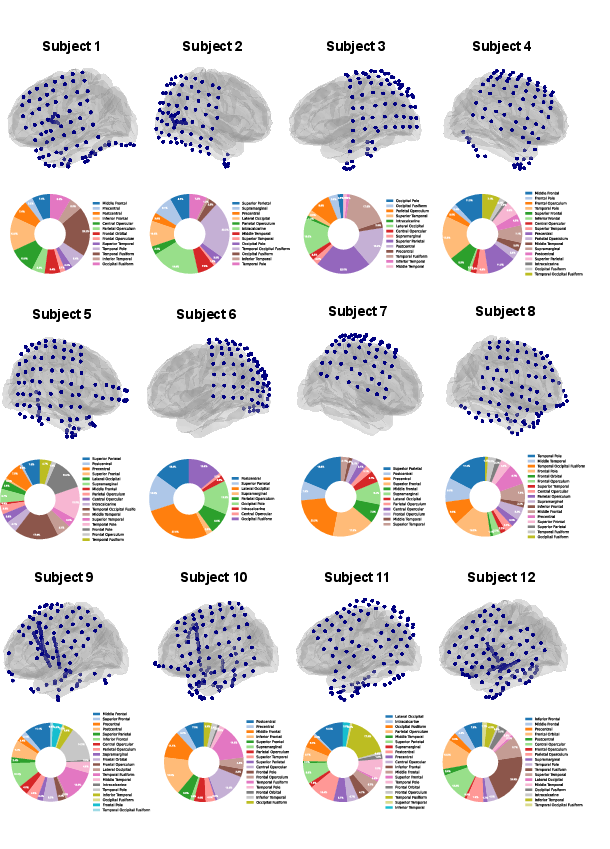
Electrode distributions across the AJILE12 cohort, highlighting inter-subject variability in grid coverage, are depicted below.
Figure 2: Cortical renderings and AAL-based summaries emphasize the anatomical heterogeneity in iEEG sampling across AJILE12 subjects.
Intra-Subject and Cross-Subject Reconstruction
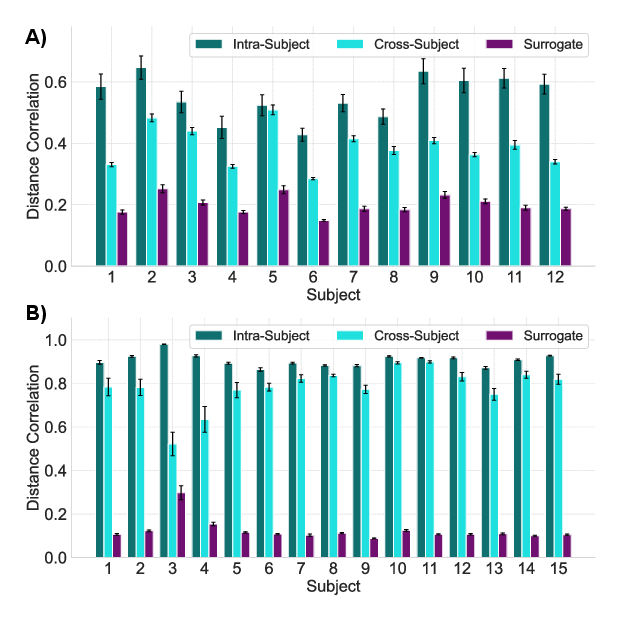
SMR produces high-fidelity reconstructions in the intra-subject regime: mean DistCorr is 0.908±0.028 for EEG and 0.553±0.068 for iEEG, indicating strong linear and nonlinear dependence between the original and model-predicted signals for both modalities, albeit higher for EEG due to greater spatial smoothness and redundancy.
Figure 3: Bar plots of mean DistCorr across electrodes per subject, illustrating substantial intra- and cross-subject performance differences between iEEG and EEG.
Transferring learned models across subjects reveals modality-specific limitations of distributed predictability. For EEG, the standardized montage allows robust transfer (0.783±0.093 mean DistCorr); for iEEG, transfer performance is notably reduced (0.389±0.064), reflecting the idiosyncratic electrode placement and decreased redundancy in intracranial settings.
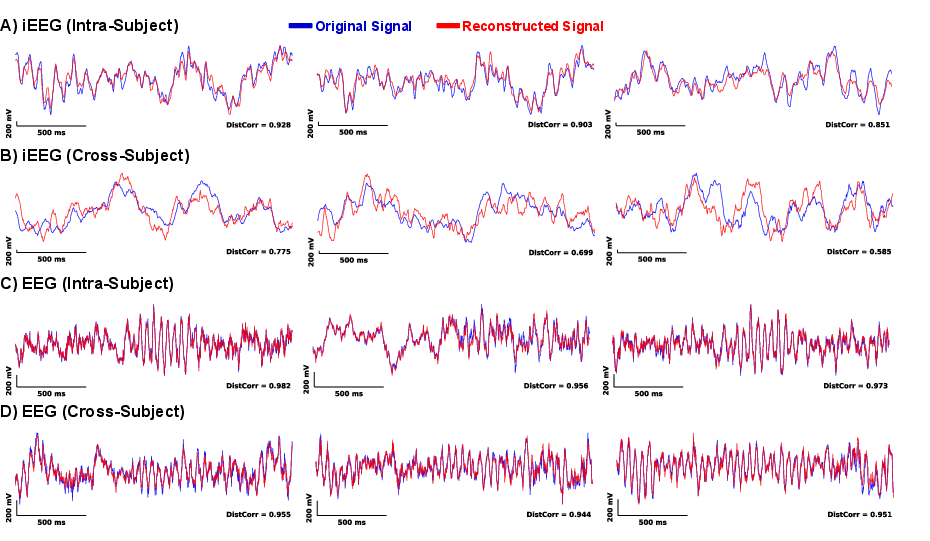
Figure 4: Example original (blue) and reconstructed (red) time series for each modality and regime, showing the quality and degradation of signal recovery under cross-subject transfer.
Masking Local Predictors: Quantitative Assessment of Spatial Redundancy
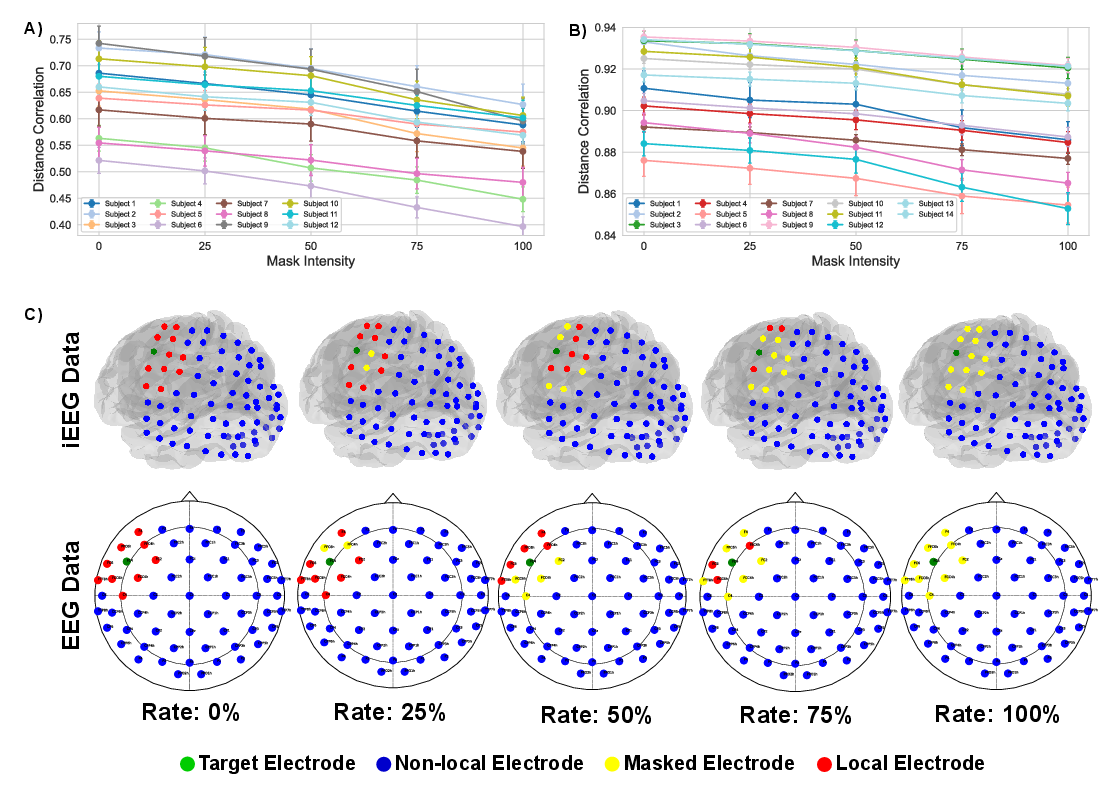
By increasing the masking intensity (from 0% to s0 of the predefined neighborhood), the analysis reveals a monotonic, nontrivial decline in reconstruction performance. This demonstrates that short-range spatial structure is a dominant, but not exclusive, source of predictable signal content.
Figure 5: DistCorr as a function of mask intensity for iEEG and EEG: reconstruction drops as more local neighbors are masked, but residual distributed predictability persists at high masking.
Electrode Coverage Manipulations
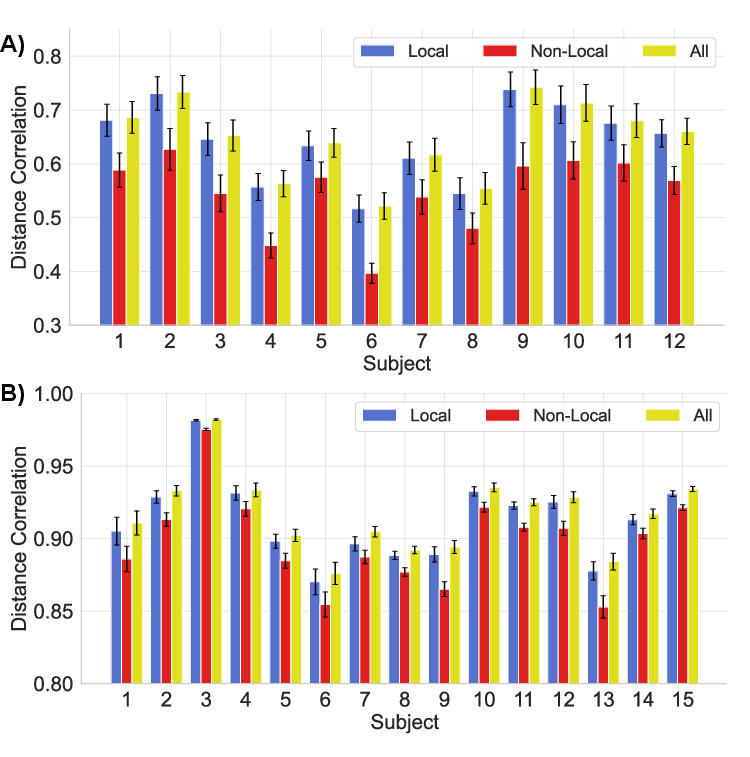
Comparative analyses evaluate three configurations: using only local electrodes, only non-local (distant) electrodes, or the entire electrode set. The all-electrode model achieves the highest performance, confirming that while local neighborhoods provide the most concentrated predictive information, distant electrodes add unique, complementary structure not captured by local sensors alone.
Figure 6: Comparison of reconstruction with local, non-local, and all electrodes for both modalities, highlighting the additive value of distributed predictors.
Surrogate Data Controls
Model evaluation on surrogate datasets (phase-shuffled, IAAFT, block-shuffle) demonstrates that SMR does not derive its reconstructive power from trivial marginal statistics (e.g., amplitude distribution or power spectrum) alone. Phase-randomization and destruction of temporal order both lead to pronounced reductions in DistCorr (e.g., drop from s1 to s2 for EEG), confirming that model performance is driven by structured temporal and cross-channel dependencies.
Theoretical and Practical Implications
Empirical findings clarify several critical points:
Electrode signals in both iEEG and EEG are neither strictly local nor purely global: masking experiments and coverage manipulations establish that both spatial regimes are essential.
In EEG, higher redundancy enables more effective cross-subject transfer, while the specificity and anatomical idiosyncrasy of iEEG diminish the portability of learned inter-electrode relationships.
Surrogate analyses control for static and frequency-limited statistics, verifying that SMR leverages nontrivial nonlocal and temporal structure.
This analytic framework provides operational tools for quantifying redundancy, guiding sensor/montage optimization, and probing how neural information is differentially embedded across modalities, brain states, or conditions. It complements conventional functional connectivity and network analysis by making the notion of "predictability from elsewhere" an explicit, measurable axis, and by permitting targeted manipulation of spatial dependencies.
Future Directions
Immediate extensions of the SMR framework could incorporate:
Kernel or nonlinear regression for mapping higher-order dependencies
Autoregressive or state-space predictors for capturing directed, lagged, or causal interactions
Task- or state-dependent modulation, quantifying changes in redundancy and distribution across behavioral or pathological transitions
Automated channel selection or BCI applications, where maximizing independent information is critical
Conclusion
This work demonstrates that spatially masked regression enables interpretable dissection of local and distributed information in electrophysiological data, revealing that field signals are neither purely local nor exclusively global, but reflect a hierarchical interplay governed by modality, recording geometry, and the underlying biophysics. SMR provides a rigorous, scalable tool for quantifying—and controlling—the operational balance between spatial redundancy and distributed predictability in neural timeseries, with implications for experimental design, clinical neuroengineering, and the study of network-level neural computation.
“Emergent Mind helps me see which AI papers have caught fire online.”
Philip
Creator, AI Explained on YouTube
Sign up for free to explore the frontiers of research
Discover trending papers, chat with arXiv, and track the latest research shaping the future of science and technology.Discover trending papers, chat with arXiv, and more.