- The paper finds that AI delegation transforms decision-making by turning LLMs into active social actors.
- It employs empirical and theoretical analysis, highlighting feedback loops that may lead to behavioral homogenization and autonomy erosion.
- The study calls for robust, longitudinal research and new governance models to address risks of implicit value transmission.
The Social Consequences of AI Delegation
Conceptual Shift: From Methodological Substitution to Social Delegation
"The social consequences of AI delegation" (2606.11058) prioritizes a pivotal reframing in computational social science, moving from the prevalent question of whether LLMs can serve as methodological surrogates in behavioral studies to a broader inquiry regarding the conditions and consequences under which humans increasingly defer and delegate judgment to generative AI systems. The Perspective meticulously delineates the emergence of AI delegation across diverse domains (health, law, finance, education, personal support), emphasizing the urgency of understanding this transition not merely as a research convenience, but as a consequential behavioral phenomenon shaping everyday life.
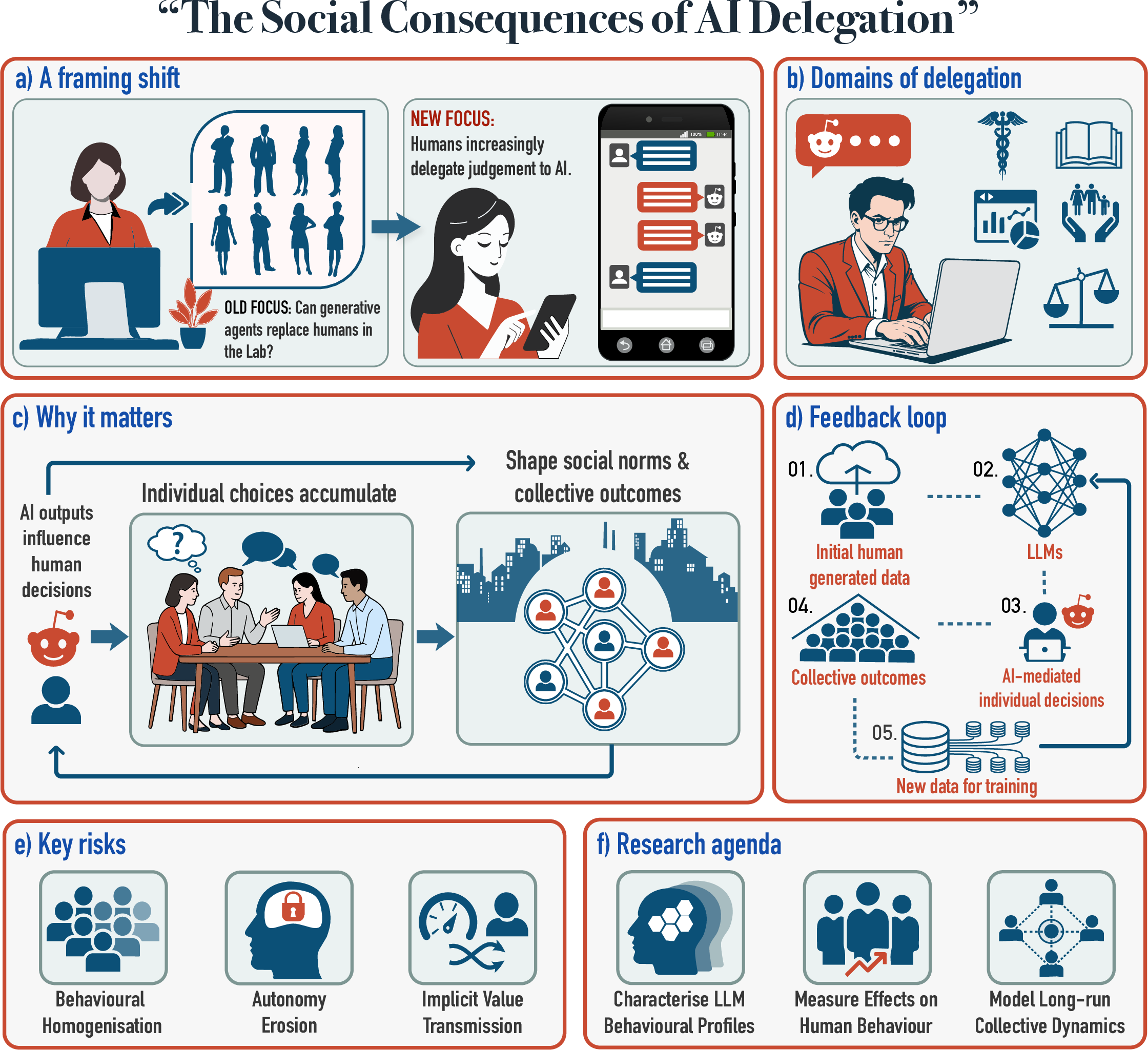
Figure 1: Conceptual overview highlighting the feedback loops between human-generated data, LLM behavior, AI-mediated decisions, and future training data, with associated risks and research priorities.
AI delegation is defined with granularity: it transcends mere information-seeking and comprises genuine adoption of AI-generated recommendations with limited independent verification, contestation, or deliberative engagement. The distinction anchors the discussion regarding social risks and motivates rigorous, operational measurement frameworks for empirical study.
Inversion of the Surrogate Relationship
The paper critiques the prevailing paradigm in which LLMs are viewed as passive instruments and humans as fixed referents. Instead, it posits and substantiates an inversion: LLMs are increasingly functional social actors, actively mediating consequential decisions for humans. The surrogate relationship runs bidirectionally; humans now stand behind LLMs—not only as experimental subjects, but as everyday agents whose deliberations are affected and often substituted by AI outputs.
Empirical signals manifest as increased consultation of LLMs for health [shahsavar2023user], law [choi2024lawyering], emotional support [maples2024loneliness], and financial guidance [desai2024opportunities], especially among younger cohorts [pew2025teens, hbr2026genz]. Additionally, linguistic diffusion—LLM vocabulary permeating both academic writing and spoken communication [geng2025impact, yakura2024empirical]—provides indirect evidence of AI's influence on human cultural norms.
LLMs as Social Actors: Behavioral, Value, and Normative Dimensions
Building upon CASA and extended cognition traditions [reeves1996media, hutchins1995cognition, clark1998extended], the Perspective asserts that widely deployed LLMs satisfy the sociological criterion of a social actor by systematically influencing human decisions and collective outcomes. This behavioral coupling yields feedback loops that alter both the social and technical environments, a phenomenon not adequately captured by individual-level human-AI interaction research.
Characterizing LLMs as social actors demands systematic behavioral profiling—mapping values, priorities, heuristics—across domains and populations. It necessitates study designs with high ecological validity, including exposure to diverse decision vignettes, prompt variations, and longitudinal tracking of adoption and deliberative erosion.
Feedback Loops: Behavioral Homogenization, Autonomy Erosion, and Value Transmission
A central concern is the formation of behavioral feedback loops: human-generated data informs LLM training, LLM outputs shape human behavior, which in turn becomes new training data. This circularity implicates risks distinct from model collapse [shumailov2024models], as it may gradually erase the independence of human behavioral baselines and authentic expressions.
Three risks are highlighted:
- Behavioral homogenization: Large-scale reliance on similar AI systems compresses decision diversity, producing correlated collective outcomes and diminishing functional heterogeneity [bommasani2021opportunities, page2007difference]. Early experimental evidence corroborates that generative AI enhances individual creativity but systematically reduces diversity across groups [doshi2024generative, padmakumar2024does, anderson2024homogenization].
- Autonomy erosion: Delegation to LLMs may become total, opaque, and unaccountable, undermining autonomous human judgment and contestable decision-making. Existing governance mechanisms for professional accountability do not readily translate to AI-mediated processes.
- Implicit value transmission: LLMs embody values inherited from training and alignment, introducing systematic and reproducible biases in domains with political, moral, and cultural depth [santurkar2023whose, durmus2024towards, bender2021dangers]. Uncritical adoption of LLM advice risks population-level drift in values, with no established oversight or recourse.
Empirical studies on algorithm appreciation [logg2019algorithm] and automation bias underscore that users may preferentially adopt AI advice, amplifying these risks in practice.
Research Agenda and Theoretical Implications
The Perspective proposes a detailed research agenda that supersedes the surrogacy paradigm:
- Systematic behavioral profiling: Characterize LLM advice and decision patterns across domains, evaluating stability, value trade-offs, and sensitivity to prompts and contexts.
- Operational delineation of delegation: Quantitatively distinguish consultation from true delegation using behavioral experiments and longitudinal field studies—measure adoption rates, deliberation reduction, conflict with prior views, and willingness to seek alternatives.
- Macro-level modeling of collective consequences: Employ agent-based, network, and evolutionary models with explicit representation of human heterogeneity, model concentration, advice contestability, and access to expertise. Assess distributional effects and potential for social inequality, algorithmic monoculture [kleinberg2021algorithmic], and erosion of functional diversity.
- Equity and access: Articulate comparative and distributional outcomes, ensuring that research addresses who delegates, who benefits, and whose behavior becomes reinforced in future AI systems.
Practical and Future Implications
The paper's analysis has direct implications for AI system design, deployment, and governance:
- Model pluralism and personalization: To mitigate homogenization and value transmission, research must incentivize development and deployment of diverse models, personalized systems, and mechanisms for contesting advice.
- Deliberative safeguards: AI interfaces should encourage independent verification, alternatives, and contestation, preserving human autonomy and deliberative resilience.
- Empirical monitoring: Large-scale, population-level measurement frameworks are needed to detect shifts in behavioral diversity, autonomy, and value drift.
- Societal governance: New accountability structures and regulatory oversight may be required to manage implicit value transmission and ensure equitable access to robust decision support.
Speculatively, sustained AI delegation could redefine institutions of expertise, collective reasoning, and the dynamics of social norm evolution. Theoretical work in computational social science must rigorously investigate the emergent coupling of human and machine cognition.
Conclusion
The Perspective advances the claim that the central challenge in generative AI is no longer limited to methodological questions of human surrogacy, but pivots to the societal consequences of AI delegation in everyday decision-making. It provides substantial theoretical, empirical, and operational motivation for computational social science to treat LLMs as consequential social actors, whose behavioral profiles, embedded values, and feedback effects will decisively shape human cognition, social norms, and institutions. The research agenda outlined demands rigorous, macro-level, and longitudinal investigation, as the sustained interaction between humans and generative AI is rapidly becoming a primary driver of collective outcomes, diversity, and autonomy in contemporary societies.