- The paper demonstrates that the Hawking–Page and Davies transitions function as topological defects whose signed moments yield universal dipole ratios in AdS black holes.
- It applies a common thermodynamic vector field to quantify entropy and temperature shifts, establishing key metrics like C_S, C_T, and nucleation barrier B.
- The work extends to richer multipolar structures and categorical symmetries, offering new computational frameworks for classifying complex phase diagrams.
Topological Characterization of the Hawking–Page Transition: Dipoles and Categorical Defects
Introduction
The paper "Hawking--Page Universality, Thermodynamic Dipoles and Categorical Defects" (2606.10680) undertakes a formal analysis of the Hawking–Page transition and Davies point in anti-de Sitter (AdS) black hole thermodynamics, recasting them in the language of topological defects within the thermodynamic phase space. It demonstrates how universal ratios traditionally observed in black hole phase transitions (CS, CT, and the barrier B) can be interpreted as signed moments of winding-number defects in an auxiliary thermodynamic vector field. Moreover, the approach naturally accommodates richer multipolar structures for more complex phase diagrams and extends conceptually to categorical (non-invertible) symmetries, opening a path to defect-resolved thermodynamic invariants.
Thermodynamic Defects and the Common Vector Field
The formalism builds on the construction of a "common thermodynamic vector field" φ(S,θ) whose zeros correspond precisely to the Davies and Hawking–Page points in the phase diagram. At each zero zi, a winding number wi is assigned, reflecting the local orientation of the defect. In elementary AdS black hole branches, the Davies point (D) is assigned wD=−1 and the Hawking–Page point (HP) wHP=+1, yielding a neutral pair. These assignments are fixed locally from the technical properties of the free energy and temperature as functions of entropy.
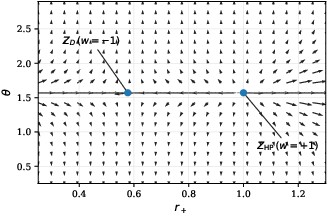
Figure 1: Normalized common vector field for Schwarzschild--AdS in the CT0 plane. The isolated zeros at CT1 and CT2 correspond to the Davies (CT3) and Hawking–Page (CT4) points, respectively.
Universal Ratios as Thermodynamic Topological Dipoles
The paper introduces a central reinterpretation: the experimentally robust universal ratios CT5 and CT6 arise as components of the signed first moment (i.e., "dipole moment") of the winding-number defect pair, normalized by the Davies-point scales.
Explicitly, for entropy (CT7) and temperature (CT8), the signed first moments are
CT9
and the normalized ratios become
B0
In four-dimensional Schwarzschild–AdS and Reissner–Nordström–AdS, the values B1 and B2 are robustly recovered. The results generalize to charged non-rotating AdS black holes in arbitrary dimension.
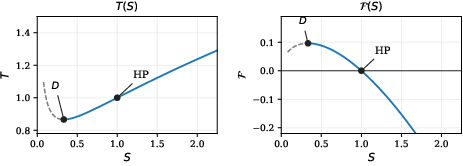
Figure 2: Thermodynamic curves for four-dimensional Schwarzschild–AdS showing B3 and B4. The oriented segment from Davies (B5) to Hawking–Page (B6) yields the dipole components B7 and B8.
The barrier height for phase nucleation, B9, is likewise universal, yielding φ(S,θ)0 in four dimensions and φ(S,θ)1 in arbitrary dimension.
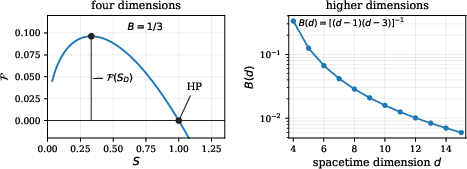
Figure 3: Normalized Hawking–Page barrier as a function of dimension. In four dimensions, the normalized barrier is φ(S,θ)2, while in higher-dimensional charged families, it follows φ(S,θ)3.
Multipole Hierarchy for Complex Phase Structures
For phase diagrams involving more than one Davies or Hawking–Page point—such as those arising in reentrant, Born–Infeld, or higher-curvature corrected black holes—the simple dipole description is insufficient. The paper generalizes the analysis by introducing a hierarchy of signed moments: φ(S,θ)4
where φ(S,θ)5 denotes the negative-charge centroid. Higher multipole moments (second and beyond) can distinguish orderings and spatial separations of transition points that are invisible to total charge and first moment data.
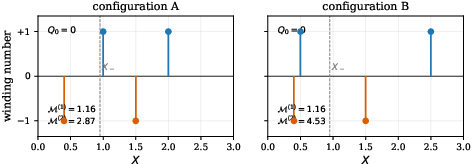
Figure 4: Toy multipole defect configurations with identical monopole and dipole moments but distinct second moments, illustrating the necessity of higher-order moments in motif classification.
Categorical Defects and Non-Invertible Symmetry Sectors
The final sections conjecture a categorical extension, motivated by recent developments in generalized and non-invertible symmetries in QFT and holography. If topological defects (labeled by category objects φ(S,θ)6) are inserted in the thermal trace, the partition functions and resulting Hawking–Page conditions can be resolved sector by sector: φ(S,θ)7
enabling defect-resolved definitions of transition temperatures and dipole moments. The fusion algebra of the category imposes nontrivial constraints on the pattern of possible sector-dependent phase transitions: φ(S,θ)8
Sector-resolved universality or splitting of the dipole ratios depends on whether the defects shift both relevant saddles equally or not.
Implications and Outlook
The interpretation of Hawking–Page and Davies points as a neutral pair of topological defects whose signed first moment reproduces known universal ratios deepens the connection between black hole thermodynamics and topological field theory. The approach is both calculationally efficient (especially for higher-dimensional or charged black holes, where all dependence on local scales drops out after normalization) and conceptually powerful, unifying universality and topological invariance.
The extension to multipole hierarchies offers finer classification tools for complex phase diagrams, while the categorical proposal sketches a pathway for the impact of generalized symmetries on thermodynamic transitions—particularly relevant for holographic orbifolds, brane constructions, or matrix models where symmetry defects naturally arise.
Future directions include:
- Realizing explicit computations of defect-resolved partition functions in tractable holographic settings.
- Exploring the full moment hierarchy for thermodynamic constructs in Born–Infeld, Lovelock, reentrant transitions, or multi-phase models.
- Investigating the robustness of universal dipole ratios under quantum corrections and higher-curvature deformations.
- Analytically deriving the impact of non-invertible symmetry sectors on phase transition order and universality classes.
Conclusion
This work recasts the Hawking–Page and Davies transition points in AdS black hole thermodynamics as a neutral pair of winding-number defects whose signed first moments encapsulate classical universal ratios. The theoretical formulation extends naturally to richer defect configurations and categorical symmetry structures, providing not only a novel unifying language but also promising new avenues for the quantitative and topological classification of black hole phase transitions.

