Holographic Thermodynamic Signatures of Simpson--Visser--AdS Black Holes
Published 25 May 2026 in gr-qc | (2605.26300v1)
Abstract: We study a Simpson--Visser regularization of the four-dimensional Schwarzschild--anti--de\,Sitter (SV--AdS) black hole, treated as the bulk dual of a planar conformal field theory (CFT) on the AdS boundary. The bulk lapse $f(r)=1-2M/\sqrt{r2+a2}+(r2+a2)/\ell2$ is regular at $r=0$ for any $a>0$, and the holographic dictionary inherits this regularity at the boundary CFT level. We derive in closed form the boundary entropy, energy, temperature, and chemical potentials, and we trace how the SV regularization parameter $a$ deforms each of them as a function of the horizon radius. For $\tila<\tila_c=1/\sqrt{24}\approx 0.204$ the bulk temperature develops a van der Waals--type small/intermediate/large branch structure and the off-shell free energy supports three coexisting equilibria; the topological-vector-field analysis assigns local winding numbers $(+1,-1,+1)$ with total charge $W=+1$, matching the universality class of regular AdS black holes (Bardeen-AdS, Hayward-AdS) and distinguishing the SV-AdS family from Schwarzschild-AdS ($W=0$).
The paper introduces a regularization of AdS black holes via the Simpson–Visser metric that eliminates central singularities and transitions to wormhole geometries.
It employs holographic thermodynamics to calculate entropy, temperature, and energy on the CFT boundary, revealing a van der Waals–like three-branch phase structure.
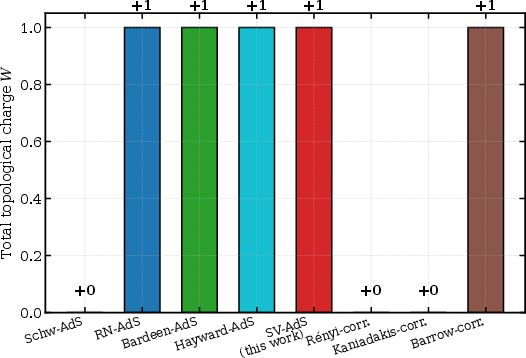
The work utilizes topological diagnostics, including winding numbers and a universal extremality function, to classify phase stability and distinguish SV–AdS from singular black holes.
Holographic Thermodynamics of Simpson--Visser--AdS Black Holes
Introduction
This work conducts a comprehensive analysis of the thermodynamic and topological properties of AdS black holes regularized by the Simpson–Visser (SV) geometric prescription, focusing on the holographic correspondence between the bulk SV–AdS solution and its boundary CFT dual (2605.26300). Unlike standard singular Schwarzschild–AdS configurations, SV–AdS spacetime eliminates central singularities via a radial deformation r→r2+a2, with the parameter a controlling the transition between regular black holes and wormhole geometries. The study leverages holographic thermodynamics, explicitly computing the entropy, energy, temperature, and chemical potentials on the CFT boundary, and applies contemporary topological diagnostics—total winding number W, universal extremality function U, and critical SV parameter c(ϵ)—to classify phase structures and their stability.
Bulk Thermodynamic Structure and Three-Branch Phase Topology
The SV–AdS metric introduces the lapse
f(r)=1−r2+a22M+(1+ϵ)ℓ2r2+a2
where ϵ is a quantum-gravity-inspired deformation of the cosmological term. The horizon mass and Hawking temperature are given in closed form, and the standard Bekenstein-Hawking entropy receives a logarithmic correction due to SV regularization:
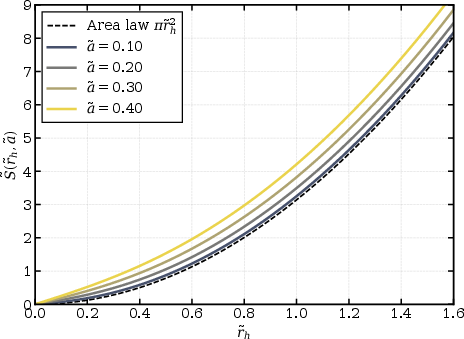
S(rh,a)=π[rhrh2+a2−a2ln(arh2+a2−rh)].
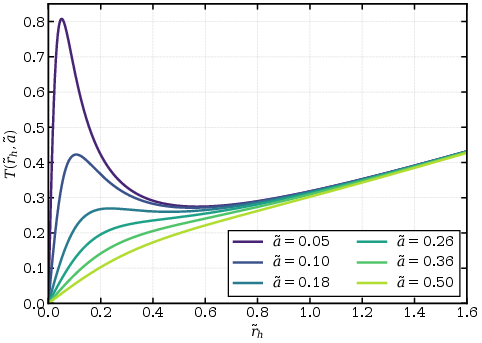
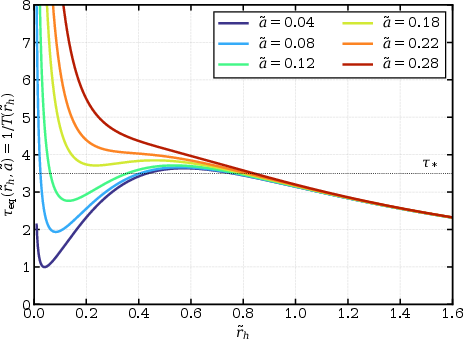
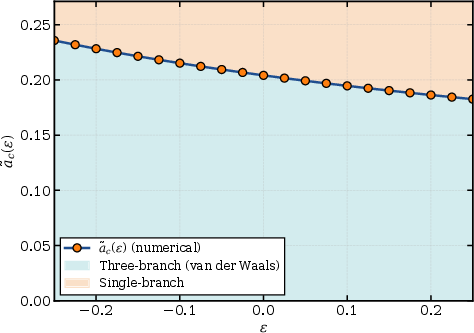
For <c=1/24≈0.204 (at ϵ=0), the bulk temperature a0 displays a van der Waals–type three-branch behavior, characterized by a local maximum and minimum and separated by an unstable region.
Figure 1: Bulk Hawking temperature for SV–AdS at a1, illustrating the emergence of three branches for a2 and monotonicity beyond.
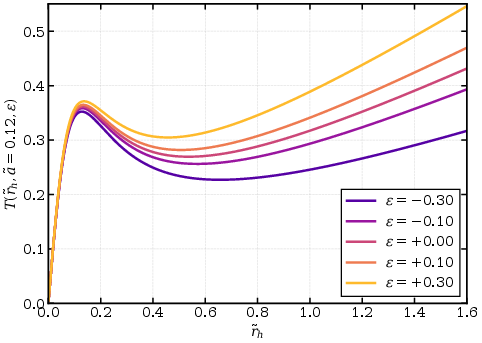
The temperature loop persists under cosmological deformation (a3), shifting the critical parameter and loop endpoints but retaining the topology:
Figure 2: a4-deformation shifts temperature curves; three-branch topology is stable across a5.
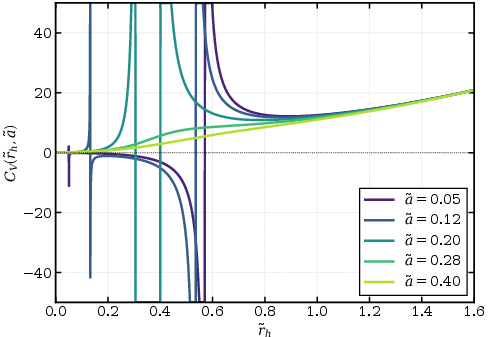
Specific heat behavior exhibits the canonical a6 sequence, with positive heat marking stable phases and negative signifying instability.
Figure 3: Specific heat a7 diverges at loop endpoints, demarcating stable and unstable branches.
The equilibrium radii for representative parameters are tabulated; as a8, with regularization effects visible at small a9:
Figure 4: Boundary entropy for SV–AdS deviating from area law at small regularization scales due to SV corrections.
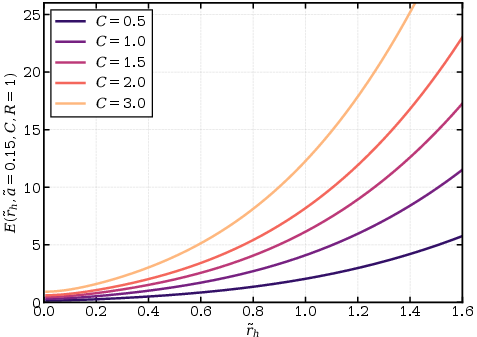
Boundary CFT energy scales with central charge and (W0), confirming expectations from conformal stress-energy tensors:
Figure 5: Boundary CFT energy for various central charges, displaying characteristic scaling behavior.
Off-Shell Free Energy and Topological Vector Field Analysis
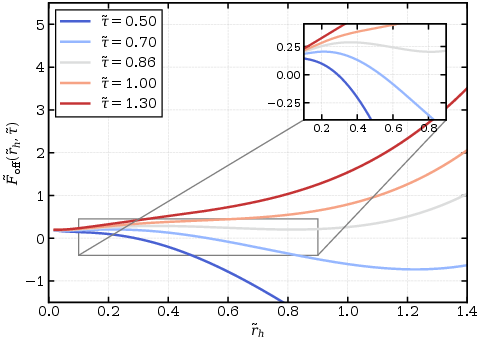
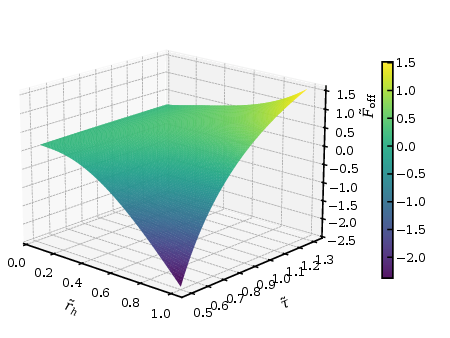
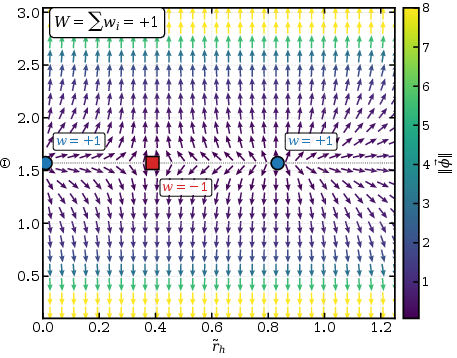
Off-shell free energy is computed with an independent inverse temperature label, and canonical ensemble equilibria are identified via stationary points. The auxiliary topological vector field W1 assigns local winding numbers to these equilibria, yielding total charge W2 for the SV–AdS family:
Figure 6: Off-shell free energy profile featuring three stationary equilibria in canonical ensemble.
Figure 7: 3D landscape of off-shell free energy, with saddle structure encoding three canonical equilibria.
Bulk equilibrium relation and winding numbers establish the universality class topology:
Numerical equilibrium radii for different U2 and U3, as well as the master diagnostic table, allow direct quantitative comparison across AdS black hole models.
Entropy scheme classification for non-extensive generalizations (R\'enyi, Tsallis, Kaniadakis, Barrow) reveals that multiplicative corrections collapse the three-branch structure to U4, while geometric area deformations (Barrow) preserve U5.
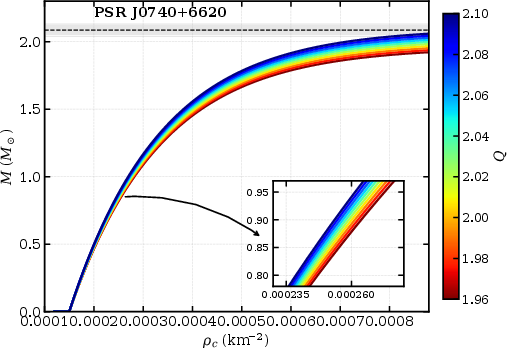
Observational constraints are imposed using mass-radius data for millisecond pulsars PSR~J0740+6620, with SV–AdS mass-density curves consistent across equation-of-state families.
The SV–AdS family, characterized by geometric regularization and a tunable cosmological deformation, manifests a robust three-branch van der Waals–type phase structure parameterized by U7. Topological diagnostics (U8) classify SV–AdS with other regular AdS black holes, distinguishing it from entropy-corrected families (U9). The universal extremality function is established and validated as a quantitative classifier. Boundary thermodynamics reveal entropy and energy corrections consistent with the SV geometric prescription. Observational constraints from compact-object data are satisfied by SV–AdS, indicating compatibility without resolving power at current precision. Future work should generalize to rotating configurations, explore wormhole–black bounce transitions, and seek explicit boundary CFT realizations of SV-induced entropy corrections.
“Emergent Mind helps me see which AI papers have caught fire online.”
Philip
Creator, AI Explained on YouTube
Sign up for free to explore the frontiers of research
Discover trending papers, chat with arXiv, and track the latest research shaping the future of science and technology.Discover trending papers, chat with arXiv, and more.