Analytical performance evaluation of quantum radar architectures: From single-photon to entangled-noise radars
Published 9 Jun 2026 in quant-ph | (2606.10436v1)
Abstract: This article presents a comprehensive analysis of two classes of quantum radars, including quantum direct-detection and quantum-entangled noise radars. In the first case, inspired by the well-established concept of single-photon LiDARs, we investigated the performance of single-photon radars, in which state-of-the-art single microwave-photon detectors are employed to enhance the detection sensitivity and enable the detection of weaker signals. We derived analytical expressions for the maximum detection range of both classes of quantum radars in terms of the Lambert W function, by considering all relevant system, target, and environmental parameters. Our formulation facilitates direct comparison of noise radars with direct-detection radars and suggests that a quantum-entangled noise radar can be regarded as an enhanced direct-detection radar with an effective threshold signal-to-noise ratio. Furthermore, we applied this framework to classical-correlated noise radars and defined the parameter range enhancement factor (REF) to quantify the superiority of quantum-entangled noise radars over their classical counterparts. Moreover, we introduced a rule-of-thumb for approximating the REF. We also examined the influence of limitations imposed by various microwave detection technologies. Our analysis shows that the conventional antennas limit the potential benefits of quantum-entangled noise radar systems. We also demonstrated that the optimal detection method for these radars is a microwave detector based on a quantum transducer combined with a single optical-photon detector. We showed that, with the current technology, implementing a quantum-entangled noise radar with the maximum detection range on the order of few kilometers is possible. Finally, we explored the potential applications of quantum-entangled noise radars.
The paper presents closed-form range equations using the Lambert W function to compare classical, single-photon, and quantum radar systems.
It demonstrates that quantum-enhanced correlations lower effective SNR thresholds, enabling kilometer-scale detection with nanowatt-level power.
The study critically analyzes detection technology limits, emphasizing the need for advanced receivers to fully harness quantum radar advantages.
Analytical Performance Evaluation of Quantum Radar Architectures: From Single-Photon to Entangled-Noise Radars
Introduction and Scope
The paper provides a comprehensive analytical framework for assessing the operational limitations and capabilities of quantum radar architectures, specifically spanning single-photon direct-detection radars and quantum-entangled noise radars. By systematically deriving range equations incorporating all pertinent system metrics—such as amplification gain, bandwidth, false-alarm probability, environmental noise, and practical hardware limitations—the study establishes a quantitative basis for performance comparison between classical, single-photon, and quantum-entangled modalities. The analysis culminates in explicit, closed-form expressions for maximum detection range, parameterized via the Lambert W function to enable predictive assessments tailored for real-world radar deployments.
Direct-Detection and Single-Photon Radar Fundamentals
Conventional direct-detection radar systems are analyzed with explicit attention to the incident and scattered microwave photon budget and its interplay with receiver sensitivity, detector noise, and environmental backscattering. The detection process is revised under single-photon detection regimes made possible by recent advances in single microwave-photon detectors (SMPDs), as detailed in Table 1 in the original manuscript.
The governing range equation for maximum detectable range Rmax is derived as:
Rmax=ln(10)γ20W0(20ln(10)γ(SNRthM)1/4Rc)
where γ is the atmospheric absorption coefficient, M the number of coherent integration samples, SNRth the detection threshold SNR, and Rc the characteristic range encoded by system and target properties.
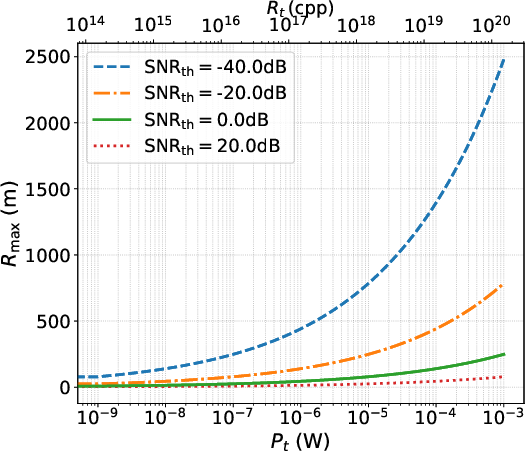
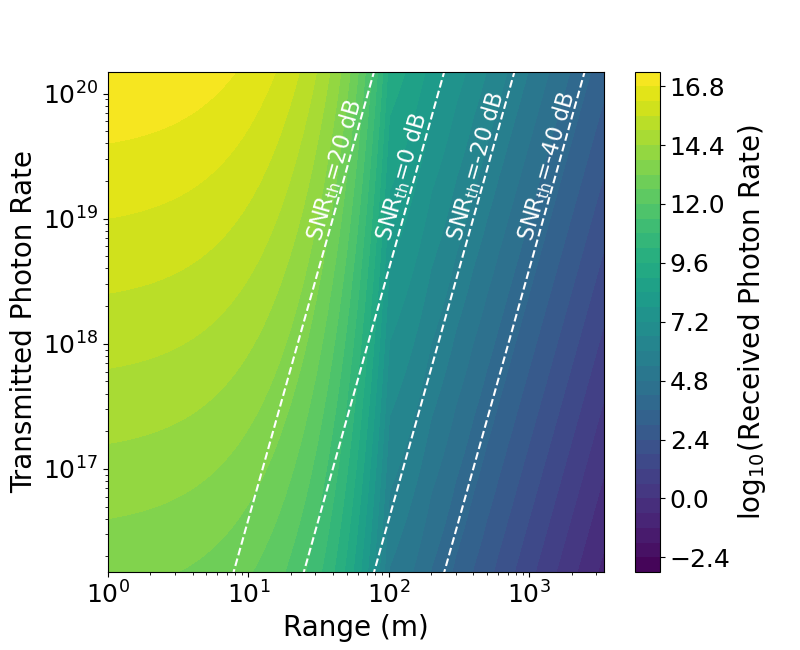
Empirically, as the attainable SNR threshold is reduced (e.g., via single-photon microwave detection strategies), dramatic increases in detection range are observed for low-power radar modes. For instance, with state-of-the-art detectors achieving SNR thresholds as low as −40dB, kilometer-scale detection is achievable with nanowatt-level transmitted power.
Figure 1: Impact of transmission power and SNR threshold on direct-detection radar range and incident photon statistics at the receiver.
Quantum-Entangled Noise Radar: Analytical Range Characterization
Quantum-entangled noise radars utilize two-mode squeezed vacuum (TMSV) sources to generate strongly quantum-correlated microwave photon pairs. In these architectures, target detection is achieved via correlation-based metrics (e.g., Pearson correlation coefficient ρ) rather than direct power detection, necessitating a fundamentally different analytical treatment.
The central result is the range equation for quantum noise radars:
where SNRthQI is an "effective" threshold, determined by the signal-idler source correlation, background noise, and detection statistics.
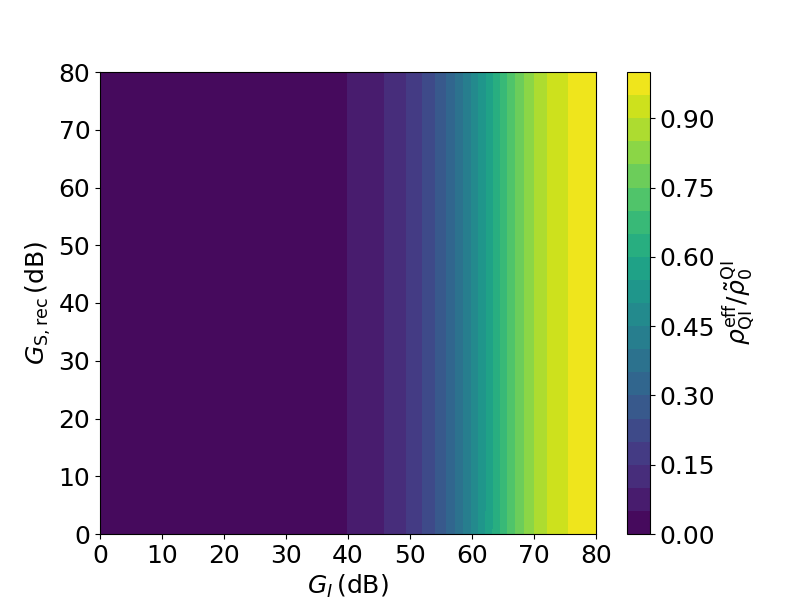
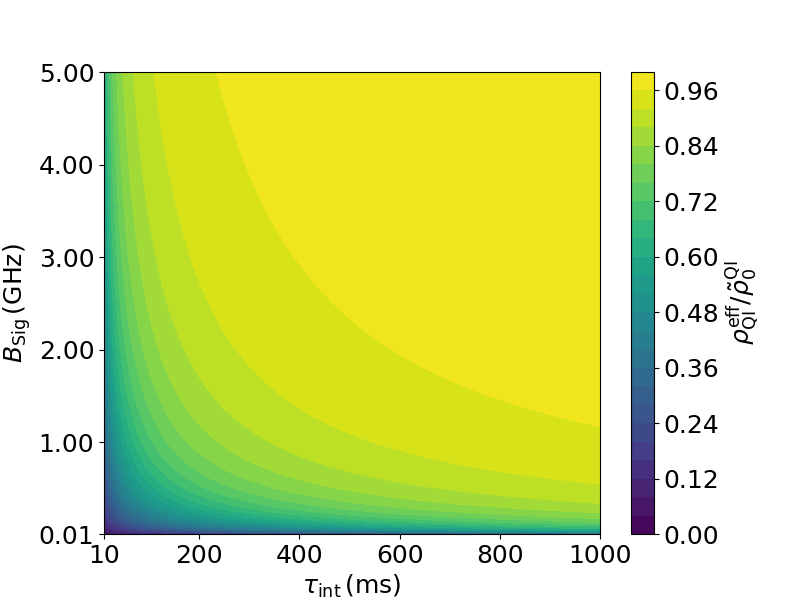
A rigorous derivation is provided for the Pearson correlation between signal and idler under the effects of system gain, added amplifier noise, finite detection bandwidth, and environmental attenuation. The results highlight that quantum noise radars can achieve substantially lower effective SNR thresholds compared to their classical analogs, due to quantum-enhanced correlations that persist even when entanglement is degraded during propagation.
Figure 2: Dependence of normalized signal-idler correlations on receiver gain, idler gain, detection bandwidth, and integration time in quantum noise radar systems.
Range Enhancement Factor and Quantum Advantage
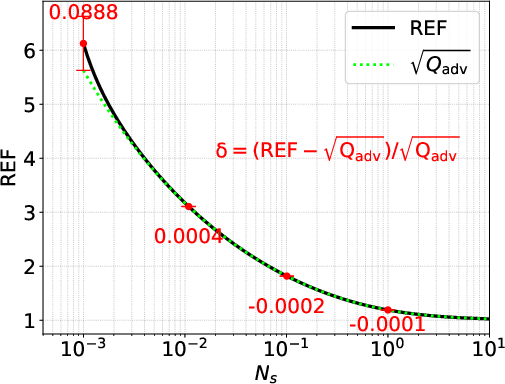
To quantify the practical superiority of quantum-entangled architectures, the study defines a "range enhancement factor" (REF), representing the ratio of the maximum detectable range of a quantum system to its classical counterpart under identical system parameters:
Rmax=ln(10)γ20W0(20ln(10)γ(SNRthM)1/4Rc)0
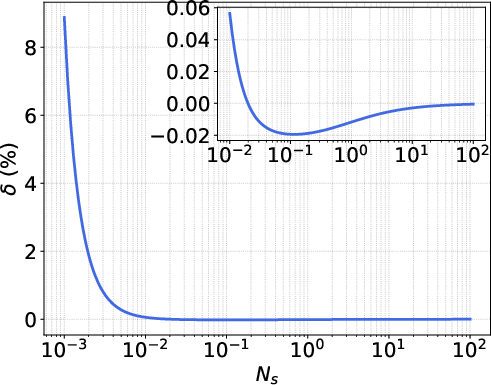
The analysis shows that, in the regime of low mean photon number per mode Rmax=ln(10)γ20W0(20ln(10)γ(SNRthM)1/4Rc)1,
Rmax=ln(10)γ20W0(20ln(10)γ(SNRthM)1/4Rc)2
where Rmax=ln(10)γ20W0(20ln(10)γ(SNRthM)1/4Rc)3 is the quantifiable quantum advantage in signal-idler correlations over classical splitting.
Consequently, reductions in the required SNR threshold by Rmax=ln(10)γ20W0(20ln(10)γ(SNRthM)1/4Rc)4 double the detection range, underpinning the architectural benefit of leveraging quantum resources in radar design.
Figure 3: Analytical and approximate predictions for the range enhancement factor as a function of photon number per mode, validating the robustness of the proposed estimation.
Experimental Context and System Parameterization
Assessment of the feasibility of long-range quantum radar is underpinned by benchmarking explicitly against state-of-the-art experimental implementations. Key system parameters including gain, bandwidth, operational frequency, quantum efficiency, integration time, and false alarm probability are enumerated for Josephson traveling-wave parametric amplifier (JTWPA)-based quantum sources and modern receiver chains.
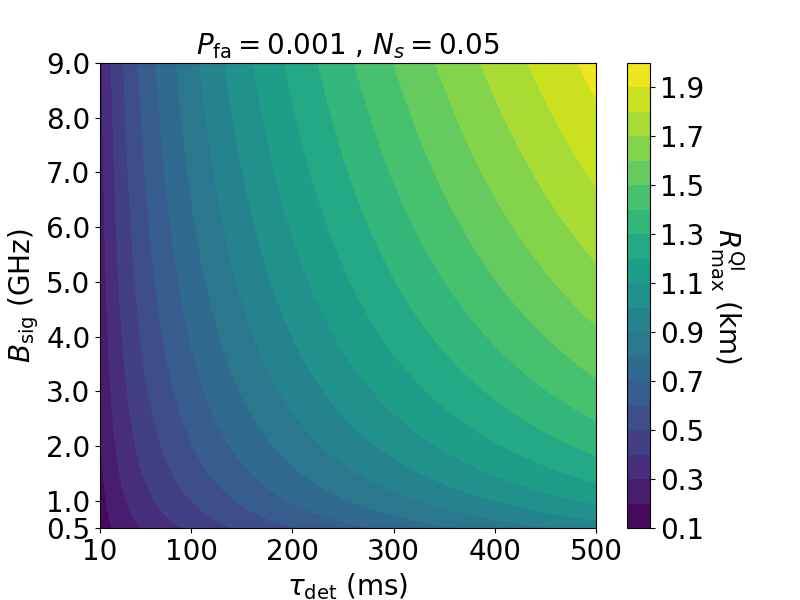
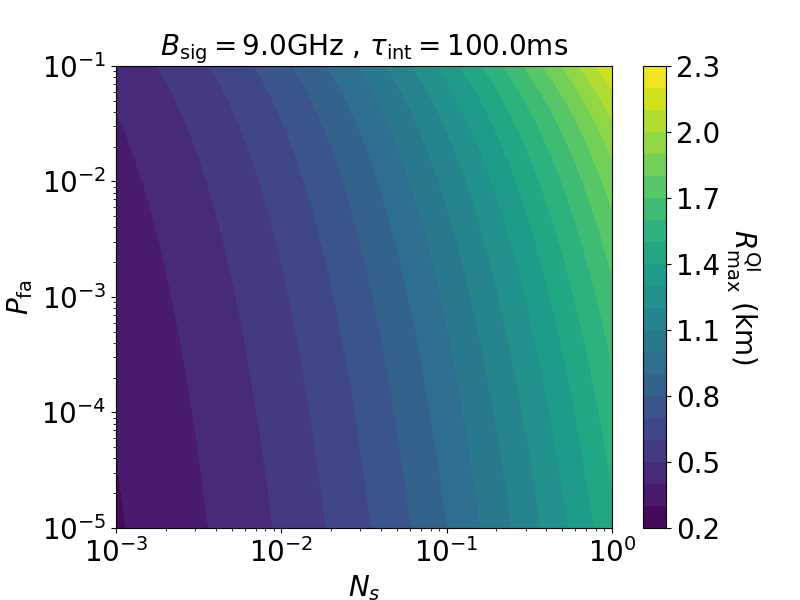
Figure 4: Maximum detection range as a function of signal bandwidth, integration time, photon number per mode, and false alarm probability for a JTWPA-based quantum radar system.
Detailed analysis demonstrates that kilometer-scale detection is feasible for targets with moderate radar cross-section (RCS) when deploying wideband quantum sources, long integration times, and ultra-low-noise receivers—provided that receiver detection technologies are not a limiting factor.
Detection Technology Limits and Practical Challenges
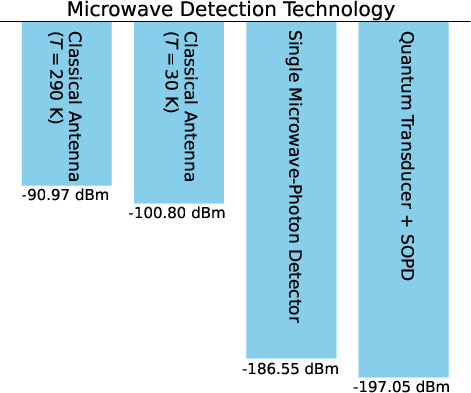
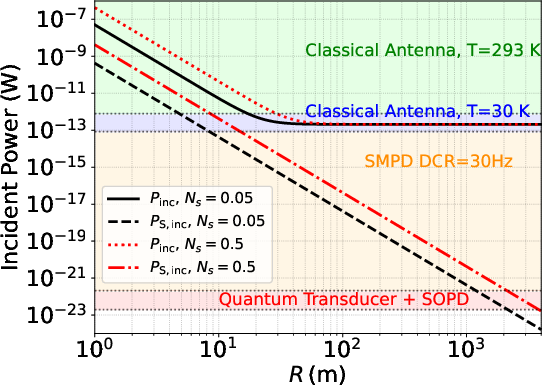
Critical evaluation of the physical detection limits (PDL) imposed by real-world antenna and SMPD technologies reveals that, although quantum architectures offer performance advantages in theory, these are contingent on the receiver’s ability to discern the returned quantum signal above both the system’s noise floor and the hardware’s PDL. The study integrates rigorous comparisons between current SMPDs, classical antennas, and hybrid quantum transducer receivers, concluding that quantum advantage is only meaningful if detection technology is sufficiently advanced—that is, Rmax=ln(10)γ20W0(20ln(10)γ(SNRthM)1/4Rc)5.
Figure 5: Incident power at the receiver and PDL boundaries for various detection technologies; shaded areas indicate operational regimes where quantum radar advantage is preserved or lost.
Application-Specific Suitability and Entanglement Resource Analysis
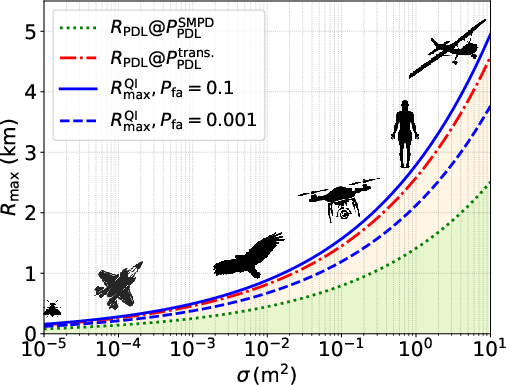
The implications of quantum radar performance for real-world targets—ranging from stealth aircraft and commercial drones to avian and human targets—are explored via explicit detection range/RCS charts. The analysis establishes that current quantum architectures, even with aggressive detection hardware, remain unsuitable for early-warning or long-range high-speed targets, but are promising for low RCS targets within urban or airport surveillance scenarios.
Figure 6: Achievable maximum detection range versus target RCS for various classes of objects, juxtaposed with PDL-imposed range restrictions from different detection technologies.
Additionally, the work clarifies that while quantum entanglement is rapidly degraded in realistic propagation and amplification settings, quantum discord and residual quantum correlations remain as the underlying operational resources responsible for observed performance gains, in agreement with recent theoretical results regarding quantum illumination.
Perspective and Future Directions
The theoretical findings highlight several technical vectors for improvement:
Ultrawide-bandwidth entangled sources and integrated photonics-based radar platforms;
Room-temperature entanglement sources via advanced optomechanical or NV-center-based schemes;
High-efficiency, low-DCR SMPDs and quantum transducers for microwave-to-optical conversion;
Adoption of non-Gaussian quantum states to enhance detection sensitivity and resilience.
Further analyses extending this framework to encompass SWaP considerations, cost, and real-time operation are critical for roadmap development toward field-ready quantum radar systems.
Conclusion
This study presents a rigorous analytical foundation for evaluating and comparing quantum vs. classical radar architectures. It demonstrates that the operational viability and quantum advantage of entangled noise radar are critically mediated by both optical/microwave source engineering and, most importantly, receiver detection technology. While theoretical models predict substantial range advantages, practical realization of these benefits will require continued technological progress in quantum-limited microwave detection and ultrabroadband entanglement generation. The framework provided should guide both future experimental design and the theoretical study of emergent quantum radar protocols.
“Emergent Mind helps me see which AI papers have caught fire online.”
Philip
Creator, AI Explained on YouTube
Sign up for free to explore the frontiers of research
Discover trending papers, chat with arXiv, and track the latest research shaping the future of science and technology.Discover trending papers, chat with arXiv, and more.