Efficient Magic State Cultivation for $\sqrt{T}$ Gates
Published 9 Jun 2026 in quant-ph | (2606.10430v1)
Abstract: Recently, experimental and theoretical quantum error correction methodology has seen remarkable breakthroughs. In particular, magic state cultivation has been shown to simplify magic-state preparation and make it feasible for near-term devices. However, recent research on magic state cultivation has focused primarily on the cultivation of $T\left| + \right>_L$. Only a few other magic state cultivation methods beyond $T\left| + \right>_L$ have been investigated. Here, we generalize phase kickback checks for magic states at arbitrary Clifford hierarchy levels in specific codes. We provide an example of cultivation of $\sqrt{T}\left| + \right>_L$ in the doubled color code and the corresponding escape strategy using lattice surgery from the color code to large rotated surface codes. Using state vector simulation for un-grown cultivation, we observe a strong consistence between $S\left| + \right>_L$ and $\sqrt{T}\left| + \right>_L$ cultivation's performance on the doubled color code. Finally, we discuss the application of the corresponding $\sqrt{T}\left| + \right>_L$ cultivation, incorporating the STAR architecture and $T$ gates, for early fault-tolerant quantum computing and its potential to shorten gate synthesis in the fully fault-tolerant quantum computing era.
The paper extends MSC to √T gates by generalizing phase kickback methods to validate high-fidelity √T magic states.
It employs transversal control-gates with GHZ ancillas to detect errors, achieving logical infidelities as low as ~10⁻⁵ for d=3 codes.
The integration of doubled color codes and lattice surgery provides a pathway for efficient gate synthesis and scalable fault-tolerant architectures.
Efficient Magic State Cultivation for T Gates
Introduction
Magic state distillation (MSD) and, more recently, magic state cultivation (MSC) are central methods in fault-tolerant quantum computation for enabling high-fidelity non-Clifford gates through state injection protocols. Progress in MSC has focused predominantly on T∣+⟩L magic states, with limited theoretical and experimental exploration for higher-level Clifford hierarchy gates such as T and, to a lesser extent, S. This work extends the MSC paradigm to the T gate, generalizing the double phase kickback mechanism for magic state validation and introducing new cultivation, growth, and escape strategies that target T∣+⟩L.
Generalized Magic State Cultivation via Phase Kickback
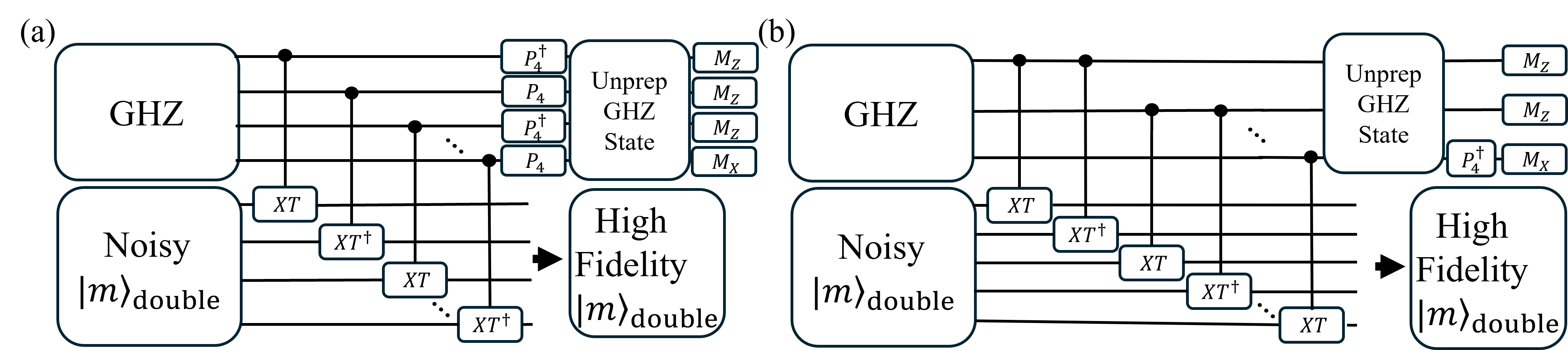
The paper introduces a general method for checking the quality of logical magic states ∣m⟩L by using transversal gates and phase kickback measurements with large GHZ ancilla states. The core criteria are that the code admits a transversal gate U with U∣m⟩L=+∣m⟩L. During the protocol, the parity of X-basis measurements on the GHZ qubits distinguishes correct logical state preparations from faulty ones.
Figure 1: General phase kickback measurement for arbitrary ∣m⟩L using a GHZ ancilla and transversal control-T∣+⟩L0 gates.
For T∣+⟩L1, the protocol constructs the phase-kickback check by concatenating transversal control-T∣+⟩L2 and control-T∣+⟩L3 gates and then undoing the GHZ entanglement, finalized with phase correction on the ancilla. Two circuit constructions (full and paired-cancellation) are provided to minimize the required GHZ state size.
Figure 2: The phase kickback measurement circuits for T∣+⟩L4: phase correction can be distributed across ancillas or consolidated by pairing controls.
This systematic construction permits MSC across Clifford hierarchy levels, contingent on availability of transversal gates T∣+⟩L5 in the chosen code.
Implementation for the T∣+⟩L6 Gate
The protocol is concretely realized on the doubled color codes, notably the T∣+⟩L7 code for T∣+⟩L8 and recursively constructed T∣+⟩L9, T0 for T1:
Injection Stage: Prepare T2, apply noisy physical T3 via controlled CNOT ladders, followed by syndrome measurement for postselection.
Cultivation Stage: Apply the generalized double phase kickback check as above.
Post-cultivation: Additional syndrome measurements for enhanced error detection.
Escape/Growth: Convert to a two-dimensional code (e.g., via transversal CNOT or lattice surgery (LS)) and finally to a large rotated surface code.
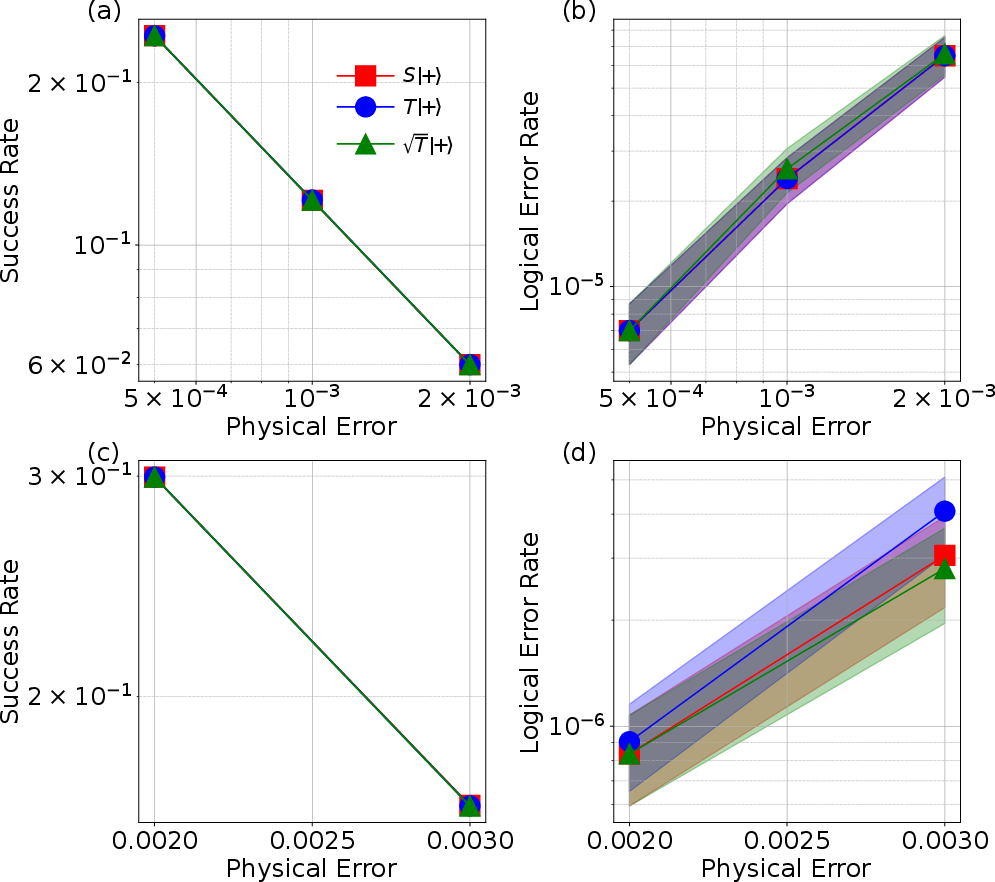
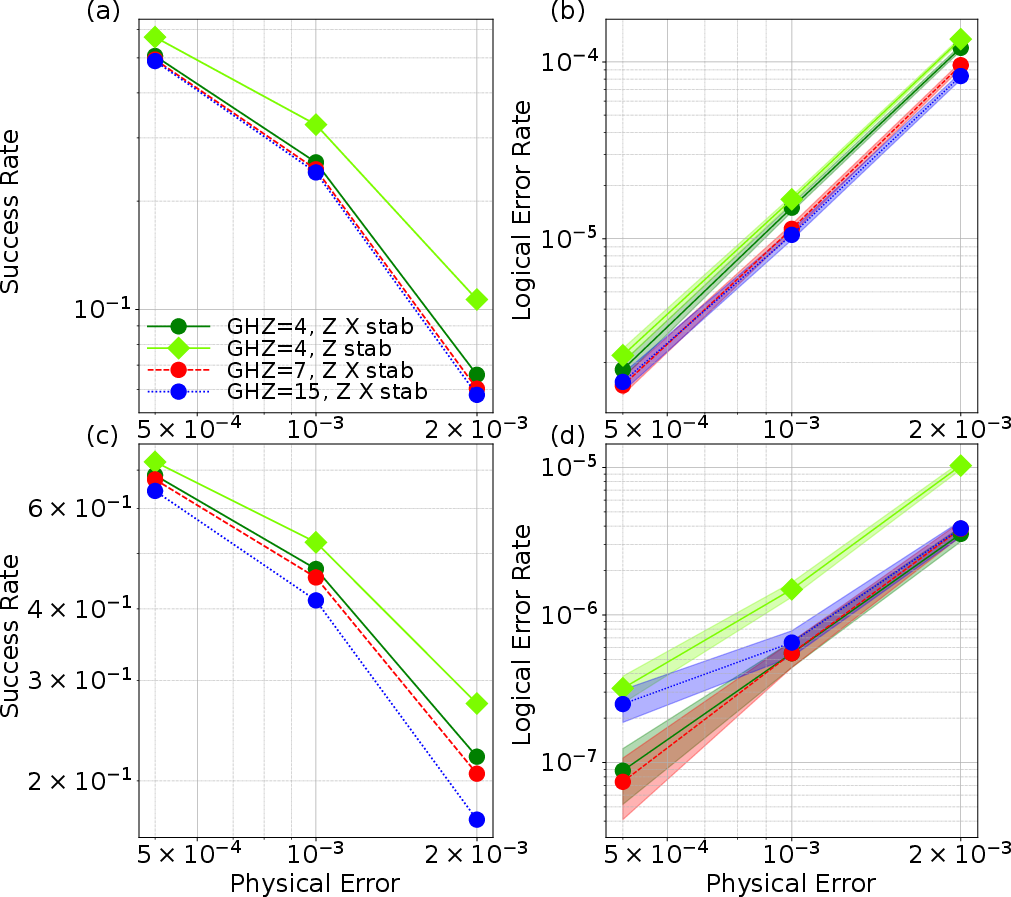
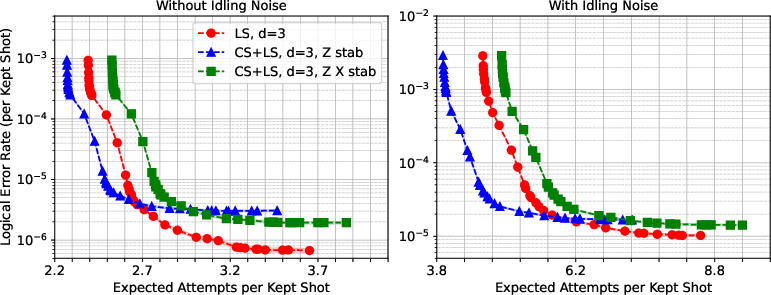
Numerical simulations of the end-to-end protocol demonstrate logical error rates and success probabilities for ungrown and grown MSC in various noise models, both with and without idling noise.
Figure 3: The performance of ungrown T4 T5 MSC, T6, and T7 under different noise conditions.
Figure 4: Logical error rates and success probabilities of T8 ungrown MSC with various syndrome measurement strategies and GHZ sizes; comprehensive Clifford simulation validates protocol consistency.
For T9 codes, logical infidelities at physical error rates S0 reach S1 (idling noise) or lower without idling noise, and a similar pattern holds for S2 with even lower logical error rates but reduced success rates.
Figure 5: End-to-end simulation infidelity for S3 code, with and without idling noise, exploring various escape/growth strategies and postselection thresholds.
Growth and Escape: Lattice Surgery and Code-Switching
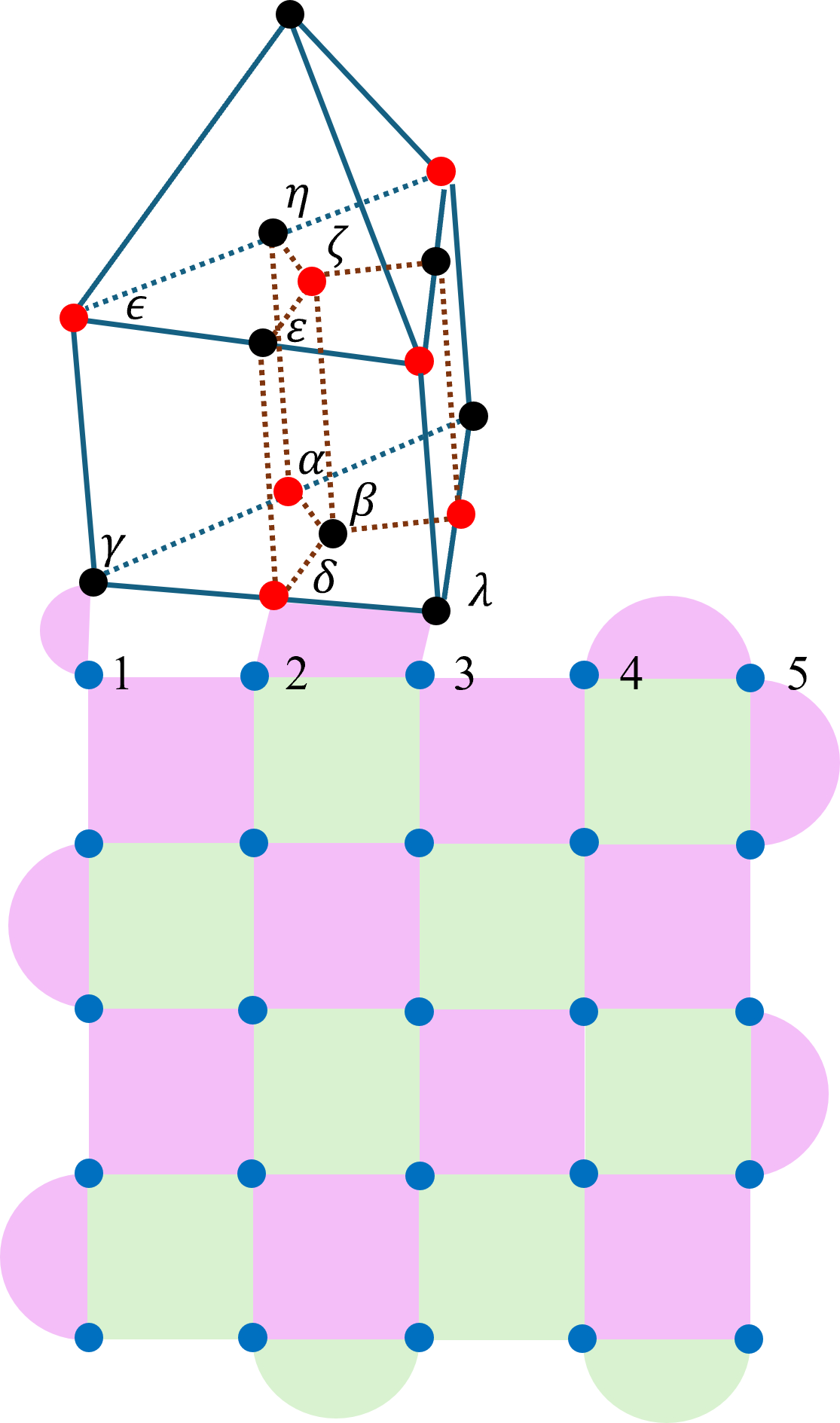
Escape from the small code is realized via code-switching protocols from the doubled color code to a 2D color code (or directly to the rotated surface code) using lattice surgery.
Figure 6: Lattice surgery between doubled color code and rotated surface code; logical operators and syndrome extraction for reliable state transfer.
This enables high-fidelity MSC states to be transplanted onto macroscopic codes suitable for long-term quantum storage and computation, forming the bridge from near-term to full-scale architectures.
Application: Shorter Gate Synthesis and STAR Architectures
High-fidelity S4 enables two primary future avenues:
Catalyzed and Teleported Gates: Magic state catalysis (MSCa) and magic state teleportation (MST) protocols can realize S5 and S6 gates with reduced non-Clifford resource overhead if seeds are available efficiently. The work quantifies cost-benefit regimes for MST versus MSCa in terms of expected spacetime volume per shot and logical error rates.
Figure 7: The S7 gate catalyst circuit—consumes S8 gates to catalyze two S9 gates, reusing a T0 seed.
Figure 8: Magic state teleportation circuit for the T1 gate—the action is transferred from a resource state to an arbitrary target.
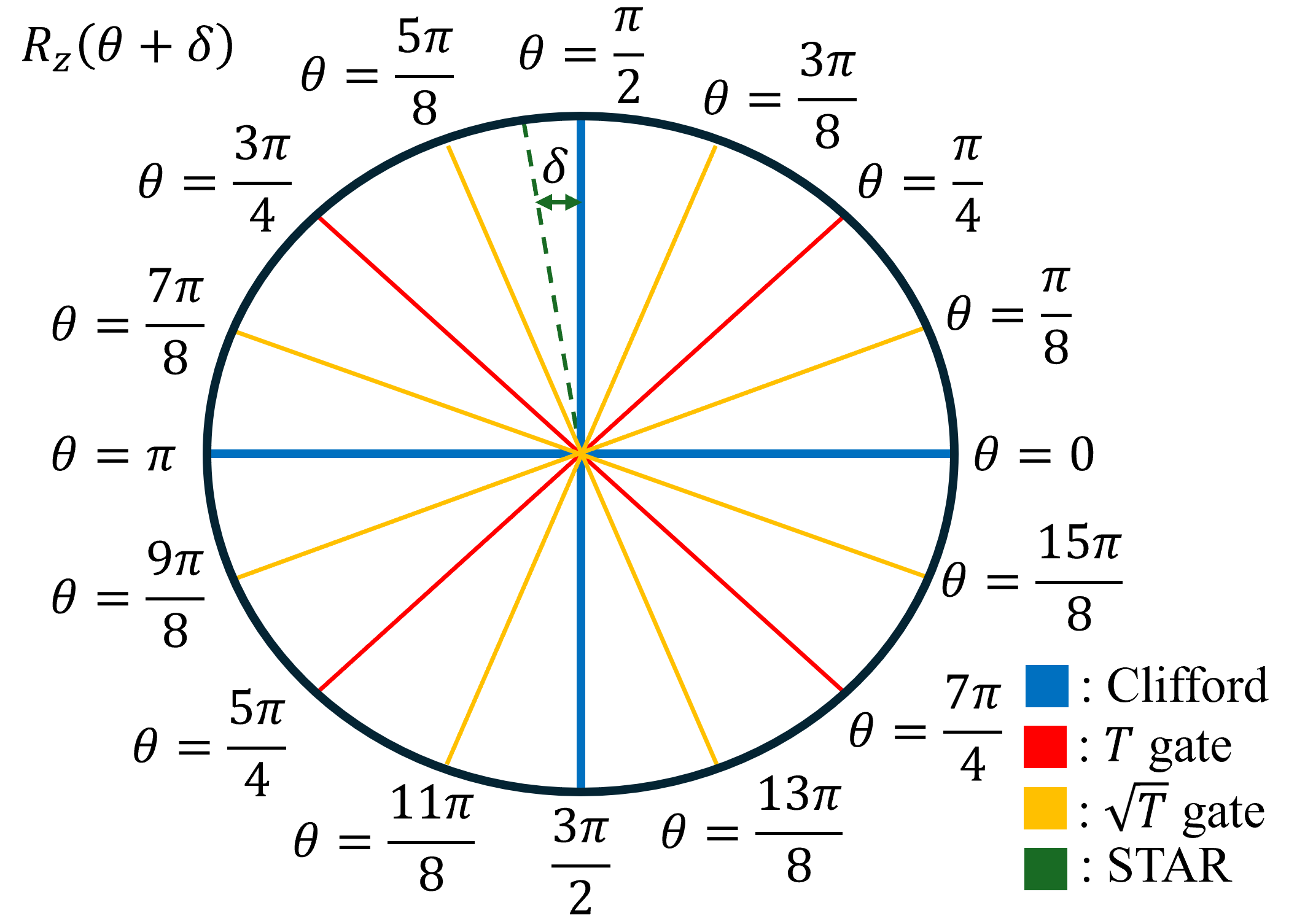
STAR and Omni-STAR Architectures: Integration with small-angle rotation protocols (STAR) allows for efficient, low-overhead arbitrary-angle rotations in the early fault-tolerant regime. The combined use of T2, T3, and Clifford gates (Omni-STAR) systematically lowers logical error rates for arbitrary T4 rotations versus pure STAR.
Figure 9: Decomposition of an arbitrary Z rotation in Omni-STAR; large angles are handled with T5/ T6, small remainders by analog STAR injection.
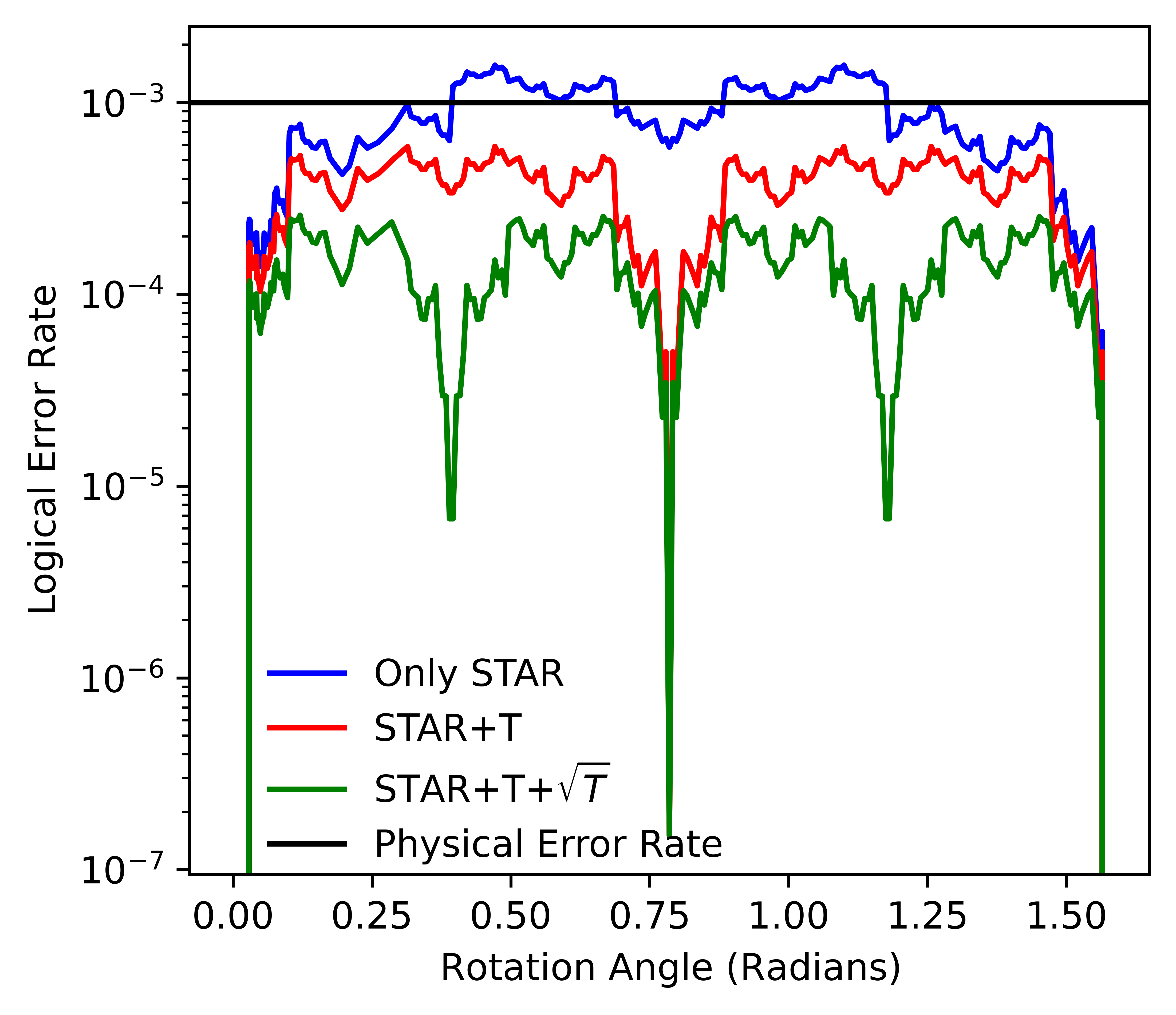
Figure 10: Logical error rates for arbitrary angle rotations—Omni-STAR (STAR+T7+T8) outperforms STAR-only and STAR+T9 across the range, especially near Clifford hierarchy angles.
The protocol is particularly advantageous when synthesizing complex rotations as needed in the Fermionic Fast Fourier Transform or general quantum simulation, reducing total non-Clifford gate count and corresponding overhead.
Resource Analysis
Space-time volume, success rates, and logical error rates are tabulated for various code choices, postselection thresholds, and escape strategies. Performance matches or improves upon baseline color code/surface code MSC protocols for T∣+⟩L0 (with idling noise: logical infidelity T∣+⟩L1, space-time volume T∣+⟩L2 few T∣+⟩L3), and substantially exceeds for T∣+⟩L4 (logical infidelities T∣+⟩L5 at cost of lower yield).
Theoretical and Practical Implications
Hierarchy Generalization: The proposed framework systematizes construction of MSC for arbitrary Clifford hierarchy gates via phase kickback, addressing a longstanding gap for non-T∣+⟩L6 magic states, paving the way for more versatile universal gate sets in FTQC.
Near-Term and Long-Term Utility: The techniques are not only viable for near-term neutral-atom and ion-trap hardware but are designed for seamless scaling to large codes, essential for both early- and fully-fault tolerant eras.
Path to Lower-Overhead Universal Sets: By efficiently catalyzing and teleporting higher-level resource gates, the protocol shortens gate synthesis sequences, potentially making Clifford+T∣+⟩L7+T∣+⟩L8 or richer sets preferable to Clifford+T∣+⟩L9 alone.
Future Directions
Further optimization of MSC protocols for depth, GHZ ancilla resource consumption, and postselection strategies to boost yield and lower error rates.
Experimental demonstration on larger codes and with more general catalyst protocols (e.g., ∣m⟩L0).
Integration with alternative codes such as quantum LDPC to test universality of the double phase kickback method and its adaptability to hardware with dominant noise biases.
Investigation of dimension-jumping code conversion for high-level hierarchy (∣m⟩L1) gates and robust error mitigation during complex growth/escape stages.
Conclusion
This work rigorously generalizes MSC to higher Clifford hierarchy gates, with a primary focus on the ∣m⟩L2 gate. It thoroughly analyzes protocol construction, growth, and resource tradeoffs, and provides strong evidence—via simulation and formal cost analysis—that high-fidelity ∣m⟩L3 is feasible and operationally beneficial both for near-term quantum devices and in the asymptotic regime of universal quantum computation. The methods and results significantly broaden the set of practical resource states accessible to quantum computers, aligning realistic noise and hardware constraints with future algorithmic requirements.