- The paper introduces a camera-based homodyne detection method that enables simultaneous, shot-noise-limited quadrature measurements across 60 optical modes.
- It achieves a six-orders-of-magnitude reduction in local oscillator power while maintaining high linearity and negligible crosstalk.
- The method facilitates the verification of multimode squeezing, entanglement, and conditional state preparation, paving the way for scalable CV quantum systems.
Camera-Enabled Scalable Homodyne Detection of Multimode Quantum Light
Introduction and Motivation
The efficient and scalable measurement of quantum optical fields is fundamental to enabling practical advances in quantum information processing, quantum communication, and quantum metrology. Continuous-variable (CV) photonic systems offer a powerful route to realizing large-scale entanglement, which is pivotal for the implementation of cluster states, Gaussian Boson Sampling, and the preparation of Gottesman–Kitaev–Preskill (GKP) states. However, while the generation of highly multimode quantum states has seen significant progress, scalable quantum measurement—specifically multimode homodyne detection—remains a bottleneck due to the high power, noise, and crosstalk issues inherent to traditional approaches.
This paper introduces and experimentally validates a scalable homodyne detection method leveraging a high-efficiency CCD camera to drastically reduce the required local oscillator (LO) power per mode and enable simultaneous, shot-noise-limited quadrature measurements across 60 optical modes. The approach is demonstrated to deliver high clearance, negligible crosstalk, and compatibility with advanced continuous-variable quantum protocols, thereby opening a viable path to million-mode quantum measurement architectures.
Camera-Based Homodyne Detection Architecture
The homodyne detection scheme utilizes the massively parallel nature of modern CCD cameras, allocating pairs of pixels to distinct frequency modes produced via spectral dispersion of quantum and LO fields. Each twin-pixel pair, corresponding to a frequency-bin, measures the difference signal, which is digitally processed using a calibrated weight function and normalization protocol to yield the quadrature outcomes per mode.
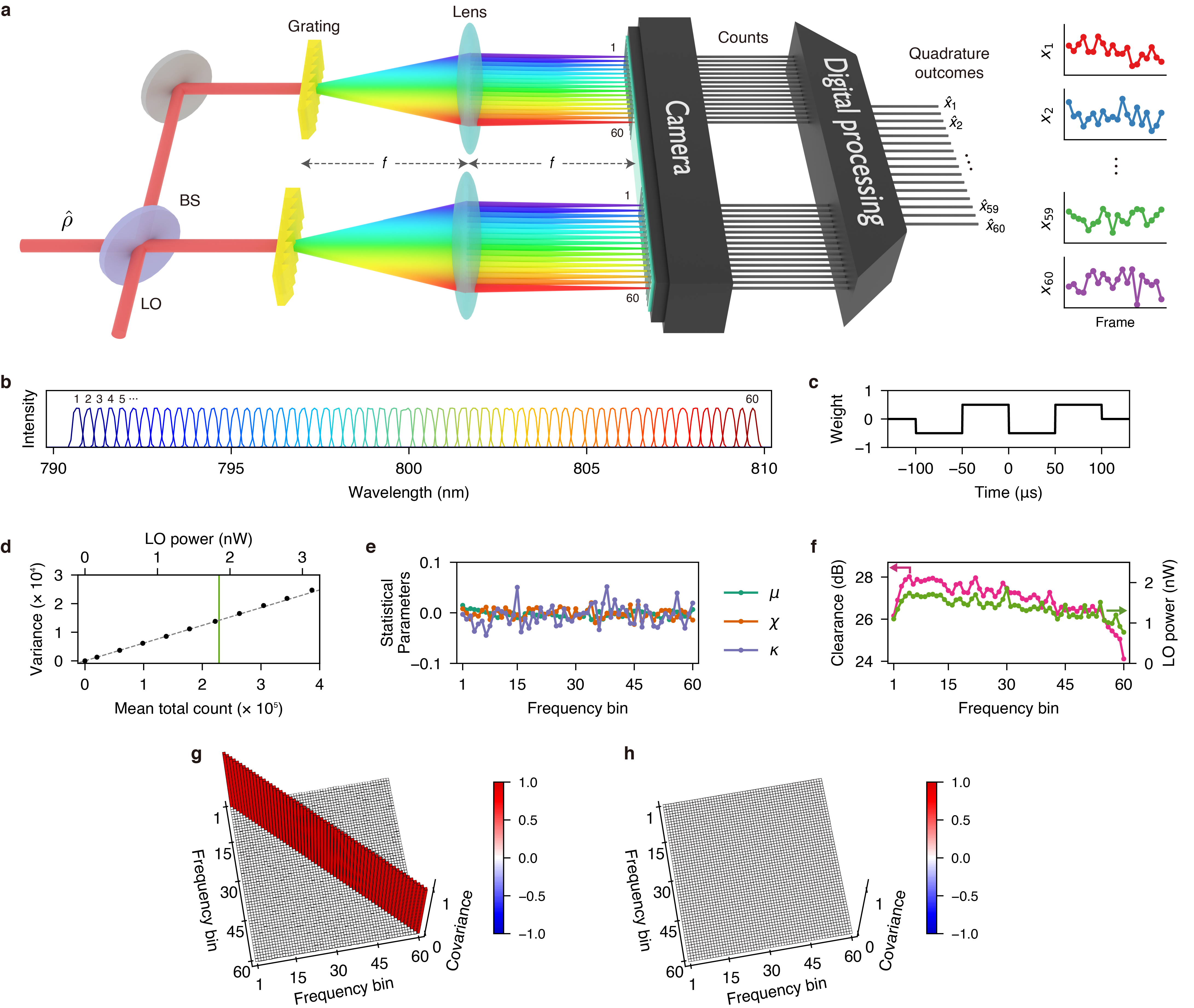
Figure 1: Schematic of the camera-based homodyne detection system, showing multimode signal–local oscillator interference, grating-based frequency-mode decomposition, and parallel CCD pixel-pair readout leading to simultaneous quadrature measurement.
Key technical outcomes include:
- Linearity: The detector's response in each mode demonstrates high linearity across the operational LO power range, as quantified by R2 values exceeding 0.99 (see also Figure 2 in the Supplement), indicating shot-noise-limited performance.
- Statistical Fidelity: Offset, skewness, and excess kurtosis of the shot noise distribution approach zero, confirming Gaussian statistics consistent with theoretical expectation.
- LO Power Reduction: The CCD-based readout achieves high clearance (24–28 dB) with LO powers below 2 nW per mode—a six-orders-of-magnitude reduction compared to conventional APD or PIN-diode based architectures.
Multimode Quantum State Detection and Entanglement Verification
The experimental system integrates the camera-based homodyne unit with a synchronously pumped optical parametric oscillator generating highly multimode squeezed states distributed over 60 frequency bins. The simultaneous measurement of all modes supports advanced CV protocols, including the direct observation of multimode squeezing and entanglement.
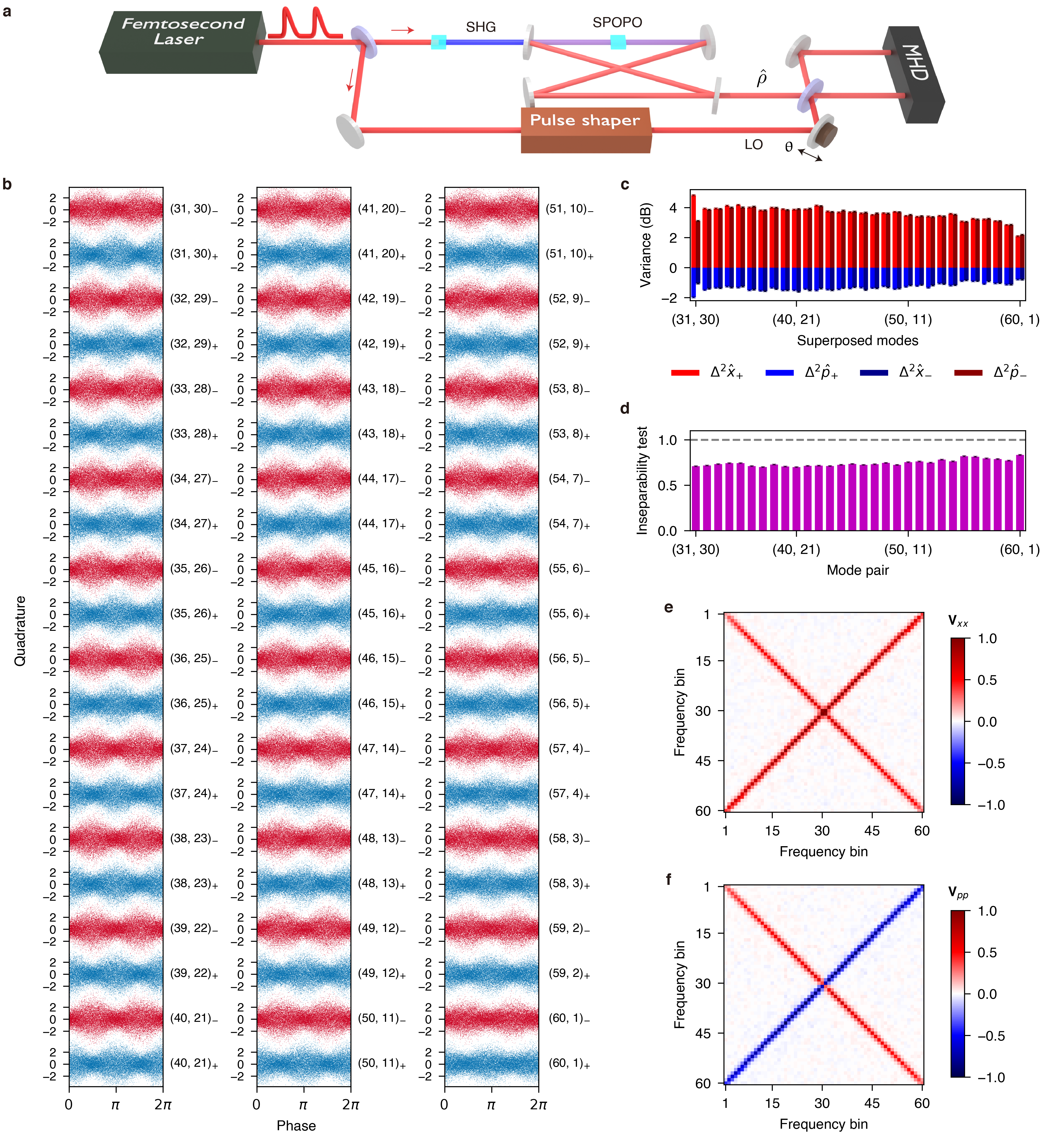
Figure 3: Multimode quantum state homodyne detection—experimental configuration, quadrature distribution matrices, and mode-wise variance and inseparability analysis using the Duan criterion.
Salient findings:
- All symmetric and antisymmetric superpositions of mode pairs show sub-vacuum noise in one quadrature, indicating strong bipartite squeezing across the measured basis.
- The Duan inseparability criterion is universally satisfied across all 30 mode pairs, providing robust evidence of entanglement.
- Covariance analyses of the x and p quadratures reveal expected structural correlations (positive for x, negative for p), verifying multimode quantum resource structure.
Multipartite Entanglement and Mode Reconfigurability
An essential advantage of the camera-based multimode homodyne approach is intrinsic reconfigurability: arbitrary real-unitary superpositions of mode quadratures can be accessed through digital summation of camera-pair outcomes, with no need for additional hardware such as beamsplitter networks.
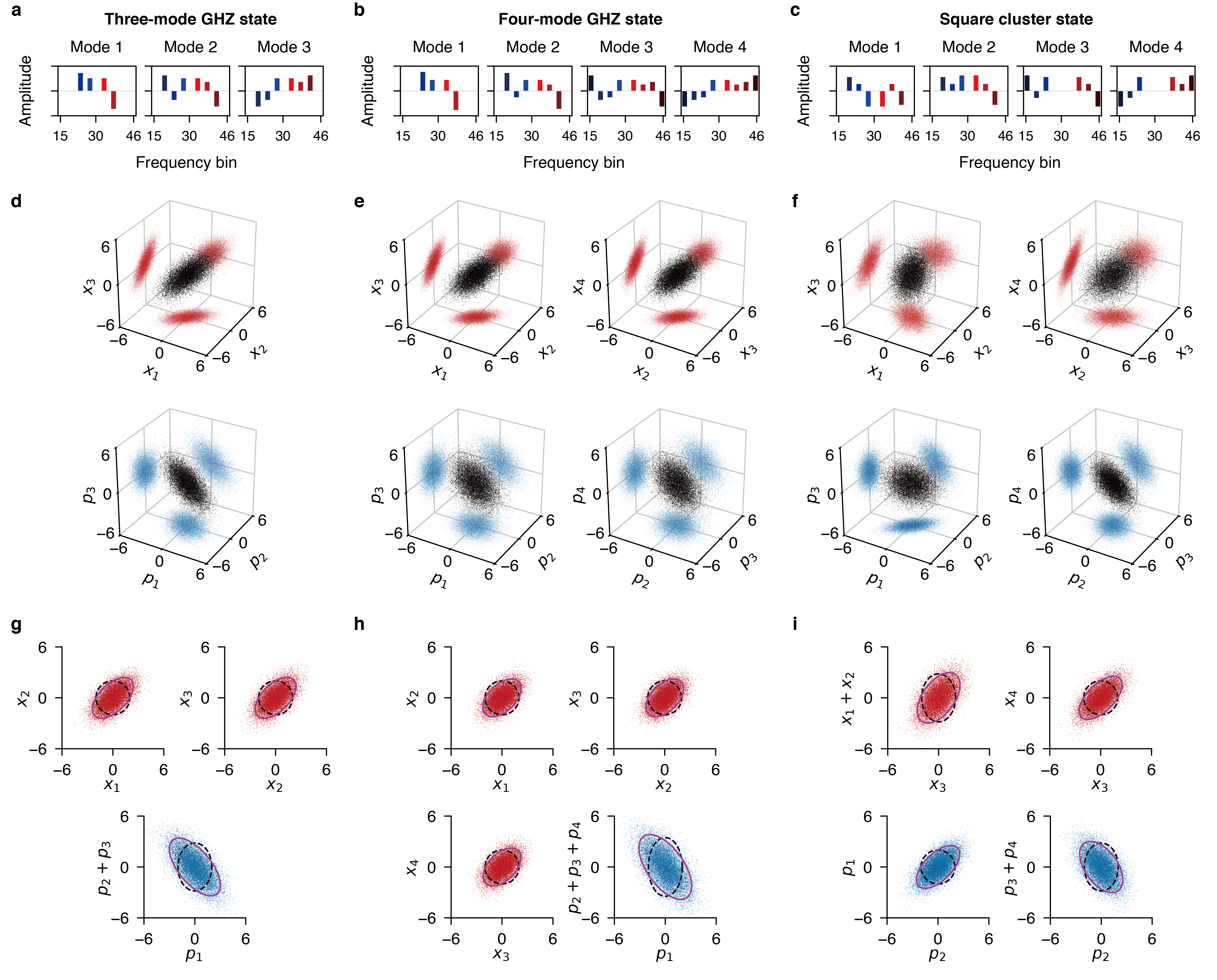
Figure 4: Experimental access to multipartite entangled states (GHZ and square cluster) via camera-enabled multimode homodyne detection, demonstrating strong nullifier correlations and satisfaction of multipartite entanglement criteria.
The paper demonstrates preparation and verification of multipartite CV GHZ and cluster states, with nullifier variances consistently below vacuum noise, and all entanglement witnesses exceeding the van Loock–Furusawa criteria thresholds.
Conditional State Preparation
Scalable homodyne detection also unlocks protocols for measurement-induced conditional preparation of multimode states. Leveraging EPR entangled pairs distributed between two parties (Alice and Bob), Alice's local quadrature measurements and classical communication enable Bob to realize an arbitrary multimode squeezed state via electronic displacement.
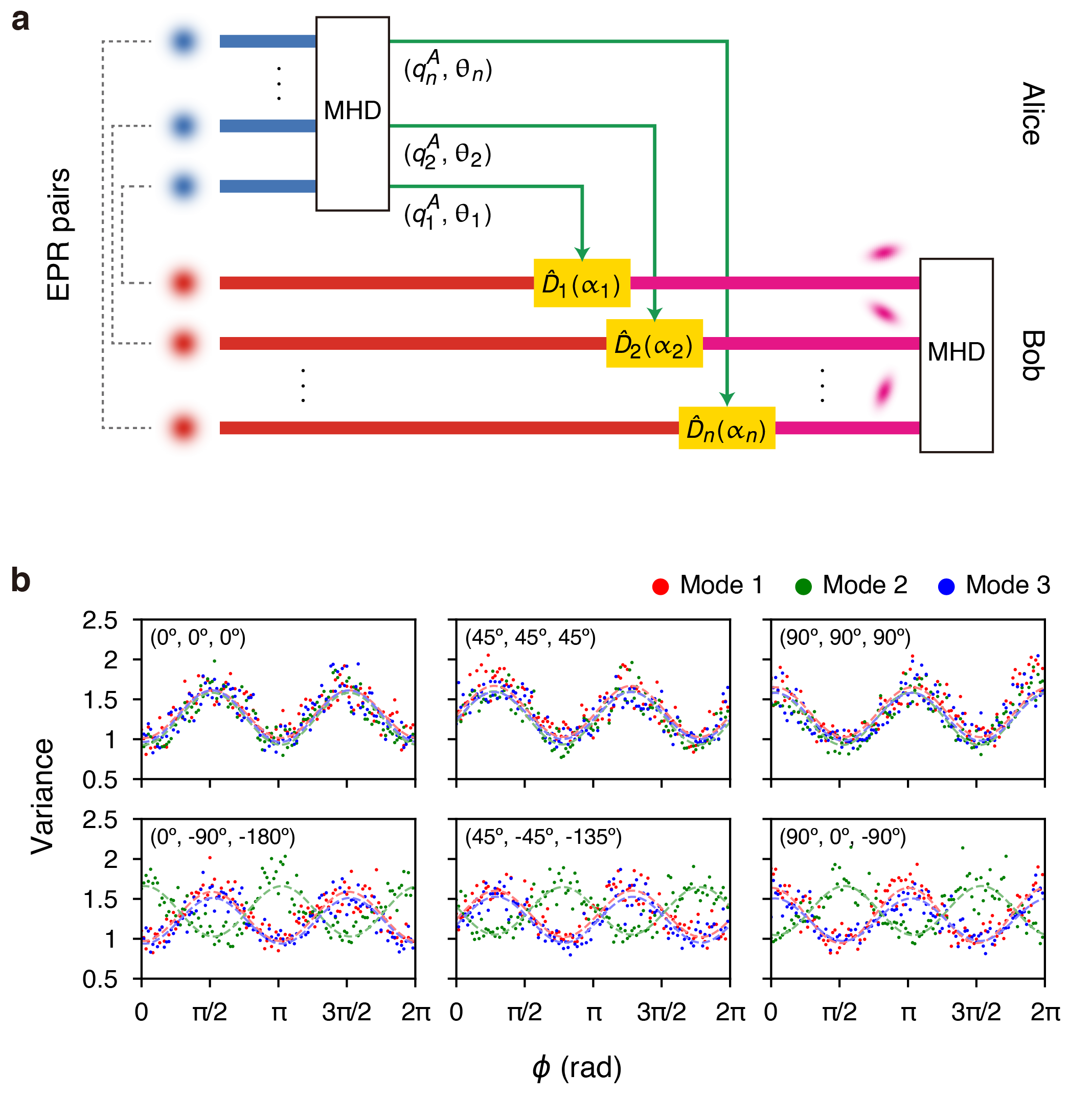
Figure 5: Conditional preparation protocol in the multimode regime and verification of prepared three-mode states via variance modulation under angle sweeps at Bob's side.
Experimental results confirm the creation of conditionally squeezed states with programmable squeezing axes, capturing the versatility of the camera-based approach for distributed quantum state engineering.
The following numerical outcomes capture the system's critical performance:
| Metric |
Value |
Notes |
| Number of parallel modes |
60 |
Limited by pixel count |
| LO power per mode |
< 2 nW |
6 orders lower than traditional |
| Clearance (all modes) |
≥ 24 dB |
99.6–99.8% efficiency |
| Crosstalk (covariance) |
Negligible |
Confirmed via covariance matrix |
| Nullifier variances |
~0.63–0.65 |
Below vacuum (1.0) |
| Duan criterion (all pairs) |
Satisfied |
Strong entanglement |
These results represent a substantial advance over single- or few-mode homodyne architectures, particularly regarding scalability and robustness.
Implications and Future Directions
The camera-based approach fundamentally alters the scaling behavior of CV homodyne measurement in both frequency and (prospectively) spatial domains. With milliwatt-scale total LO power, million-pixel camera arrays can, in principle, support simultaneous measurement of up to 106 modes, enabling CV quantum processors and networks that far exceed current experimental capability. The negligible LO power also mitigates issues with classical noise and device heating, which traditionally limit multi-channel homodyne systems.
Prospective directions include:
- Direct extension to two-dimensional spatial mode detection, supporting high-dimensional boson sampling, cluster state computing, and quantum-enhanced imaging protocols.
- Integration with CMOS/ASIC camera technologies to raise frame rates and further suppress classical and readout noise.
- Application to quantum error correction (GKP syndrome extraction), real-time tomography in high-dimensional Hilbert spaces, and robust measurement-based quantum computing pipelines.
Conclusion
The demonstration of camera-enabled, scalable homodyne detection opens a robust and versatile pathway towards large-scale quantum information processing. With shot-noise-limited performance, low-local-oscillator power operation, and digital reconfigurability, this architecture directly addresses longstanding challenges in the scalable measurement of multimode quantum optical fields. The experimental system achieves simultaneous, high-fidelity quadrature measurements across 60 modes, direct verification of multimode squeezing and entanglement, and supports advanced conditional measurement protocols. These innovations will be central for realizing the next generation of continuous-variable quantum technologies, from fault-tolerant computing to networked quantum sensors and beyond.

