- The paper demonstrates a scalable dual integrated squeezed-light source on TFLN using two tunable OPOs that generate stable two-mode entanglement.
- It leverages advanced fabrication techniques such as electron beam lithography and periodic poling to achieve high quality factors and efficient fiber coupling at telecom wavelengths.
- Experimental results verify EPR-type entanglement by violating the Duan–Simon criterion with an inseparability value of 1.87, confirming its suitability for CV quantum applications.
Integrated Squeezed Light Sources for Two-Mode Entanglement in Thin-Film Lithium Niobate
Motivation and Background
Continuous-variable (CV) quantum information processing relies on deterministic generation and manipulation of nonclassical states, notably squeezed light. Squeezed states reduce quantum noise in specific quadratures, enabling enhanced sensitivity in quantum sensing and providing resources for measurement-based quantum computing (MBQC). Integrated photonics platforms, particularly based on thin-film lithium niobate (TFLN), are highly promising due to strong second-order nonlinearities, mature fabrication procedures, low-loss waveguides, and compatibility with telecom wavelengths, which are crucial for scalable photonic quantum processors. However, current demonstrations in TFLN mainly focus on single squeezed-light sources, lacking the ability to scale toward multi-source, circuit-based architectures necessary for MBQC and cluster-state generation.
Device Architecture and Fabrication
The paper demonstrates the fabrication and operation of two indistinguishable, independently controllable optical parametric oscillators (OPOs) on a single TFLN chip. Each OPO features:
- Periodically poled nonlinear section: Enables efficient spontaneous parametric down-conversion (SPDC) at 1550 nm, targeting compatibility with telecom CV quantum circuits.
- Integrated heaters: Allow precise resonance tuning for individual sources, supporting reproducible nonlinear processes and wavelength matching.
- Dichroic directional couplers: Separate pump and signal modes, optimize cavity escape efficiency, and ensure minimal noise propagation.
The overall chip design ensures single-mode operation for the squeezed signal, straightforward fiber coupling, and adaptability to fabrication tolerances across the nonlinear and coupling sections.
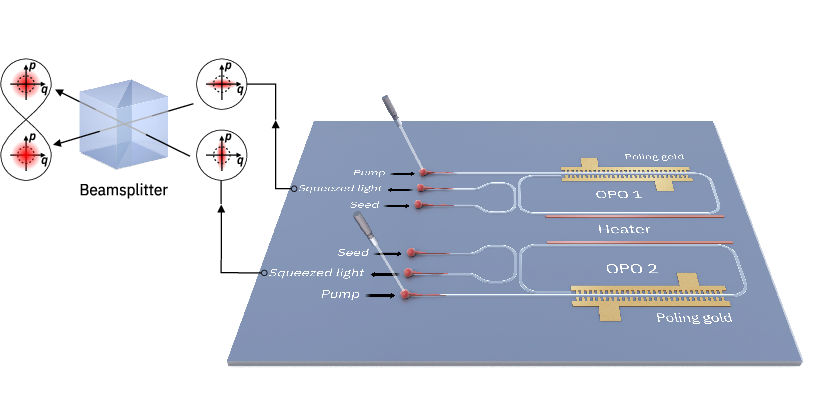
Figure 1: Scheme illustrating integrated dual-OPO architecture on TFLN, combining on-chip resonance tuning, periodically poled sections, and off-chip entanglement generation.
Fabrication utilizes electron beam lithography for electrodes and poling, argon milling for waveguide definition, and piezoresponse force microscopy (PFM) to verify uniform domain inversion. The periodically poled section is optimized for bandwidth and fabrication robustness through sub-millimeter lengths, minimizing sensitivity to nanoscale inhomogeneity.
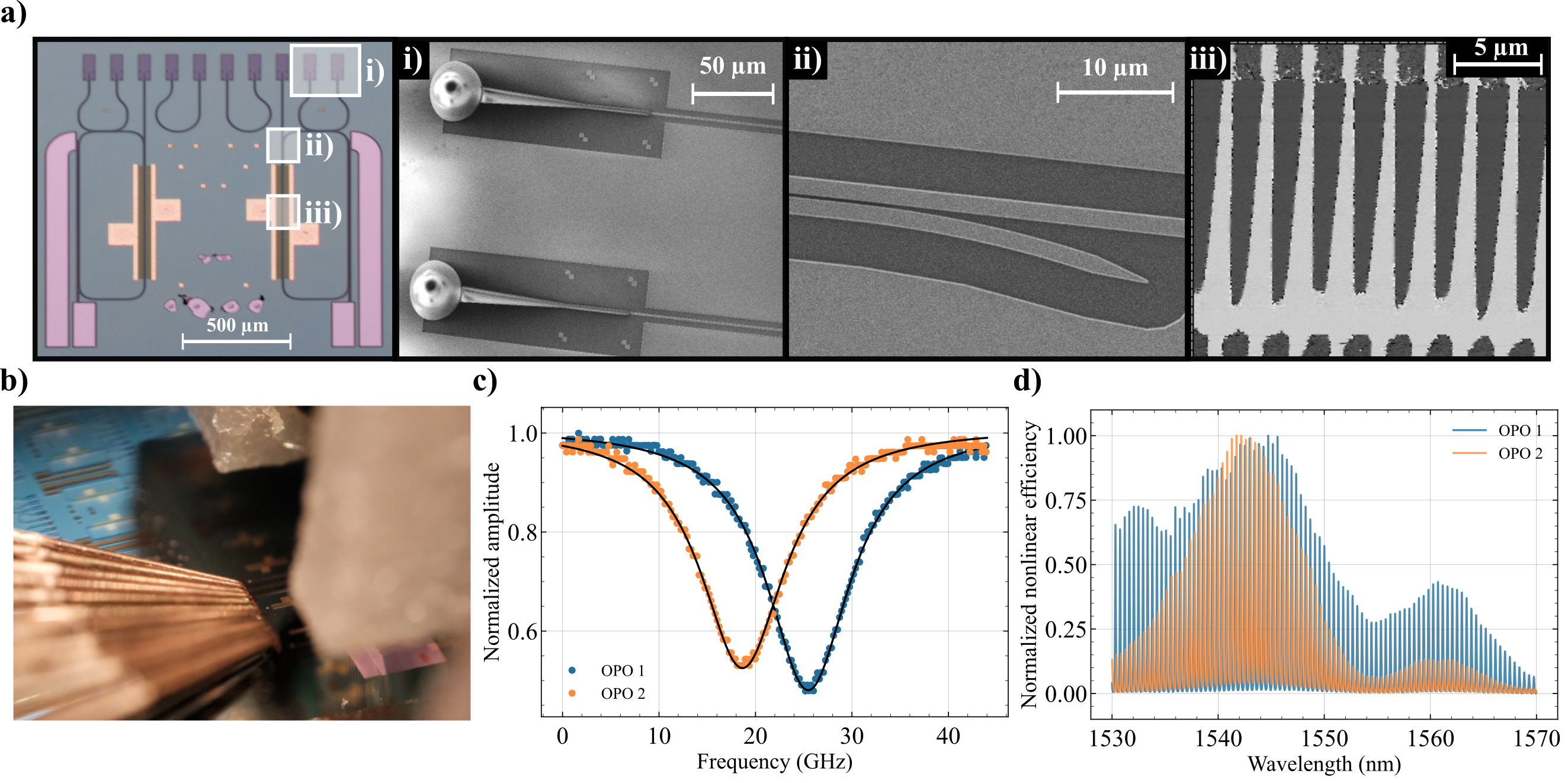
Figure 2: Micrographs and characterization details of chip fabrication, confirming coupler quality, domain inversion uniformity, and resonance spectra for both OPOs.
Measured loaded quality factors for the two resonators are QL=14.4×10³ and QL=13.8×10³, with escape efficiencies exceeding 85%. The nonlinear SHG spectra indicate phase-matching near 1544 nm, adjustable via both global and local temperature control. Fiber-to-chip coupling losses are minimized through polymer lens approaches; detection efficiencies reach ≈87%.
Quantum Characterization and Two-Mode Entanglement Generation
The experimental setup employs phase-coherent pump and seed lasers at both 775 nm and 1550 nm. Independent attenuation and polarization control enable individualized OPO operation and optimal pump-seed matching. Individual OPOs are characterized by homodyne detection, showing flat squeezing spectra over GHz bandwidths.
At optimal settings, single-mode squeezing levels reach −0.43 and −0.5 dB below shot noise, with anti-squeezing of comparable magnitude. The symmetry between squeezing and anti-squeezing demonstrates operation well below threshold (Ppump/Pth≪1), facilitating linear scaling in variance suppression.
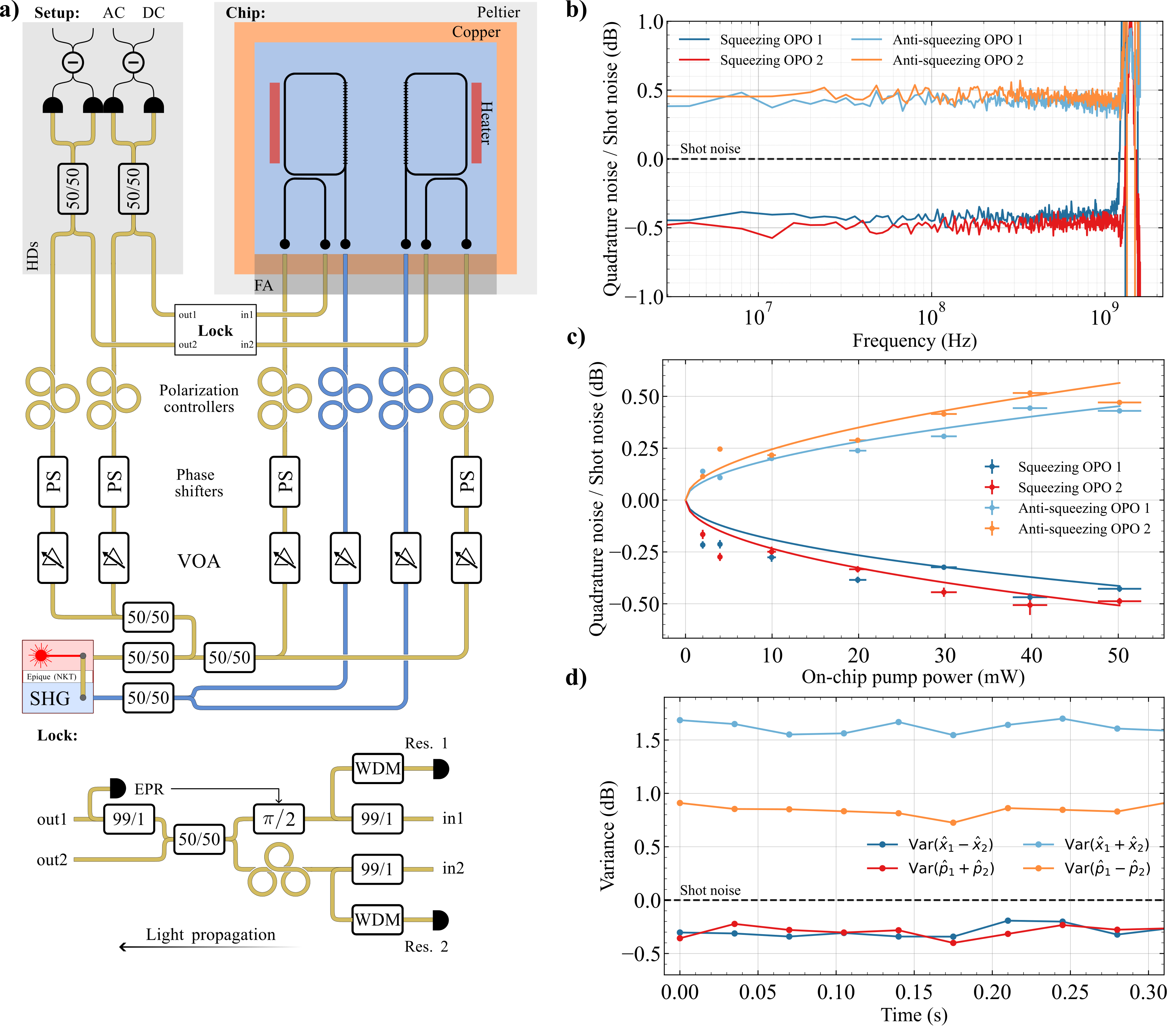
Figure 3: Setup schematic and squeezing measurement results, including power scaling, squeezing spectra, and two-mode entanglement verification.
Pump power thresholds are measured to be 23±4 W and 15±3 W, primarily limited by waveguide propagation and coupling losses. The device achieves simultaneous, stable squeezing from both OPOs, with negligible mode or polarization mismatch.
Two-mode entanglement is generated by interfering the outputs via an off-chip beam splitter and phase shifter. Homodyne detection records correlated quadrature fluctuations, yielding continuous suppression below shot noise for both amplitude subtraction and phase summation. The experiment verifies violation of the Duan–Simon criterion, with a measured inseparability value of 1.870±0.005 consistently below the classical limit of 2, thus confirming EPR-type entanglement.
- Squeezing level: Direct quadrature squeezing measured as up to 0.5 dB below shot noise for both OPOs.
- Threshold power: 23±4 W and QL=13.8×1030 W for OPOs 1 and 2, limited by propagation losses and escape efficiency trade-offs.
- Entanglement: Duan–Simon criterion violated with QL=13.8×1031 and QL=13.8×1032 suppressed below shot noise over extended measurement times.
- Reproducibility: Indistinguishable spectra and power scaling; mutual compatibility of dual-OPO operation demonstrated and verified.
Practical and Theoretical Implications
The demonstration of two individually tunable, indistinguishable squeezed-light sources on a single TFLN chip is a key milestone for scalable CV quantum photonics. The reproducibility and compatibility of nonlinear generation processes support extension to larger arrays, essential for generating temporal and spatial cluster states. The architecture leverages strong nonlinear interactions, robust fabrication, and efficient coupling, supporting integration of additional optical components such as tunable modulators and switches.
This platform is immediately compatible with MBQC protocols and scalable to multi-mode entanglement required for universal CV quantum computation [PhysRevLett.97.110501]. Ongoing advances in high-fidelity, wafer-scale poling [Chen2024; Xin2025], low-loss detectors [Lomonte2021], and active circuit control further accelerate progress. The results provide a foundation for practical, fault-tolerant photonic processors in quantum sensing, communication, and computation, especially in the telecom regime.
Prospects and Future Directions
Significant improvements are anticipated through reduction of waveguide propagation losses, enhancement of nonlinear efficiency via optimized poling, and adaptation of escape efficiency to maximize squeezing levels. Future work should integrate larger numbers of OPOs, tunable optical networks, and monolithic homodyne detection. Combining on-chip cluster-state generation with integrated single-photon detection opens pathways to hybrid discrete-variable/CV architectures [Andersen2015_HybridQuantumInfo].
Efficient, scalable entanglement on TFLN chips is promising for universal quantum computation, quantum metrology, and robust quantum communication infrastructure. Specific focus on further reduction of coupling losses, improvement of pump power handling, and wafer-scale reproducibility will drive continued progress.
Conclusion
This work establishes a scalable, reproducible architecture for integrated squeezed-light generation and two-mode entanglement in TFLN. The dual-OPO design and experimental demonstration of stable squeezing and EPR-type CV entanglement advance the capabilities of quantum photonics toward large-scale MBQC and practical quantum information processing. The demonstrated mutual compatibility and architectural tunability position TFLN integrated platforms as robust candidates for future CV quantum technologies.
References:
- Lohmann et al., "Integrated squeezed light sources for two-mode entanglement in thin-film lithium niobate" (2605.26583)
- Additional relevant works: [doi:10.1126/sciadv.aat9331], [doi:10.1126/sciadv.adl1814], [Chen2024], [Xin2025], [Lomonte2021], [PhysRevLett.97.110501]

