- The paper introduces Sim2Schedule, a simulator-guided framework using a locally deployed LLM to achieve 94–99% of MILP-optimal NPV under complex geotechnical constraints.
- It employs a dual-pathway design, combining real-time, transparent simulation with a MILP benchmark to ensure robustness and interpretability in block sequencing.
- Empirical results demonstrate linear scalability and rapid computation, making the approach a viable alternative for dynamic, large-scale mine scheduling.
Simulator-Guided LLMs for Autonomous Open-Pit Mine Scheduling
Problem Setting and Motivation
Open-pit production scheduling (OPPS) centers on maximizing net present value (NPV) from mining operations while navigating complex spatial precedence, extraction-processing coupling, and operational capacity constraints. Classical mathematical programming, predominantly Mixed-Integer Linear Programming (MILP), has achieved optimal schedules but suffers from exponential computational complexity, inflexibility in dynamic environments, and limited interpretability for planners. Previous metaheuristics and reinforcement learning models reduce computational burden at the expense of global optimality and real-time adaptability. Recent developments exploiting LLMs for combinatorial optimization demonstrate potential in producing interpretable, near-optimal solutions with robust adaptability. However, prior LLM-driven mining solutions have not addressed the multi-period, geotechnically-constrained OPPS problem.
Framework Overview
The paper introduces Sim2Schedule, a simulator-driven autonomous mine scheduling framework where a locally-deployed LLM functions as a sequential decision-making agent. The LLM receives structured prompts encoding the current mine state and feasible actions, dictated by a custom simulator that internally manages geotechnical constraints (block precedence, slope stability), extraction-processing dependencies, and dynamic production limits. The framework operates entirely zero-shot, with no domain-specific re-training, ensuring data privacy and rapid deployment.
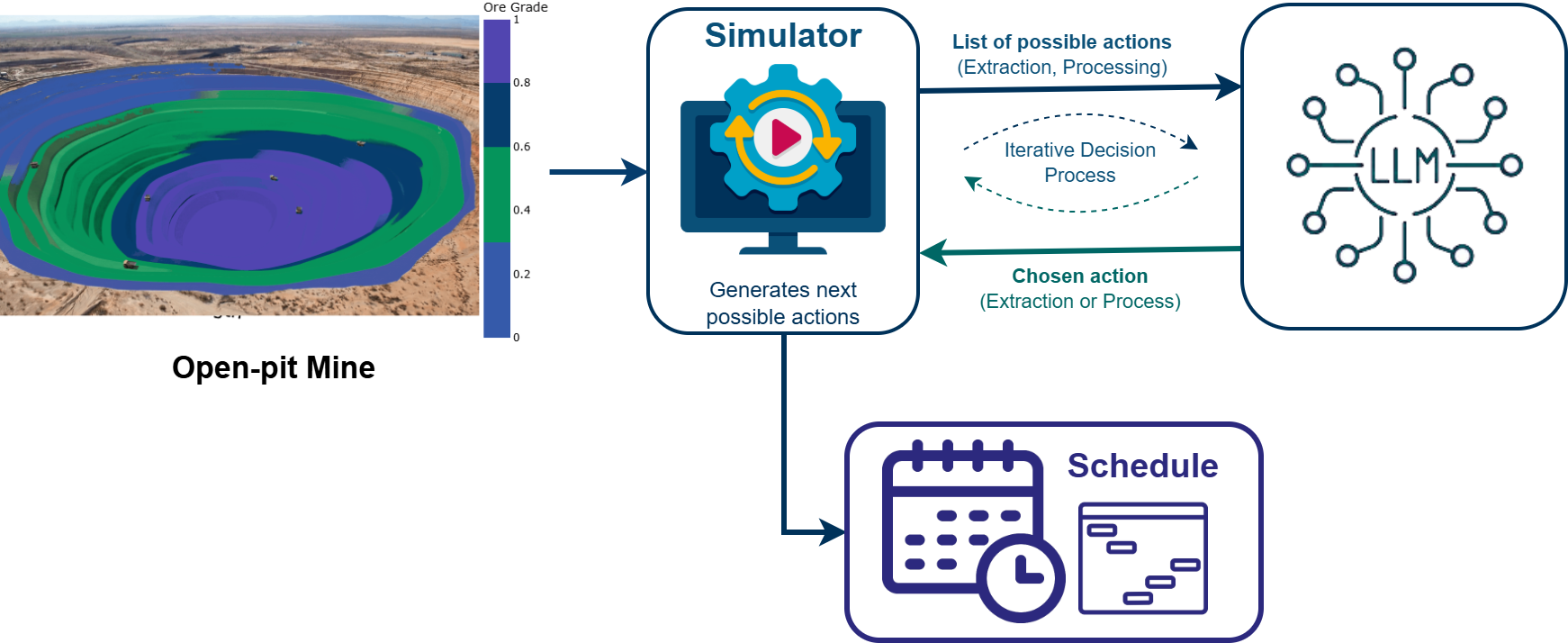
Figure 1: Overview of the LLM-Assisted Scheduling Framework.
The procedural workflow initiates from mine block properties, parallelizing into:
- a simulator pathway (Random, Greedy, and LLM agents)
- a MILP optimization pathway (deterministic global optimum baseline).
Both yield complete extraction/processing schedules for comparative analysis, with the simulator adaptable and real-time, and the MILP providing mathematically rigorous but computationally expensive solutions.
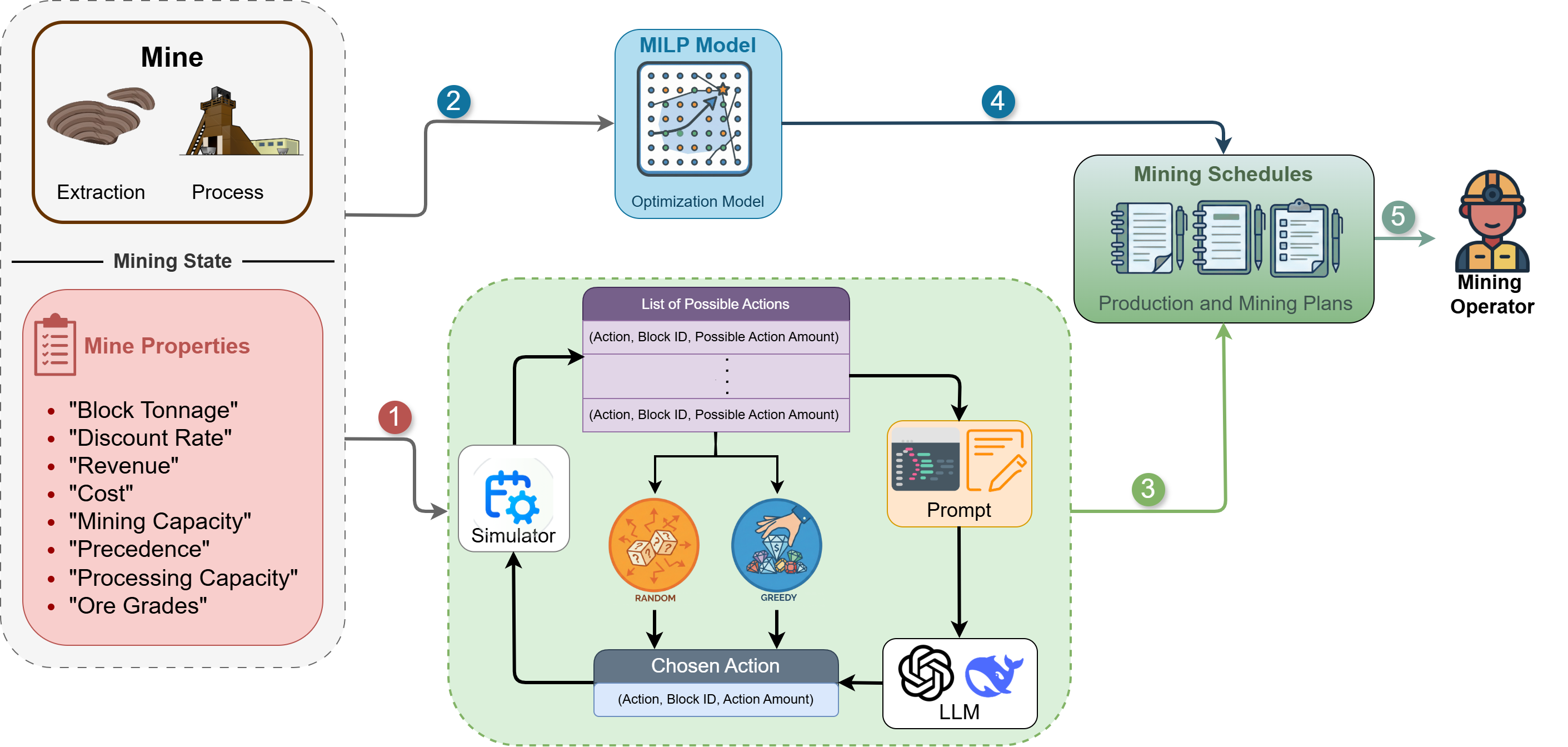
Figure 2: Dual-pathway framework contrasting simulator-driven heuristics with MILP optimization for comparative schedule generation.
Constraint Modeling and Simulator Design
OPPS feasibility demands enforcing spatial precedence (no block at (i,j,k) may be extracted before overlying blocks are cleared), extraction-processing coupling (a block must be fully extracted prior to processing), dynamic capacity constraints (allowing for winding down at end-of-life), and grade blending limits. The simulator constructs the predecessor sets and updates the feasible action space dynamically, only exposing admissible choices to the LLM at each iteration.
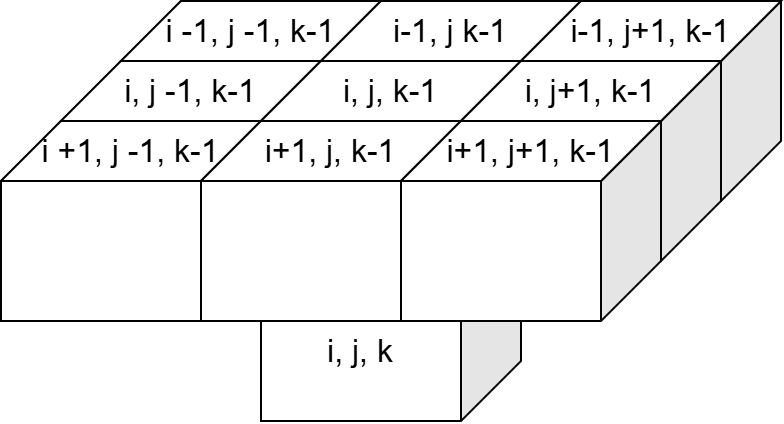
Figure 3: 3D block-structured grid precedence, enforcing physical slope stability prior to block extraction.
Unlike MILP, the simulator enables transparent, stepwise schedule generation, interpretable by planners and allowing mid-horizon interventions. The LLM agent, via structured prompts, selects actions maximizing discounted NPV, leveraging its reasoning capability to sequence extractions optimally under operational constraints.
The MILP model is enhanced beyond traditional approaches by incorporating:
- dynamic extraction lower bounds (avoiding infeasibility near mine depletion)
- explicitly constructed spatial predecessor sets from slope geometry
- strict extraction-processing binary coupling
- blended ore quality constraints.
While MILP attains the globally optimal schedule and highest NPV, its runtime escalates exponentially with problem size and requires expert reformulation for operational changes.
Experimental evaluation spans mining instances with varying block counts and horizon lengths. MILP, LLM-based (GPT-OSS, DeepSeek), Greedy, and Random strategies are benchmarked with consistent block sizes, economic parameters, and capacity limits.
Key empirical findings:
- Context-aware LLM recovers 94–99% of MILP-optimal NPV, substantially outperforming Greedy and Random baselines.
- LLM-based methods demonstrate linear scalability in computation time, in contrast to MILP’s exponential growth.
- LLM schedules closely mirror MILP’s block sequencing and phase transitions, validating operational robustness.
- Real-time dispatch logs from the simulator facilitate transparency and user auditability.
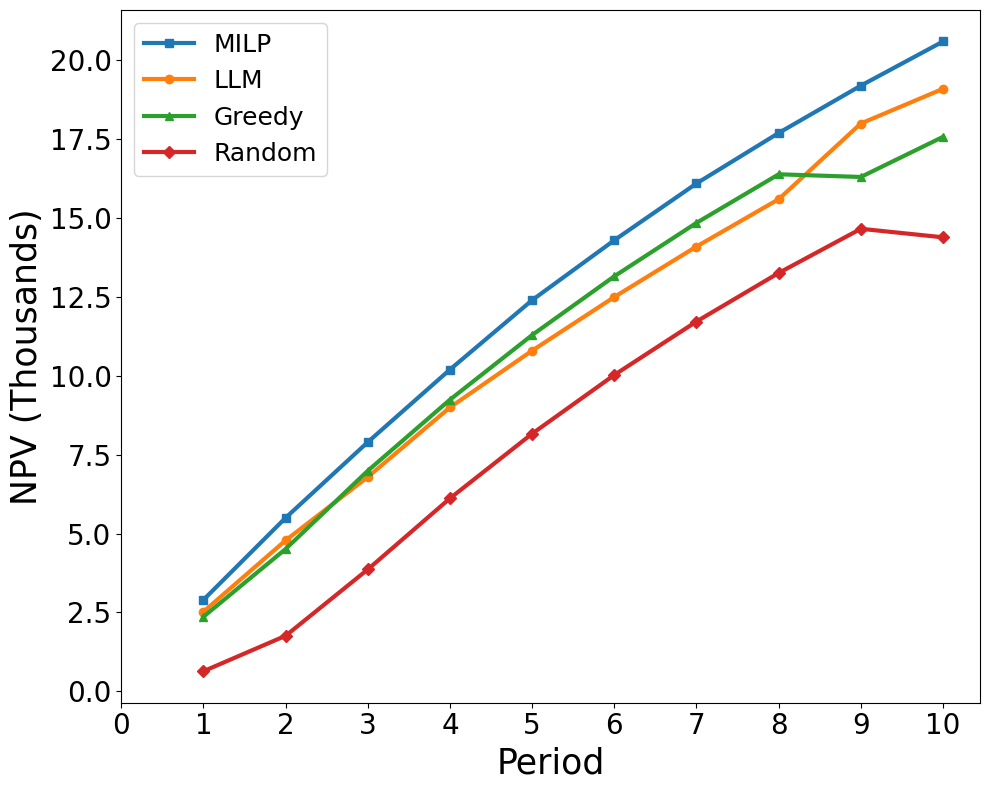
Figure 4: Comparative NPV for a 27-block instance across MILP, LLM, greedy, and random strategies.
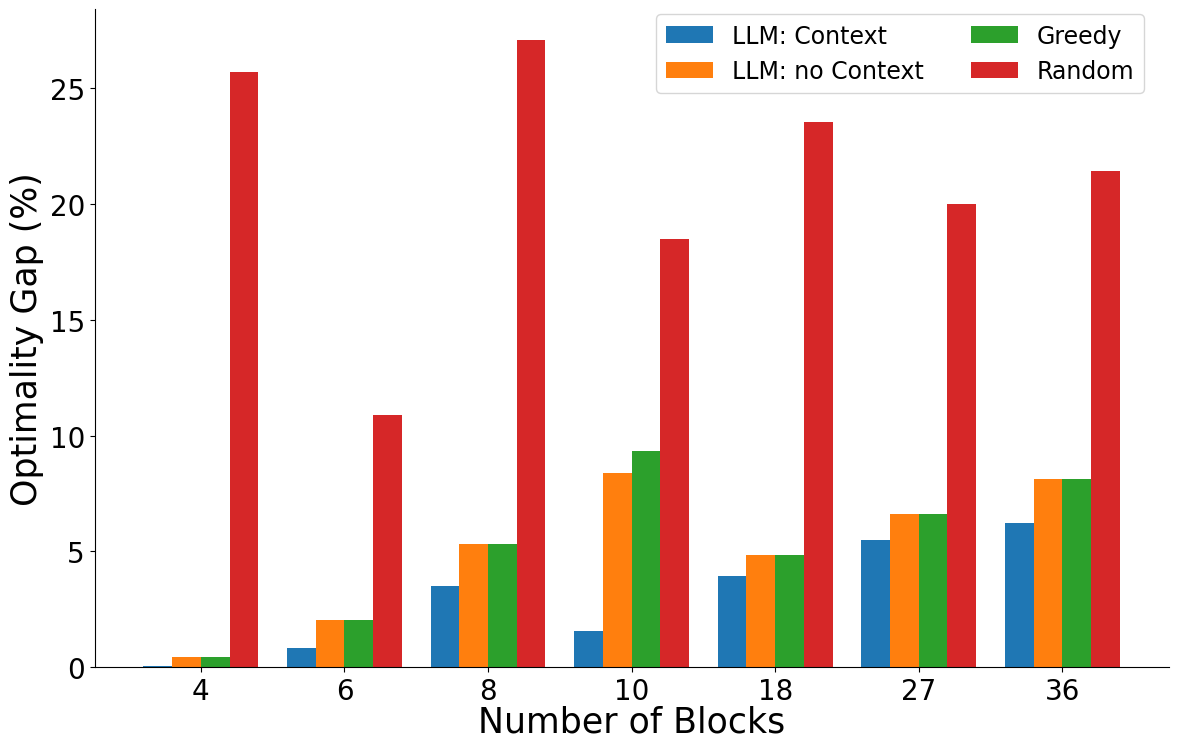
Figure 5: Optimality gap (relative to MILP) for each approach across problem sizes.
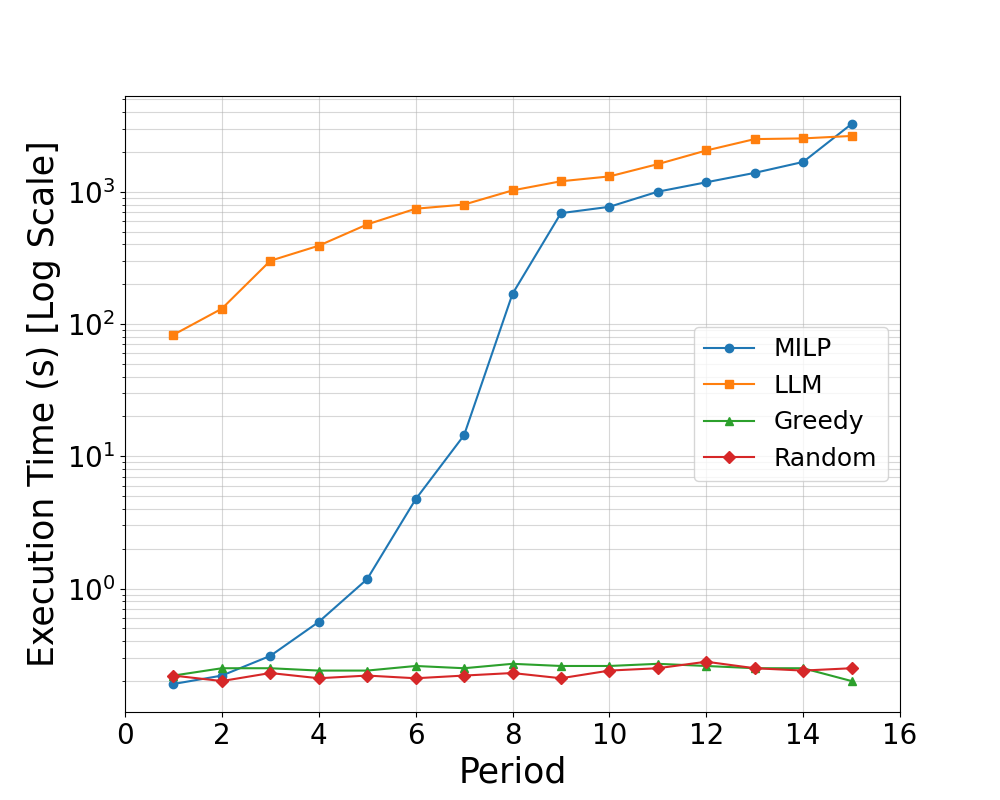
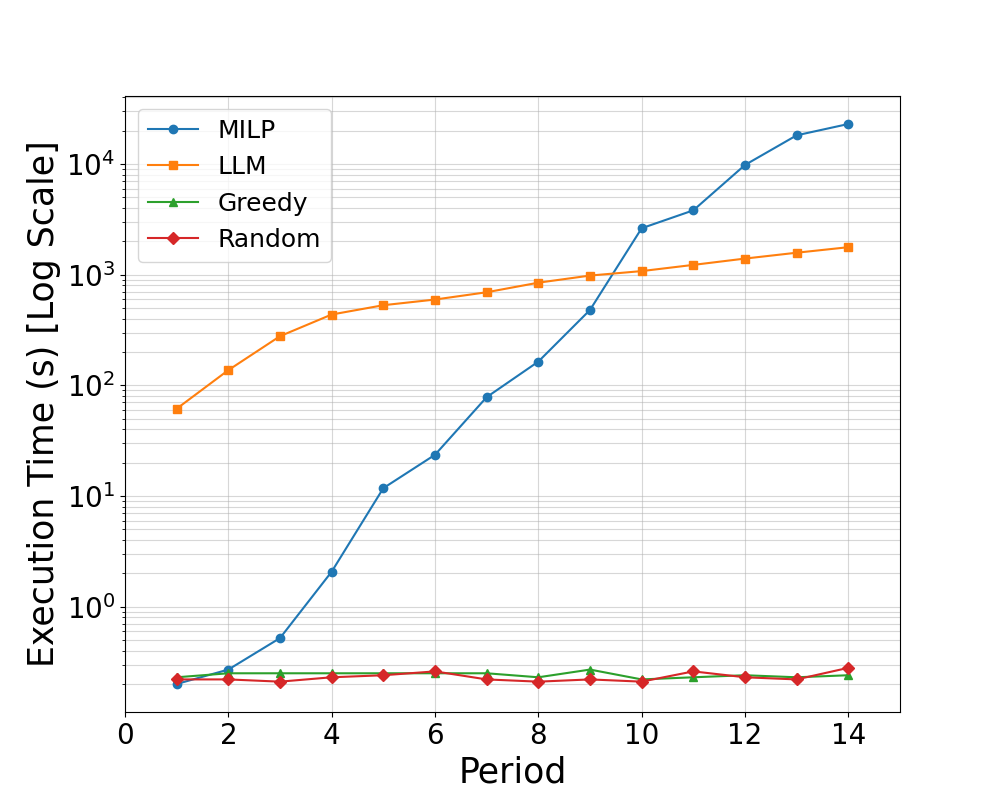
Figure 6: Log-scale execution times, highlighting LLM's linear computational growth vs MILP's exponential behavior.
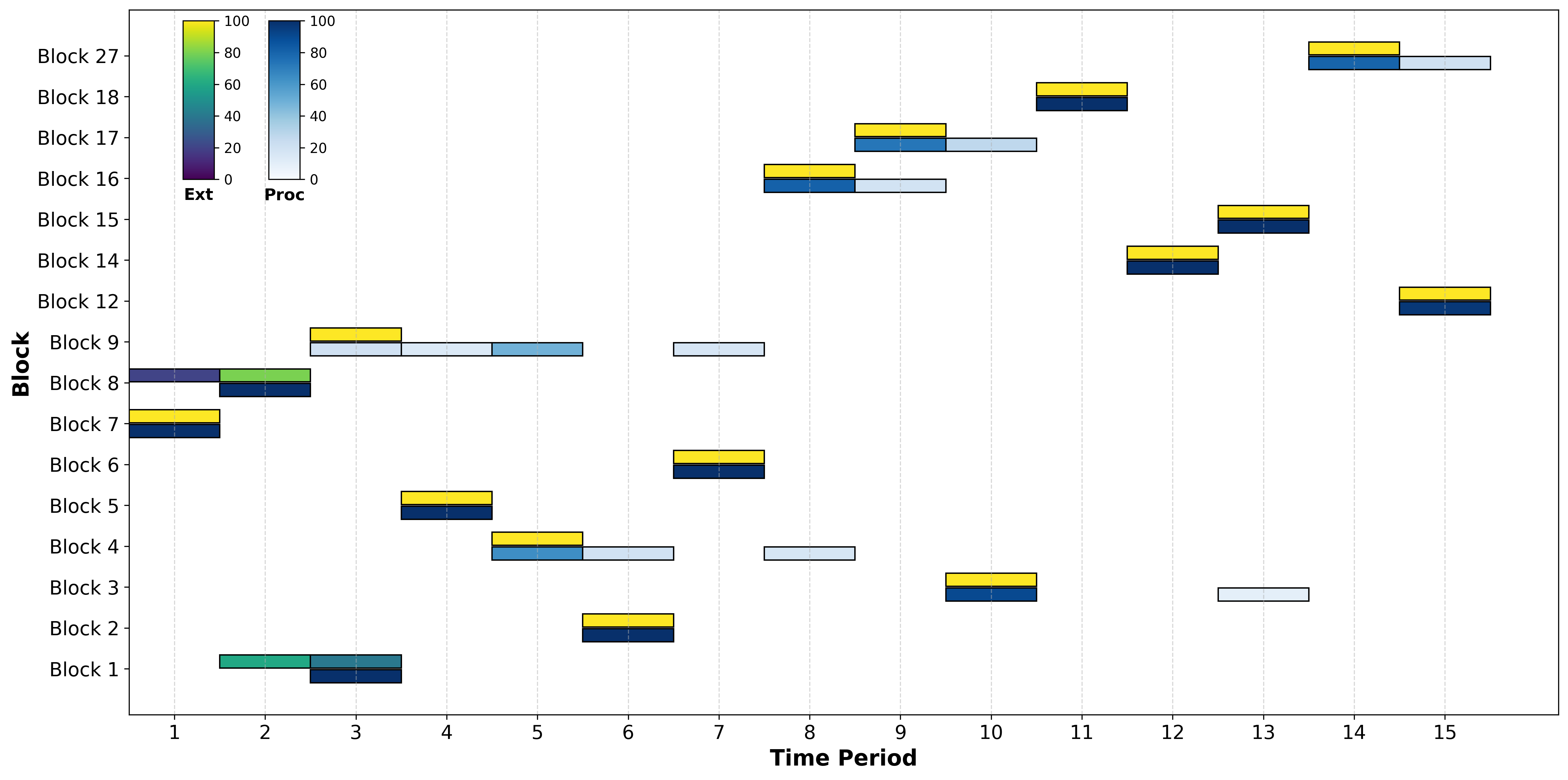
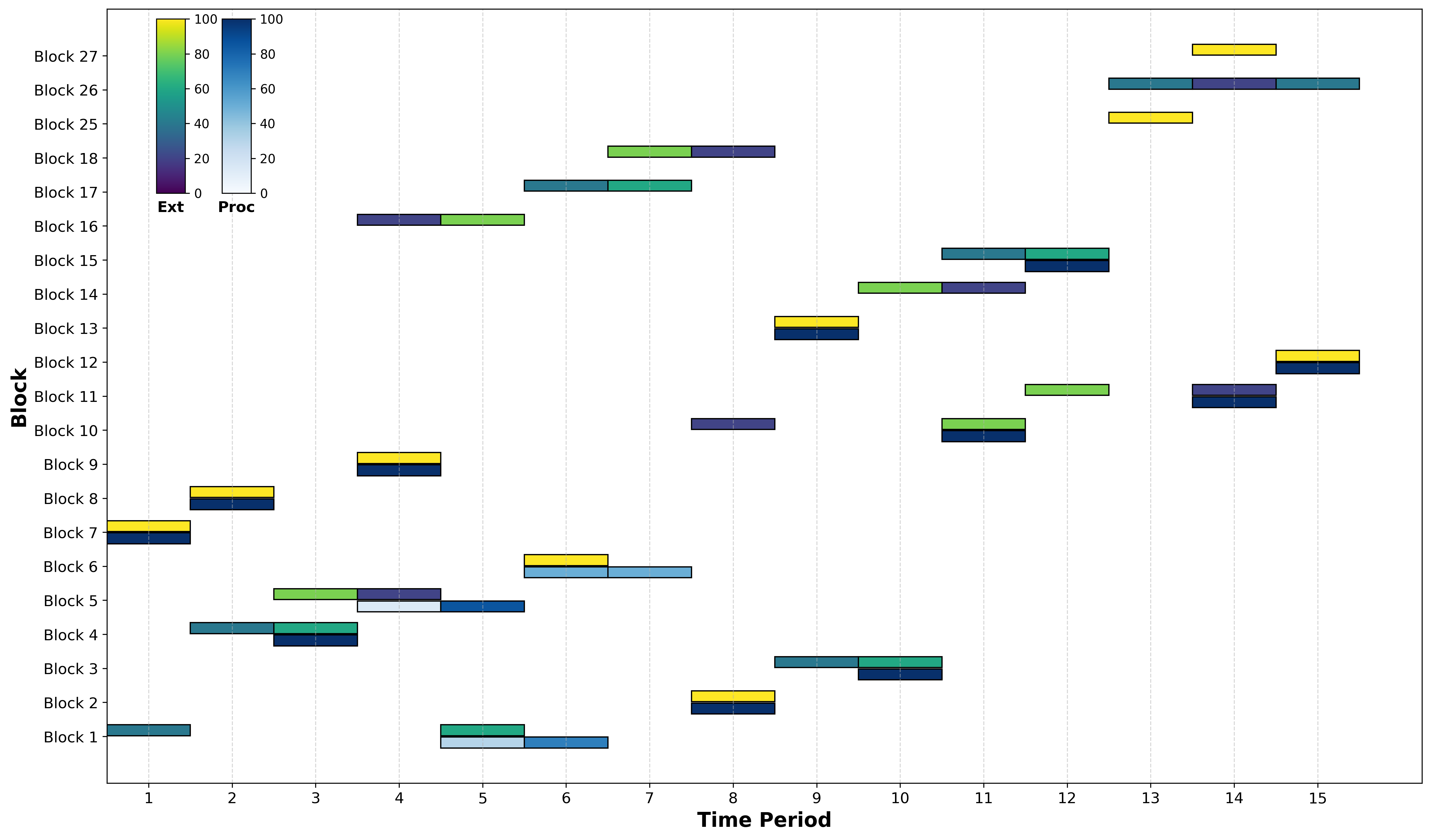
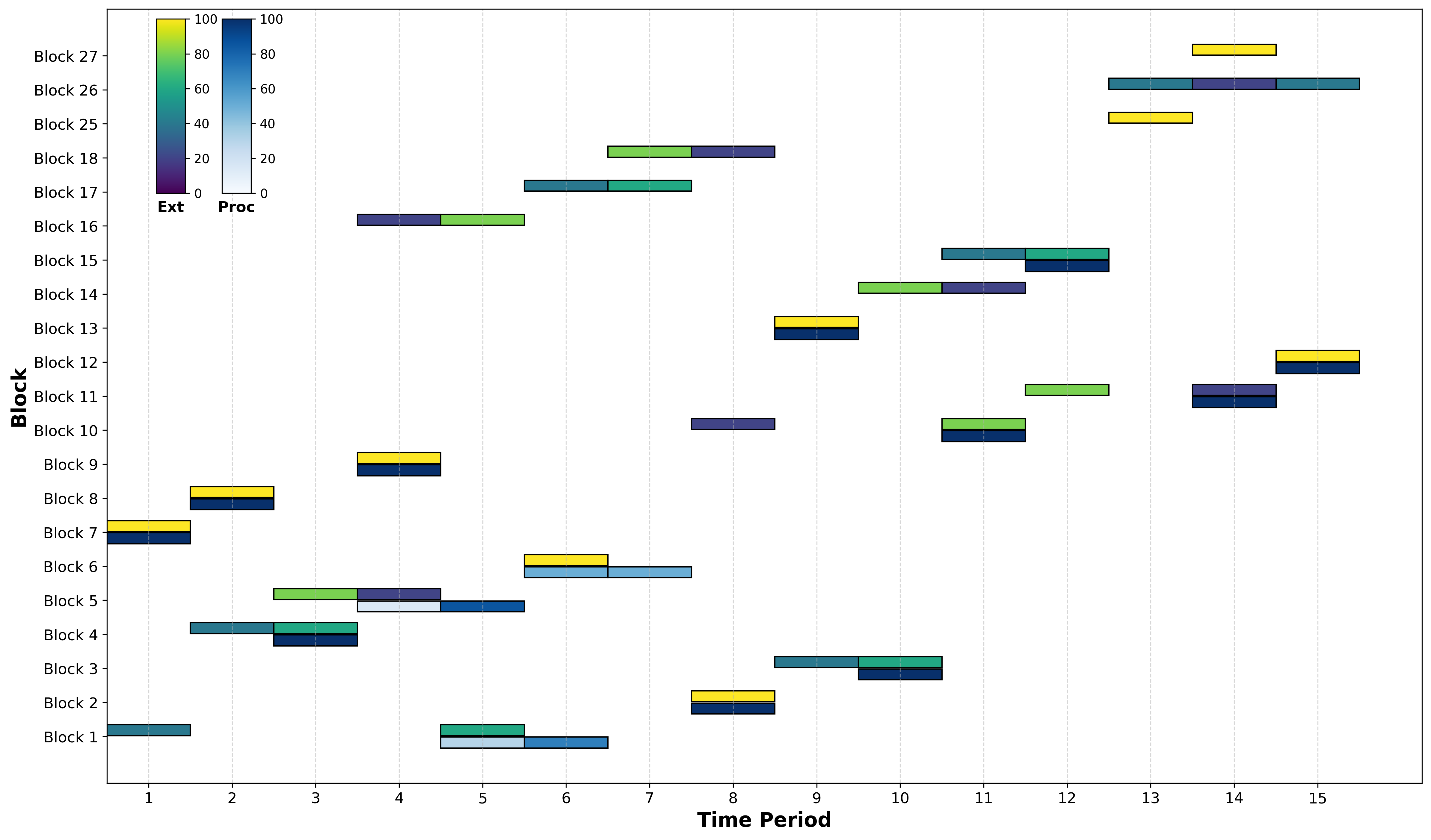
Figure 7: Gantt chart comparison of extraction and processing schedules; LLM replicates MILP’s operational logic in block prioritization and sequencing.
Architectural Implications and Operational Transparency
Sim2Schedule’s principal innovation is its operational transparency and real-time adaptability. The simulator emits interpretable, actionable directives at each scheduling step, enabling planners to monitor, audit, and adjust schedules on-the-fly. By encoding all geotechnical and operational feasibility within the simulator, the LLM agent reason exclusively over value maximization, bypassing constraint verification and reducing hallucination risk.
Empirically, solution quality depends critically on prompt context. Restricting LLM prompts to recent mine state produces superior NPV and computational efficiency, suggesting that global recall is unnecessary for high-fidelity scheduling.
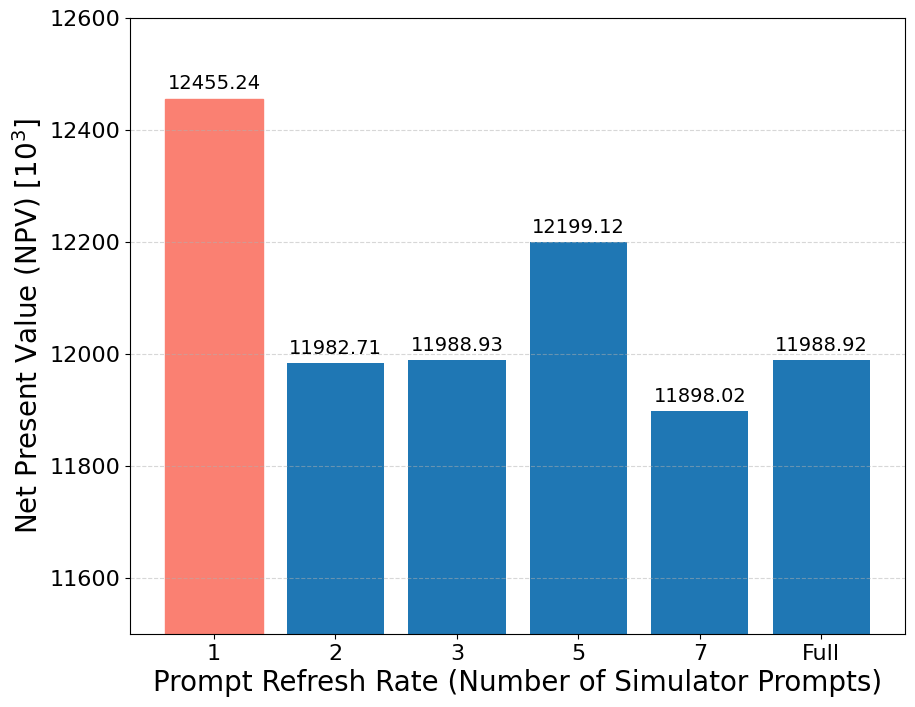
Figure 8: NPV sensitivity as a function of LLM prompt context window; recent-state-only prompts yield maximal solution quality.
Practical Implications and Future Directions
Simulator-constrained LLM scheduling demonstrates practical viability for large-scale, dynamic mine operations—delivering near-optimal schedules with linear scalability, real-time interpretability, and minimal compute overhead. The framework enables autonomy in settings where MILP is computationally prohibitive, unlocking rapid response to operational changes and efficient planner oversight.
Theoretically, this architecture generalizes to any long-horizon, constraint-driven industrial sequencing task, offering a blueprint for scalable, interpretable automation under physical dependencies.
Further research should extend to:
- larger, real-world mine block models
- incorporation of geological uncertainty and commodity variability
- advanced prompt strategies for improved optimality gap closure
- deployment on edge hardware for field-scale applications.
Conclusion
Sim2Schedule presents a rigorously evaluated, simulator-guided LLM framework for autonomous open-pit mine scheduling, achieving 94–99% of MILP-optimal NPV with linear computational scalability and real-time interpretability. By partitioning constraint enforcement (simulator) and long-term reasoning (LLM agent), the system offers a transparent, adaptive, and operationally robust alternative to classical static optimization. This architectural principle enables efficient deployment across structured industrial domains requiring sequential, physically-valid scheduling under hard operational constraints (2606.10286).

