- The paper introduces a continuous neural reparameterization approach using an untrained SIREN and mesh spectral features to achieve foldover-free UV repair.
- It employs a determinant-aware distortion energy and explicit injectivity barriers to prevent common mapping artifacts in challenging charts.
- Practical experiments show zero local flips on diverse assets, demonstrating its robustness compared to classical UV unwrapping methods.
Continuous Neural Reparameterization for Robust Fixed-Chart UV Repair
Problem Context and Motivation
UV unwrapping—the assignment of 2D texture coordinates to the surface of a 3D mesh—is critical for texturing, remeshing, and downstream asset pipelines. Classical UV parameterization approaches, such as those based on conformal, angle-based, or isometric energies, can optimize distortion efficiently when the input charts satisfy clean geometric and topological requirements. In practical workflows, however, invalid initializations and topological artifacts often drive these solvers into foldovers, local minima, or invalid UVs—instabilities that may propagate as image artifacts or require expensive manual clean-up.
The paper "Continuous Neural Reparameterization as a Deep Geometric Prior for Robust Fixed-Chart UV Repair" (2606.10050) reframes the classic fixed-chart UV unwrapping problem as a continuous neural reparameterization task. Rather than directly optimizing per-vertex UVs, the chart UV map is modeled as the output of an untrained SIREN (Sinusoidal Representation Network), leveraging mesh coordinates and Laplace–Beltrami eigenfunctions as input features. The network's weights are trained to minimize a determinant-aware distortion energy, explicitly incorporating foldover avoidance and injectivity through loss design and optimization constraints.
This approach positions the neural solver as a practical addition to the toolkit for robust chart-level UV repair, particularly when high-quality, flip-free mappings must be guaranteed on supplied charts under challenging input conditions.
Methodological Framework
The core method represents the chart UV map ϕθ as the output of a 5-layer SIREN fθ, which maps concatenated normalized 3D mesh coordinates and the top k=16 Laplace–Beltrami eigenfunctions to R2 UVs. The neural network is untrained prior; its parameters are optimized per-chart via Adam, guided by a carefully constructed loss:
- A C2-smooth variant of the Symmetric Dirichlet energy, to penalize both isometric and area distortion.
- An explicit injectivity barrier and determinant-aware penalty, ensuring that all local mesh Jacobians remain non-degenerate (detJt>0 for all triangles).
- Algorithmic step rejection: optimizer steps leading to flipped triangles are discarded, retried with reduced step lengths, or result in fallback routing.
Crucially, the method initializes the SIREN to fit a Tutte embedding, providing a distortion-minimizing, valid starting map within the injectivity basin. Features are scaled to balanced variance, and spectral sign ambiguities in the eigenfunctions are handled deterministically. The system incorporates spectral-bias diagnostics based on the neural tangent kernel (NTK) and measures its alignment with intrinsic mesh harmonics (LBO eigenfunctions), offering mechanistic insight into optimization trajectories but not as a validity predictor.
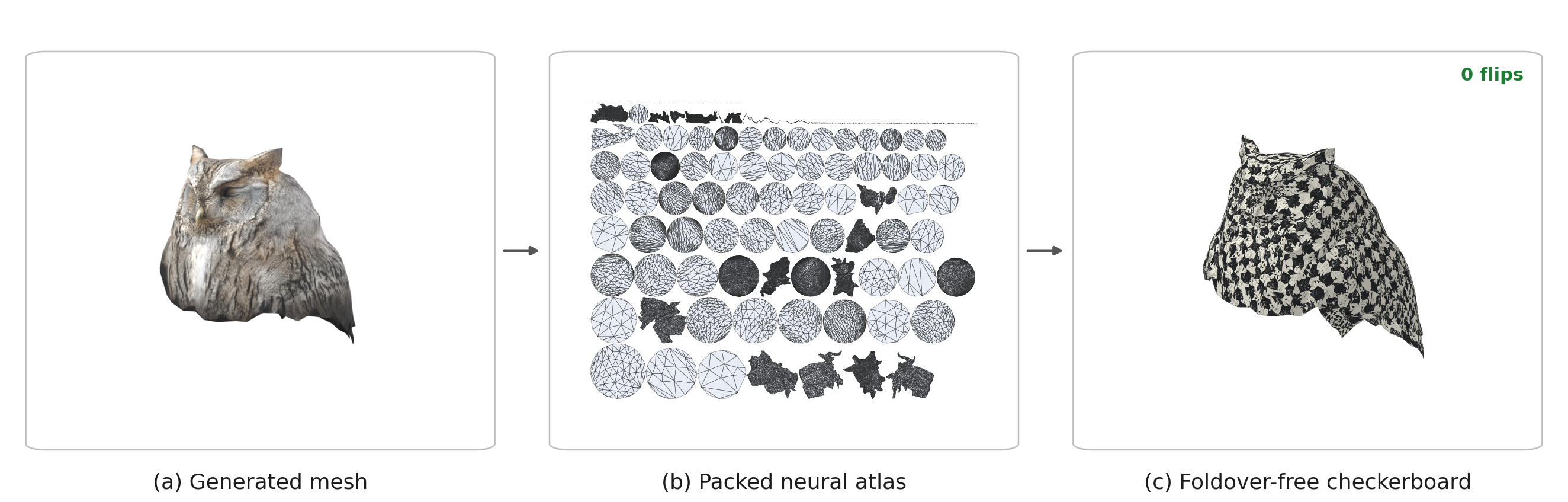
Figure 1: Schematic overview of the UV atlas pipeline, with neural charts (blue) and fallback routes (red) composing a foldover-free packed atlas.
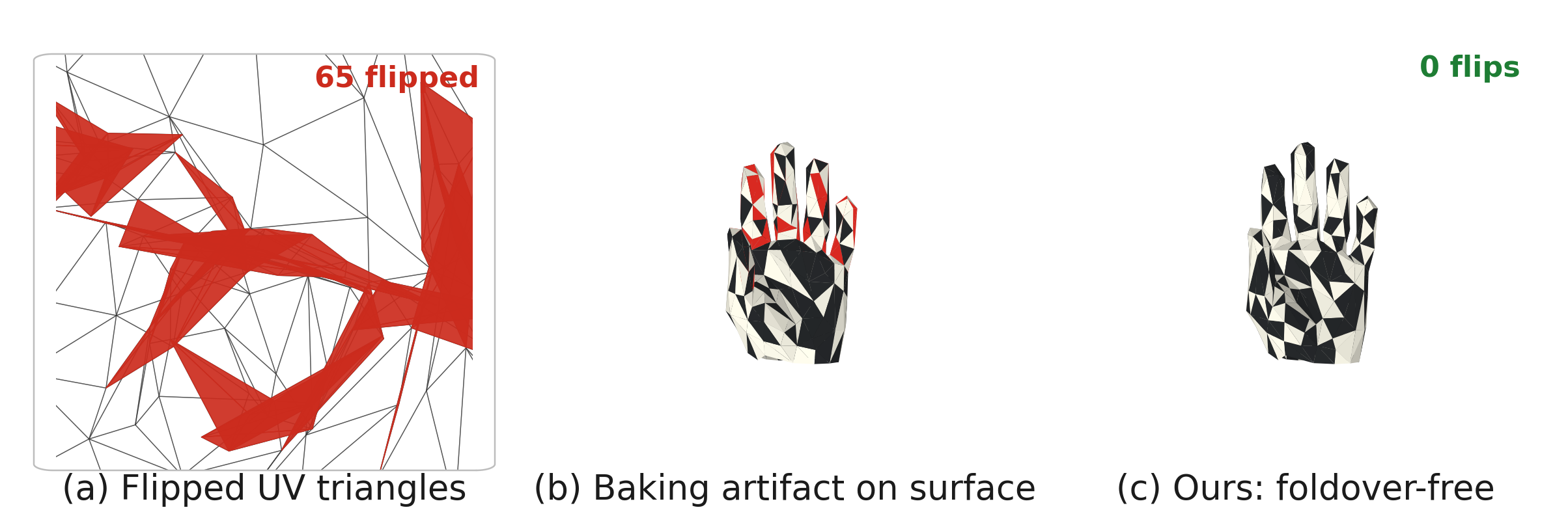
Figure 2: Demonstration of local validity—fixed-chart solvers can output flipped regions (red), causing visible artifacts, which are eliminated in the neural, foldover-free solution.
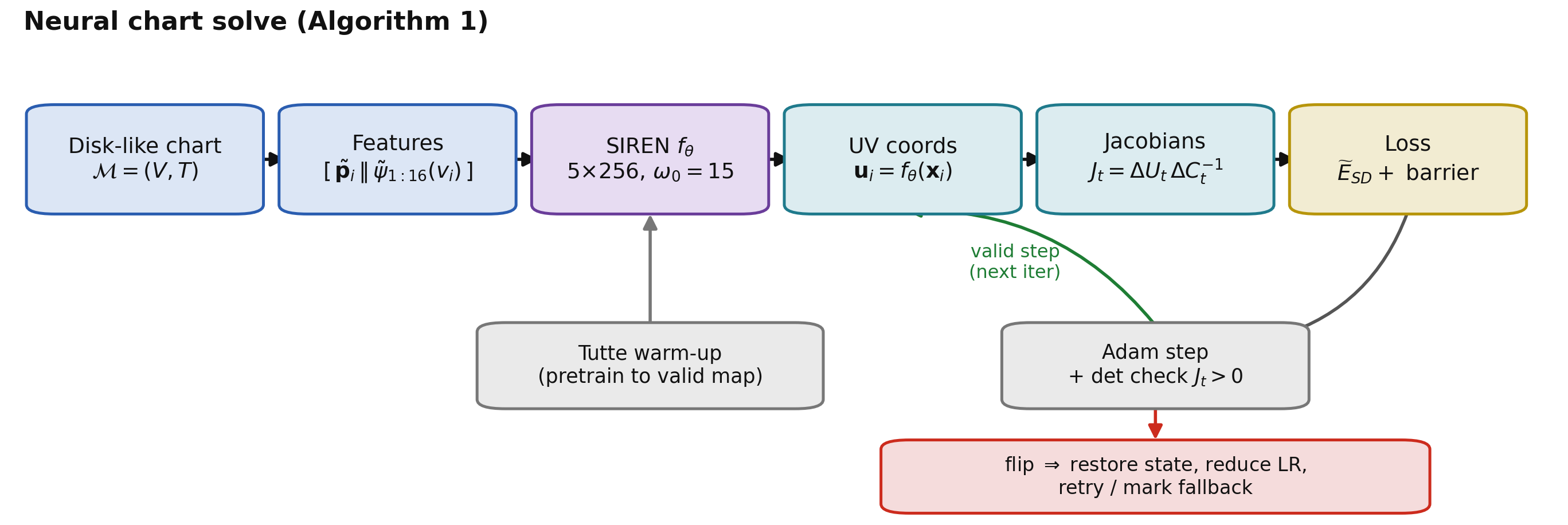
Figure 3: Structure of the neural chart solver, from input feature construction through gradient-based SIREN optimization and validity-checked step acceptance.
Atlas-Level System and Fallback Routing
For full-mesh assets, generated meshes are decomposed into candidate charts. Each is validated for disk-likeness and, if passing, routed to the neural solver; otherwise, or upon repeated failure, fragments fall back to a deterministic method (e.g., PCA-based, per-face charting). Accepted charts are packed into an atlas using an area-scaled shelf-packing algorithm, with final validity and coverage diagnostic checks.
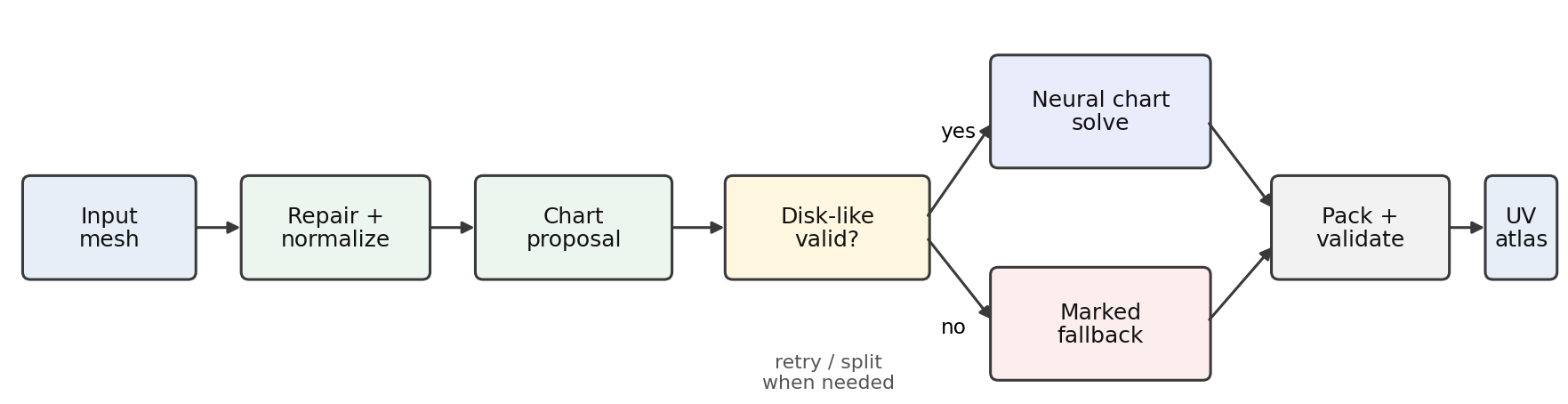
Figure 4: Pipeline for validation-first atlas construction, leveraging neural charting only on suitable chart candidates and fallback on others.
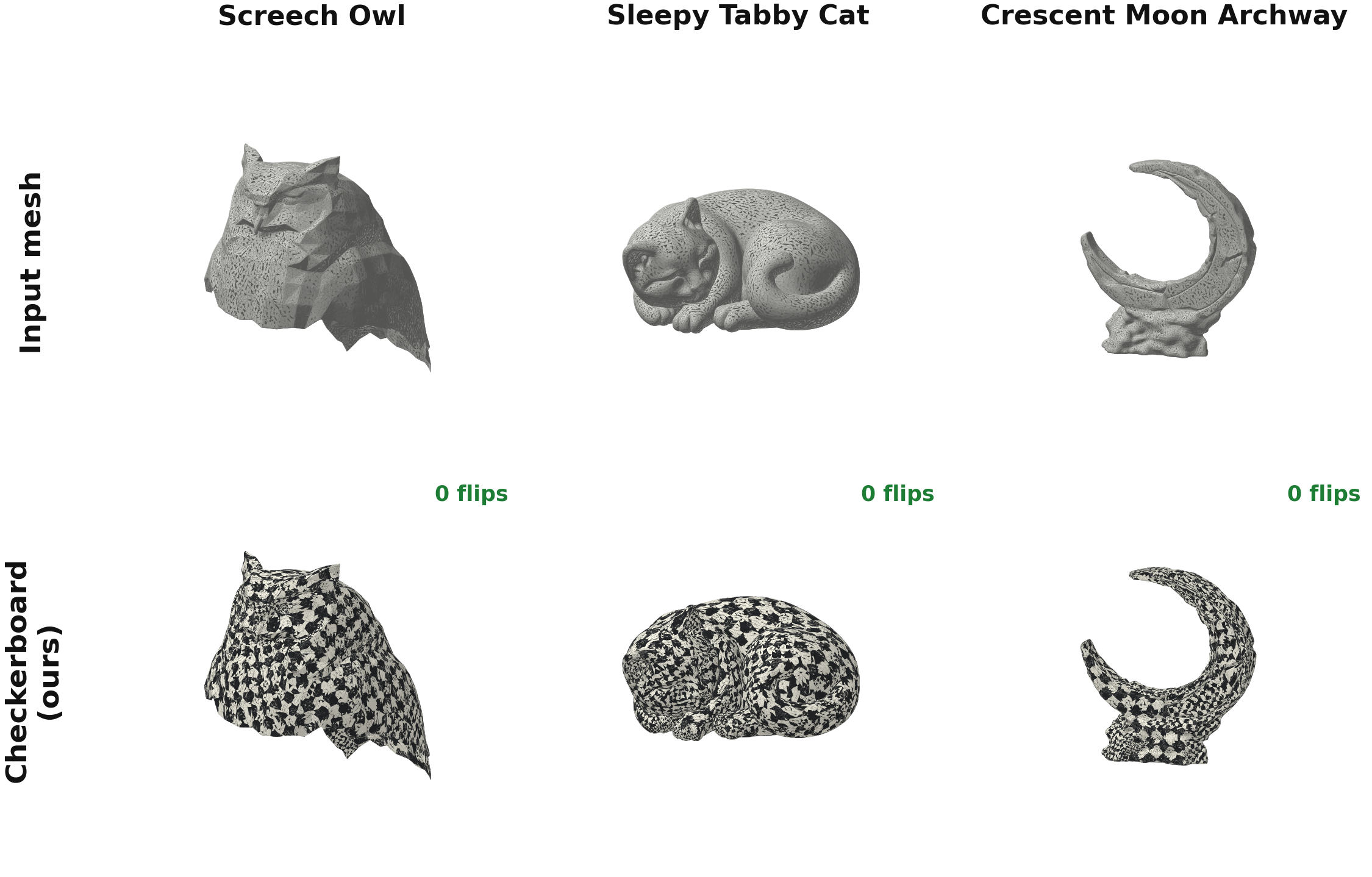
Figure 5: Foldover-free checkerboard visualizations for several generated mesh atlases in the Amara Spatial dataset, demonstrating geometric fidelity and local validity.
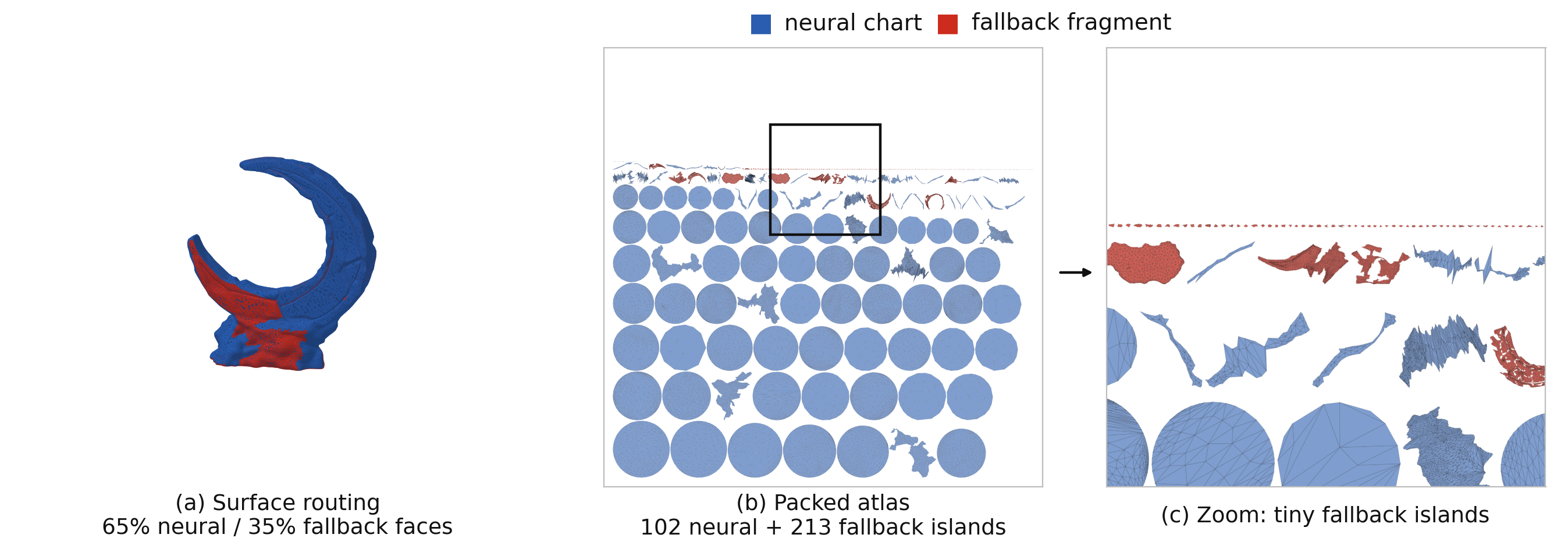
Figure 6: Visualization of routing decisions and fallback limitations—non-disk-like regions are marked as red islands, often resulting in many small fallback charts.
Empirical Results
On a suite of benchmarks (Hand, Camel, Bob; Thingi10K/xatlas-cut; Amara Spatial generated assets):
- Zero local UV foldovers were achieved on all compact supplied charts, and on 42/47 larger stratified charts on Thingi10K/xatlas-cut. Remaining cases demonstrated very low flip rates.
- On generated meshes (Amara Spatial, 25-asset set), all 4,708 neural charts were solved with zero local flips, and the fallback mechanism ensured 100% coverage with zero local flips on 1,219,074 faces.
- Runtime–quality trade-off: The neural solver is slower than classical fixed-chart solvers (e.g., SLIM, BFF), but compact-chart solution quality saturates in 750–1,000 iterations (sub-6 s per chart), while larger charts improve further with longer optimization.
- Comparative classical baselines: Methods like SLIM and BFF can outperform the neural solver in speed and distortion on charts satisfying their requirements, but they are more susceptible to local flips and invalid UVs on difficult charts.
- Atlas-level robustness: Blender’s Smart UV and other classical atlas generators have a small but nonzero rate of flipped triangles; the neural + fallback system delivered strictly zero flips at scale.
- Spectral diagnostics (NTK–LBO alignment): Spectral features increase alignment with intrinsic harmonics at initialization, giving smoother deformations in early optimization; this does not directly predict final validity, but has mechanistic impact on the update dynamics.
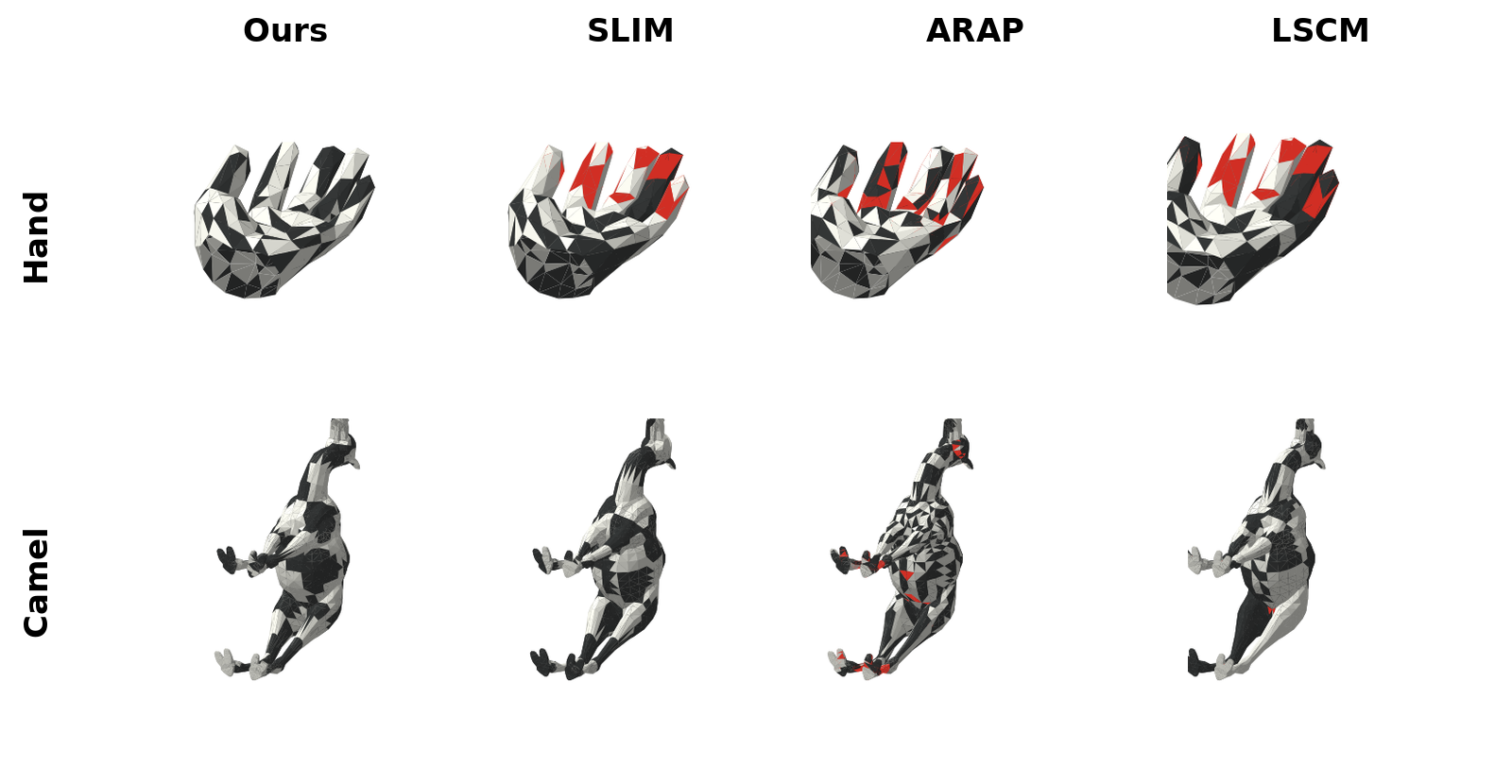
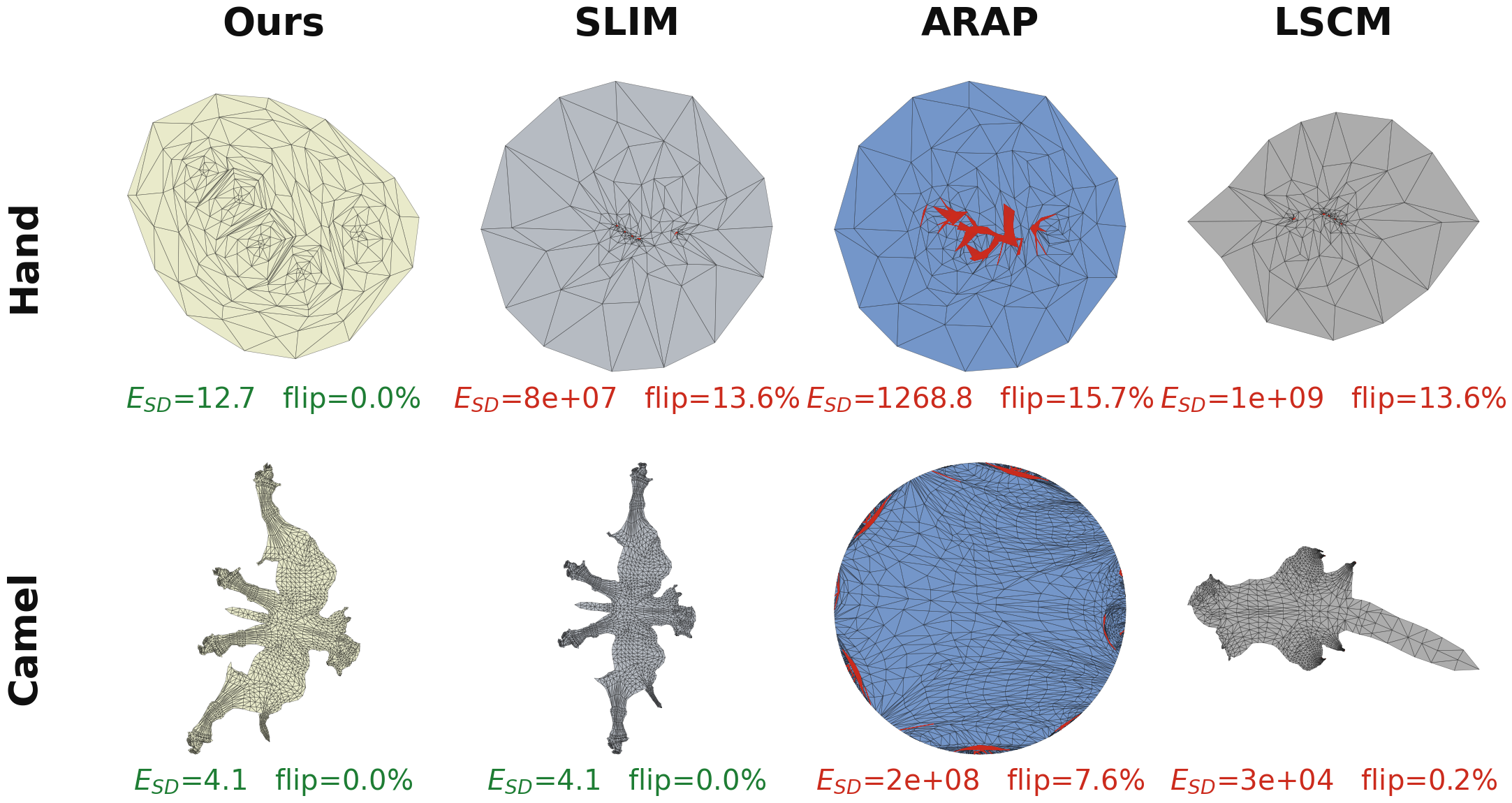
Figure 7: Checkerboard transfer visualizations of fixed-chart parameterizations—charts with flipped triangles (red) exhibit visual artifacts that are absent in the neural approach.
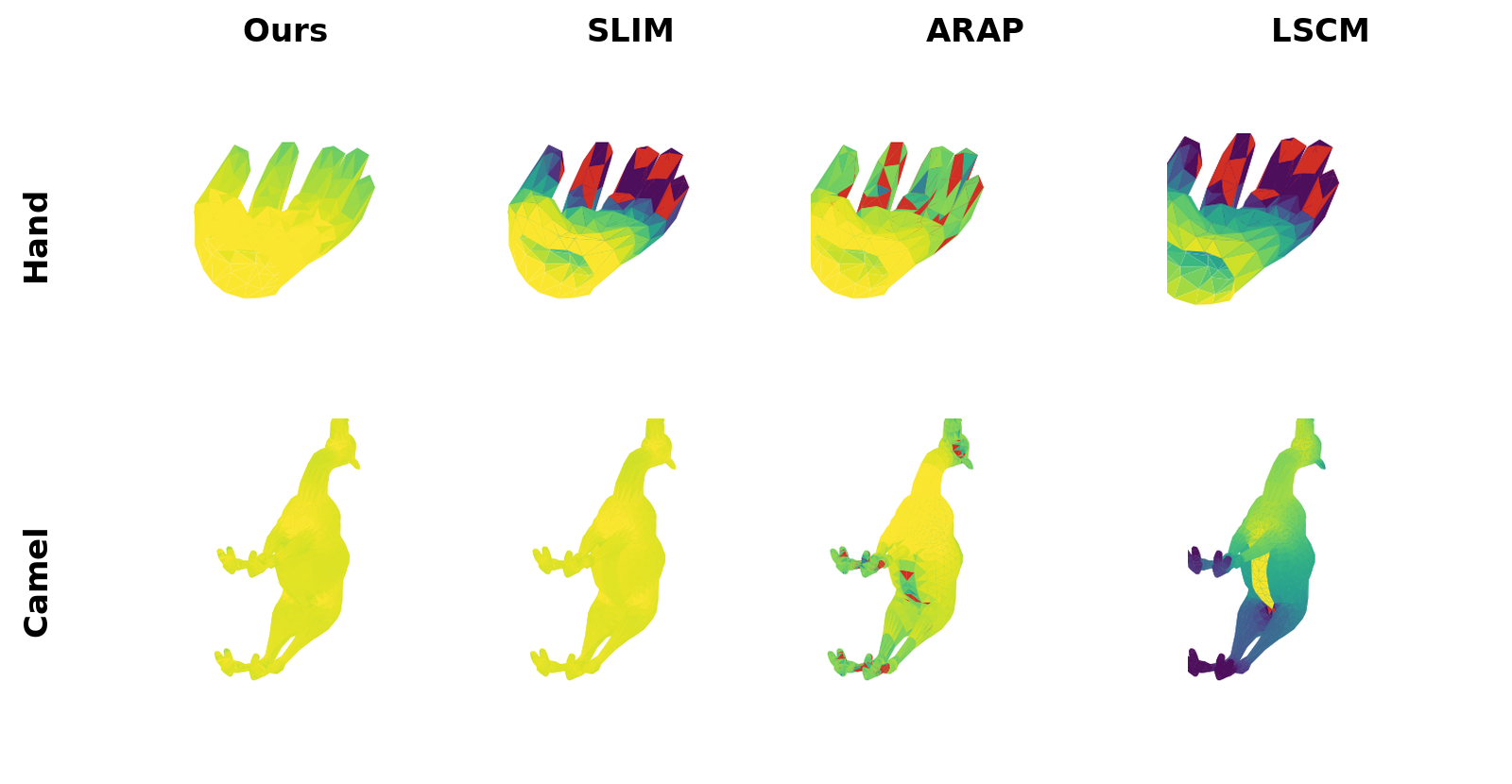
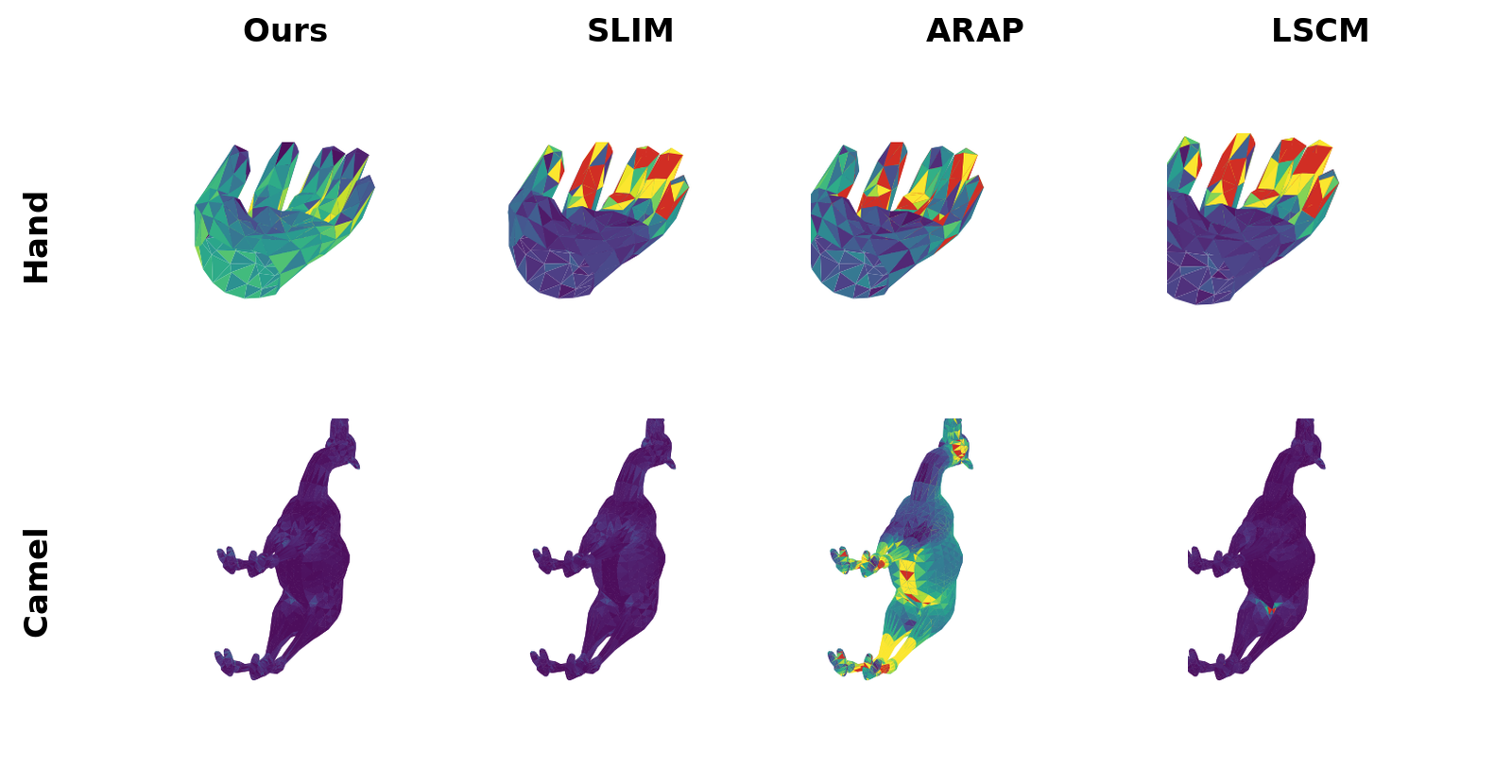
Figure 8: Jacobian determinant and conformal distortion heatmaps—classical solvers can produce red, negative-determinant regions, which are eliminated in the neural method.
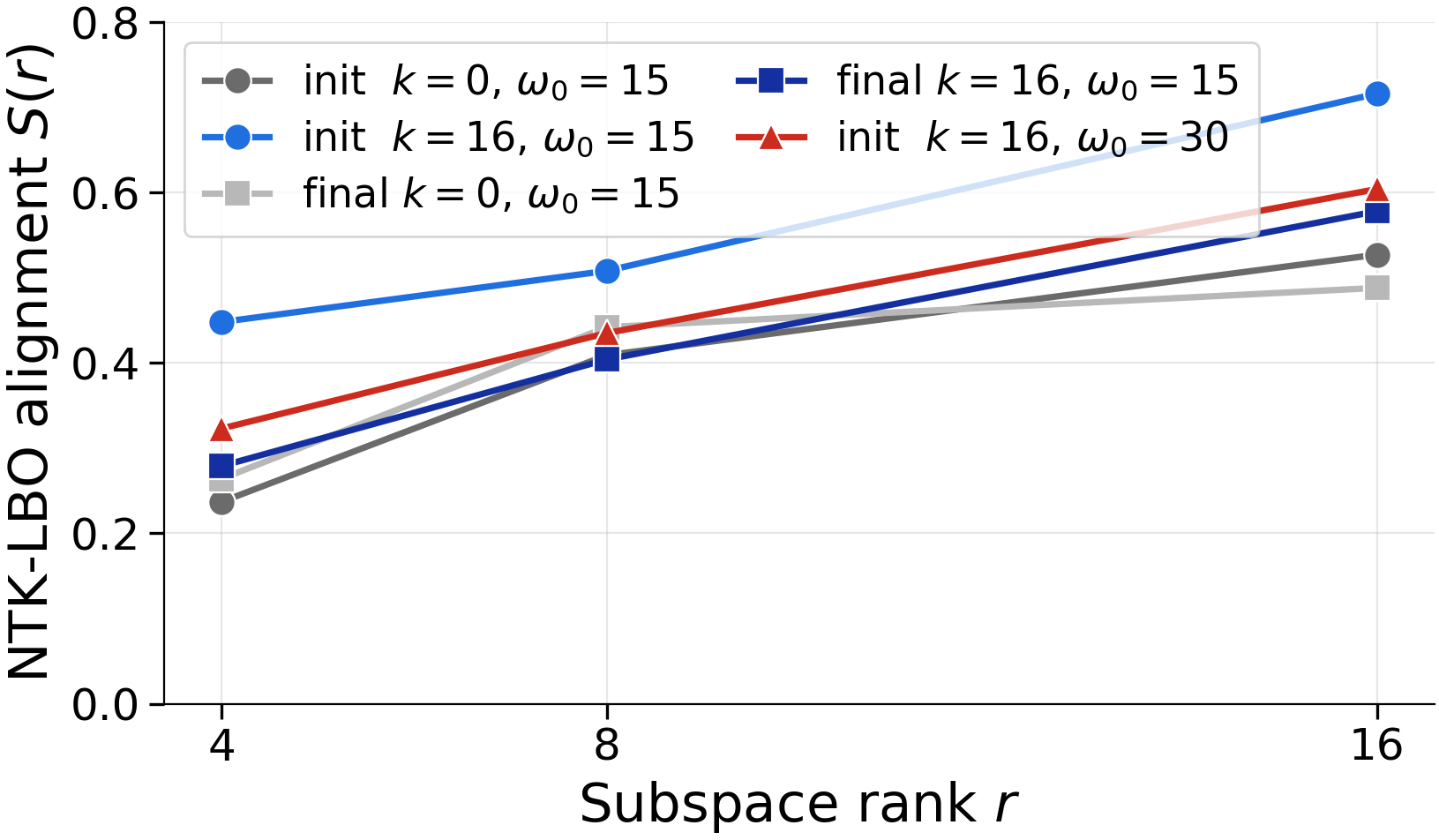
Figure 9: Average NTK–LBO spectral alignment—higher SIREN bandwidth weakens alignment, but spectral features increase initial subspace agreement.
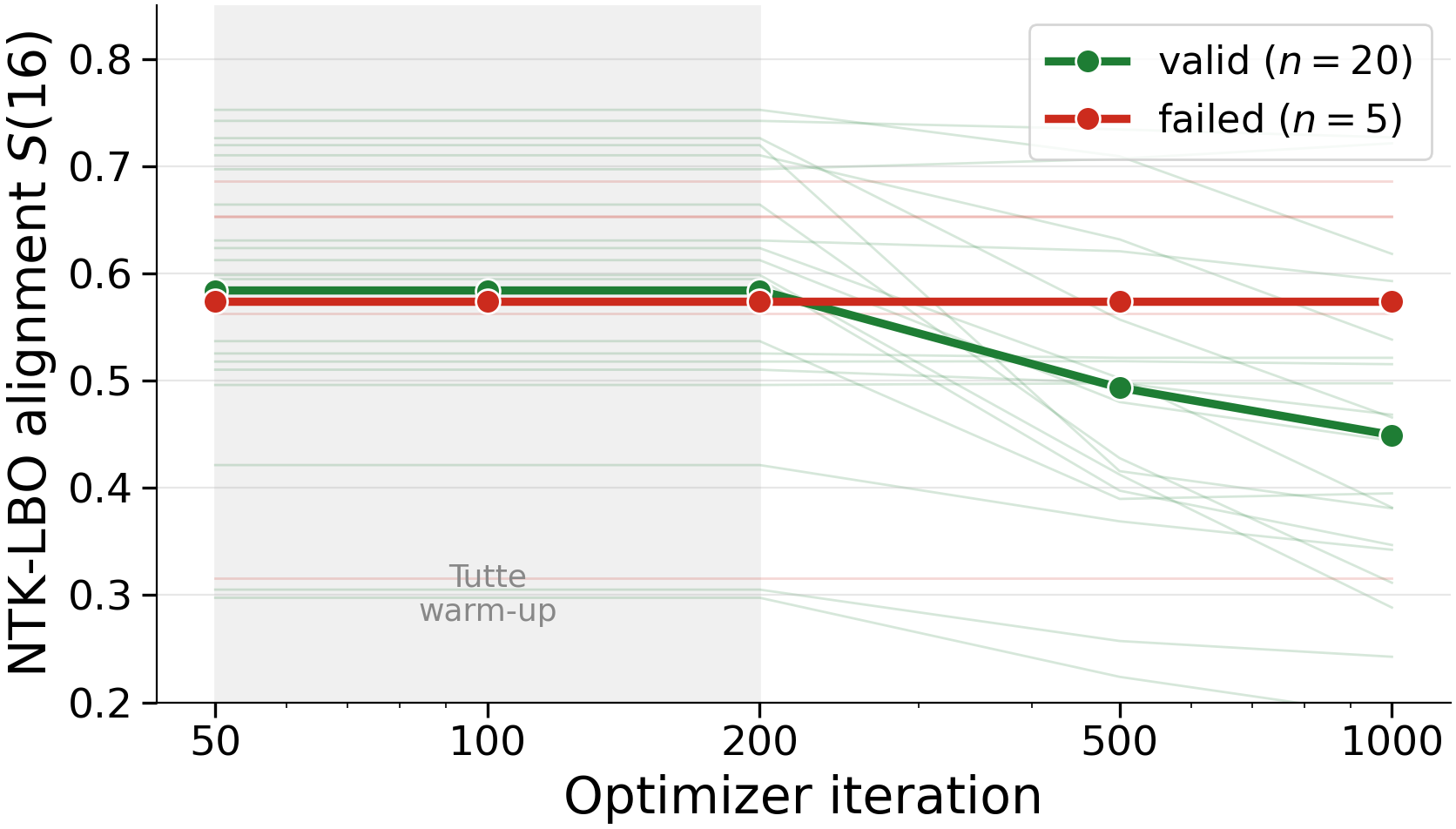
Figure 10: Trajectories of NTK–LBO alignment during optimization—charts that end valid diverge from the initial subspace, while persistently invalid charts remain stuck, correlating only moderately with outcome.
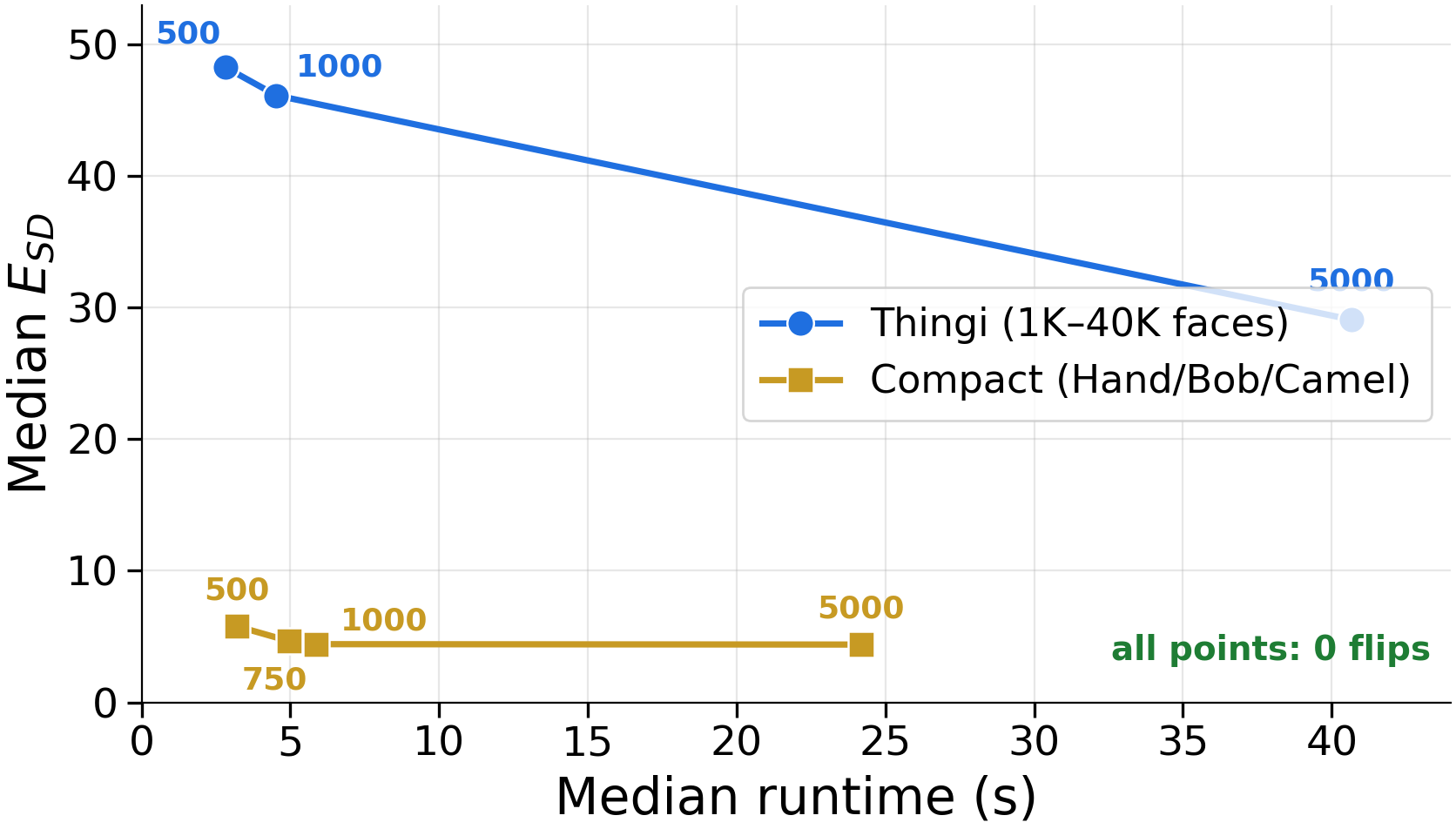
Figure 11: Pareto frontier for runtime versus UV distortion on compact and large charts—neural solver obtains quality commensurate with runtime, retaining zero-flip validity throughout.
Discussion and Theoretical Implications
The continuous neural reparameterization framework is positioned as a robust, practical approach for fixed-chart UV repair, offering deterministic local injectivity guarantees when initialization or chart quality undermine standard solvers. The neural prior, underpinned by mesh spectral features and SIREN architecture, functions as both a capacity constraint and a smoothness bias rather than a learned mapping in the supervised sense. The tight coupling of Tutte initialization, determinant barrier optimization, and step rejection delivers empirical guarantees on foldover avoidance, albeit with higher computational cost.
This method nuances the role of neural priors: spectral conditioning changes the landscape of optimization and update geometry but does not obviate the need for careful initialization and step-wise validity checks. The fallback mechanism remains essential for coverage on arbitrary generated assets, underscoring that a fully automated, high-quality atlas workflow requires robust upstream charting, remeshing, and seam placement.
Practical Implications and Future Directions
Practically, the method adds a validation-first neural chart solver to mesh processing pipelines, making it tractable to guarantee flip-free mappings on assets where chart topologies are fixed, and classical solvers fail or produce artifacts. Use cases include asset repair, content pipeline automation, and high-value asset preparation where local foldovers are unacceptable.
Looking forward, several areas warrant exploration:
- Integration with learned and joint surface-atlas systems: While the present method outperforms official Blender and hand-tuned fixed-chart libraries in supplied contexts, methods like Nuvo and Neural Jacobian Fields, which learn surface-wide or Jacobian field representations, are important baselines but require seamless integration and comparative evaluation.
- Automatic robust charting and packing: The limitations of fallback (proliferation of small islands, incomplete coverage on degenerate charts) point to the need for improved algorithms for chart merging, splitting, and packing, potentially leveraging the strengths of deep geometric priors.
- Runtime acceleration: Reducing optimization time, perhaps through hybrid differentiable solvers or warm starts from analytical approximations, could close the gap with classical solvers.
Conclusion
Continuous neural reparameterization using an untrained SIREN per chart, initialized by Tutte embedding and optimized using determinant-aware distortion energies with explicit injectivity constraints, provides a robust mechanism for foldover-free fixed-chart UV unwrapping. Empirical validation across a diverse set of mesh benchmarks demonstrates strict local validity in challenging cases where classical solvers fail. Theoretical analysis of spectral alignment illustrates the nuanced role of mesh harmonics in neural optimization. This approach strengthens chart-centric workflows in asset pipelines and opens avenues for future hybrid and fully learned surface parameterization systems.

