PartUV: Part-Based UV Unwrapping of 3D Meshes
Abstract: UV unwrapping flattens 3D surfaces to 2D with minimal distortion, often requiring the complex surface to be decomposed into multiple charts. Although extensively studied, existing UV unwrapping methods frequently struggle with AI-generated meshes, which are typically noisy, bumpy, and poorly conditioned. These methods often produce highly fragmented charts and suboptimal boundaries, introducing artifacts and hindering downstream tasks. We introduce PartUV, a part-based UV unwrapping pipeline that generates significantly fewer, part-aligned charts while maintaining low distortion. Built on top of a recent learning-based part decomposition method PartField, PartUV combines high-level semantic part decomposition with novel geometric heuristics in a top-down recursive framework. It ensures each chart's distortion remains below a user-specified threshold while minimizing the total number of charts. The pipeline integrates and extends parameterization and packing algorithms, incorporates dedicated handling of non-manifold and degenerate meshes, and is extensively parallelized for efficiency. Evaluated across four diverse datasets, including man-made, CAD, AI-generated, and Common Shapes, PartUV outperforms existing tools and recent neural methods in chart count and seam length, achieves comparable distortion, exhibits high success rates on challenging meshes, and enables new applications like part-specific multi-tiles packing. Our project page is at https://www.zhaoningwang.com/PartUV.

Paper Prompts
Sign up for free to create and run prompts on this paper using GPT-5.
Top Community Prompts
Explain it Like I'm 14
Explaining “PartUV: Part-Based UV Unwrapping of 3D Meshes”
What is this paper about?
This paper is about a smarter way to “unwrap” 3D models so they can be painted with 2D images (textures). The new method, called PartUV, tries to cut a 3D model into a few, meaningful pieces and lay them flat with as little stretching as possible. It uses both learned knowledge about object parts (like “this is a handle,” “this is a screen”) and geometry rules to do a cleaner, faster job—especially on messy, AI-generated 3D shapes.
What questions did the researchers want to answer?
They focused on simple, practical goals:
- Can we make UV maps (the flat layouts) with fewer pieces, so they’re easier to edit?
- Can we keep stretching and squashing (distortion) low, so textures look good?
- Can we place the cuts (seams) in sensible places, like along the edges between parts, instead of slicing through important surfaces?
- Can we do all this quickly and reliably, even for complicated or imperfect 3D models?
How did they do it? (The method, in everyday terms)
UV unwrapping is like peeling an orange and pressing the peel flat to make a map. If you try to flatten the whole peel at once, it tears or stretches. So you make cuts (seams), peel off pieces (charts), then flatten each piece.
PartUV does this in three main steps, using both “what the object is” and “what it looks like”:
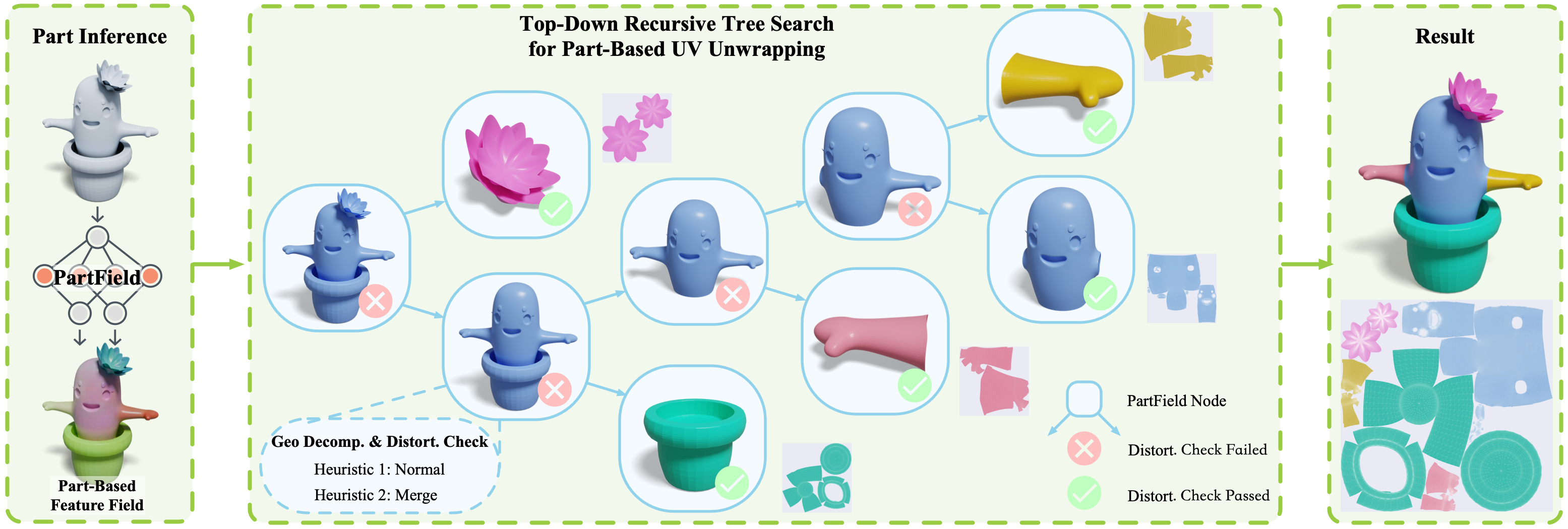
Step 1: Find the parts
- They use a machine learning tool called PartField to guess the meaningful parts of the object. Think of a robot that can look at a 3D model and say, “This group of faces looks like a leg,” “This is a screen,” “These are buttons,” and so on.
- This gives a “part tree” (a hierarchy): big parts at the top (like “body”), smaller parts inside (like “panel,” “hinge”).
Why this helps: If you respect object parts, you avoid ugly seams right across important surfaces, like a TV screen or a face.
Step 2: Split each part into charts (with two simple rules)
Even inside a part, you might still need a few cuts to flatten it nicely. PartUV tries two geometry-based strategies:
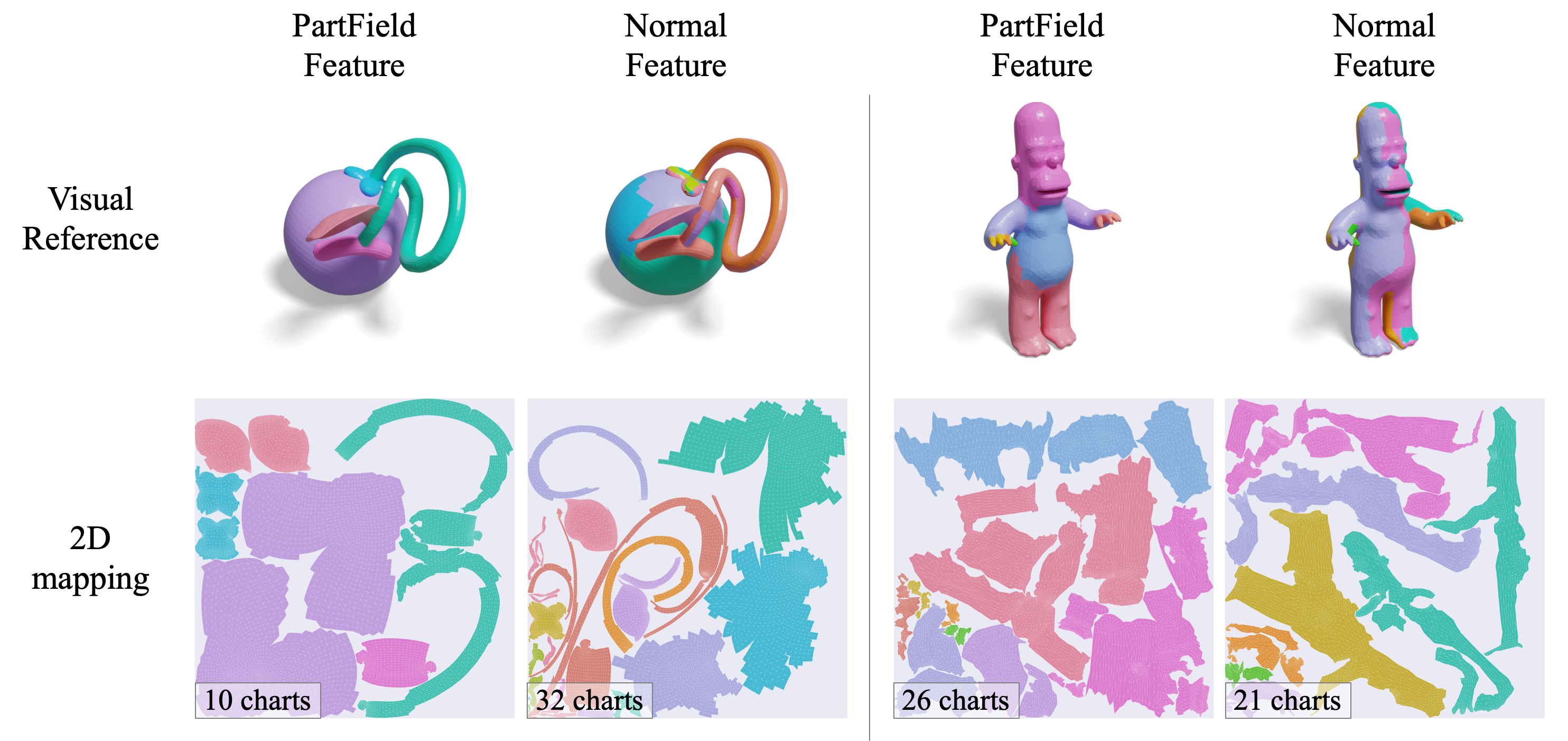
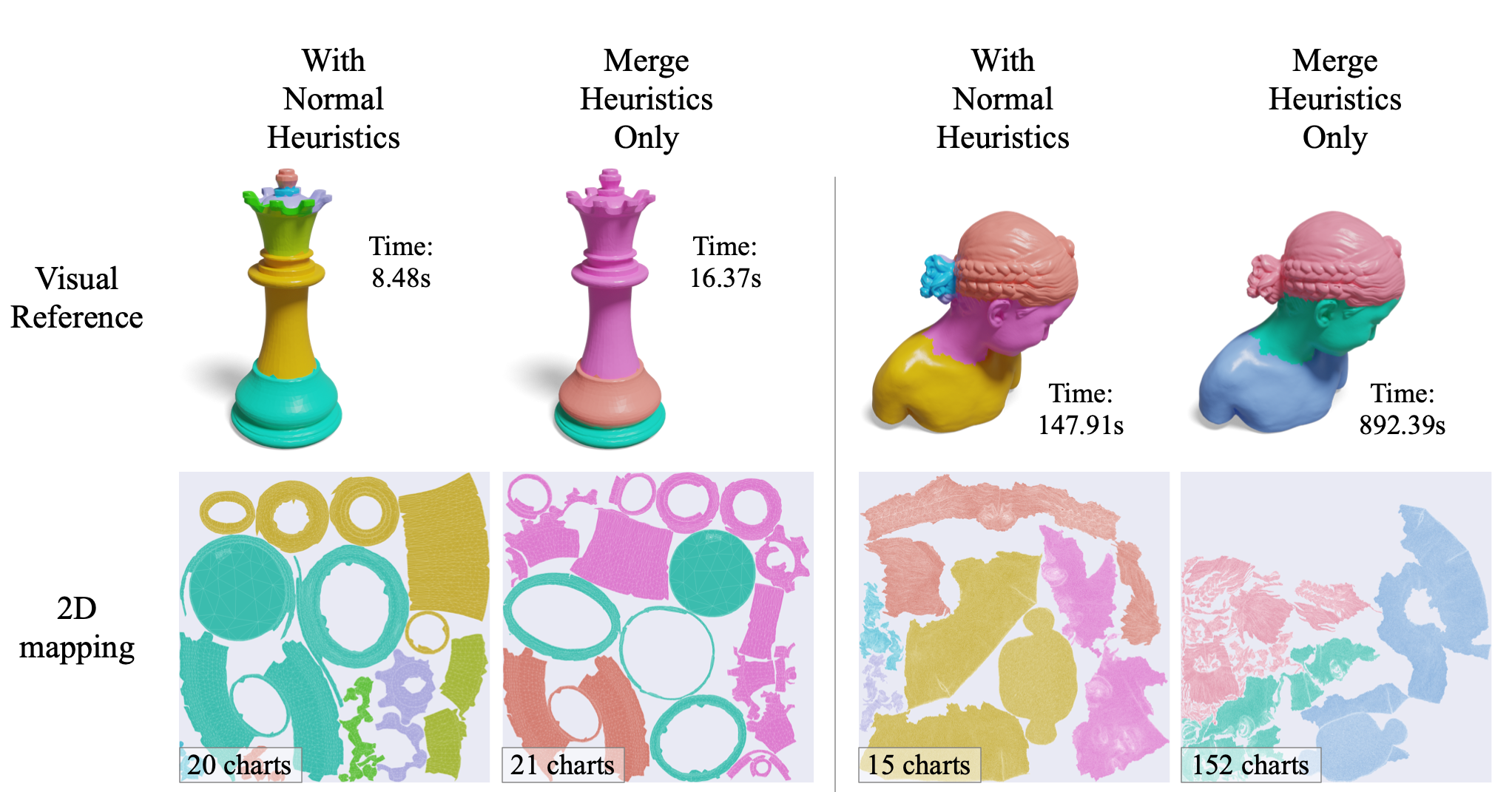
- Normal (fast): Group faces that point in similar directions (like all faces pointing “up” go together). This quickly makes reasonable pieces.
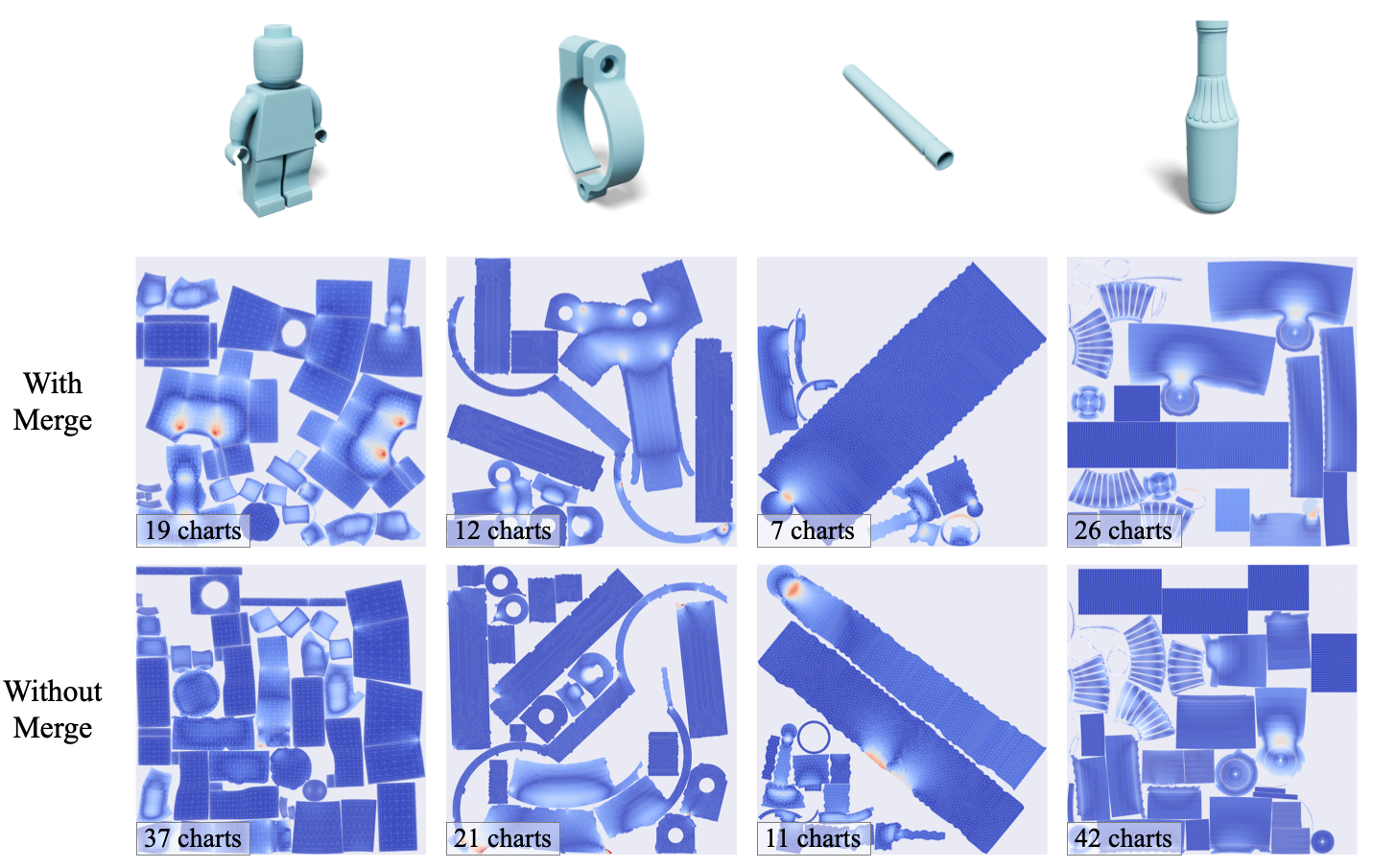
- Merge (careful and slower): Start with many small pieces, then try to combine neighbors whenever the combined piece still flattens well without overlaps. This often reduces the number of pieces further.
Analogy: First, sort puzzle pieces by how they face, then carefully snap neighboring pieces together if they still lie flat.
Step 3: Keep distortion under control and choose the best option
- They flatten candidate pieces with a classic method called Angle-Based Flattening (ABF), which tries to keep angles the same so shapes don’t look squished.
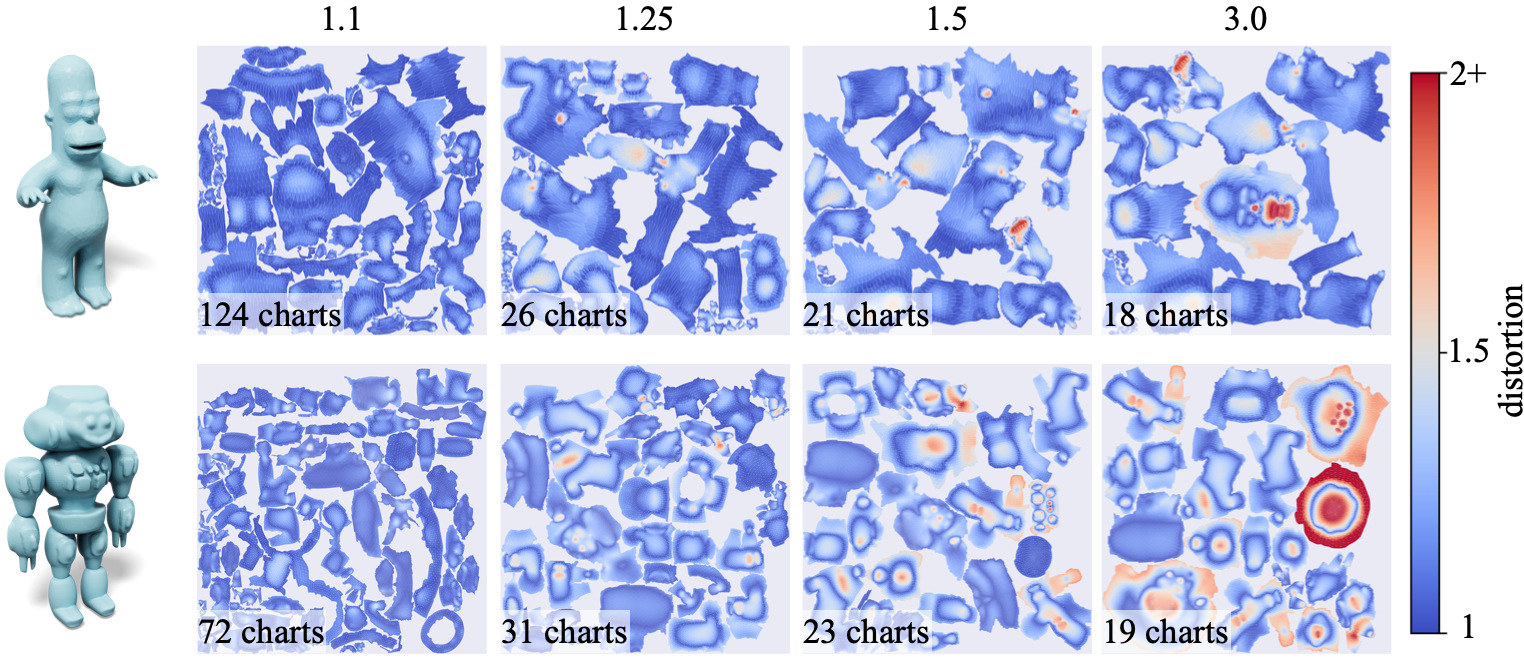
- They measure “distortion” (how much an area is stretched or shrunk) and only accept layouts that stay under a user-chosen limit (a threshold).
- They run a top-down “search”: try the current part’s best cuts; if that’s too distorted, go down the part tree (split into smaller parts) and try again. The goal is to use the fewest pieces possible while staying under the distortion limit.
To make this fast and robust:
- They do many steps in parallel (use multiple CPU cores/GPU).
- They temporarily simplify geometry to test ideas quickly, then compute the final UVs on the full, high‑quality mesh.
- They handle “weird” meshes (like those with holes or edges shared by too many faces) by fixing them up so flattening works.
What did they find, and why is it important?
Across several types of 3D models—clean man‑made shapes, CAD parts, common benchmark shapes, and especially noisy AI‑generated meshes—PartUV:
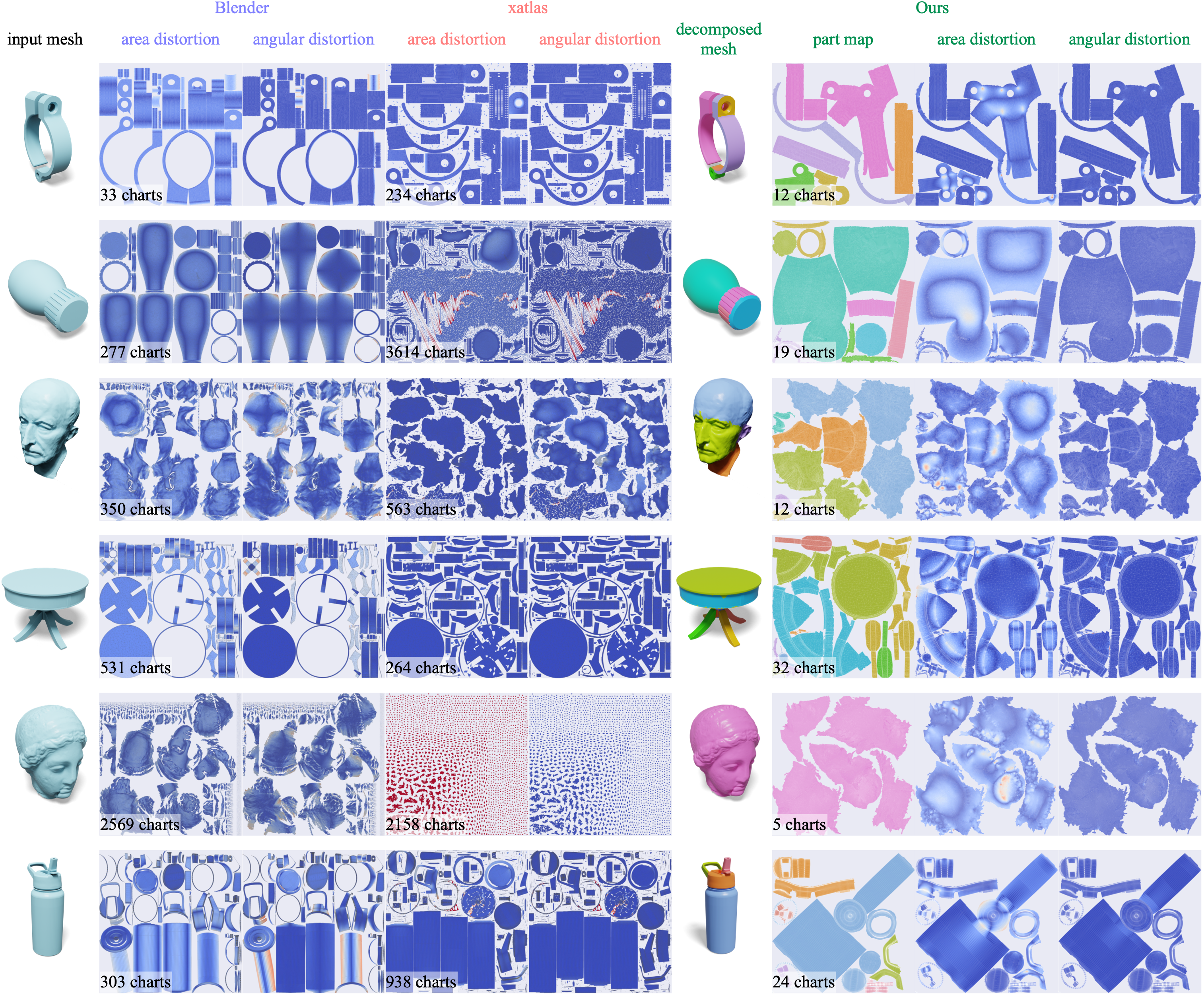
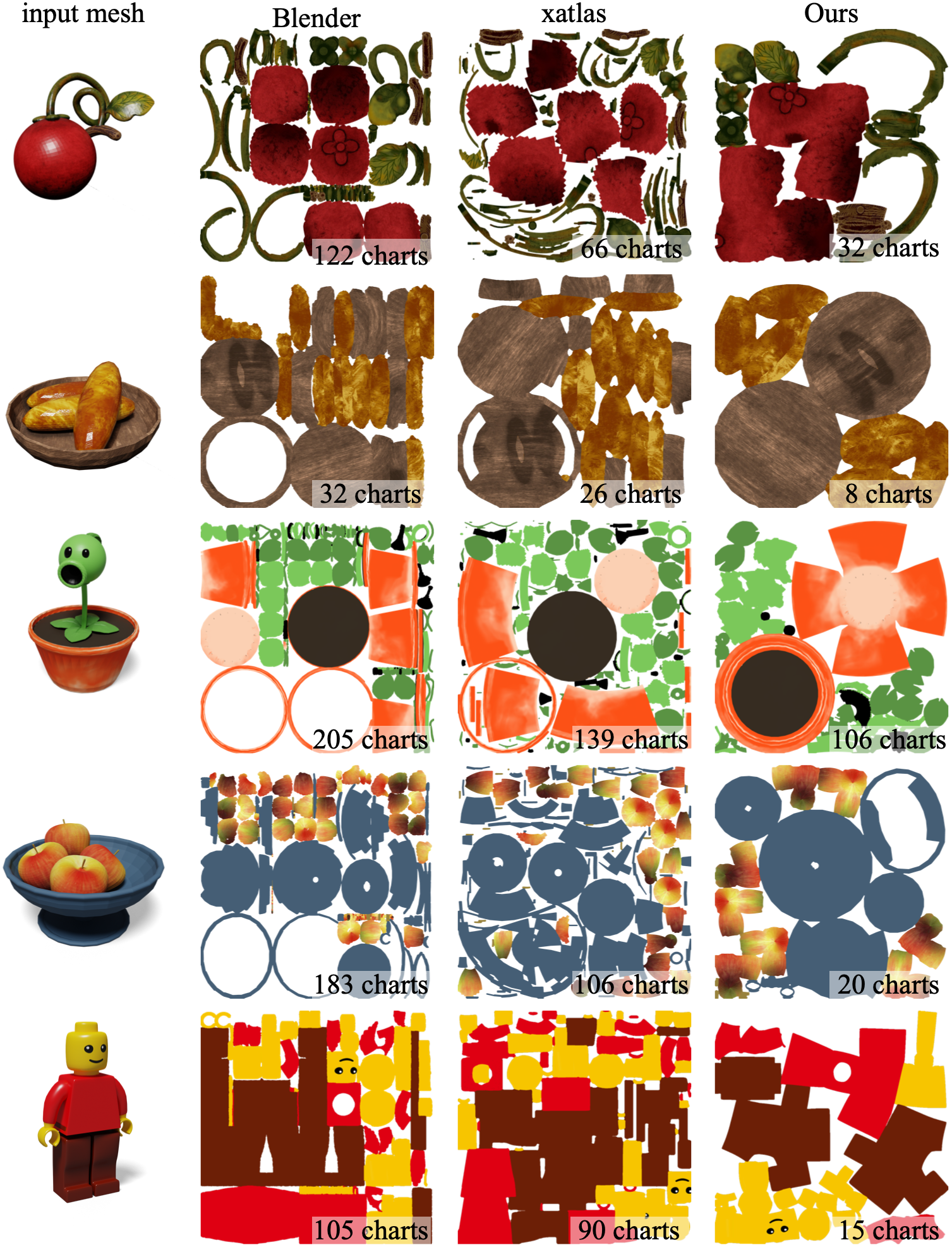
- Uses far fewer charts (pieces) than popular tools like Blender’s Smart UV and xatlas. On one standard set, it used about 1/31 as many pieces as Blender.
- Creates shorter total seam length (fewer cuts).
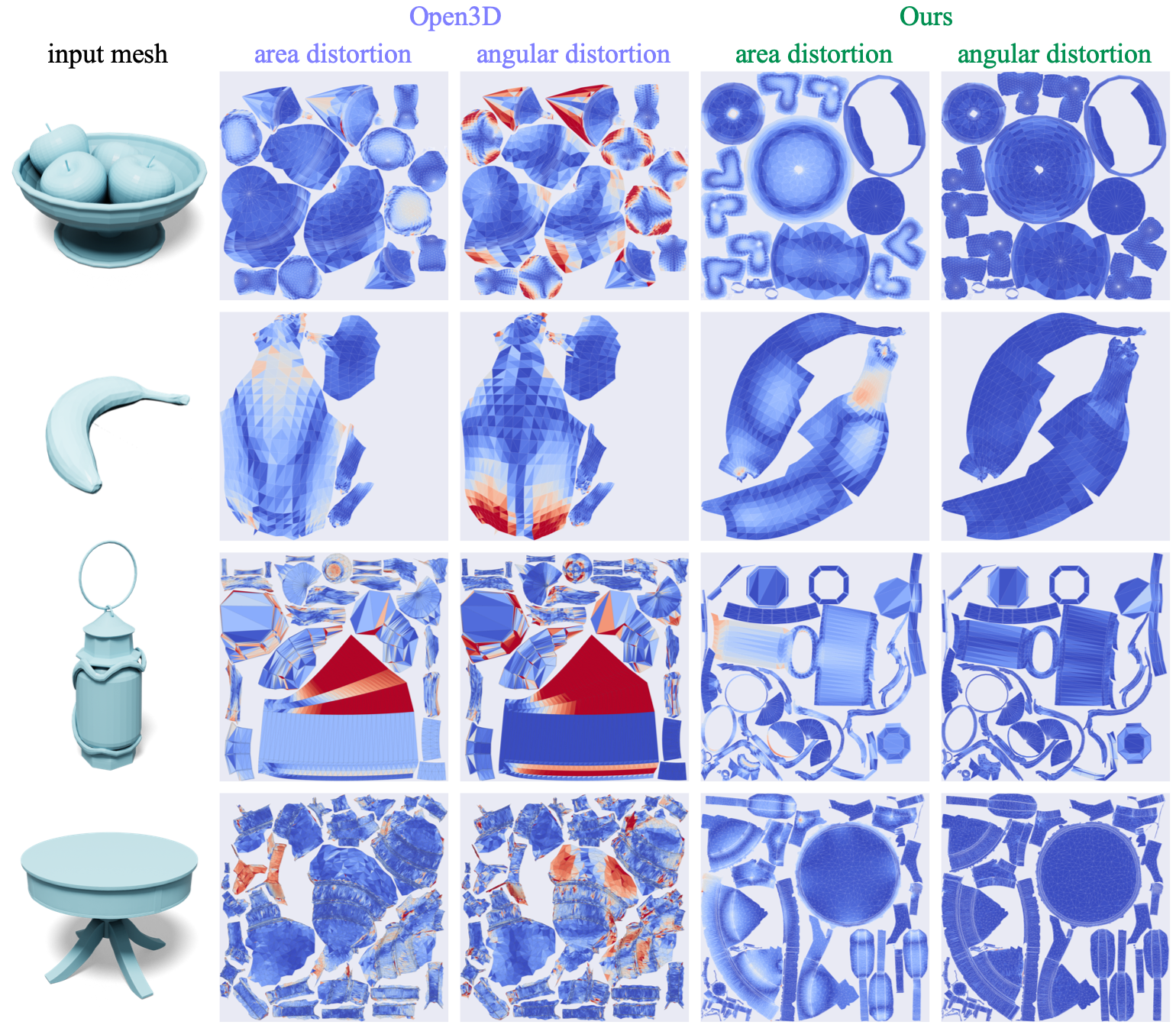
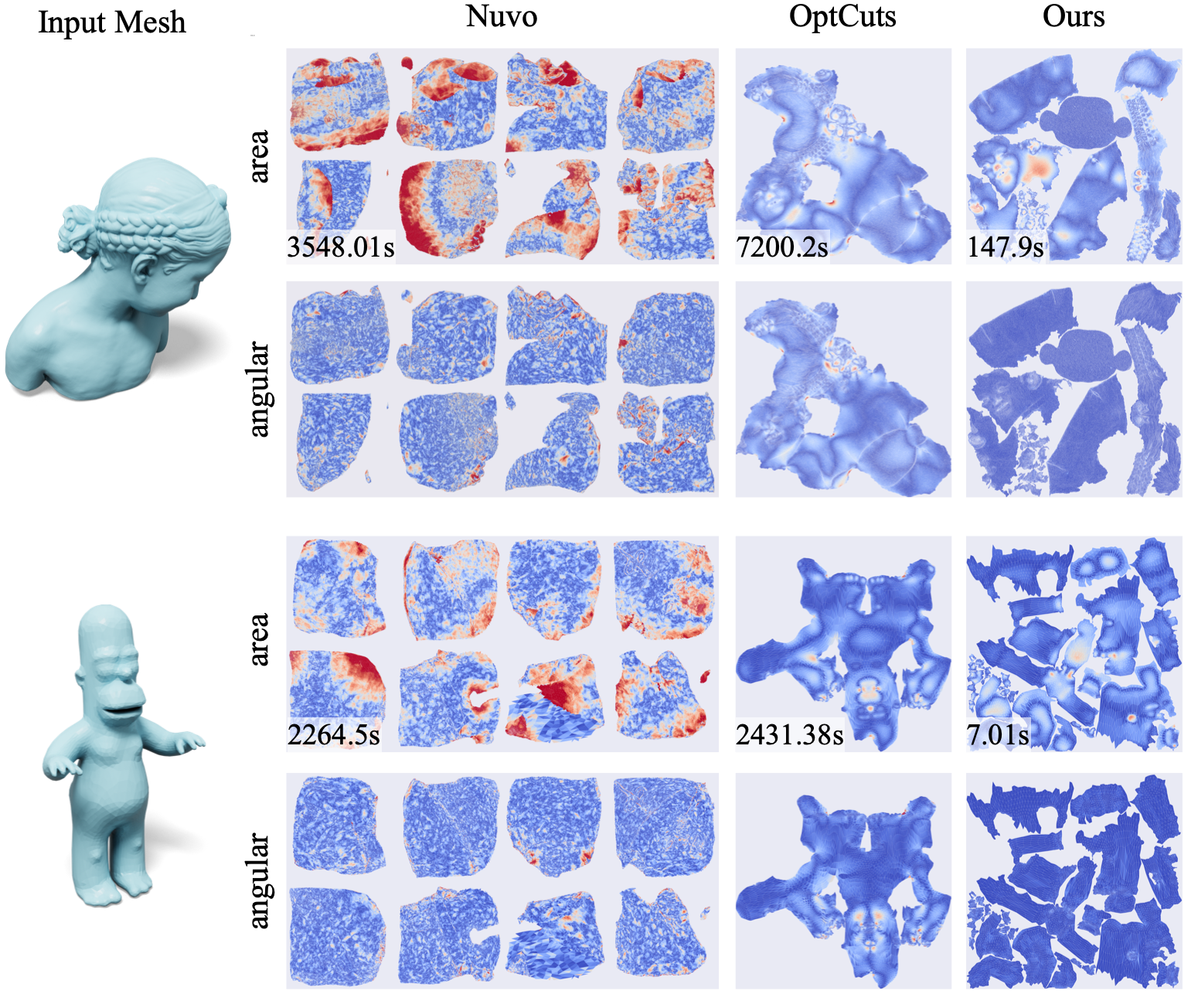
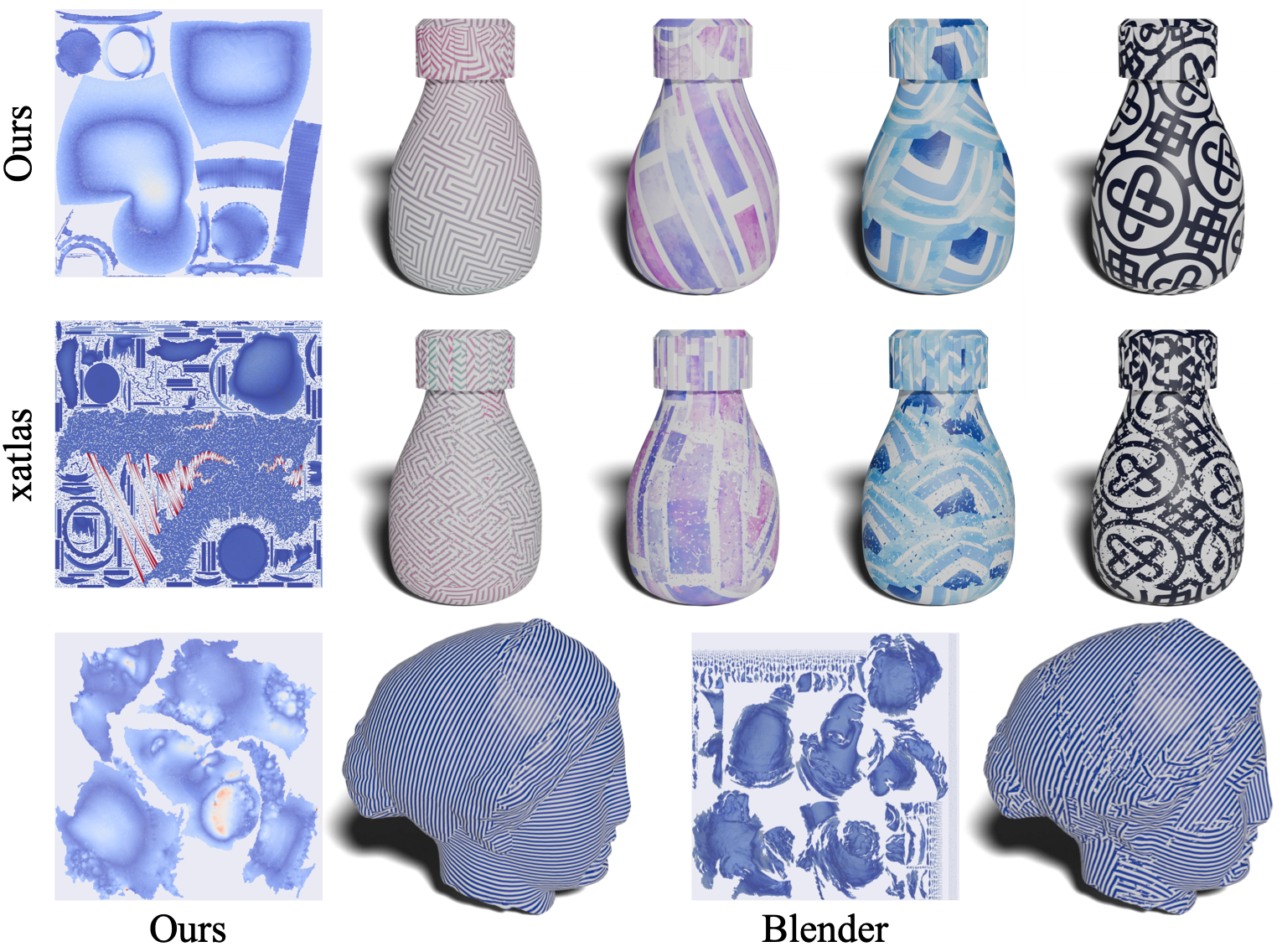
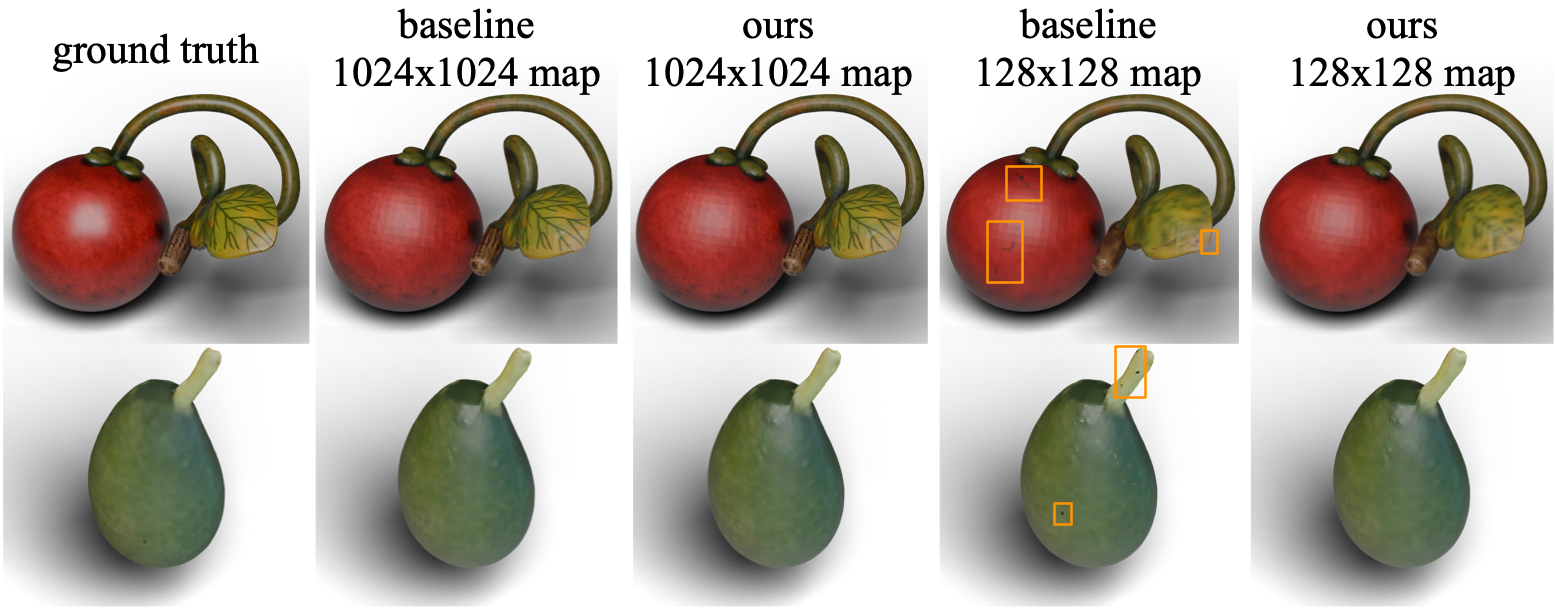
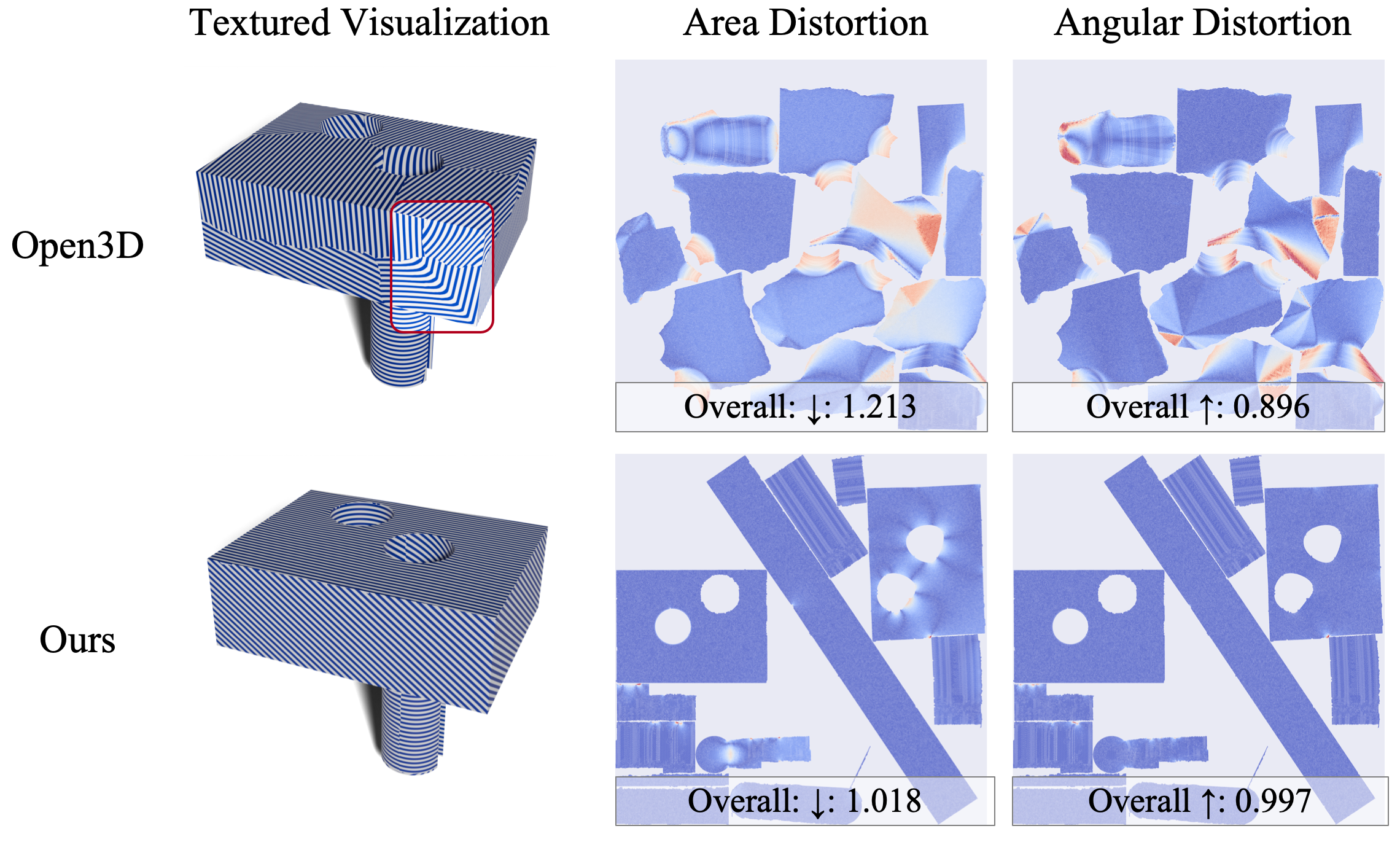
- Keeps distortion low and comparable to or better than baselines, so textures look good.
- Runs in seconds to tens of seconds per model, whereas some newer neural methods can take 30+ minutes.
- Works reliably even on rough, AI-generated meshes that often break other tools.
Why this matters:
- Fewer, larger, part-aligned charts make texture painting and editing much easier. You won’t hunt through hundreds of tiny islands just to paint a single part.
- Seams tend to sit in less visible, more logical places (like along part borders), reducing visual artifacts.
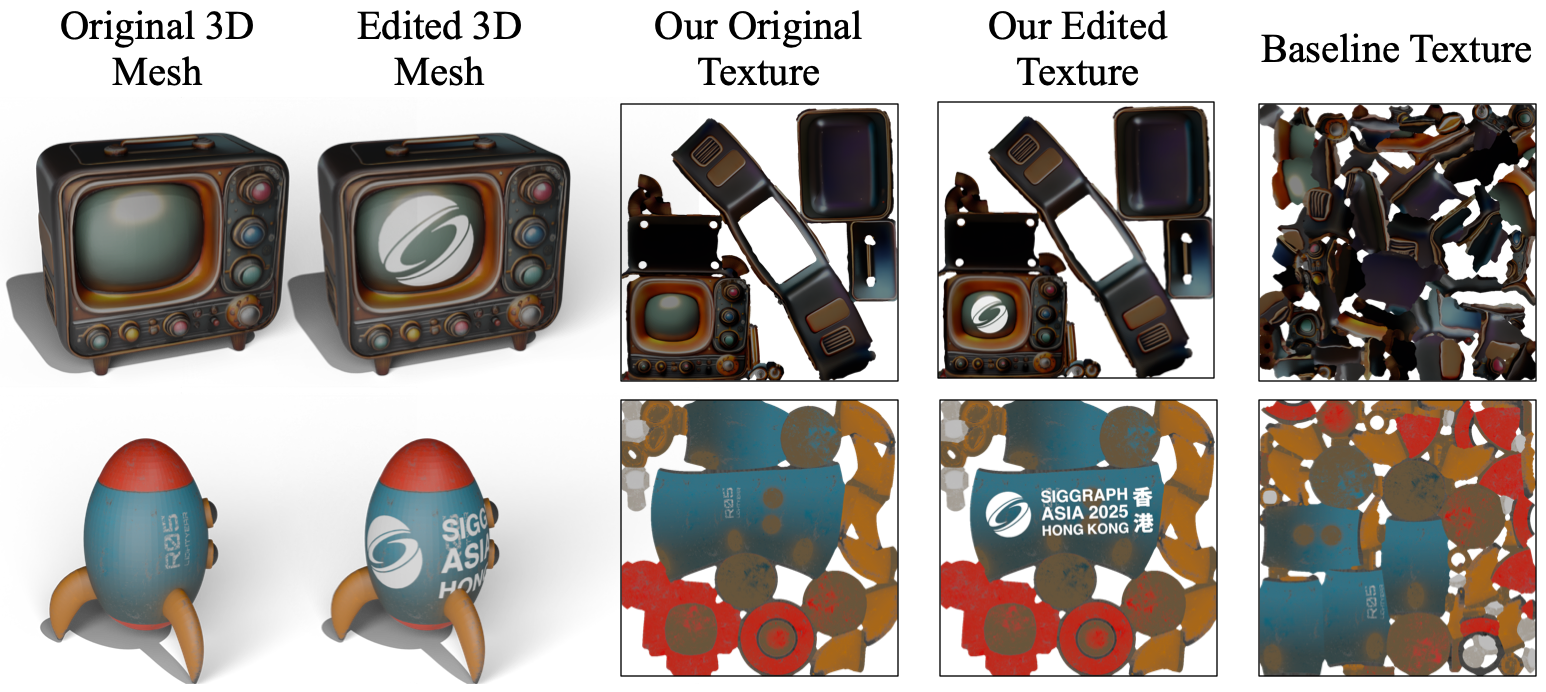
- Part-aware layouts let you pack UVs by part: for example, put all “screen” charts together, or give each part its own texture tile. This is great for workflows in games, films, and AR/VR.
What could this change in the future? (Implications)
- Faster, cleaner texturing: Artists and tools can texture complex models—especially messy AI outputs—without spending hours fixing UVs.
- Better pipelines: Because charts follow parts, downstream tasks like swapping materials, editing particular parts, or baking maps become simpler and more reliable.
- Smarter automation: Combining learned “part knowledge” with geometry rules may become the standard for handling real‑world, imperfect 3D data at scale.
- New applications: Part-aware multi‑tile packing (e.g., one UV tile per part) could improve organization, performance, and visual quality in large projects.
In short, PartUV shows that respecting an object’s parts, not just its raw geometry, leads to less-fragmented, higher-quality UV maps—delivered quickly enough to be truly useful in everyday 3D work.
Knowledge Gaps
Knowledge gaps, limitations, and open questions
Below is a single, actionable list of what remains missing, uncertain, or unexplored in the paper; each point is framed to guide future research.
- Dependence on PartField: no ablation showing how PartField segmentation accuracy or errors propagate to UV quality (chart count, seams, distortion), nor a fallback analysis when PartField missegments or fails.
- Training cost and accessibility: PartField requires 8×H100 GPUs for 15 days; there is no evaluation of whether lighter-weight models or pre-trained alternatives achieve comparable results, nor guidance on reproducible training/finetuning under modest hardware.
- Domain shift and bias: PartField is trained on Objaverse; the paper lacks a systematic evaluation of performance under significant domain shifts (e.g., CAD-only, organic shapes, heavily noisy AI meshes) and an analysis of dataset-induced biases on semantic segmentation and UV outcomes.
- Parameter sensitivity: no study on sensitivity to key hyperparameters (distortion threshold τ=1.25, t=10 candidate decompositions, ABF++ iterations, simplification thresholds/iterations), nor on automated tuning or adaptive strategies per shape/part.
- Surrogate distortion validity: the GPU simplification-based surrogate distortion is not validated; there are no error bounds or calibration showing how well surrogate decisions predict final ABF distortions, nor a quantified rate of false accept/reject.
- Optimality and complexity: the recursive search provides no theoretical optimality guarantees for minimizing chart count under constraints, and no worst-case or average-case time/space complexity analysis to inform scalability.
- Overlap constraint clarity: “NoOverlap” is enforced at flattening time, but the definition and scope (within-chart vs. cross-chart pre-packing vs. post-packing) are ambiguous; the effect of this constraint on search space pruning and solution quality is unquantified.
- Distortion metrics coverage: evaluation omits stretch and bijectivity/flip counts for PartUV itself (not just baselines), as well as area preservation metrics tailored to equiareal tasks; no formal guarantees (e.g., flip-free parameterizations) are provided.
- Seam quality assessment: seam placement is argued to be more perceptually unobtrusive, but there is no user study, psychophysical assessment, or task-based evaluation (e.g., texture painting error rates) to substantiate perceptual claims.
- Non-manifold handling side-effects: vertex duplication and edge splitting may introduce additional seams or texture discontinuities; the impact on visual artifacts, continuity across repaired regions, and chart count is not quantified.
- Multi-component handling: the fallback strategy for disconnected parts (depth thresholds, when heuristics are skipped, component-wise flattening) lacks a sensitivity analysis and quantitative impact on chart fragmentation and distortion.
- OBB-based Merge heuristic limitations: label assignment to six OBB directions may be brittle for curved or highly anisotropic parts; failure modes and alternative directional bases (principal curvature frames, learned axes) are not explored.
- Packing analysis: while semantic grouping is supported, there is no quantitative evaluation of packing efficiency (texel utilization, wasted space), UDIM usage, or the impact of semantic grouping on texture memory footprint and streaming.
- Multi-objective trade-offs: the search optimizes chart count under a distortion bound but does not explicitly optimize seam length or packing efficiency; Pareto front analyses and multi-objective formulations are absent.
- Alternative parameterizations: ABF++ is used throughout; the benefits of adaptively choosing parameterization (e.g., symmetric Dirichlet, ARAP, equiareal methods) per part-type are not investigated.
- Consistent UV orientation: there is no mechanism or evaluation for enforcing consistent UV orientation/axis alignment across instances or parts, which is critical for texture transfer and procedural texturing.
- Robustness stress tests: no controlled stress tests on extreme noise, self-intersections, inverted normals, large triangle counts, and highly degenerate meshes; success/failure distributions and diagnostic failure modes are missing.
- Fairness and coverage of baselines: comparisons omit industry-grade tools (e.g., RizomUV, Houdini, Maya’s unwrapping) and stronger Blender modes/settings; baseline parameter tuning fairness and reproducibility are not documented.
- Sensitivity to τ: the distortion threshold is fixed across datasets; the paper lacks a systematic analysis of chart count/seam length/distortion trade-offs as τ varies, including guidance for task-specific thresholds.
- Chart budget B: the role and tuning of the budget constraint are unclear; there is no study of how B affects recursion depth, runtime, and solution optimality.
- Hierarchical clustering choices: agglomerative clustering linkage criteria, feature normalization, and connectivity constraints are not ablated; alternative segmentation strategies (spectral, curvature-aware, learned clustering) remain unexplored.
- Downstream task metrics: beyond qualitative figures, there is no quantitative evaluation on baking normals/AO/displacement, texture bleed, mipmapping artifacts, or rendering errors at seams.
- Reproducibility and availability: the status of code, pre-trained PartField weights, model licenses, and exact pipeline configurations is unclear; without public artifacts, reproducibility and adoption are limited.
- Open meshes and boundary conditions: handling of meshes with open boundaries (vs. closed surfaces), boundary parameterization strategies, and their interaction with seam placement are not discussed.
- UV orientation and scale normalization in seam length: seam length measured after normalization to [0,1] may depend on packing/scaling decisions; a principled, packing-independent seam metric (e.g., 3D-space seam penalty or scale-invariant UV metrics) is not provided.
- Failure-case catalog: the paper does not enumerate representative failure cases or provide guidance on detecting and mitigating them (e.g., when semantics mislead chart boundaries or heuristic merges oversimplify curved regions).
- Integration with cut-optimization: combining semantic priors with global cut optimization (e.g., OptCuts-like objectives) is not explored; potential hybrid methods could jointly optimize seams, distortion, and semantics.
Practical Applications
Below are practical, real-world applications that follow from the paper’s findings, methods, and innovations (part-aware UV unwrapping, top-down semantic+geometric decomposition, distortion-bounded charting, robust handling of non-manifold/degenerate meshes, and semantically structured packing).
Immediate Applications
Industry
- Part-aware auto-UV for DCC and game engines (gaming, VFX, animation)
- Replace bottom-up unwrappers (e.g., xatlas, Smart UV) with PartUV for AI-generated and artist-modeled meshes to achieve drastically fewer islands, shorter seams, and low distortion; enable per-part UDIM layouts for hero assets.
- Tools/products/workflows: Blender/Maya/Houdini/3ds Max add-ons; Unreal/Unity import-time unwrapping step; batch processing in build farms; integration with UVPackmaster for per-part packing.
- Dependencies/assumptions: Access to PartField weights; CPU multithreading; optional GPU for simplification; ABF++ availability; UDIM support in DCC/engine pipelines; distortion threshold tuning.
- Post-processing for 3D generative pipelines (software, creative AI, asset marketplaces)
- Convert noisy AI-generated meshes into production-ready UVs; enable “one atlas per part” to streamline downstream texturing and automated material assignment.
- Tools/products/workflows: Cloud API/SDK that accepts meshes from diffusion/NF pipelines and returns UV + semantic groups; marketplace ingestion step to auto-unwrap and QC assets before publishing.
- Dependencies/assumptions: Throughput for batch jobs; licensing of pre-trained PartField; category/domain shift handling for out-of-distribution shapes.
- Material and texture painting acceleration (game/VFX texturing, digital content creation)
- Per-part islands simplify material libraries and painting in Substance Painter/Designer, Mari, or Blender; reduce bleed and edge artifacts via fewer, semantically placed seams.
- Tools/products/workflows: “Apply material by part” scripts; per-part texture baking; atlas-per-part UDIM setup for priority parts (faces, screens, logos).
- Dependencies/assumptions: Tools must consume semantic groups; texture painters support UDIM; consistent part labels from PartField.
- CAD/product visualization for real-time (manufacturing, automotive, retail/e-commerce)
- Prepare CAD assemblies with robust UVs despite mixed sharp/smooth geometry; ensure per-BOM part texture control for interactive viewers and AR try-on.
- Tools/products/workflows: CAD-to-DCC pipeline stage with automated part-aligned UVs; glTF/USD export with semantic grouping.
- Dependencies/assumptions: Handling of multi-component meshes already included; tessellation quality affects distortion; glTF/USD extensions for UDIM or multi-atlas packing vary by tool.
- Simulation and robotics domain randomization (robotics, simulation, AV)
- Assign randomized textures/materials per semantic part to improve synthetic data diversity and sim2real transfer.
- Tools/products/workflows: Simulation asset preprocessors; per-part texture pools for randomized episodes; automated QA of UV metrics (chart count, seam length).
- Dependencies/assumptions: Mapping from PartField part clusters to task-relevant labels; simulation stack supports UDIM/multi-atlas.
- Web/e-commerce 3D viewers (software, retail tech)
- Cleaner UVs reduce visual artifacts and enable higher-quality product configurators; per-part atlases support dynamic material swapping (e.g., strap vs. face on watches).
- Tools/products/workflows: Server-side pre-unwrap for all catalog models; viewer-side material switchers keyed by part groups.
- Dependencies/assumptions: Viewer support for multiple atlases or UDIM; bandwidth/texture memory budgets.
- Asset QA and automated repair (software tooling across sectors)
- Use reported metrics (chart count, seam length, angular/area distortion) for gating; apply built-in non-manifold fixes and robust flattening to salvage problematic models.
- Tools/products/workflows: CI/CD gatekeeper for asset libraries; dashboards highlighting “UV debt” per project; auto-fix/annotate non-manifold edges before unwrapping.
- Dependencies/assumptions: Thresholds must reflect use-case budgets; some extreme meshes still require manual intervention.
- Color 3D printing prep (manufacturing, makers, visualization)
- Fewer islands and better seam placement reduce print-time artifacts and color bleeding on full-color printers.
- Tools/products/workflows: Pre-print UV cleanup step; per-part color/texture assignment for product mockups and anatomical models.
- Dependencies/assumptions: Pipeline to convert PBR textures to printer’s color material mapping; printer software compatibility.
Academia
- Strong baseline for UV research and benchmarks
- A semantically guided, distortion-bounded method for comparing against neural field UVs and seam optimization; useful for studying seam placement vs. distortion trade-offs.
- Tools/products/workflows: Open evaluation scripts for chart/seam/distortion metrics; ablation on heuristics (Normal vs. Merge) and recursion budgets.
- Dependencies/assumptions: Access to datasets similar to those used in the paper or domain-adapted sets; reproducible training for PartField.
- Teaching resource in computer graphics courses
- Demonstrates integration of learned semantic priors with classical ABF++ and packing; examples for assignments on parameterization and mesh processing.
- Tools/products/workflows: Classroom demos; lab exercises with provided meshes; comparative charts against LSCM/ABF-only pipelines.
- Dependencies/assumptions: Classroom compute; educators’ familiarity with DCC/graphics tooling.
Policy and Standards
- Marketplace and studio intake guidelines for UV quality
- Define acceptance criteria using reported metrics (max chart count per area, seam-length budgets, distortion thresholds); promote consistency and lower downstream costs.
- Tools/products/workflows: Submission checklists; automated compliance checks at upload.
- Dependencies/assumptions: Stakeholder agreement on thresholds; transparency around method/versioning.
Daily Life and Creator Ecosystems
- Streamlined modding and avatar customization (gaming, social VR)
- One-click “PartUV unwrap” on community assets enables easier skinning and custom paint jobs without expert UV skills.
- Tools/products/workflows: Blender add-on for modders; VRChat/VTuber avatar toolchains.
- Dependencies/assumptions: Platform importers accept multi-atlas/UDIM or consolidate per-part maps; performance budgets managed via packing and texture sizes.
Long-Term Applications
Industry
- Temporal/animation-consistent UVs (VFX, games, digital humans)
- Extend the part-aware approach to ensure consistent seams across blendshapes or deforming meshes, enabling stable texture playback and minimal “crawling.”
- Tools/products/workflows: Character rig preprocessors that lock seams across LODs/morphs; reparameterization-aware retargeting.
- Dependencies/assumptions: New research on temporal coherence and topology changes; integration with rigging tools.
- Real-time/on-device procedural unwrapping (engines, XR, generative runtime)
- Lightweight or feedforward variants for runtime parametric assets and user-generated content in games/AR.
- Tools/products/workflows: Engine plugins performing on-the-fly unwrap for kitbashed assets; mobile-optimized inference for PartField.
- Dependencies/assumptions: Model compression/pruning/quantization; GPU inference on consoles/mobile; strict latency targets.
- End-to-end generative 3D with UV-aware feedback (creative AI)
- Close the loop so 3D generators are trained with UV quality signals; generate shapes already “UV-ready” or with predicted seam networks.
- Tools/products/workflows: Joint training where unwrapping loss steers geometry; text-guided “material-ready” generation with per-part UDIM plans.
- Dependencies/assumptions: Differentiable proxies for unwrapping and packing; large-scale training with stable gradients.
- Part-aware streaming and compression (web, cloud rendering)
- UDIM- and part-prioritized texture streaming (LOD by part importance); improved compression via reduced seam entropy.
- Tools/products/workflows: CDN pipelines that stream “critical parts” first; adaptive bitrate tied to semantic salience (faces, logos).
- Dependencies/assumptions: Viewer and codec support; glTF/USD extensions for multi-atlas semantics; empirical studies on QoE.
- Automated repair suite for enterprise (MRO, digital twins)
- Productize robust non-manifold repair + part-guided unwrap as a universal “asset fixer” for large brownfield libraries.
- Tools/products/workflows: SaaS or on-prem pipeline with dashboards and auto-ticketing for failures; integration with PLM/DAM systems.
- Dependencies/assumptions: Scalability, audit trails, enterprise security; handling of exotic mesh pathologies.
Academia
- Unified benchmarks and open challenges for AI-generated meshes
- Standardize datasets and metrics for UV quality on noisy, low-regularity shapes; evaluate generalization and robustness across domains.
- Tools/products/workflows: Benchmarks with leaderboards; diagnostic suites that isolate failure modes (non-manifold, extreme curvature, micro-triangles).
- Dependencies/assumptions: Community curation; reproducible training artifacts and licenses.
- Differentiable unwrapping modules
- Develop approximations of ABF++ and packing that are differentiable to enable learning-driven seam placement and end-to-end supervision.
- Tools/products/workflows: PyTorch/JAX layers for parameterization losses; curriculum learning for stability.
- Dependencies/assumptions: Numerical stability and convergence; careful design of bijectivity constraints.
Policy and Standards
- Semantic UV grouping as a standard asset feature
- Propose glTF/USD extensions for “semantic UV groups” and per-part UDIM maps; define interoperability for engines and DCCs.
- Tools/products/workflows: Reference implementations, conformance tests; best-practice guides for packing by part importance.
- Dependencies/assumptions: Working group buy-in (Khronos/ASWF); backwards-compatible fallbacks.
- Procurement/QA specifications for digital twins and training sims
- Mandate UV quality thresholds and semantic group deliverables in RFPs for simulation assets (defense, automotive, aviation).
- Tools/products/workflows: Automated acceptance tests; supplier scorecards on UV and mesh health.
- Dependencies/assumptions: Sector-specific thresholds and compliance processes.
Daily Life and Creator Ecosystems
- Consumer-grade “fix my model” apps
- Mobile/desktop utilities that auto-repair and unwrap Thingiverse/Sketchfab models for printing, modding, or AR.
- Tools/products/workflows: One-click UI; offline batch mode for hobbyists; presets by target (print, AR, game).
- Dependencies/assumptions: Lightweight inference; edge compute limits; simplified UX for non-experts.
Notes on cross-cutting dependencies and feasibility
- Model and data: Availability and licensing of the pre-trained PartField model; potential domain gaps for specialized verticals (medical/anatomy, cultural heritage) requiring fine-tuning.
- Compute: While the pipeline runs in seconds to tens of seconds per mesh with parallel CPU and optional GPU simplification, real-time targets will need further optimization or distilled models.
- Interoperability: UDIM and multi-atlas support vary across engines/viewers; glTF/USD ecosystems may require extensions for semantic UV groups.
- Quality controls: Distortion threshold selection and packing policies must match memory/performance budgets; some extreme meshes will still need artist oversight.
Glossary
- ABF++ (Angle-Based Flattening): A nonlinear angle-preserving mesh parameterization method that optimizes triangle angles before deriving UV coordinates. "We utilize an Angle-Based Flattening algorithm(ABF++), to flatten each chart onto a 2D plane, yielding mappings:"
- Agglomerative clustering: A hierarchical clustering algorithm that progressively merges clusters based on similarity to form a tree. "we construct a hierarchical part tree using agglomerative clustering~\cite{johnson1967hierarchical} on these face features."
- Ambient occlusion: A shading technique that approximates soft shadowing from ambient light occlusion to enhance perceived depth. "along with auxiliary maps like ambient occlusion and displacement—"
- Area distortion: Deviation of area in the UV map relative to the 3D surface; equiareal methods aim to minimize it. "Area (Equiareal) Distortion: We compute both area distortion and overall area distortion."
- Area stretch metric: A measure of per-chart area scaling used to quantify parameterization distortion. "we quantify distortion using an area stretch metric, defined as:"
- Bijectivity (global bijectivity constraint): A one-to-one mapping property that avoids overlaps and flips; enforced in optimization to ensure validity. "OptCuts jointly optimizes surface cuts and distortion under a global bijectivity constraint."
- Bitangent: A vector orthogonal to the surface normal and tangent; used with the tangent to define local UV directions. "We compute the cosine between the tangent and bitangent vectors of each face."
- Chart: A connected subset of mesh faces that is flattened as a single UV patch. "allowing each chart to be flattened with reduced distortion."
- Chart budget: A limit on the number of charts allowed during decomposition/search. "a distortion threshold , and a chart budget (initially set to )"
- Conformal distortion: Angle distortion; conformal mappings preserve angles, and angular distortion measures deviations. "Angular (Conformal) Distortion:"
- Cosine similarity: A similarity measure between feature vectors based on the cosine of the angle between them. "Points whose features are similar—as measured by cosine similarity—are therefore more likely to belong to the same part."
- Degenerate meshes: Meshes with ill-conditioned geometry (e.g., zero-area or collapsed elements) that violate algorithm assumptions. "incorporates dedicated handling of non-manifold and degenerate meshes"
- Displacement: A texture/map that displaces surface geometry along normals to add detail. "along with auxiliary maps like ambient occlusion and displacement—"
- Distortion threshold: A user-specified upper bound on allowable UV distortion per chart. "If the distortion exceeds a user-specified threshold "
- Equiareal: Area-preserving property of a mapping. "minimizing various distortion metrics (e.g., isometric, conformal, equiareal)"
- Isometric: Distance-preserving property of a mapping (no stretch). "minimizing various distortion metrics (e.g., isometric, conformal, equiareal)"
- Isosurface: A surface consisting of points with equal scalar value, often extracted from volumetric/neural fields. "neural‑field isosurfaces (e.g., via marching cubes~\cite{lorensen1998marching})"
- Laplacian eigen-decomposition: Spectral method using eigenvectors of the Laplacian operator for embeddings and analysis. "Laplacian eigen-decomposition techniques~\cite{belkin2003laplacian,mullen2008spectral,taubin1995signal}"
- Least Squares Conformal Maps (LSCM): A widely used conformal mesh parameterization solved via least squares. "xatlas employs a greedy algorithm that balances geometric deviation, UV distortion, and seam cost, followed by Least Squares Conformal Maps (LSCM)~\cite{lscm} for flattening."
- Manifold: A surface where local neighborhoods are well-defined and edges are incident to at most two faces. "each input chart is a manifold and connected surface"
- Marching cubes: An algorithm to extract polygonal isosurfaces from volumetric data. "neural‑field isosurfaces (e.g., via marching cubes~\cite{lorensen1998marching})"
- Mesh parameterization: Mapping a 3D mesh surface to a 2D domain while controlling distortion. "Mesh parameterization—the process of mapping a 3D mesh to a 2D domain while minimizing various distortion metrics"
- Multi-tiles packing: Organizing charts across multiple UV tiles/squares instead of a single atlas. "enables new applications like part-specific multi-tiles packing."
- Neural field: A continuous function represented by a neural network over space, used to define mappings or surfaces. "representing the UV mapping using a neural field"
- Non-manifold edges: Edges shared by more than two faces, violating manifoldness. "non-manifold edges—i.e., edges shared by more than two faces—"
- Oriented bounding box (OBB): A bounding box aligned to object orientation rather than global axes. "the Merge heuristic begins by computing its oriented bounding box (OBB)."
- Region growing: Segmentation strategy that expands regions by merging neighboring elements under criteria (e.g., stretch). "which uses region growing guided by the isometric stretch metric"
- Seam cutting: Placing boundary cuts to split a mesh into charts for flattening. "chart segmentation (or seam cutting) is typically used to divide the mesh into multiple charts"
- Seam length: The total length of chart boundary edges in UV space. "Seam Length: We compute the seam length by summing the lengths of all chart boundary edges"
- Spectral analysis: Using eigenstructures (e.g., Laplacian spectra) for decomposition/segmentation. "Top-down methods recursively subdivide the mesh, often using spectral analysis"
- Surrogate distortion: An approximate distortion computed on simplified charts to accelerate evaluation. "used to estimate distortion metrics quickly (i.e., surrogate distortion) during intermediate evaluations."
- Triplane: A feature representation using three orthogonal planes to encode 3D fields. "predicts a continuous, part-based feature field encoded as a triplane."
- Tutte’s embedding: A barycentric planar embedding guaranteeing non-self-intersecting layouts. "Tutte’s embedding~\cite{tutte1963draw}"
- UV atlas: The unit-square domain that contains packed charts for texturing. "the unit square (the UV atlas)"
- UV packing: Arranging charts inside the atlas to maximize texture-space use. "Finally, UV packing arranges the resulting charts within the unit square (the UV atlas) to maximize texture‑space use."
- UV parameterization: Solving for UV coordinates that map surface points to 2D with low distortion. "Several approaches jointly optimize UV parameterization and 3D reconstruction"
- UV unwrapping: The process of flattening a 3D mesh into 2D UV coordinates. "UV unwrapping projects the 3D surface of a mesh onto a 2D plane"
Collections
Sign up for free to add this paper to one or more collections.