- The paper introduces a spectral method for solving the Fokker-Planck equation in constant-roll inflation with a quadratic hilltop potential.
- It demonstrates that rare, long-lived stochastic trajectories drastically inflate the mean first-passage time, making the median a more reliable estimator.
- The analysis unveils non-Gaussian features in the curvature perturbation, providing insights into primordial black hole formation.
Stochastic Constant-Roll Inflation Beyond the Hilltop: Spectral Method Analysis
Introduction and Motivation
This work presents a rigorous analysis of stochastic effects in constant-roll inflationary scenarios, specifically focusing on models with a quadratic hilltop potential. The treatment employs the spectral method to solve the Fokker-Planck equation governing the probability distribution of e-folds, thereby elucidating the non-Gaussian statistics relevant for large inflationary fluctuations, including those associated with rare events such as primordial black hole (PBH) formation. Unlike earlier studies, this framework systematically incorporates stochastic trajectories that cross over the hilltop, become trapped near a reflecting boundary, and subsequently escape by quantum diffusion. The study emphasizes the conceptual and practical breakdown of using mean first-passage time (FPT) as a background estimator under such extreme stochastic conditions, advocating instead for the median. The paper also details the transition of the curvature perturbation distribution from an exponential tail to a pronounced peak at a maximal ΔN.
Hilltop Potential and Stochastic Framework
The model is defined by a quadratic hilltop potential,
V(ϕ)=V0(1+21ηVϕ2),
with ηV<0 and H≈ const near the hilltop. The dynamics reduce to a stochastic differential equation in e-fold time N for the inflaton field ϕ, incorporating both classical drift and quantum diffusion terms. The drift term is proportional to ϕ, representing constant-roll (ϵ2>0) dynamics. Crucially, the noise amplitude is constant in this regime.
Absorbing and reflecting boundaries are imposed to model the end of inflation and a confining regime, respectively. This setup captures both standard trajectories ending inflation classically and rare stochastic excursions where the field crosses the hilltop and becomes temporarily confined before tunneling back.
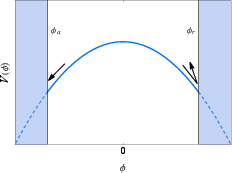
Figure 1: The hilltop potential V(ϕ) exhibiting the absorbing and reflecting boundaries, encapsulating the physically relevant regions for field evolution.
Spectral Method for the Fokker-Planck Operator
The spectral method is leveraged for the exact solution of the Fokker-Planck equation relevant to the system. This involves decomposing the time-evolving probability distribution into eigenfunctions and eigenvalues of the Fokker-Planck operator. Owing to the underlying Sturm–Liouville structure, the spectrum exhibits a discrete set of modes, with the lowest-lying eigenmode controlling the long-time asymptotics.
The eigensystem's behavior—and the resulting FPT statistics—depends on the placement of the boundaries in field space. The analysis covers the narrow, wide, and half-wide limiting cases for boundary location. In the wide limit, the lowest eigenvalue becomes extremely small, corresponding to exponentially suppressed escape from the trapping region, and the spectrum for higher n approaches that of a quantum harmonic oscillator.
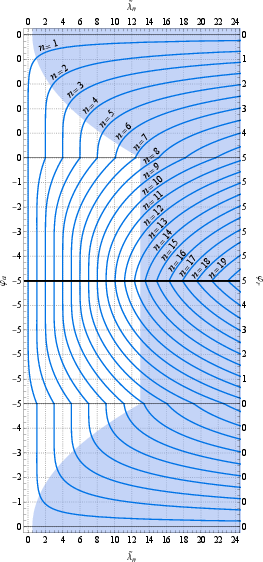
Figure 2: The lowest eigenvalues V(ϕ)=V0(1+21ηVϕ2),0 versus boundaries, capturing the transition from narrow to wide boundary regimes and the emergence of a qualitatively distinct spectral structure.
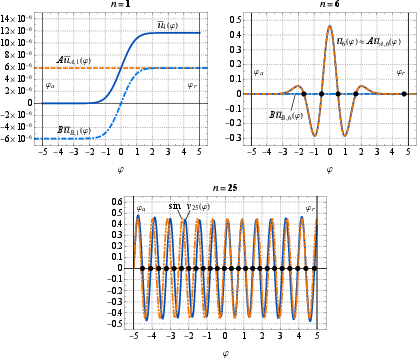
Figure 3: Representative eigenmodes for V(ϕ)=V0(1+21ηVϕ2),1 and V(ϕ)=V0(1+21ηVϕ2),2 in the wide regime, demonstrating damped and oscillatory structure.
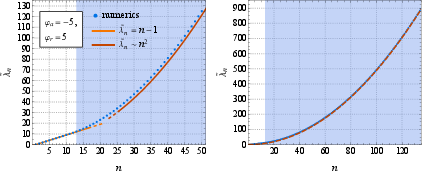
Figure 4: High-lying eigenvalues in the wide limit, numerically extracted and overlayed with analytical approximations.
Stochastic Evolution and Late-Time Universal Behavior
The early-time dynamics of the probability distribution V(ϕ)=V0(1+21ηVϕ2),3 are well-reproduced by a Gaussian form until boundary effects become significant. As the system evolves, higher modes decay, and at late times, the probability concentrates near the reflecting boundary and decays at a rate determined by the smallest eigenvalue. The spectral method delivers quantitative agreement with stochastic simulations across the entire temporal range.
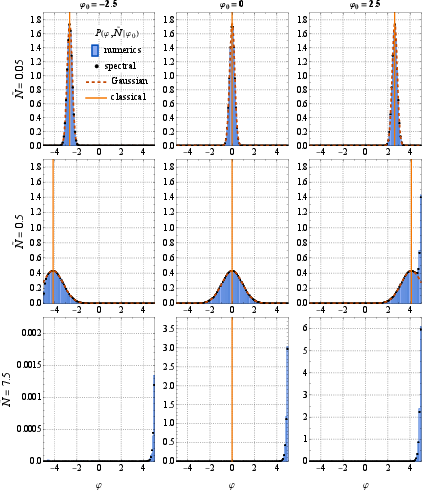
Figure 5: Time evolution of the field's probability distribution demonstrating the progressive influence of boundaries and the approach to the universal late-time shape.
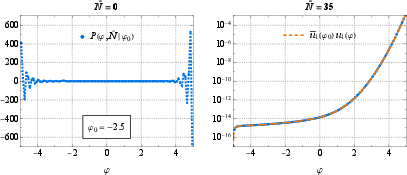
Figure 6: Spectral decomposition illustrating oscillatory artifacts at very early times (finite mode truncation), and eventual dominance by the lowest mode at late times.
First-Passage Statistics and Background Quantification
The paper provides a systematic comparison between mean, median, and modal FPT as candidate definitions for the “background” expansion in the V(ϕ)=V0(1+21ηVϕ2),4 formalism. It is explicitly shown that rare, extremely long-lived trajectories—those associated with stochastic trapping near the reflecting boundary—dominate the mean first-passage time by orders of magnitude, rendering it an unrepresentative background measure for most realizations. In contrast, the median aligns with the classical attractor behavior for negative initial field values and smoothly connects to diffusion-dominated statistics for positive initial values.
Strong numerical results in the paper demonstrate, for a canonical example (V(ϕ)=V0(1+21ηVϕ2),5, V(ϕ)=V0(1+21ηVϕ2),6), that the mean FPT can exceed the median by many orders of magnitude for a broad class of initial conditions.
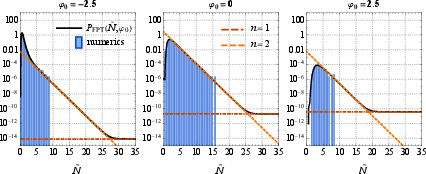
Figure 7: First-passage-time distributions for different initial positions; the spectral method resolves late-time tails inaccessible by direct simulation.
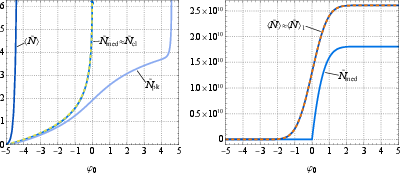
Figure 8: Comparative plot of the mean, median, and modal FPTs as a function of initial field value, highlighting the severe inflation of the mean due to rare events.
Within the V(ϕ)=V0(1+21ηVϕ2),7 formalism, the stochastic nature of expansion is mapped to the curvature perturbation V(ϕ)=V0(1+21ηVϕ2),8. The work considers both the classical and stochastic computation of V(ϕ)=V0(1+21ηVϕ2),9 for fixed coarse-graining scales. Notably, the inclusion of trajectories beyond the hilltop produces novel non-Gaussian features in the ηV<00 distribution: the familiar exponential tail not only flattens but ultimately gives rise to a sharp maximum at a limiting value, governed by the structure of the spectral modes and the trapping time near the reflecting boundary.
This result has major implications for PBH formation, as the statistics of rare, large perturbations are acutely sensitive to the population of hilltop-crossing trajectories and their fate in the non-classical, diffusion-dominated regime.
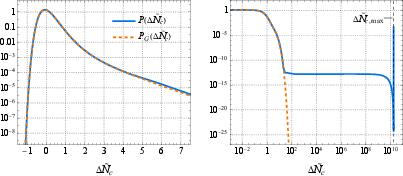
Figure 9: Probability distribution ηV<01 in both linear and log scale, showing the plateau and the emergence of a final sharp peak at maximum ηV<02 from the reflecting boundary/diffusion regime.
Methodological and Theoretical Context
The spectral method formulation is compared with the widely used characteristic function technique, emphasizing the spectral method’s analytic accessibility to arbitrary initial conditions and entire time evolution, particularly in the presence of boundaries and for extracting deep tail behavior. This approach underscores benefits over semi-classical ηV<03 techniques, which become inapplicable in the extreme diffusion-dominated regime.
The work also addresses the inherent ambiguities in defining a cosmological background when rare regions dominate statistical moments, an issue acute in scenarios approaching eternal inflation and fractal inflating domains.
Conclusion
This analysis provides a comprehensive spectral solution to stochastic constant-roll inflation in hilltop potentials, systematically capturing both classical and diffusion-dominated regimes—especially trajectories that cross the hilltop and become trapped before tunneling out. The results definitively show that mean-based characterizations of inflationary background duration fail in the presence of rare, long-lived stochastic excursions, and that a median-based characterization is essential for connecting to classical behavior and accurately capturing the statistics relevant for PBH and large-ηV<04 studies. The ηV<05 perturbation distribution, when properly extended, features a plateau and sharp maximum governed by the stochastic trapping phenomenon, a result not accessible in classical approaches or by truncating at the exponential tail.
The methodology and insights developed are broadly relevant for stochastic inflation, PBH abundance calculations, and the theoretical characterization of large non-Gaussian primordial fluctuations. Future work may extend these techniques to more general potentials and explore alternative background quantifications suitable for highly inhomogeneous, diffusion-dominated cosmic regions.

