- The paper presents an eigenvalue-based spectral method to solve the Fokker-Planck equation, linking inflationary perturbations to primordial black hole formation.
- It derives analytic solutions for both drift-free and constant-drift regimes, revealing an intermediate N⁻³⁄² power-law behavior in the probability distribution function.
- Key implications include enhanced predictions of non-Gaussian tails, with potential applications to PBHs, ultra-compact minihalos, and extending to variable drift scenarios.
Introduction and Motivation
The formation of Primordial Black Holes (PBHs) through the gravitational collapse of enhanced curvature perturbations during the early universe provides a unique probe into inflationary dynamics at small scales, far beyond Large Scale Structure and CMB probes. PBH abundance is exponentially sensitive to the non-Gaussian tails of the probability distribution function (PDF) describing these fluctuations. Accurate theoretical predictions for these non-Gaussian tails are therefore essential, especially for scenarios involving features in the inflationary potential—such as inflection points or localized wells—that can produce rare, large fluctuations.
Stochastic inflation, via a Fokker-Planck approach, offers a non-perturbative technique for computing the distribution of inflationary perturbations, taking into account both classical drift and quantum diffusion of the inflaton field. However, while characteristic function approaches have yielded partial analytic results for special cases, a comprehensive and self-contained spectral (eigenvalue) solution directly to the PDF has not previously been constructed. The paper "Eigenvalue formulation of Stochastic Inflation and application to large perturbation generating inflationary features" (2606.00176) addresses this gap by providing a rigorous eigenvalue-based framework for the Fokker-Planck equation in stochastic inflation, with systematic analysis of both drift-free and constant-drift stochastic dynamics—covering both narrow- and broad-well regimes.
The distribution for the first-passage number of e-folds, P(N;Φ), is governed by an adjoint Fokker-Planck operator acting on the phase-space of the coarse-grained inflaton field Φ. The equation is: ∂N∂P=L^FP†P=[Dϕ∂Φ∂+21Σϕϕ∂Φ2∂2]P
where Dϕ is the classical drift and Σϕϕ is the stochastic diffusion coefficient.
The spectral method restates the solution as a sum over eigenmodes: P(N;Φ)=n∑cnΨn(Φ)exp(−ΛnN)
with eigenfunctions Ψn and quantized exponents Λn determined by the boundary-value problem (reflecting and absorbing walls in field space).
Boundary conditions are:
- Absorbing at the exit boundary: Ψn(ϕA)=0
- Reflecting at the entry boundary: Ψn′(ϕR)=0
Completeness and orthogonality are established with a Sturm-Liouville weight Φ0 appropriate to the drift, yielding a self-adjoint operator.
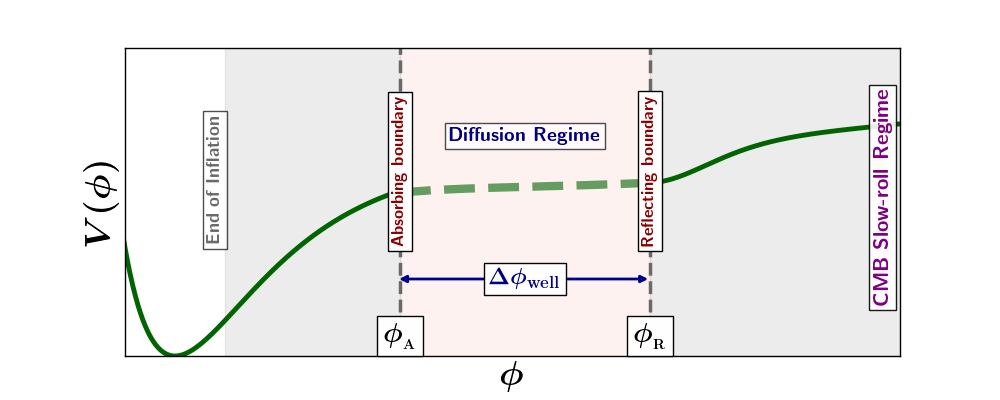
Figure 1: Schematic illustration of the inflaton potential with an intermediate diffusion-dominated feature of width Φ1, highlighting the location of absorbing and reflecting boundaries.
The coefficients Φ2 are fixed by matching to a sharply peaked initial condition at the absorbing boundary—physically, initial field configurations that immediately cross the boundary produce zero e-folds, mathematically leading to a derivative of the Dirac delta.
Drift-Free Diffusion: Analytical Solution and PDF Structure
For vanishing classical drift (Φ3), the quantum diffusion equation reduces to that of a particle in a box. The solution is: Φ4
with Φ5 the dimensionless field coordinate, and Φ6 the dimensionless diffusion width. The analytic PDF is: Φ7
This exactly recovers previous characteristic-function-based results but frames the solution entirely in terms of spectral data.
Importantly, the solution reveals an intermediate regime where Φ8 before transitioning to the expected exponential tail—this intermediate power-law was not highlighted in earlier literature.
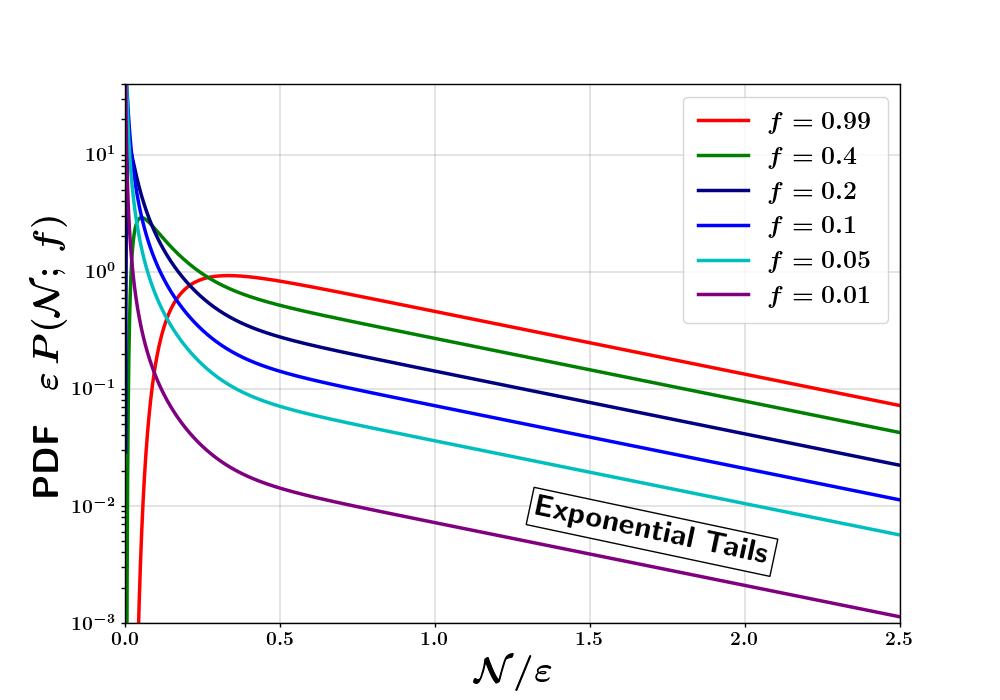
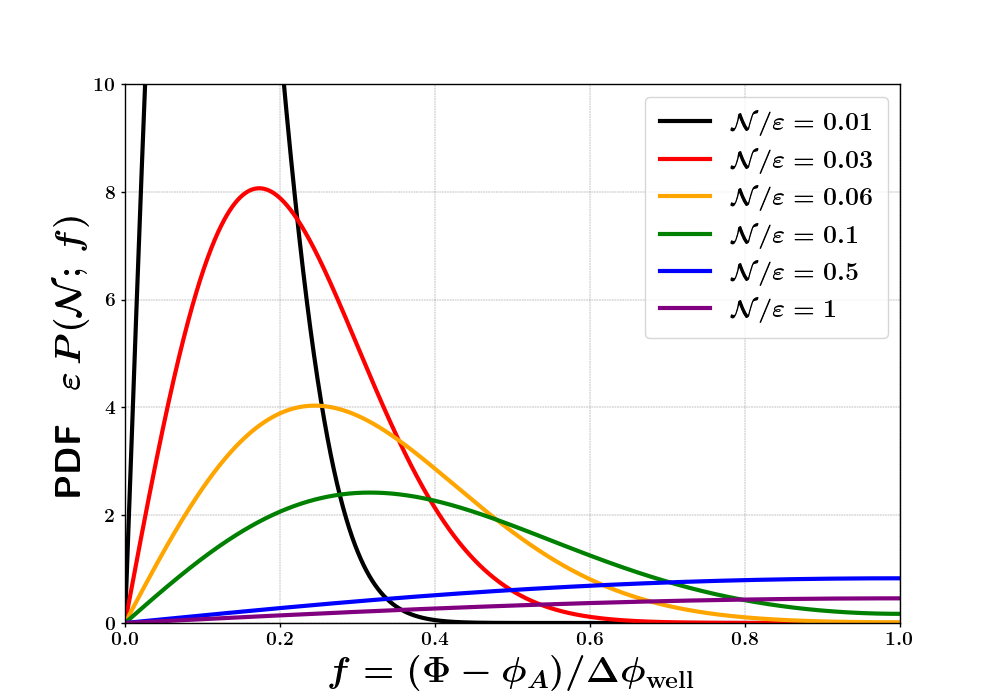
Figure 2: The exact rescaled PDF, Φ9, for drift-free (pure diffusion) inflation, illustrating both the exponential tail and intermediate power-law regime.
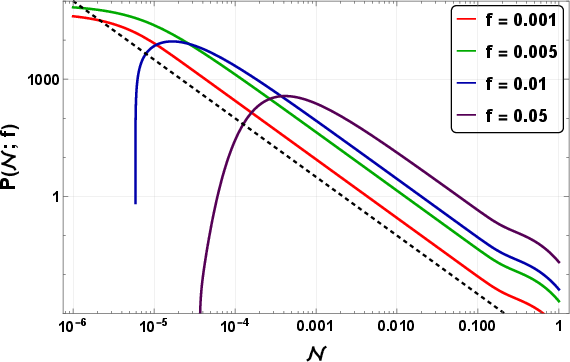
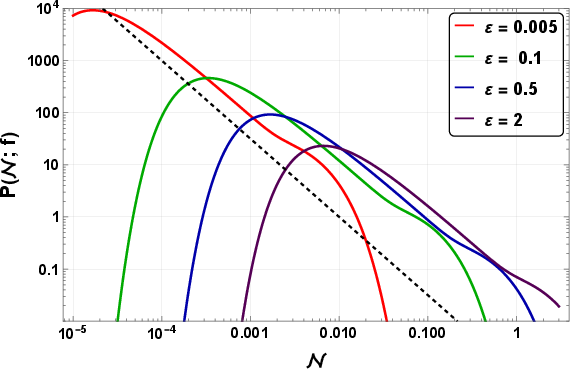
Figure 3: The PDF ∂N∂P=L^FP†P=[Dϕ∂Φ∂+21Σϕϕ∂Φ2∂2]P0 as a function of ∂N∂P=L^FP†P=[Dϕ∂Φ∂+21Σϕϕ∂Φ2∂2]P1 for various ∂N∂P=L^FP†P=[Dϕ∂Φ∂+21Σϕϕ∂Φ2∂2]P2 and ∂N∂P=L^FP†P=[Dϕ∂Φ∂+21Σϕϕ∂Φ2∂2]P3, with the intermediate ∂N∂P=L^FP†P=[Dϕ∂Φ∂+21Σϕϕ∂Φ2∂2]P4 scaling highlighted.
Constant-Drift Inflation: Spectral Structure in Narrow- and Broad-Well Regimes
With nonzero drift, the eigenvalue equation requires solution of a transcendental quantization condition, with physically distinct limits:
Narrow-Well Limit (∂N∂P=L^FP†P=[Dϕ∂Φ∂+21Σϕϕ∂Φ2∂2]P5)
In this regime, the eigenvalue and PDF are analytic perturbations of the drift-free case: ∂N∂P=L^FP†P=[Dϕ∂Φ∂+21Σϕϕ∂Φ2∂2]P6
The PDF closely resembles the pure diffusion result at small ∂N∂P=L^FP†P=[Dϕ∂Φ∂+21Σϕϕ∂Φ2∂2]P7, deviating at large ∂N∂P=L^FP†P=[Dϕ∂Φ∂+21Σϕϕ∂Φ2∂2]P8 due to mild suppression of the tail.
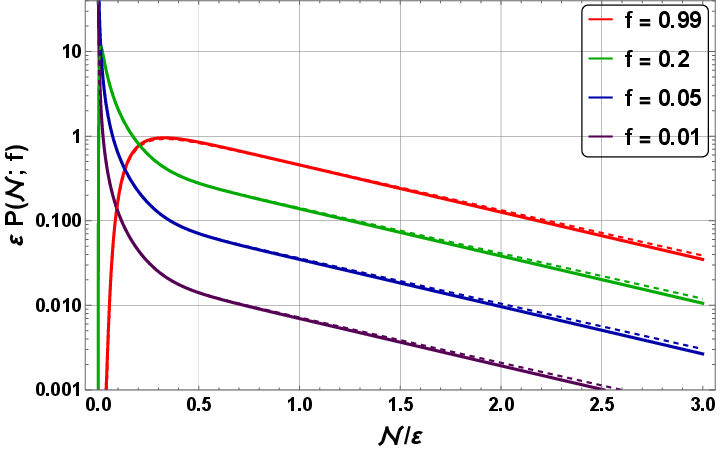
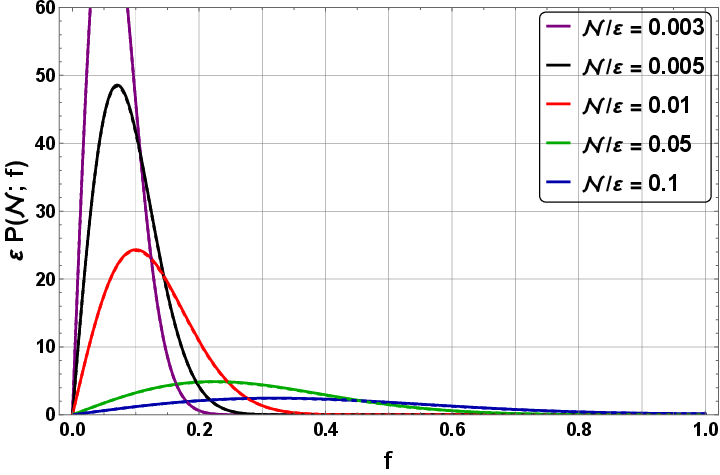
Figure 4: The rescaled PDF, ∂N∂P=L^FP†P=[Dϕ∂Φ∂+21Σϕϕ∂Φ2∂2]P9, in the narrow-well constant-drift regime, showing the small deviation from free diffusion for various Dϕ0.
Broad-Well Limit (Dϕ1)
Here, classical drift dominates, leading to a sharply peaked PDF with a suppressed exponential tail. The eigenvalue spectrum is obtained by a piecewise analytic approximation, validated against full numerical solutions: Dϕ2
This suppresses the probability of large first-passage times (long Dϕ3), dramatically reducing the abundance of rare, large-amplitude events compared to the diffusion-dominated regime.
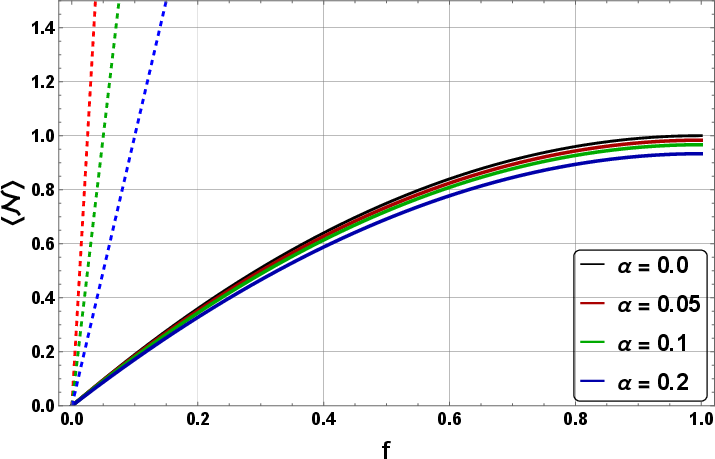
Figure 5: The expectation value of the stochastic number of e-folds, Dϕ4, compared to the classical value for constant-drift inflation; broad-well regime approaches the classical result.
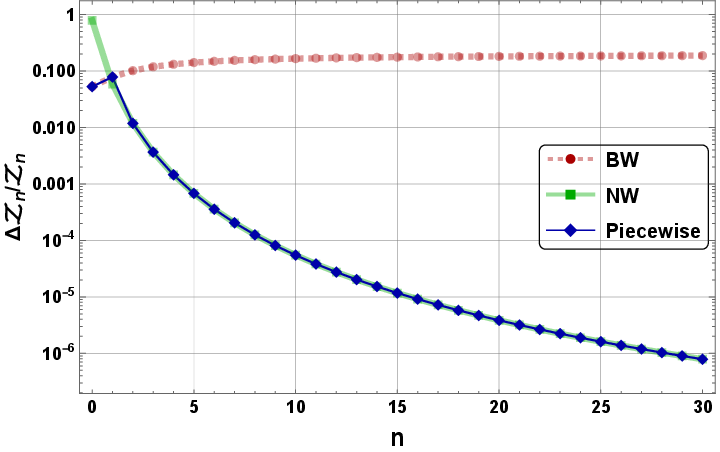
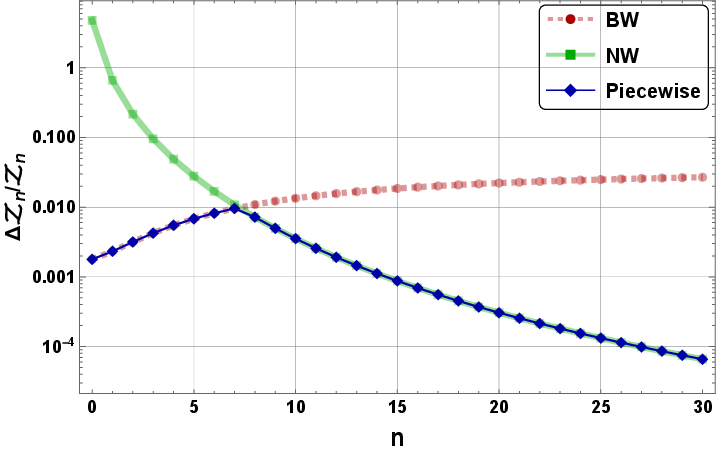
Figure 6: The fractional error in the analytic (piecewise) estimate of the eigenvalue spectrum compared to the full numerical solution, validating the approximation for moderate-to-large Dϕ5.
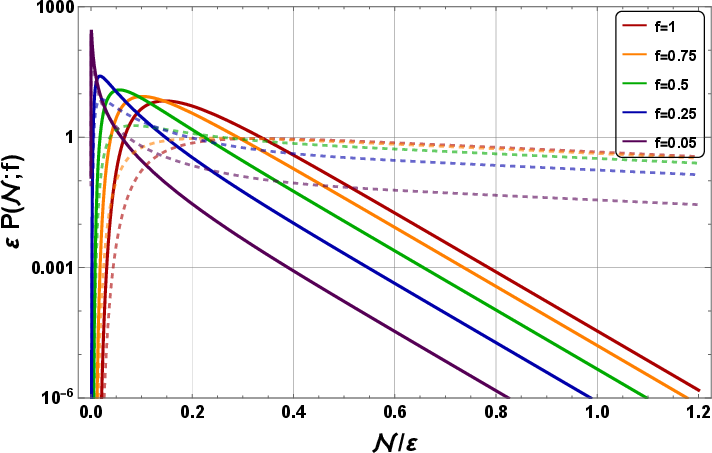
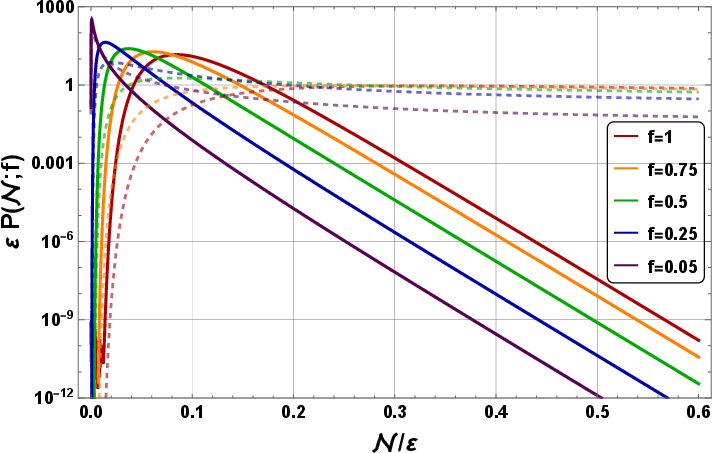
Figure 7: Rescaled PDF, Dϕ6, for various field positions Dϕ7 and several choices of drift parameter Dϕ8, highlighting the strong suppression of tails in the broad-well regime.
Theoretical and Practical Implications
- Stochastic Enhancement and Suppression: In the diffusion-dominated (narrow-well, low-drift) limit, rare PBH-forming perturbations are exponentially more likely due to the long exponential tail in the PDF. Conversely, in the broad-well, drift-dominated regime, the probability of large perturbations is dramatically reduced.
- Intermediate Power-Law Regime: The identification of a Dϕ9 regime may affect predictions not just for PBHs but also for other rare-structure phenomena, such as ultra-compact minihalos, by altering the shape of the non-Gaussian PDF at intermediate e-fold numbers.
- Formal Rigour and Generalisability: The eigenvalue (spectral) method applies broadly, not just to Σϕϕ0 (constant drift) inflation, but can be, with further development, adapted to cases of variable drift (e.g., constant-Σϕϕ1, hilltop, or multiple-well scenarios). The formalism is immediately applicable to eternal inflation and the stochastic dynamics of light fields during inflation.
- Numerical and Analytical Tradeoffs: In regimes with rapidly changing drift, the PDF cannot be captured by simple analytic eigenvalue formulas, necessitating either numerical spectral solutions or appropriately matched piecewise approximations. The bias introduced by such approximations is quantitatively examined in the paper.
Future Directions
Further work will be required to generalize the spectral approach to scenarios with nontrivial field-dependent drift (e.g., constant or varying Σϕϕ2), multi-field extensions, and more complex boundary conditions relevant for realistic inflationary features. Applications to spectator field dynamics and analyses of eternal inflation boundaries are natural extensions. The methodology provides a systematic, formally controlled framework for addressing a broad class of problems involving stochastic processes in early-universe cosmology.
Conclusion
This work provides a comprehensive spectral (eigenvalue) formulation for solving the Fokker-Planck equation in stochastic inflation, yielding detailed analytic and numerical characterizations of the full non-Gaussian PDF—including exponential tails and intermediate regimes—relevant to PBH production from inflationary features. The method resolves technical limitations of prior approaches by enabling self-contained computation of the PDF, is shown to recover and generalize earlier results, and quantitatively details strong suppression of rare-event rates in the drift-dominated regime. The spectral formalism developed is a robust tool for theoretical and phenomenological explorations of non-Gaussianity and rare event statistics in the early universe.
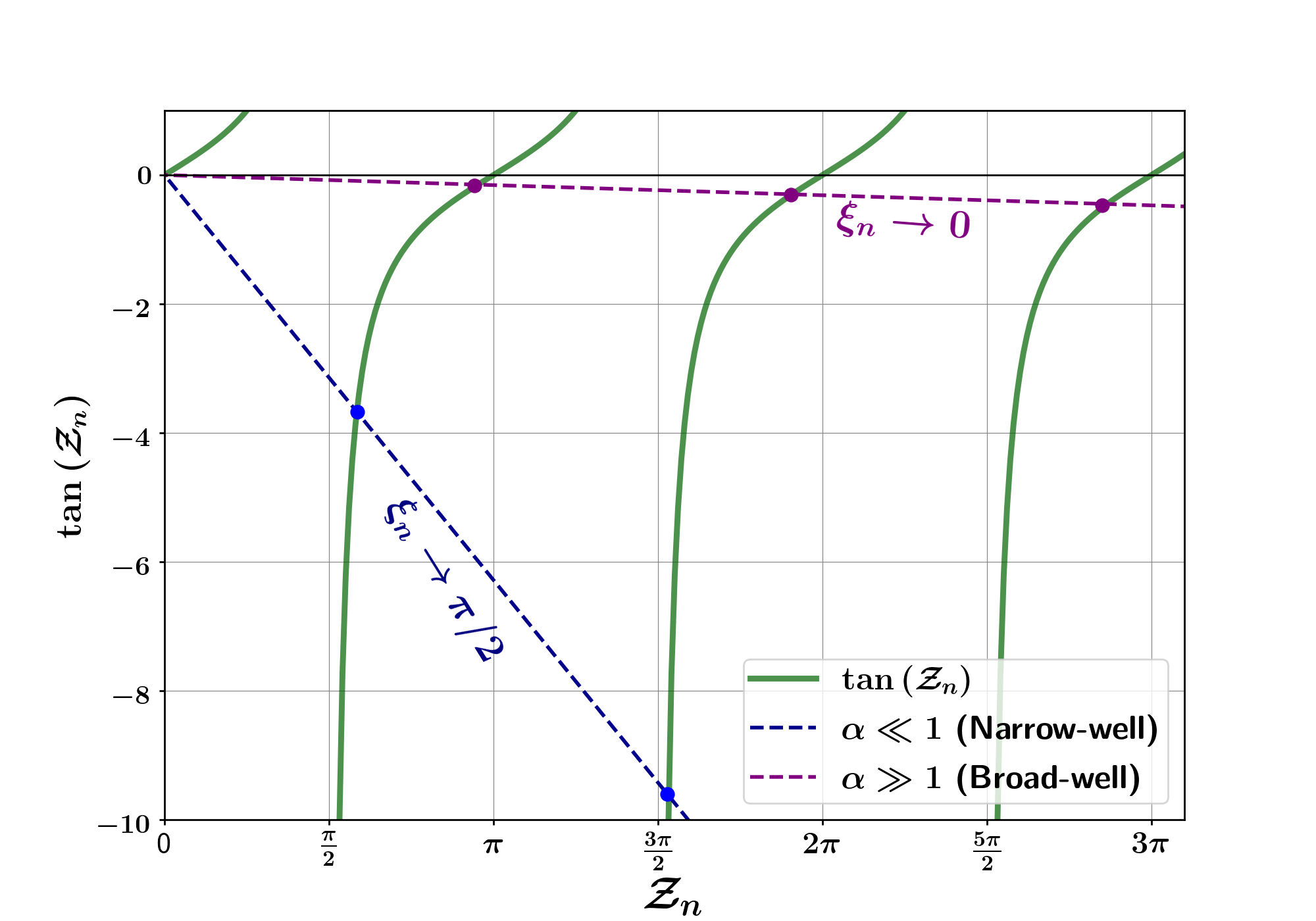
Figure 8: Illustration of the solutions of the eigenvalue quantization condition for the stochastic Fokker-Planck operator as a function of the drift parameter, indicating regime boundaries and the entailed change in stochastic dynamics.

