- The paper introduces TRL-Bench, a benchmark that decouples representation quality from task-specific pipelines via an encode-once, probe-many protocol.
- It empirically compares 20 diverse models across row, column, and table tasks, revealing that no single encoder excels in every scenario.
- The study highlights the importance of hybrid pipelines and diagnostic embedding metrics to enhance transferability in tabular representation learning.
Standardizing Cross-Paradigm Evaluation of Tabular Encoders: An Expert Review of "TRL-Bench: Standardizing Cross-Paradigm Representation-Level Evaluation of Tabular Encoders"
Motivation and Benchmark Overview
Tabular representation learning has seen rapid development, yet foundational questions persist regarding what makes a tabular encoder generally useful across heterogeneous tasks, training paradigms, and data granularities. The evaluation landscape is historically fragmented: row encoders are benchmarked on predictive modeling, column and table encoders on schema/types, retrieval, or QA, and models are often tested under their own task-specific pipelines, conflating the encoder’s intrinsic quality with adaptation, downstream head complexity, and training protocols.
"TRL-Bench: Standardizing Cross-Paradigm Representation-Level Evaluation of Tabular Encoders" (2606.09323) introduces TRL-Bench, a benchmark suite that decouples representation quality from task-specific adaptation through a multi-granular, cross-paradigm, representation-level protocol. Specifically, it proposes a unified encode-once, probe-many evaluation: each encoder produces frozen row-, column-, or table-level embeddings under its native interface, which are then assessed by a common set of lightweight downstream probes across three comprehensive benchmark suites—TRL-CTbench (column/table), TRL-Rbench (row), and TRL-DLTE (compositional data-lake enrichment).
This protocol enables controlled, granular, and capability-specific comparison across 20 models spanning generic text, table-aware, column-specialist, target-table SSL, and meta-pretrained prior-based encoders.
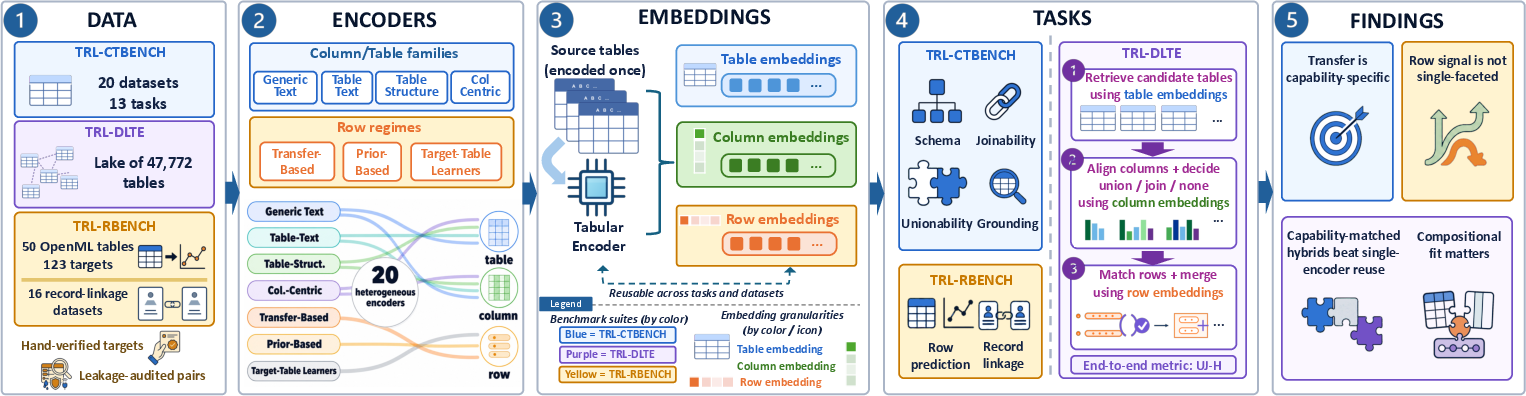
Figure 1: TRL-Bench architecture: one-time export of row-, column-, or table-level embeddings per model, then probing those embeddings across atomic and compositional tasks spanning schema, joinability, unionability, row prediction/linkage, and multi-stage enrichment.
Benchmark Assets and Curation
TRL-Bench releases meticulously curated and standardized assets:
- Column/Table: 20 datasets repurposed for end-to-end representation-level evaluation, covering schema typing, join/union discovery, and table-to-question grounding.
- Row Prediction: 50 OpenML tables with 123 hand-verified targets, filtering for well-posed, multi-target evaluation and eliminating degenerate, duplicated, or leaked signals.
- Record Linkage: 16 datasets reformulated for explicit row-pair matching, systematizing evaluation for inter-table row identity under varying schema or entity noise.
- DLTE Lake: A highly challenging 47,772-table lake synthesizing union and join targets at four noise tiers, embedded within a large distractor pool.
Curation enforces cross-table generalization—e.g., table-disjoint splits for pairwise tasks and removal of label-equivalent columns in linkage—to ensure models are evaluated on transfer quality rather than trivial memorization or shortcut exploitation.
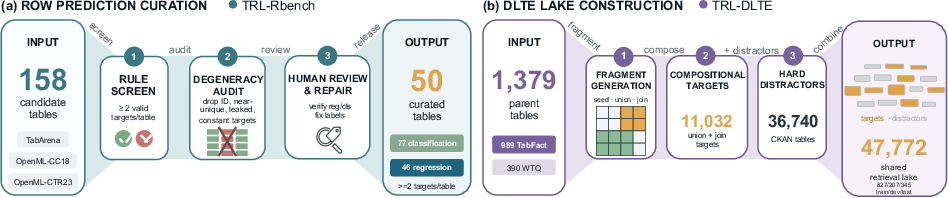
Figure 2: (a) Rigorous curation pipeline for row prediction tables; (b) Construction of the large-scale DLTE data lake with a controlled hierarchy of enrichment noise and distractor coverage.
Evaluation Protocol and Task Suites
Protocol: Each encoder is utilized under its native preprocessing and context regime. No forced serialization is used; probes are capacity-limited (linear heads or 1-layer MLPs for supervised tasks), holding out end-to-end fine-tuning to truly isolate embedding quality. Three downstream module types are considered: training-free (e.g., clustering, cosine ranking), supervised probes, and query-conditioned modules.
- TRL-CTbench covers schema, joinability, unionability, and text-grounding tasks at column/table level. Task splits and metrics are reconciled for strict cross-table generalization and representation-level transferability.
- TRL-Rbench evaluates both within-table (row prediction: can a single row embedding support multiple targets?) and cross-table (record linkage: entity-level row matching under noise) transfer, using unified probes and robust baselines (character n-gram TF-IDF, Jaccard, etc.).
- TRL-DLTE explicitly benchmarks compositionality: given a seed table and a large distractor lake, can a pipeline recover missing rows (union) and columns (join) via staged retrieval, alignment, and row matching, with the ability to use different models per pipeline stage?
Empirical Results and Comparative Analysis
Cross-Granularity Findings
1. Capability Specificity and Pretraining Alignment:
Once adaptation protocols are standardized, no "universal" tabular representation emerges. Performance is strongly capability-dependent:
- CTbench: Generic text encoders (BERT, GTE) outperform on tasks driven by surface-level textual signal (headers, short strings), while tabular specialists dominate tasks favoring structural or cross-table alignment (e.g., union search, schema matching, table QA).
- Strengths correspond to pretraining objectives: e.g., contrastive column-centric models (Starmie) excel at tasks requiring fine-grained column geometry; structure-aware models outperform on compositional table understanding.
2. Intra- vs. Inter-Table Transfer Decoupling:
- Row-prediction (intra-table): Prior/meta-pretrained models (TabICL) and target-table SSL methods (SCARF, DAE) are competitive, especially for regression targets, while transfer-based encoders are mid-pack.
- Record linkage (inter-table): Transfer-based encoders (BERT, GTE) excel, leveraging cross-table comparability in compressed row spaces; target-table SSL methods trail substantially.
- Combined objectives (e.g., TransTab, TabICL) can partially bridge this gap but do not achieve universal optimality, exposing a fundamental transfer-scope tension not visible in task-specific evaluations.
Compositional Table Enrichment (DLTE)
In the multi-stage DLTE suite, pipeline composition outperforms monolithic re-use:
Diagnostic and Intrinsic Evaluation
- Embedding geometry metrics (RankMe, NESum, αreq) and task-free cluster structure are highly correlated with downstream transfer (Spearman ∣ρ∣ up to 0.80 for robust linkage; up to 0.36 for row-level regression), providing robust intrinsic predictors of model suitability for different transfer regimes.
- Baseline ablations and strict split enforcement confirm that strong performance is not contingent on superficial signal, with protocols (e.g., removal of high-overlap pairs in union search, table-disjoint splits for pairwise tasks) enforcing real generalization.
Numerical Highlights and Contradictory Claims
- No encoder dominates: BERT achieves highest schema task NR (0.000), but is outperformed by Starmie (0.662 MAP) and TURL (0.277 QA accuracy) on union and grounding, respectively.
- Hybrid pipelines are essential for DLTE: best hybrid achieves UJ−H=0.229, exceeding monolithic best by 0.090, with statistically robust dev/test pipeline rank agreement.
- Row transfer is fundamentally split: TabICL achieves AUROC 0.816 on row prediction but only ranks mid-pack on robust linkage (F1=0.318), where GTE reaches F1=0.516.

Figure 5: Radar plots visualize performance family-shifts as granularity changes; GTE and BERT dominate schema/grounding, while tabular specialists are superior for alignment, union, and robust linkage.
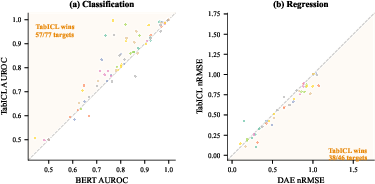
Figure 7: Target-wise scatterplots confirm the breadth of TabICL's advantage on row classification/regression, while showing that DAE remains competitive on a subset of regression tasks.

Figure 3: DLTE category-wise heatmap: Stage-2 (column alignment) dominates pipeline-level downstream effect, while Stage-3 (row matching) differences are largely masked except in oracle-augmented analyses.
Implications and Future Research Directions
TRL-Bench establishes that the effective choice of tabular encoder in encode-once, reuse-many settings is fundamentally capability- and compositionality-driven. Transfer via exported representations does not admit a universal backbone: transferability, embedding recoverability, and compositional fit are all structurally decoupled. Practical implications include:
- Model deployment in tabular data lakes should be pipeline- and stage-adaptive, not restricted to monolithic encoders.
- Task-agnostic pretraining remains insufficient; hybrid and compositional approaches yield superior results.
- Diagnostic geometric criteria may enable improved early-stage model selection or architecture search for tabular transfer learning.
The results forecast a theoretical avenue toward formalizing compatibility/compositionality in tabular representation learning, as well as motivating further research on joint intra/inter-table transfer objectives and explicit representation diagnostics that generalize beyond present datasets.
Conclusion
TRL-Bench delivers a principled, granular, and protocol-agnostic characterization of encoder transferability in tabular domains. By exposing critical capability, transfer-scope, and compositionality gaps, this work both advances the empirical rigor of tabular ML evaluation and provides foundational tools and datasets for long-term innovation in representation-centric tabular AI (2606.09323).