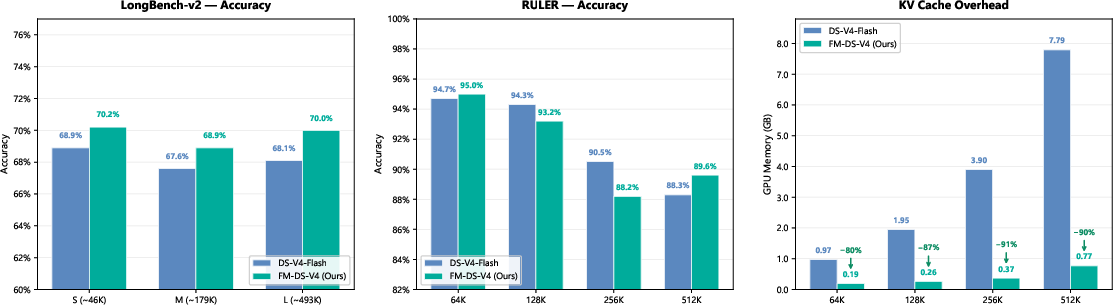
- The paper introduces Lookahead Sparse Attention, a technique that dynamically retrieves only critical key-value segments to significantly reduce GPU memory usage in ultra-long context processing.
- The paper details a dual-encoder Neural Memory Indexer that, through independent training and thresholded retrieval, efficiently predicts and fetches necessary historical activations.
- The paper demonstrates empirical success with up to 90% GPU memory savings and modest accuracy gains, validating the approach on benchmarks like LongBench-v2 and RULER.
FlashMemory-DeepSeek-V4: Ultra-Efficient Ultra-Long-Context Serving via Lookahead Sparse Attention
Introduction
The rapid proliferation of LLMs with million-token context windows introduces formidable challenges in GPU memory management due to the linear scaling of Key-Value (KV) cache requirements. While prevailing approaches, such as compressed or linear attention, slow the rate of GPU memory growth, they do not fundamentally address the necessity for storing large volumes of historical activations. "FlashMemory-DeepSeek-V4: Lightning Index Ultra-Long Context via Lookahead Sparse Attention" (2606.09079) proposes a new approach, Lookahead Sparse Attention (LSA), which decouples critical context retrieval from the conventional attention mechanism, utilizing a Neural Memory Indexer trained independently to proactively retrieve only necessary KV cache segments for upcoming computations.
Lookahead Sparse Attention and Neural Memory Indexer
The central architectural innovation in FlashMemory-DeepSeek-V4 (FM-DS-V4) is LSA, integrated atop the DeepSeek-V4 backbone. The conventional Compressed Sparse Attention (CSA) layers require all historical KV cache chunks to be memory-resident during decoding, leading to hardware bottlenecks for long sequences. LSA replaces the passive all-history scan with predictive query-critical chunk retrieval. At fixed intervals (e.g., every τ=64 steps), a compact, dual-encoder Memory Indexer evaluates the current hidden state and predicts which historical chunks will be required, fetching only those into GPU memory for subsequent attention operations.
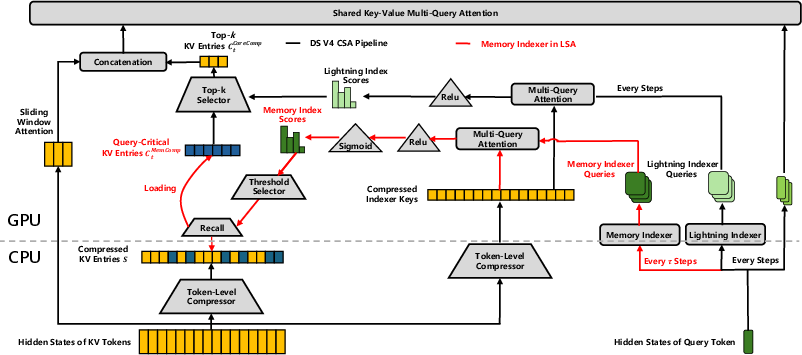
Figure 1: Architectural comparison of standard CSA (black lines) and LSA (red lines), where LSA leverages a Memory Indexer for dynamic, demand-driven context retrieval, resulting in reduced GPU memory usage.
Key technical aspects include:
- Dual-Encoder Architecture: The Memory Indexer is trained independently of the full LLM, using a contrastive metric learning framework on pre-computed representations, eliminating full-backbone loading during training.
- Thresholded Retrieval: Instead of fixed Top-k selection, a Sigmoid-based classification threshold is used to dynamically retrieve context, adapting to the query's requirements.
- Cross-Layer Voting Data Pipeline: Training labels for the indexer are obtained by a denoising process combining Softmax normalization, Top-p thresholding, and cross-layer majority voting, targeting high-confidence, contextually significant chunks.
This design reduces the memory footprint and, empirically, acts as an attention denoiser—removing irrelevant context that would otherwise perturb attention outputs.
Optimization and Configuration
The optimization process fully decouples the Memory Indexer from the LLM backbone, with only the (small) query-side encoder being trained, leveraging fixed historical embeddings. The network is trained using Binary Cross-Entropy (BCE) and Focal Loss, further enhanced by:
- Strategic Layer Placement: Indexers are placed on three specific transformer layers (layers 10, 12, 20) following large-scale Pareto-frontier experimentation, balancing recall accuracy with memory efficiency.
- Low-Rank Conditioning: A large internal projection rank (r=2048) is used to expand the representational capacity of the query encoder.
- Efficient Execution: The system allows hundreds of design sweeps in short compute windows, a direct benefit of indexer-backbone decoupling, which would be infeasible for joint end-to-end tuning.
Common retrieval strategies such as pairwise ranking, hard negative mining, or weighted loss schemes did not yield improvements in this context and are excluded from the final design.
Experimental Results and Analysis
FM-DS-V4 demonstrates consistently strong results across leading long-context benchmarks such as LongBench-v2, LongMemEval, and RULER. The core findings are:
The advantage over recency-only or random chunk selection is significant. These baselines collapse when tasks demand genuine global context retrieval, highlighting the criticality of predictive selection over heuristic or random retention.
Limitations and Open Problems
Systematic diagnostics expose three primary limitations in the current FlashMemory-DeepSeek-V4 paradigm:
- Context-Independent Ceiling: For context-free queries, the expected O(1) memory scaling is not fully realized. Background probability mass in the indexer yields memory allocation that grows with sequence length due to accumulated false positives.
- Dense Global Memory Tasks: On benchmarks demanding dense, multi-range context aggregation (e.g., MRCR), accuracy collapses, and even oracle chunk retention cannot recover baseline performance with sublinear retrieval ratios.
- Length Generalization: The indexer generalizes reliably only up to approximately twice the maximum context length seen during training. Beyond this, accuracy degrades sharply, likely due to out-of-distribution effects in positional embeddings.
Each issue reflects a fundamental architecture limitation: reliance on frozen historical keys, shallow single-forward dot-product matching, and absence of end-to-end training blocks adaptation to live autoregressive demands. These are active frontiers for future iteration.
Implications and Future Prospects
The FlashMemory-DeepSeek-V4 approach advances the state-of-the-art in memory-efficient LLM inference for ultra-long contexts. Its emphasis on architecture–indexer decoupling, proactive memory management, and dynamic context adaptation is highly relevant as practical deployment of LLMs with million-token windows becomes the norm. Immediate practical benefits include enormous potential memory cost savings and increased scalability, which directly impact service economics and resource provisioning for large-deployment LLM systems.
Theoretically, FM-DS-V4 motivates future research in close-loop, actively optimized memory routing, cross-layer attention denoising, and plug-and-play retrieval augmentation. Joint optimization, more powerful cross-interaction architectures (late interaction, ColBERT variants), and adaptive, context-length-aware retrieval policies represent promising pathways to close remaining gaps in performance generalization and adaptivity.
Conclusion
FlashMemory-DeepSeek-V4, through the introduction of Lookahead Sparse Attention and a decoupled Neural Memory Indexer, achieves a substantial reduction in GPU memory requirements while maintaining or improving competitive accuracy on long-context benchmarks. Strong empirical evidence affirms the viability of predictive, dynamic context routing for LLMs, albeit with certain architectural and training limitations yet to be addressed. As context lengths, practical deployment expectations, and competitive baselines continue to rise, predictive memory indexing regimes such as LSA will play a central role in enabling efficient, accurate ultra-long-context inference for next-generation large-scale LLMs.